
Your business is currently a reflection of your own exhaustion. Knowing what to expect in the first 90 days with a fractional integrator means preparing for a shift from founder-dependent chaos to a self-sustaining engine. If every decision still stops at your desk, you don't have a company. You have a high-stress job that you can't quit.
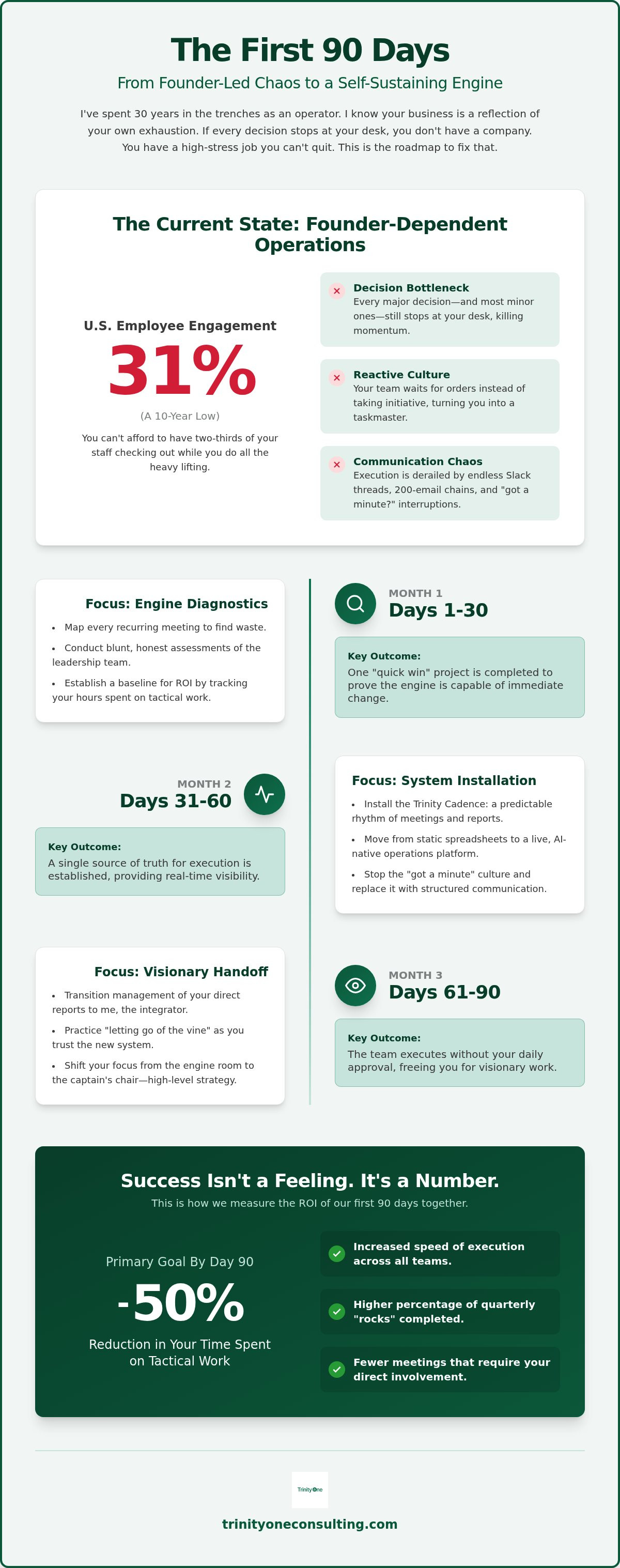
You likely feel the weight of a team that waits for orders instead of taking initiative. US employee engagement is at a 10-year low of 31 percent. You can't afford to have two-thirds of your staff checking out while you do all the heavy lifting.
I've spent 30 years in the trenches as an operator and a coach. I've seen how a lack of rhythm kills growth. We'll walk through the specific weekly milestones and operational shifts required to turn your vision into a functional business engine. This is a surgical recalibration of how your team executes.
We'll look at how to install a consistent meeting cadence and gain real-time visibility into team execution. You'll also see a roadmap for integrating AI into your daily operations. This isn't a theoretical exercise. These steps build a company that runs without you.
Key Takeaways
- Learning what to expect in the first 90 days with a fractional integrator means moving from a deep audit of your current friction points to installing a unified operating cadence.
- You will replace erratic meetings with the Trinity Cadence system to gain real-time visibility into team execution without needing to micromanage every task.
- Letting go of the vine is painful but necessary as I take over management of your direct reports to free up your focus for high-level strategy.
- We align your staff by using Matthew Kelly's Dream Manager methodology to connect their personal goals with your company's performance.
- Success is measured by the speed of execution and the percentage of quarterly rocks completed rather than just hours spent in the office.
What should you expect in the first 90 days with a fractional integrator?
I don't believe in onboarding periods that drag on for months without results. When you hire a Fractional executive, you're hiring an architect for your business engine. Understanding what to expect in the first 90 days with a fractional integrator begins with a simple truth. The first month is about finding out why the machine is smoking.
The second month is about installing the parts. By the third month, we're testing the speed. We measure our progress by how many hours you get back and how many tasks actually get finished without you asking twice.
The first 30 days of engine diagnostics
I start by looking at your specific fractional COO needs. I need to see where the engine is leaking oil. This means mapping out every recurring meeting on your calendar. Most of them are likely a waste of your time.
Expect a blunt assessment of your leadership team. I'm not here to be a cheerleader. If a director isn't performing or a manager is hiding behind vague reports, I'll tell you. We can't fix what we don't acknowledge.
Establishing the initial baseline for ROI
We start by recording the exact hours you spend on tactical tasks today. If you're spending 15 hours a week answering Slack questions or fixing spreadsheets, that's our starting point. This data becomes the benchmark for measuring my value.
We don't wait 90 days to see a result. I identify one quick win project to complete before day 30. This might be fixing a broken hiring process or cleaning up a messy project management board. It proves that the engine is capable of change.
Between days 31 and 60, we install the Trinity Cadence. This is the predictable rhythm of meetings and reports that drives execution. We stop the "got a minute" culture that drains your focus. Instead, we move to a structured system where every manager knows their numbers.
By day 90, the visionary begins to step out. You move from the engine room to the captain's chair. You focus on high level strategy and the future of the company. The team stops looking at you for every single green light.
This transition is often the hardest part for founders because it requires trust in the new system. Success is not a feeling. It is a reduction in founder-led meetings and a measurable increase in team execution. We aim for a 50 percent reduction in your tactical workload by the end of this period.
How does an integrator install a new operating cadence?
An operating cadence is the heartbeat of your business. It is the predictable rhythm of meetings and reports that drives execution. Without it, you are just reacting to the loudest fire. Knowing what to expect in the first 90 days with a fractional integrator means preparing for a total overhaul of how your team communicates. We move away from the noise and toward a system that functions like an integrated circuit. Every signal is clear and every component knows its role.
Many founders start by looking for a Fractional EOS Integrator to bring discipline to their chaos. I take that discipline and add a layer of technology and human depth that traditional systems miss. We stop the 200-email threads and the endless Slack notifications that clog your day. We replace them with a single source of truth that runs on machine precision and human empathy.
Moving from manual to AI-native operations
I show you how to create a business operating system that uses AI to track engagement in real time. We stop using static spreadsheets that are out of date the moment you hit save. Instead, we use the Trinity Cadence platform. This live digital huddle shows me who is winning and who is stuck before the problem becomes a crisis.
This platform provides AI-driven coaching for your managers. It helps them identify bottlenecks without waiting for a weekly update. It gives you real-time visibility into the health of your engine. If you want to see how this level of visibility changes your daily workload, you can schedule a brief cadence call to walk through the system.
The shift to a weekly execution rhythm
We install a weekly meeting structure that focuses only on solving issues. I take over the management of these meetings. This allows you to stay in your visionary seat where you belong. Your team learns to report on results rather than just listing their activities. A manager saying they were "busy" is not a report. I want to see the specific outcome of their 40 hours.
The transition is often blunt. We stop talking about "trying" and start talking about "done." Your managers will feel the pressure of accountability at first. This is a necessary friction. It is the only way to build a company that grows without killing its founder. By the end of the second month, the team will stop looking at you for every single green light.
Why does the visionary integrator relationship feel difficult at first?
Letting go of the vine is painful for most founders. You have built this business from nothing, and now I am asking you to stop touching the controls. Knowing what to expect in the first 90 days with a fractional integrator means acknowledging this emotional cost. You will feel a loss of control when I start managing your direct reports. This is not a failure of your leadership. It is a requirement for your growth.
This friction is a necessary part of how to improve your visionary and integrator relationship. We address this by creating clear swim lanes for every leadership role. I use Proven Strategies for Getting Up to Speed Faster and Smarter to ensure we don't waste time on power struggles. We define who owns the "what" and who owns the "how."
I believe that every leader is called to a higher purpose, and that purpose is often buried under the weight of daily fires. My job is to dig you out. We create a binary structure where you handle the future and I handle the present.
Redefining the visionary seat
Your job changes from the chief problem solver to the chief culture officer. This is a massive shift. We identify the specific tasks that give you energy and the ones that drain you. I handle the draining tasks so you can focus on the big ideas. If you enjoy selling but hate managing the sales team's CRM data, I take the data. You stay in the field.
The visionary seat is about the future. It is about where the company will be in three years. If you are stuck in a 45-minute meeting about the office lease or a software glitch, you aren't being a visionary. I protect your time so you can be the leader your company actually needs.
Managing the team's reaction to change
Some employees may resist the new accountability standards. They have been used to a loose environment where deadlines were suggestions. When I arrive, those deadlines become firm requirements. I handle the difficult conversations that you have been avoiding for months. This is often the biggest relief for founders.
We use the fractional integrator role to protect your relationship with the team. I can be the "bad guy" who enforces the rules. You remain the inspirational leader. This dynamic allows the business to scale without you losing the loyalty of your longest-tenured staff.
Understanding what to expect in the first 90 days with a fractional integrator requires an honest look at your own ego. It is hard to see someone else run your meetings. It is harder to watch your company stay small because you won't let go. I am here to help you make that choice.
How do we align your people using the Dream Manager methodology?
A company only becomes the best version of itself to the extent its people are becoming better versions of themselves. This is the core of my philosophy. When you are looking at what to expect in the first 90 days with a fractional integrator, don't just look at the software or the spreadsheets. Look at the humans running the machines.
We use Matthew Kelly's Dream Manager methodology to link personal goals to professional output. I've seen teams where only 20 percent of employees are truly engaged. That disengagement costs the global economy about 10 trillion dollars. You can't fix that with a new project management tool or a louder megaphone.
Integrating dreams into the business engine
I facilitate sessions where employees identify dreams across twelve specific categories defined by Matthew Kelly. These include physical, emotional, intellectual, and spiritual goals. We also look at psychological, material, professional, and financial dreams. The final four categories are creative, adventure, legacy, and character.
We build a bridge between what the company needs and what the person wants. I show you how the Dream Manager program reduces your turnover costs. Companies with high employee engagement have 59 percent less turnover. Replacing a key manager can cost twice their annual salary, so keeping your best people is a massive financial win.
The ROI of human performance
Engagement is not a soft metric. It is a leading indicator of profit. When an employee sees that you care about their life, they care more about your business. This isn't about being soft. It's about being effective.
We use Dream Manager coaching to build this trust in the first 90 days. I've coached enough football teams to know that players play harder for a coach who knows their name and their story. Business is no different. I believe we are all created for a purpose that goes far beyond a paycheck.
The cost of this approach is vulnerability. You have to be willing to listen to your team's personal aspirations. This methodology is bad at fixing people who simply don't want to work. But for your high performers, it creates a culture of loyalty that no competitor can buy with a slightly higher salary.
How do you measure the ROI of a fractional integrator after 90 days?
ROI is not a feeling or a vague sense of relief. It is a math problem. When determining what to expect in the first 90 days with a fractional integrator, you have to look at the hard data of your own calendar. ROI is measured by the time you get back and the speed of your execution. If you are still the bottleneck for every minor decision, the investment is not paying off yet.
I provide a report on the adoption of the Trinity Cadence system. This shows exactly how your team is using the new communication tools. We also look at the completion rate of your quarterly rocks. If your team historically finished 30 percent of their priorities and they are now hitting 80 percent, that is a measurable win. The ultimate test is whether the business runs better when you are not there.
The 90 day business engine audit
We compare your week one schedule to your week twelve schedule. I've seen founders go from 40 hours of tactical meetings down to 15. If your time is worth $500 an hour, saving 25 hours a week is worth $12,500 in found value every seven days. This is the cost of meeting fatigue that we actively remove from your balance sheet.
We also review the progress of the first rapid launch sprint. This is a focused effort to fix one specific operational leak. Whether it was a messy hiring process or a broken sales handoff, we look at the results. We want to see a 50 percent reduction in the time it takes to move a project from "started" to "done."
Planning for the next 90 days
We set new priorities based on the operational clarity we achieved. The first three months often expose talent gaps that you were too busy to notice. I help you decide if you need a full time leader or continued fractional support. We look at the when to hire a fractional executive guide to plan your next move. This prevents you from hiring the wrong person out of desperation.
Knowing what to expect in the first 90 days with a fractional integrator helps you stay grounded when the friction of change hits. We move into the next phase with a clean engine and a team that understands the rhythm. I believe that a company only becomes the best version of itself when its leaders have the space to lead. We have built the foundation, and now we prepare to scale the output.
Building a business engine for the long game
You now have a clear map for the first three months of our partnership. We move from the initial audit of your meeting rhythm to the installation of a unified operating cadence. By the end of this period, you're no longer the bottleneck for every tactical decision.
Knowing what to expect in the first 90 days with a fractional integrator is about preparing for a surgical shift in your culture. I bring over 30 years of operational experience to this process to ensure we don't waste time on theories. I use Certified Dream Manager methods to ensure your team is as invested in the company as you are.
This transition is hard. It's the only way to build a company that survives your success. I believe God's purpose for your work goes far beyond your quarterly bottom line. You were meant to lead a mission, not just manage daily fires.
Let's start building a business that finally gives you the space to breathe while your team executes with precision.
Common questions about the first 90 days
How much time does a fractional integrator spend in my business?
I typically spend a few hours each week managing your leadership team and running your meetings. I don't bill for every minute because I focus on outcomes. My time is spent ensuring your engine is running at peak speed. Understanding what to expect in the first 90 days with a fractional integrator means realizing I am a part-time architect for your full-time vision. I'm there to drive execution, not to occupy a desk.
Does a fractional integrator replace my current leadership team?
I don't replace your team. I help them become more effective. I manage your direct reports so you can focus on high-level strategy and growth. If a leader isn't the right fit for their seat, I'll give you a blunt assessment. My role is to install a clear operating cadence and provide the visibility your managers need to hit their numbers without you micromanaging them.
What is the difference between a consultant and a fractional integrator?
A consultant gives you a binder full of advice and walks away. An integrator stays to turn the key and run the machine. I take accountability for the execution of your vision. While a consultant might suggest a new strategy, I am the one managing the weekly digital huddle. I ensure your managers stay on track using the Trinity Cadence system. I'm an operator, not just an advisor.
How do I know if my business is ready for this role?
You are ready when your growth stops because you are too busy fixing minor problems. If your team waits for your permission to breathe, you have a bottleneck. Most firms reach this point between 10 and 50 employees. Understanding what to expect in the first 90 days with a fractional integrator helps you see if you're prepared to hand over the keys. If you want freedom, you must accept accountability.
What happens if the visionary and integrator do not click?
Friction is normal at first. We establish clear swim lanes from day one to prevent power struggles. If the relationship doesn't work, we identify the cause quickly. Sometimes the founder isn't actually ready to stop micromanaging. In those cases, we have a real talk conversation about the cost of staying in the engine room. I believe every leader has a God-given purpose that extends beyond their daily fires.
Can a fractional integrator help with AI implementation?
Yes, I use AI to track your team's execution and engagement in real time. We move away from manual spreadsheets and toward an AI-native operating system. This provides your managers with automated coaching and gives you visibility without constant status updates. We map out an AI ROI plan during the initial launch sprint. This ensures the technology actually saves you time instead of adding more digital noise.
How do the twelve dream categories impact my bottom line?
They reduce the massive cost of turnover. Matthew Kelly's twelve dream categories, such as financial and professional goals, help employees see their job as a vehicle for personal growth. When people feel that you care about their physical or creative dreams, they work with more loyalty. High engagement leads to 59 percent less turnover. This keeps your hiring costs low and your execution speed high. It's just good business.
What is the typical cost of a 90 day integration sprint?
I offer retainer-based fees for the integrator role and fixed-fee engagements for launch sprints. I don't provide a generic price list because every business engine is unique. You have to weigh the fee against the cost of your own burnout. If you are spending 50 hours a week on tactical tasks, you are losing money. The investment is designed to pay for itself through faster execution and founder freedom.
Book a 30-minute Trinity One cadence call with Kevin Patrick to discuss your operational engine.