
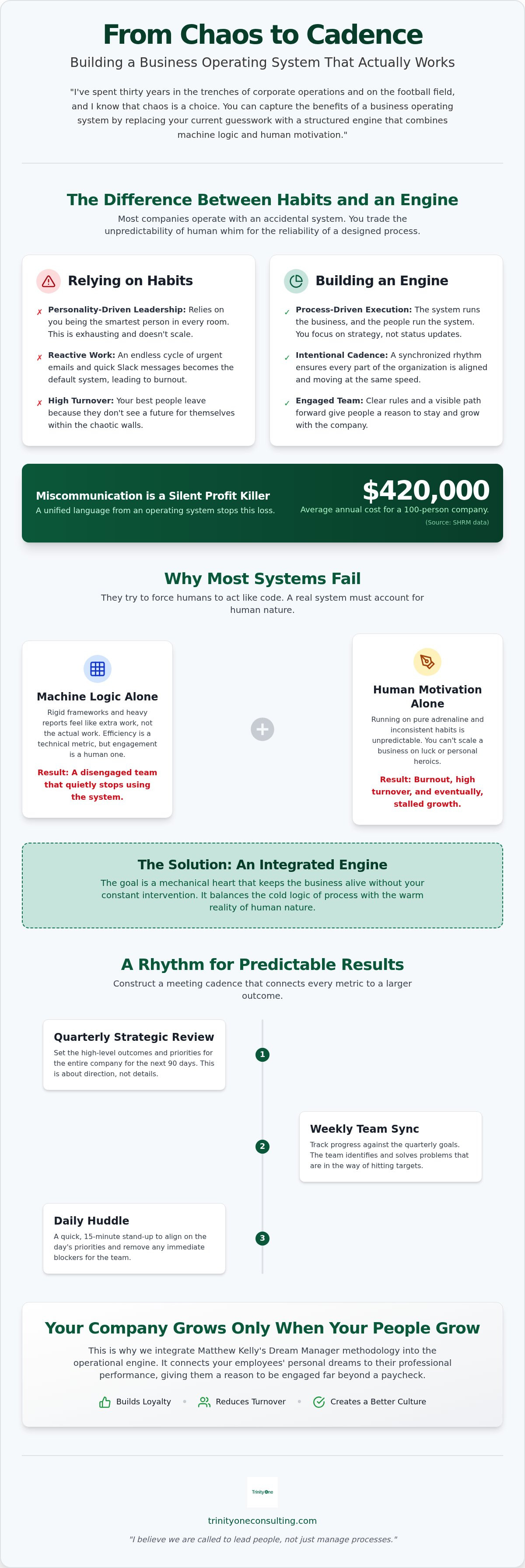
Most leaders believe they're running a business, but they're actually just babysitting a series of fires. I've spent thirty years in the trenches of corporate operations and on the football field, and I know that chaos is a choice. You can capture the benefits of a business operating system by replacing your current guesswork with a structured engine that combines machine logic and human motivation. I believe we are called to lead people, not just manage processes.
You're likely tired of meetings that feel like a circular firing squad. It's frustrating to watch your best people walk out the door because they don't see a future for themselves within your walls.
A unified system that integrates AI efficiency with human performance drives real operational results. This approach turns your company into a well-oiled engine. Your team moves in one direction without you needing to pull every lever yourself.
Installing a specific cadence gives you clear visibility into team performance. A well-designed operating system naturally ensures your employees are actually engaged in their work.
Key Takeaways
- One of the main benefits of a business operating system is replacing erratic leadership with a consistent rhythm that drives predictable results.
- Stop trying to force your employees to act like rigid software code and start building a system that balances machine logic with human motivation.
- Construct a meeting cadence that moves from daily huddles to quarterly strategic reviews to ensure every metric connects to a larger outcome.
- Evaluate the trade-offs of frameworks like EOS and Scaling Up before you commit to a methodology that might be too rigid or overwhelming for your team.
- I believe your company only grows when your people grow, which is why we integrate Matthew Kelly's Dream Manager methodology into the operational engine.
What are the benefits of a business operating system?
I see too many leaders running their companies on pure adrenaline. They believe they have a system because they use project management software and hold a Monday morning meeting. That is usually just a collection of reactive habits. One of the primary benefits of a business operating system is replacing that chaos with a consistent rhythm that turns your strategy into actual results.
Think of this system as an integrated circuit. Every meeting and metric connects to a larger outcome. If one component fails, the entire board shorts out. Most companies operate with an accidental system built on urgent emails and quick Slack messages.
This is exhausting for you and your team. It leads to burnout and high turnover because no one knows the rules of the game. An intentional system replaces personality-driven leadership with process-driven execution. You shouldn't have to be the smartest person in every room.
When the system works, the business runs itself. I believe we are called to be good stewards of the people and resources entrusted to us. Doing that requires a mechanical heart that keeps the business alive without your constant intervention. I help leaders install this mechanical heart through my work as a Fractional COO and our Trinity One.
The difference between habits and an engine
Habits are what your individuals do when no one is looking. They're personal and often inconsistent. An engine is how your whole team moves in a synchronized cadence. This is the operational core of your company. It ensures that every part of the organization is aligned and moving at the same speed.
Without this engine, your growth will eventually stall because you cannot personally oversee every action. When you rely on habits, you rely on luck. When you rely on an engine, you rely on engineering. The benefits of a business operating system become clear when you stop pushing the car and start driving it.
It takes work to build the engine, but it's the only way to scale without breaking your people. You trade the unpredictability of human whim for the reliability of a designed process. This allows you to focus on high-level strategy instead of hunting down status updates.
Why your company needs a unified language
Miscommunication is a silent profit killer. Data from SHRM suggests that miscommunication costs a 100-person company an average of 420,000 dollars per year. That is nearly half a million dollars vanishing because people don't understand each other. A system provides a common vocabulary for solving problems and tracking progress.
It creates a shorthand that allows your team to move faster with less effort. It eliminates the friction of people interpreting goals in different ways. In my experience as a coach and operator, I've seen teams argue for hours simply because they used different definitions for the word "done."
A unified language ensures that "done" means the same thing to the CEO and the entry-level hire. This clarity speeds up every decision you make. You stop wasting time on internal translations and start spending it on external execution. It's about getting everyone on the same frequency so the signal doesn't get lost in the noise.
Why do most system implementations fail?
Most systems fail because leaders try to force human beings to act like rigid software code. You can't just upload a PDF of rules and expect your team to execute perfectly. One of the major benefits of a business operating system is that it creates a predictable environment, but it only works if you account for human nature. Logic is cold, but people are warm.
I've watched CEOs buy expensive frameworks and then continue their own erratic behavior. They skip meetings, change priorities on a whim, and expect the system to fix the resulting mess. You are the lead domino. If you don't respect the rhythm, no one else will either. There is a massive cost in time and focus when you switch methodologies every twelve months.
Execution dies when the system feels like extra work instead of the actual work. If your team has to spend three hours a week just filling out status reports, they will resent the process. The benefits of a business operating system should include saving time, not adding more administrative weight. When a system is too heavy, the team will quietly stop using it until it eventually disappears.
The friction between logic and motivation
You can have the best spreadsheets in the world and still have a disengaged team. Efficiency is a technical metric, but engagement is a human one. If your people don't see how the system helps them, they will find ways to work around it. I believe we are called to lead with integrity because our work is a reflection of our character.
Motivation is the fuel for your operational engine. Without it, your machine is just a collection of metal parts sitting in the driveway. The Dream Manager methodology addresses this friction by aligning personal desires with professional output. This prevents the quiet sabotage that happens when people feel like gears in a machine they don't own.
Overlooking the critical Integrator role
A Visionary CEO creates the ideas, but the Integrator builds the pipes. Most founders are great at seeing the future but terrible at managing the daily details. Without a dedicated Integrator, your operating system is just a book on a shelf. This role is what separates a business that grows from one that merely survives.
You don't always need a 200,000 dollar executive on day one. You can bring in a fractional COO to act as the architect of your system. This role ensures the engine keeps running while you focus on the big picture. If you want to see how this fits into your business, we can audit your current operations to find the friction points.
How to create a business operating system from scratch?
Building a system requires engineering a way of life for your company rather than just buying software. You start by defining your core values and long-term targets to set the direction. Without a clear destination, your team is just spinning wheels in the mud. I've seen too many companies drift because they lacked a clear scoreboard.
One of the benefits of a business operating system is that it forces you to identify the five to seven key metrics that actually indicate the health of your engine. I don't care about vanity metrics. I want to see the numbers that predict your future cash flow and customer satisfaction. These are the leading indicators that tell you if you'll hit your goals next month.
You also need to document your core processes. A new hire should be able to understand their role and how they contribute to the mission in thirty minutes or less. If your training takes three weeks of shadowing, your system is broken. Prioritize lean and functional documentation over dusty manuals that no one reads.
Quarterly strategic reviews keep the engine aligned. These sessions allow you to pull your head out of the daily grind and look at the map. You assess what worked, what failed, and where you need to adjust your resources for the next ninety days.
Establishing your operating cadence
The cadence is the heartbeat of your execution. Your daily huddle should last exactly fifteen minutes and focus entirely on roadblocks. Treat this as a stand-up meeting rather than a coffee chat. If a problem takes more than two minutes to explain, move it to a separate session. This keeps the team moving without wasting collective time.
Weekly meetings must use a structured agenda to solve issues. Updates belong in an email or a dashboard. I recommend checking out this Level 10 meeting agenda template for a concrete example of how to turn friction into execution. It's a proven way to ensure your time together actually produces a result.
Integrating AI into your daily execution
AI is changing the fundamental rhythm of how we work. You can now use AI to transcribe every meeting and automatically assign action items to the right seats. This removes the "I forgot" excuse from your culture. It keeps the record clean and the accountability high without adding more paperwork for your managers.
AI coaching can also identify patterns in your data that a human manager might miss. It might notice that your sales cycle slows down every time a specific lead source is involved. Our Trinity Cadence provides real-time visibility so you stop guessing about performance and start acting on data. I believe we are called to use every tool available to build businesses that honor the potential of our people.
What are the trade-offs of different methodologies?
Every methodology has a cost. You can't install a system without accepting its specific limitations. EOS is built for simplicity. It's an excellent starting point for many, but it can feel too rigid for fast-moving tech companies that need more than a basic checklist. I've seen teams outgrow the standard EOS framework in less than two years.
Scaling Up is deep and rigorous. It provides a massive amount of strategic depth for larger organizations. The downside is the sheer volume of work required to maintain it. It often overwhelms small teams with too much homework before they see their first operational win. You end up spending more time on the system than on the business.
Custom hybrid systems offer maximum flexibility. They allow you to cherry-pick the best parts of every framework. However, they risk becoming a messy collection of disconnected tools. AI-native systems require a higher initial tech setup to map your data correctly. The trade-off is a much higher long-term ROI because the machine handles the documentation and tracking for you.
Calculating the ROI of operational clarity
You must justify the investment in your operating engine with hard data. One of the primary benefits of a business operating system is the recovery of lost time. A well-run system can reduce meeting time by 25 percent within the first ninety days. That is ten hours of production returned to every manager on your payroll.
Measure the reduction in re-work and error rates after the system is installed. If your team is doing the same task twice, you are burning cash. Real profit comes from the increased capacity of your existing headcount. You shouldn't have to hire three more people just to handle the communication overhead of your growth.
Choosing the right engine for your growth
Your system must match your headcount. Small teams under ten people need a light system focused on daily communication and clear priorities. They don't need complex software or forty-page manuals. They need a simple rhythm that keeps everyone on the same page.
Companies with over fifty people need a system with clear accountability charts. At this size, the founder can no longer keep everything in their head. You can review these business operating system examples to find the right engine for your specific growth stage. I believe we are called to lead with wisdom, which means choosing the right tool for the job.
How do you link personal dreams to professional performance?
I've spent years on the sidelines and in the boardroom, and I've learned one absolute truth: a company only grows to the extent that its people are growing. You can have the most efficient spreadsheets in the world, but they won't move themselves. One of the hidden benefits of a business operating system is creating a space where personal ambition fuels professional execution.
We use the Dream Manager methodology by Matthew Kelly to bridge this gap. This framework identifies twelve categories of human dreams, ranging from physical health to financial stability. When an employee sees that their job is the vehicle helping them buy their first home, their relationship with their work changes. They stop being a clock-puncher and start being an owner of their results.
This isn't about being soft or "nice." It's about the physics of human motivation. People don't burn out because they work too hard. They burn out because they lose sight of why they're working in the first place. I believe we are called to help the people in our care become the best versions of themselves.
The role of the Dream Manager
A Dream Manager acts as a coach to help employees identify and achieve these personal goals. This program has been shown to drastically improve retention in high-turnover industries like janitorial services and manufacturing. It turns a job into a partnership.
I facilitate this for leadership teams as a Certified Dream Manager. We integrate these conversations into your regular operational rhythm. It ensures that your high-performers stay with you because they know you are invested in their life, not just their output. Loyalty is earned through investment, not just a paycheck.
Building an AI-native cadence that supports people
The benefits of a business operating system in 2026 must include a plan for your human capital. AI should handle the boring administrative tasks like transcription and data entry. This allows your humans to focus on the high-value work that requires empathy and creativity. You didn't hire talented people to spend four hours a day in spreadsheets.
We use technology to track engagement and burnout before they lead to a resignation. By monitoring patterns in communication and task completion, we can spot a problem weeks before it becomes a crisis. The goal is a business that serves the people who build it. Your engine should produce profit, but it should also produce better lives for everyone involved.
Build an engine that lasts
You can't scale a business on adrenaline and hope. I've spent thirty years on football fields and in corporate offices seeing leaders burn out because they lacked a mechanical heart for their company. Capturing the real benefits of a business operating system requires you to stop acting like a firefighter and start acting like an architect.
I've built the Trinity Cadence to provide the AI-native visibility you need to see every friction point in real time. We combine this technical precision with Certified Dream Management coaching to ensure your team stays engaged. I believe we are called to build businesses that honor the potential of the people within them.
Execution is a habit you install. It doesn't happen by accident. You have to choose to replace your current guesswork with a structured engine that combines machine logic and human motivation.
Your business can run like a well-oiled machine. I'm here to help you build it.
Frequently Asked Questions
What is the best business operating system for a small business?
The best system is the one your team actually uses every day without feeling like it is extra work. For teams under ten people, heavy frameworks can feel like too much overhead. You need a light, communication-focused rhythm that keeps everyone aligned on the week's top priorities. I recommend starting with a simple cadence to build the right habits before adding complex software layers.
How much does it cost to implement a business operating system?
Software like Ninety.io or Bloom Growth typically starts between 12 and 16 dollars per user each month. Hiring a certified EOS implementer can cost between 4,500 and 6,600 dollars per session. A full two-year engagement often reaches 86,000 dollars. You must weigh these costs against the recovered time and reduced turnover that a structured engine provides for your company.
How long does it take to see results from a new operating system?
You should see a 25 percent reduction in meeting time within the first ninety days of implementation. The first thirty days are usually spent mapping your core processes and setting your scoreboard. By the end of the first quarter, your team will have a predictable rhythm. True cultural alignment often takes six to twelve months of consistent execution and leadership commitment.
Do I need a full-time COO to run an operating system?
No, you don't need a six-figure executive on your payroll to start. Many scaling companies use a fractional COO to architect the system and manage the initial rollout. This provides high-level expertise without the full-time overhead costs. Eventually, as you cross fifty employees, the operational complexity may require a permanent seat for a dedicated Integrator to manage the engine.
Can an operating system work for a remote or hybrid team?
A system is even more vital for distributed teams because you lack the physical visibility of an office. One of the benefits of a business operating system is providing a digital scoreboard that everyone can see regardless of their location. It replaces proximity with structured accountability and clear documentation. This ensures that every team member knows exactly what they're responsible for each day.
What is the difference between EOS and Scaling Up?
EOS focuses on simplicity and a specific set of tools for small to mid-sized businesses. Scaling Up is much more rigorous and focuses on four key pillars: Strategy, Execution, Cash, and People. EOS is an excellent starting point for founders who need immediate order. Scaling Up is a better fit for larger organizations that require deep strategic planning and have the management capacity to handle it.
How does AI coaching improve business operations?
AI coaching identifies patterns in your data that human managers often miss. It can flag a drop in engagement or a bottleneck in your sales process weeks before it becomes a crisis. By automating the tracking of action items and meeting notes, it frees your managers to focus on human development. This is a core part of our Trinity Cadence platform and operational philosophy.
What are the signs that my business needs an operating system?
You need a system if your meetings feel like a waste of time or if you're involved in every small decision. High employee turnover and constant operational chaos are also loud warning signs. One of the benefits of a business operating system is that it allows you to see if you're winning or losing by looking at a single dashboard. I believe we are called to lead with excellence.