
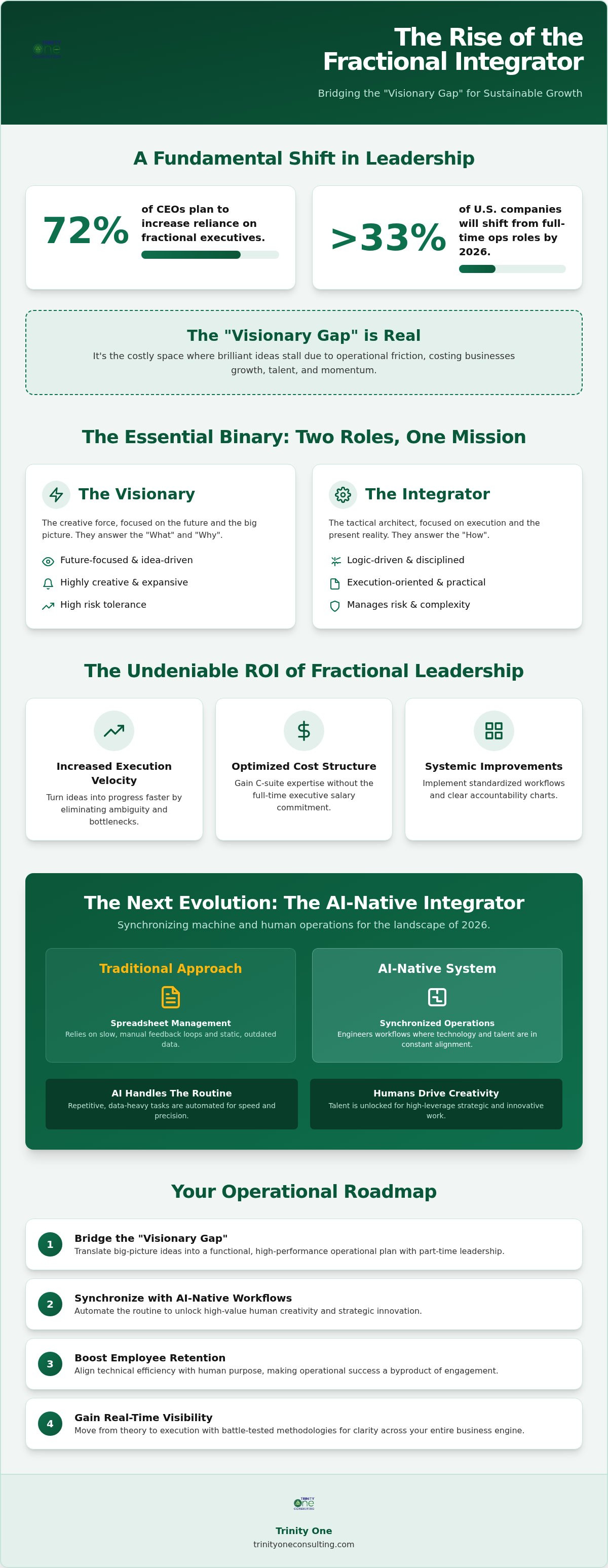
Recent data shows that 72% of CEOs plan to increase their reliance on fractional executives. By the end of 2026, over a third of U.S. companies will have moved away from traditional full-time operations roles. You likely feel the urgency behind these numbers. Your visionary ideas are hitting a wall of operational friction. The "Visionary Gap" is real; it's costing you growth and talent. Bringing in a fractional integrator provides the clinical precision your business engine needs to bridge that gap. It's the difference between a stalled motor and a synchronized machine.
You want execution that matches your ambition. We agree that manual workflows and high employee turnover are symptoms of a deeper systemic failure. This article will show you how a fractional integrator synchronizes your goals with AI-native execution to drive measurable ROI and retention. We'll examine the shift toward real-time visibility and human-centric systems. It's time to stop managing friction and start engineering results.
Key Takeaways
- Bridge the "Visionary Gap" with part-time leadership. Translate big-picture ideas into a functional, high-performance operational roadmap.
- Synchronize your business engine through AI-native workflows. Automate the routine to unlock high-value human creativity and innovation.
- Boost employee retention by aligning technical efficiency with human purpose. Operational success is a direct byproduct of this alignment.
- Evaluate a potential fractional integrator by their ability to apply systemic thinking to your specific operational friction points.
- Move from theory to execution with battle-tested methodologies. Gain real-time visibility into every component of your business engine for 2026.
What is a Fractional Integrator? Closing the Visionary Execution Gap
A fractional integrator is the tactical architect of your business engine. They provide high-level operational leadership on a part-time basis. While the CEO focuses on the horizon, the integrator focuses on the gears. They act as the "How" to the Visionary CEO’s "What" and "Why". This role bridges the gap between high-level strategic planning and the granular reality of daily execution. It's a specific application of the broader Fractional Executive Model. This model is built for companies that have outgrown their current systems but aren't ready for the weight of a full-time C-suite salary.
Many growth-stage companies suffer from the "Visionary Gap." This is the space where great ideas go to die because there's no system to support them. The fractional integrator fills this void. They don't just manage people; they manage the flow of energy through the organization. They ensure that every departmental project aligns with the primary mission. It's about clinical precision in a world of operational chaos.
Visionary vs. Integrator: The Essential Binary
Leadership is a binary force. You have the Visionary. They are future-focused, creative, and highly risk-tolerant. They see where the company should be in 2026. Then you have the Integrator. They are logic-driven, disciplined, and execution-oriented. They see how to get there today. Attempting to be both leads to operational friction. It causes founder burnout. The Visionary generates the heat; the Integrator provides the cooling system and the transmission. Without this balance, ideas remain static. The integrator is the circuitry that powers the business. They turn raw ambition into a functional, repeatable process.
The ROI of Fractional Leadership
The financial logic is undeniable. A full-time COO requires a massive capital commitment. A fractional integrator offers the same battle-tested expertise without the executive price tag. This isn't just about saving on a monthly retainer. It's about the cost of inaction. A seasoned practitioner identifies bottlenecks in days. They improve project completion rates by eliminating ambiguity. You gain an external perspective from someone who has seen these patterns across multiple industries. Speed-to-market increases. Internal waste decreases.
Consider these specific benefits:
- Immediate relief for overwhelmed CEOs who are stuck in the weeds.
- Standardized workflows that reduce human error and technical debt.
- A clear accountability structure that eliminates role confusion and double-work.
The ROI is measured in execution velocity. You stop paying for "potential" and start paying for "progress." This approach allows you to scale your leadership capacity as your revenue grows. It's a strategic investment in the structural integrity of your company.
The AI-Native Integrator: Synchronizing Machine and Human Operations
The business landscape of 2026 demands more than just human oversight. It requires machine synchronization. Traditional management models often fail because they rely on slow, manual feedback loops. A modern fractional integrator acts as the architect of an AI-native operating system. They don't just manage people; they engineer workflows where technology and talent exist in a state of high-frequency alignment. This is the evolution of The Role of the Chief Operating Officer. We are moving away from reactive management toward proactive system design.
In this new model, we draw a hard line between routine and creative work. AI handles the repetitive, data-heavy routine. Humans handle the high-leverage creative strategy. The integrator ensures these two forces never collide in a way that creates friction. They build the circuitry that allows data to flow from the machine level to the leadership level without distortion. If your current systems feel like a collection of disconnected parts, a strategic AI implementation can synchronize your operations into a single, functional unit.
Beyond Spreadsheet Management
Static spreadsheets are artifacts of a slower era. They are snapshots of the past, not indicators of the future. In a high-velocity environment, relying on manual updates is a liability. It creates a lag between reality and decision-making. The AI-native fractional integrator introduces "machine operations" into the human cadence. This means integrating AI tools that provide 24/7 guidance and supplement leadership at the fractional level. AI coaching tools can now handle routine accountability. This leaves human leaders free to focus on empathy, vision, and complex problem-solving. We replace the spreadsheet with a live circuit.
Real-Time Visibility with Trinity Cadence
Visibility is the antidote to operational friction. Without it, you are flying blind. The Trinity Cadence platform serves as the master console for your business engine. It provides a unified operating cadence that is essential for remote and hybrid teams. This isn't just about tracking tasks. It's about monitoring the health of the entire system. You gain the ability to track execution and employee engagement simultaneously. You see where the engine is overheating before it breaks down. This real-time visibility ensures that your visionary goals are backed by measurable, machine-precise execution. The gap between idea and reality finally closes.
Engineering the Human Circuit: Execution Meets Engagement
Execution fails when employees are disengaged. This is a mathematical certainty. You can have the most advanced AI-native operating system, but if the humans behind the machines are checked out, the engine stalls. A fractional integrator manages the intersection of technical efficiency and human purpose. They ensure that the "human circuit" is as optimized as the software logic. This alignment creates a culture where execution is a byproduct of engagement, not just a response to pressure. Efficiency isn't just about speed; it's about the sustainable movement of the entire organization toward a shared vision.
The Dream Manager Program for Retention
Retention is a core operational metric. High employee turnover is a catastrophic system failure. It drains resources, destroys momentum, and erodes the institutional knowledge that powers your business. We address this through the Dream Manager program. This isn't a passive benefit or a standard HR initiative. It's a strategic catalyst for performance. Forbes explains the value of a fractional COO as someone who brings seasoned leadership to a growing firm. Part of that leadership is recognizing that people work harder for their own dreams than they do for your bottom line.
Our certified facilitation connects individual aspirations to the company's long-term goals. When an employee sees that their personal growth is the fuel for corporate growth, their loyalty becomes an asset. We mitigate the high cost of turnover by creating an environment where people feel seen and supported. This isn't just about keeping seats filled. It's about ensuring the "human components" of your business engine are operating at their highest potential. It's a proprietary methodology that turns a workplace into a launchpad for personal and professional success.
Managing the Pulse of the Organization
Leadership in 2026 requires a "Dual Circuit" approach. One circuit tracks the technical execution of projects and the health of the AI-native workflows we discussed earlier. The other circuit monitors the human pulse of the team. A Trinity One fractional integrator uses AI to monitor this pulse without being intrusive. We use real-time engagement data to spot friction points before they become fractures. If engagement in a specific department drops, the integrator intervenes with proactive leadership. We don't wait for the exit interview to find out what went wrong. We synchronize machine visibility with human empathy to keep the engine running at peak capacity. This proactive stance ensures that your team remains aligned, motivated, and focused on the execution of your visionary goals.
How to Evaluate Fractional COO Services: A Selection Framework
Hiring is an engineering decision. You don't need a generalist; you need an architect. Before interviewing candidates, identify your specific operational friction points. Is the bottleneck in your fulfillment cycle? Is it in your decision-making lag? Evaluating a fractional integrator requires a move beyond checking resumes for project management skills. Project managers track tasks. Integrators engineer systems. You need a practitioner who exhibits systemic thinking. They must understand how a change in the sales circuit affects the delivery engine.
Experience matters, but relevance matters more. Look for a battle-tested practitioner who has scaled organizations similar to yours in complexity, not just size. They should arrive with a proprietary methodology, not a blank slate. If they can't explain the logic behind their framework, they'll likely repeat the same mistakes that caused your current friction. Demand clarity. Demand a roadmap that accounts for both machine efficiency and human motivation.
Technical Proficiency vs. Strategic Alignment
Methodology is the differentiator. Determine if the candidate is AI-literate or anchored in legacy processes. A legacy integrator relies on manual tracking and static reports. An AI-native integrator builds automated feedback loops. To test this, ask for a specific framework for handling AI implementation within your existing tech stack. If they don't have a plan for machine synchronization, they aren't prepared for 2026. Cultural fit remains non-negotiable. The integrator must counterbalance the Visionary without stifling them. Integrator Fit is the precise intersection of technical logic and human empathy. It's the point where the system becomes both efficient and alive.
The 90-Day Rapid Launch Sprint
Commitment shouldn't be a leap of faith. It should be a logical progression. We recommend starting with a high-velocity 90-day sprint. This "try before you buy" model allows you to witness the execution before signing a long-term retainer. The goals are clinical: ROI mapping, workflow setup, and total brand alignment. A sprint reveals the true capability of the leadership. It identifies the low-hanging fruit in your operations and harvests it immediately. This approach eliminates the risk of executive misalignment. If you're ready to see how this engineering mindset applies to your specific challenges, you can schedule a Launch Sprint to begin the synchronization process today.
The Trinity One Approach: Engineering Your Operational Future
Hiring a fractional integrator from Trinity One means more than adding an executive to your digital workspace. It means installing a proprietary operating system built for the high-velocity landscape of 2026. We are battle-tested practitioners. With over 30 years of operational experience, we've identified the recurring patterns of business failure. We've also engineered the remedy. Our approach is a binary fusion of technical logic and human motivation. We provide the architecture that turns a visionary’s ambition into a synchronized business engine. We don't just manage your current state; we engineer your future capacity.
Our methodology is anchored by the belief that technology should amplify human potential, not replace it. We deploy an AI-native operating system that integrates machine efficiency with people management. This creates a state of high-frequency alignment where every departmental circuit is closed. You gain a partner who understands both software logic and human motivation. This dual expertise is the only way to drive measurable ROI while maintaining the loyalty of your best talent.
Integrating Trinity Cadence into Your Workflow
Chaos is the default state of most high-growth companies. We replace that friction with a unified operating cadence. The Trinity Cadence platform serves as the master console for your entire organization. It transitions your team from reactive firefighting to proactive execution. The platform features AI coaching and execution tracking that handle the routine heavy lifting. This allows your fractional integrator to focus on high-leverage strategic pivots. By automating accountability, we eliminate the need for intrusive micromanagement. The software supports the integrator’s effectiveness by providing real-time data on both project velocity and team health. You no longer have to wait for end-of-month reports to see if your engine is running hot.
Your Operational Roadmap
Our engagement process is methodical and highly structured. We move from broad strategic concepts to specific tactical applications. It begins with a deep Discovery phase to identify the specific friction points in your current systems. From there, we move into a Launch Sprint. This 90-day period is designed to map your ROI, set up automated workflows, and align your brand's execution with its vision. Only after these foundations are solid do we transition into long-term fractional integration. We prioritize measurable results and employee retention at every stage. We use DreamCompass software to ensure that your human capital is as optimized as your technical stack. It's time to stop guessing and start engineering. Schedule your operational audit with Trinity One to begin the synchronization of your business engine.
Synchronize Your Operational Logic for 2026
The business landscape of 2026 won't tolerate operational friction. You've seen how the visionary gap stalls growth and how machine synchronization can restart the engine. True scale requires a binary approach. You need technical efficiency and human connection working in parallel. A fractional integrator provides the clinical precision to bridge these two worlds. They turn your raw ambition into a repeatable, high-performance system. This is the structural foundation your company needs to survive and lead.
Trinity One brings 30+ years of operational expertise to your leadership team. We use the AI-native Trinity Cadence platform to provide unified visibility into your execution engine. Our proprietary Dream Management facilitation ensures your people stay as engaged as your technology is efficient. You don't have to choose between machine logic and human purpose. You can have both. It's time to stop managing symptoms and start engineering a unified solution.
Architect your AI-native future with a Trinity One Fractional Integrator. Your vision is the fuel. Our systems are the transmission. Let's build a business engine that runs with absolute clarity.
Frequently Asked Questions
What exactly does a fractional integrator do day-to-day?
A fractional integrator manages the daily tactical execution of your business strategy. They lead leadership meetings, resolve departmental friction, and hold teams accountable to specific KPIs. Their day is spent ensuring the gears of your business engine are synchronized. They remove the operational noise that distracts the Visionary CEO. It's a role defined by movement and alignment rather than just observation.
How is a fractional integrator different from a business coach?
The difference lies in the binary of advice versus execution. A business coach stands on the sidelines and offers strategic guidance or psychological support. A fractional integrator is in the trenches with you. They don't just tell you what to do; they build the systems and lead the people to get it done. Coaches focus on the "why," while integrators own the "how."
Does my company need to be running EOS to hire a fractional integrator?
No, formal EOS adoption is not a prerequisite for hiring an integrator. While the terminology originated within that framework, the need for operational synchronization is universal. Trinity One uses a proprietary AI-native operating system called Trinity Cadence. We provide the structure and discipline required for growth regardless of your current management philosophy.
How many hours a week does a fractional integrator typically work?
Most fractional arrangements involve 8 to 20 hours of focused leadership per week. This schedule allows high-growth companies to access C-suite expertise without the overhead of a full-time salary. The focus is on output and system health rather than total hours logged. We prioritize high-leverage activities that create the most significant operational movement.
Can a fractional integrator help with AI implementation?
Yes, specifically when you partner with an AI-native practitioner. A modern fractional integrator engineers workflows where AI handles routine data tasks while humans focus on creative strategy. They act as the architect for your AI implementation, ensuring that new tools solve friction points instead of adding technical debt. They synchronize your human talent with machine efficiency.
What is the Dream Manager program and how does it fit into operations?
The Dream Manager program is a strategic retention tool designed to align personal aspirations with corporate objectives. It fits into operations by stabilizing the human circuit of your business. When employees see the company as a vehicle for their own growth, engagement increases. This reduces the high cost of turnover and ensures your business engine has a reliable, motivated workforce.
How do you measure the ROI of fractional COO services?
ROI is measured through execution velocity and cost mitigation. You track specific metrics like project completion rates, speed-to-market for new initiatives, and employee retention percentages. Additionally, the immediate savings compared to a full-time COO salary provide a clear financial win. The ultimate goal is a measurable reduction in operational friction and a corresponding increase in net profit.
What software does a Trinity One integrator use to manage my business?
We utilize a proprietary suite including Trinity Cadence and DreamCompass. Trinity Cadence serves as the master console for tracking execution and maintaining a unified operating cadence. DreamCompass provides the data needed to manage human engagement and personal growth. These tools give you real-time visibility into every component of your business engine, from machine workflows to human motivation.