
Your weekly meeting shouldn't feel like a trip to the dentist. To understand how to improve visionary integrator relationship dynamics in 2026, you must stop treating your partner like an obstacle and start treating your roles like an integrated circuit. I've spent thirty years in the trenches of leadership and on the football field. As a former Integrator, I know firsthand that friction usually comes from a lack of clear boundaries.
You probably feel like you're speaking two different languages while trying to run the same company. It's frustrating when the Visionary feels restricted by a constant stream of "no" while the Integrator feels buried under a pile of new ideas. We both know that this misalignment on what a priority actually looks like costs you time. It kills your team's morale too.
You'll learn the exact operational adjustments and human frameworks needed to fix this friction and drive execution in your leadership duo. At Trinity One, we'll show you how to build a rhythm of business that prevents burnout. You'll also see how to get real-time visibility without the need for micro-management. We'll look at the specific steps to turn your partnership into a high-performance engine.
Key Takeaways
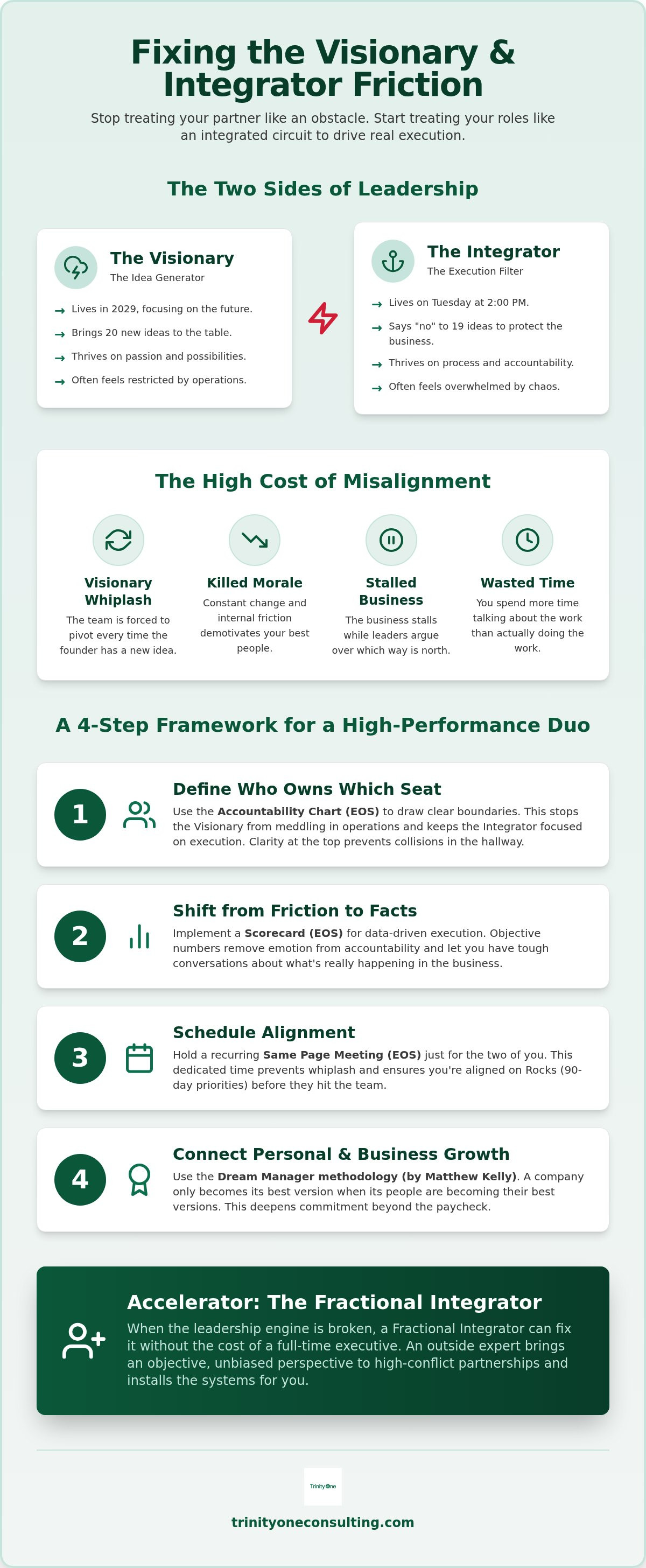
- Define who owns which seat using an Accountability Chart (EOS). This stops the Visionary from meddling in operations and keeps the Integrator focused on execution.
- Understand how to improve visionary integrator relationship health by shifting from personal friction to data-driven execution using a Scorecard (EOS). Objective numbers remove the emotion from accountability.
- Schedule a recurring Same Page Meeting (EOS) to align on priorities. These sessions prevent the whiplash that happens when a team is forced to chase too many new ideas at once.
- Connect personal growth to business outcomes using the Dream Manager methodology by Matthew Kelly. A company only becomes its best version when the people inside it are becoming their best versions.
- Hire a Fractional Integrator to fix a broken leadership engine without the cost of a full-time executive. An outside expert brings an objective perspective to high-conflict partnerships.
Why does the connection between a Visionary and an Integrator often break?
Visionaries live in 2029. Integrators live in Tuesday at 2:00 PM. This gap is where the friction starts, and if you don't build a bridge between the two, the business stalls out while the leaders argue over which way is north. Understanding how to improve visionary integrator relationship health begins with admitting that your roles are designed to be in opposition. It's a structural reality, not a personality flaw.
When the duo at the top is misaligned, the rest of the org chart feels the tremors. I've seen it in football and I've seen it in the boardroom. If the head coach and the offensive coordinator aren't speaking the same language, the players miss their blocks. In a business, this looks like "Visionary whiplash," where the team is forced to pivot every time the founder has a new idea in the shower. It drains the Integrator's mental health and kills the company's momentum.
The friction of opposing leadership archetypes
A Visionary is an idea generator. They'll come to the table with 20 new directions for the company, but only one of those ideas is actually worth the investment. The Integrator's job is to be the filter. They have to say no to the other 19 ideas to protect the business engine. This dynamic often feels like a personal conflict. The Visionary feels restricted, and the Integrator feels overwhelmed by the chaos.
This tension is explored in various leadership theories, but in the trenches, it's just plain hard. The "Integrator's dilemma" happens when holding the founder accountable to their own Rocks (an EOS term) feels like a personal attack. If you don't have a clear framework for these conversations, the relationship becomes a battle of wills instead of a partnership for growth.
When the business engine outgrows the manual tools
Most companies hit a wall when they scale past 20 employees. The manual spreadsheets and long, wandering meetings that worked at five people start to fail. You can't stay on the same page using hope and sticky notes. Fatigue sets in when you're trying to track execution without real-time data. You spend more time talking about the work than actually doing the work.
The EOS framework, which gives us the V/TO and the Accountability Chart, is a great starting point for defining these roles. However, manual implementation often falls short as the complexity of the business increases. This is why many founders look for a Fractional COO to install better systems. Without a digital backbone like Trinity Cadence to provide visibility, the Integrator ends up micromanaging just to find out what's happening. That isn't leadership. It's babysitting.
What are the practical steps to build a better partnership?
To understand how to improve visionary integrator relationship dynamics, you need a behavioral contract. Use the Accountability Chart, a tool from EOS, to define who owns which seat. If both of you are trying to drive the car at the same time, you'll eventually hit a wall. Clarity at the top prevents collisions in the hallway.
Establish a "no-go" zone immediately. The Visionary must agree not to bypass the Integrator to give orders to the staff. This habit creates chaos and destroys the Integrator's authority. If the Visionary has a new idea, it goes to the Integrator first. No exceptions. This protects the team from whiplash and keeps the operations stable.
Schedule a recurring Same Page Meeting (EOS) every week. This time is strictly for the two of you. Use the V/TO (EOS) to ensure you're both looking at the same ten-year target. If you aren't aligned on the destination, you'll fight over the map. You can schedule a call to discuss how these frameworks fit your specific headcount and goals.
Set shared Rocks (EOS) that require cooperation for success. These 90-day priorities should force you to communicate frequently. If your goals are siloed, your relationship will be too. High-performance duos work on the business together rather than just working in it separately.
Defining the rules of engagement
You must present a United Front in front of the team. Disagreements happen behind closed doors, never in the middle of a staff meeting. The Integrator has the final say on all operational decisions. This is a non-negotiable requirement for a stable business engine. It allows the Visionary to stay in their zone of genius without getting bogged down in the details of a $50,000 software implementation.
The Visionary retains the right to change the direction of the ship. However, they must follow the established cadence. You don't turn a cruise ship like a jet ski. Following a structured process protects the team from burnout. It also protects the Visionary from their own impulsive tendencies.
Measuring the health of the relationship
Use a Power Index check-in during every meeting. Rate your alignment on a scale of one to ten. If the score is below an eight, stop talking about the business and start talking about the partnership. It's helpful to understand how visionary and integrator work together when the pressure of a scaling company starts to mount.
Prioritize blunt honesty over polite agreement. If you're afraid to hurt each other's feelings, the business will suffer. I tell my coaching clients that "nice" is often a mask for cowardice. Be direct. Be clear. Then get back to work on the mission.
How do you handle accountability without creating conflict?
Accountability usually feels like an attack because it is often tied to feelings instead of facts. To understand how to improve visionary integrator relationship standards, you must move the goalposts from personality to performance. I have found that a Scorecard (EOS) is the best way to do this. It turns a "you aren't doing enough" conversation into a "the number is red" conversation. Numbers don't have feelings and they don't hold grudges.
Manual reporting is the old way of doing things. It is slow and prone to human bias. The new way uses AI-native operating systems like Trinity Cadence to provide a clear view of the field. This is not about micromanagement. It is about having one version of the truth that both of you can see at the same time. When the data is transparent, the conflict disappears.
You also need a structured way to handle the issues that the data reveals. A Level 10 Meeting (EOS) is designed to solve problems rather than just discussing them for ninety minutes. If you spend your whole meeting talking in circles, you are wasting money. A high-level executive's time can cost the company $500 an hour or more. You cannot afford to spend that time on polite conversation that leads nowhere.
Moving from opinions to data
A shared digital dashboard removes the "he said, she said" friction from your leadership meetings. Trinity Cadence provides real-time visibility into task completion and team engagement. When the system acts as the third party in your relationship, it keeps things objective. You are not arguing about who is right. You are looking at what the metrics say is actually happening in the business.
This objective visibility solves the Integrator’s dilemma. It is hard to tell a Visionary that their latest $20,000 marketing experiment is stalling. It is much easier to point to a dashboard that shows a 30% drop in lead conversion. Data provides the shield that the Integrator needs to speak the truth without damaging the partnership.
The power of a unified operating cadence
Your operating cadence is the heartbeat of your business engine. A disciplined business rhythm replaces the chaos of a reactive schedule. You need a specific time and place for every type of conversation. If your current schedule feels like a constant fire drill, you are likely missing this discipline. You can explore fractional COO services to help you install these systems and get your leadership duo back on track.
Fixing the friction requires more than just a new spreadsheet. It requires a commitment to a specific way of working. When you have a unified cadence, you stop reacting to emergencies. You start building a scalable business that can run without you hovering over every detail of the org chart.
Why should personal dreams be part of your professional alignment?
A business is just a collection of people chasing a common goal. If you want to know how to improve visionary integrator relationship health, you have to look beyond the P&L. You need to understand what drives your partner when they aren't at the office. I use the Dream Manager concept, created by Matthew Kelly, to bridge this gap. The core belief is simple. A company only becomes the best version of itself to the extent its people are becoming better versions of themselves.
When you know your partner's personal dreams, you build a level of loyalty that a paycheck can't buy. It creates a foundation of trust that survives the high-stress moments of a product launch or a market shift. Matthew Kelly identifies twelve dream categories, including physical, financial, and legacy goals. Discussing these isn't about being soft. It's about ensuring the two people at the top aren't burning out while chasing a number. Trust is the fuel.
The human fuel for the business engine
The Visionary and Integrator must support each other’s personal growth to stay effective. If the Visionary is physically exhausted or the Integrator is financially stressed, the business engine will eventually seize up. A leader who is actively achieving their personal goals is a more disciplined and focused operator at work. You can use dream manager coaching to align your personal aspirations with your professional responsibilities.
This approach requires vulnerability, which is a tradeoff. It's bad for leaders who want to keep a clinical wall between their life and their work. However, the cost of that wall is a lack of deep connection. Without that connection, friction becomes personal instead of tactical. You end up fighting about the business when you're actually frustrated about your life.
Building a culture of achievement
The leadership duo sets the tone for the entire organization. When you share your progress on personal dreams, you give your team permission to do the same. We use the DreamCompass app to track these goals privately while maintaining accountability. This isn't just a feel-good exercise. It's a strategic move to lower operational friction and improve retention.
Employees stay where they feel seen as human beings. In 2026, only 31% of U.S. employees are actively engaged at work. This lack of engagement costs the global economy an estimated $10 trillion in lost productivity. By focusing on personal dreams, you turn your company into a place where people actually want to perform. You win the battle for talent by helping your people win at life.
How can a Fractional Integrator fix a broken leadership engine?
Many founders think they need a full-time COO to get their house in order. They don't. A 40-hour-a-week commitment is often overkill for a company with 20 to 50 employees. You're paying for a full-time salary when you only need ten hours of high-level strategic alignment. This is how to improve visionary integrator relationship health without the $250,000 overhead of a permanent executive hire.
A Fractional Integrator brings an outside, objective perspective to a high-conflict partnership. Understanding how to improve visionary integrator relationship dynamics is easier when you have a third party who isn't emotionally invested in the history of the conflict. We use a Launch Sprint to install the business operating system quickly and get everyone rowing in the same direction.
Fractional leadership is bad for companies that need a warm body in a chair for 40 hours just to manage daily fires. It requires a level of maturity and trust that some founders haven't developed yet. You can see the impact of a fractional integrator on business growth when the leaders finally stop arguing and start executing.
The objective third party
A fractional leader acts as a mediator between a Visionary founder and the leadership team. I've spent 30 years as a coach and operator. I've seen the same operational failures across dozens of organizations. That battle-tested experience allows me to identify a bottleneck in ten minutes that might take an internal team ten months to solve.
The goal of a fractional role is often to build the system so you can hire a full-time replacement later. I want to work myself out of a job. We create the documentation and the cadence so a permanent hire can step into a functional seat. This reduces the risk of your next big hire failing because the environment was too chaotic to support them.
Taking the next step toward alignment
You need to be honest about where you stand today. Use a visionary integrator assessment to measure your relationship health. If your score is low, the cost of doing nothing is the eventual failure of your business engine. You can't out-earn a broken partnership at the top of the org chart.
Friction is a choice. You can keep fighting over the same three issues every Tuesday, or you can install a system that solves them forever. If the tension feels permanent, it's time to seek professional guidance. Don't let your vision die because you couldn't get the operations right.
Build a leadership engine that scales
You can't lead a team of 50 people with the same manual tools you used when there were five of you. Fixing the friction at the top requires a commitment to a shared operating cadence and objective data. I've spent 30 years as a coach and operator helping leaders understand how to improve visionary integrator relationship dynamics by moving from opinions to execution.
Start by making your accountability data-driven with the Trinity Cadence operating system. Then, connect your partnership to the personal dreams of both leaders using Matthew Kelly's Dream Manager facilitation. This isn't just about business growth. It's about becoming the best versions of yourselves while you build the company.
You don't have to stay stuck in the same cycle of weekly meeting friction. Take the next step toward a partnership that actually works. Your vision deserves an engine that can actually carry it.
Frequently Asked Questions
How do I know if I am a Visionary or an Integrator?
Visionaries are the idea generators who focus on the future and external growth. Integrators are the filters who manage the internal how and keep the business engine running. If you find yourself constantly creating new directions but struggling with 90 day execution, you are likely a Visionary. If you are the one telling the founder no to protect the team's capacity, you are the Integrator.
Can one person be both the Visionary and the Integrator in a small company?
You can wear both hats temporarily, but you will eventually hit a ceiling. It is difficult to be the person who dreams of the next $10 million while also being the person who manages the daily Scorecard (EOS). This dual role approach is bad at scaling because the operational details eventually suffocate the creative vision. Most founders need to hand off the Integrator seat once they hit 20 employees.
What is the 'Same Page Meeting' and how often should we have it?
The Same Page Meeting (EOS) is a recurring session where the duo aligns on the business direction. You should have it at least once a week for 60 to 90 minutes. This is the only way to prevent the Visionary whiplash that happens when the founder tries to change the plan mid sprint. It is the most effective tool for those wondering how to improve visionary integrator relationship health.
How do I hold a Visionary founder accountable without getting fired?
Use data as your shield. Shift the conversation from personal performance to the Scorecard (EOS) or the Rocks (EOS) you both agreed on. When the numbers are red, it isn't a personal attack. It is a mechanical failure in the business engine. Trinity Cadence provides this visibility in real time, making it harder for a Visionary to argue with the objective reality of the situation.
What should I do if my Integrator is not filtering my ideas correctly?
You must revisit your Accountability Chart (EOS) to ensure they actually have the authority to say no. If they are just acting as an assistant instead of a partner, the system will break. An Integrator must be battle tested enough to stand their ground. If the friction remains, a Fractional Integrator can provide an objective perspective to reset the boundaries and fix the leadership engine.
How much does a Fractional Integrator usually cost for a growing business?
Industry data from 2026 shows that fractional executives typically cost 40% to 60% less than a full time COO. You are paying for the results of a Launch Sprint rather than a 40 hour work week. This model allows you to access senior level expertise without the long term financial commitment of a permanent executive salary and benefits package. It is a strategic way to professionalize your leadership team.
What are the first signs that a Visionary and Integrator relationship is failing?
The most common sign is triangulation, where the team starts going to the Visionary to bypass a no from the Integrator. You'll also notice constant friction during your Level 10 Meeting (EOS) or a complete lack of a business rhythm. When you stop trusting each other's distinct roles, the execution rate drops. This misalignment creates a ripple effect of confusion throughout the entire org chart.
How does the Dream Manager program help with business alignment?
The Dream Manager program, created by Matthew Kelly, connects an employee's personal aspirations to the company's success. When a Visionary and Integrator support each other's twelve dream categories (Matthew Kelly), it builds deep loyalty. A company only becomes the best version of itself when its people are becoming better versions of themselves. This human framework provides the fuel that keeps the business engine running during high stress periods.