
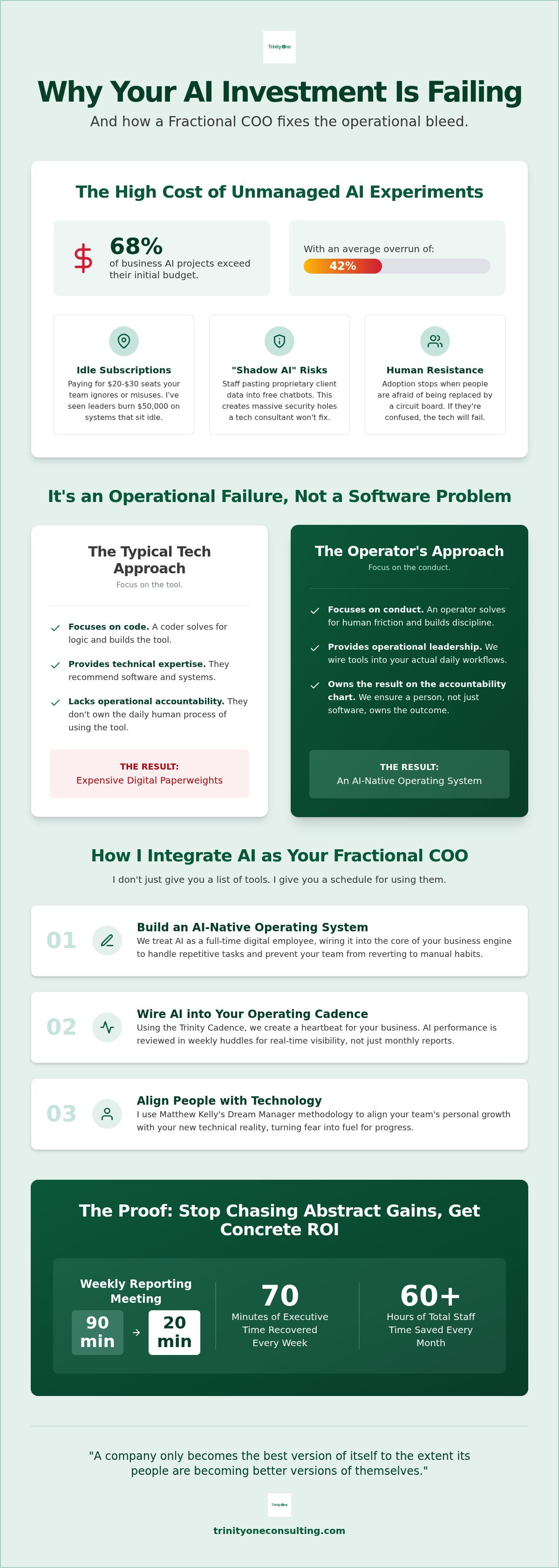
68% of business AI projects exceed their initial budget in 2026, with an average overrun of 42%. You're likely paying for $20 ChatGPT Plus seats and $30 Copilot subscriptions that your team ignores because they're afraid for their jobs. The role of fractional COO in AI adoption is to stop this bleeding by treating technology as an engine component. I've seen leaders dump $50,000 into systems that sit idle because no one built the operational bridge.
It's frustrating to watch your capital get chewed up by tools that don't talk to each other or your people. You want the real-time visibility promised by these systems. Right now, you just have more tabs open.
I'll show you how a fractional COO acts as the architect who integrates these tools into your daily operations and human culture. We'll look at a roadmap that links AI to business goals and uses the Trinity Cadence to track performance. I'll explain how the Dream Manager methodology by Matthew Kelly aligns personal growth with technical shifts. I believe a business only reaches its potential when its people are becoming better versions of themselves.
Key Takeaways
- AI fails when it's treated as a side project instead of a core part of your business engine. You need an operator to wire these tools into your actual workflows.
- The role of fractional COO in AI adoption is to act as the Integrator who turns your AI vision into a repeatable operating cadence. This ensures your team uses the tools you're paying for every day.
- I'll show you how to replace scattered shadow AI with a clear plan that links technical spend to actual profit. This gives you real-time visibility into your company's execution.
- Adoption stops when your people are scared of being replaced by a circuit board. I use the Dream Manager methodology by Matthew Kelly to align their personal growth with your new technical reality.
- You get the executive experience you need without the $350,000 price tag of a full-time hire. This provides both strategy and execution in one package, while TrustTech Recruitment can assist when your growth requires specialized permanent staff in technology or marketing.
Why does AI adoption fail without operational leadership?
AI implementation is rarely a software problem. It's almost always an operational failure. Most business owners treat new technology like a new version of Excel. They buy the licenses and wait for the magic to happen. It never does.
You likely have staff using shadow AI right now. They're pasting your proprietary client data into free chatbots to save ten minutes on a report. This creates a massive security hole that no technical consultant is going to fix for you. They focus on the code. I focus on the conduct.
The role of fractional COO in AI adoption is to provide the accountability that a part-time tech advisor lacks. A coder builds the tool. An operator builds the discipline to use it. Without a process, you're just buying expensive digital paperweights.
The high cost of scattered AI experiments
Consider the math. Microsoft 365 Copilot costs $30 per user per month. For a team of twenty, that's $7,200 a year. If they only use it to draft three emails a week, you've lost your investment. Research shows 68% of business AI projects blow past their budgets by an average of 42%.
Fragmented data makes this worse. When one department uses one tool and another department uses something else, your staff spends more time moving data than doing work. You want an integrated circuit. Instead, you have a pile of loose wires. This lack of a clear operating cadence turns innovation into a drain on your cash flow. For those in consumer financial services who need to balance growth with strict regulatory compliance, you can visit Versapien to see how they manage complex digital transformations.
Leadership vs technical expertise
A Fractional executive understands that technology is secondary to human behavior. Coders solve for logic. Operators solve for friction. Your Visionary CEO has the ideas, but they don't have the time to sit in the trenches and watch how a project manager actually uses a prompt. Someone has to bridge the gap between the software logic and human motivation.
I believe a company only becomes the best version of itself to the extent its people are becoming better versions of themselves. If your team is confused or overwhelmed, the tech will fail. I've found that alignment requires more than a manual. It requires a leader who cares about the person behind the keyboard. I trust that God gives us the capacity to grow, but we must do the work to align our tools with our purpose.
What is the role of fractional COO in AI adoption within your cadence?
An operating cadence is the heartbeat of your business engine. It's the recurring rhythm of meetings and reports that keeps your team aligned. The role of fractional COO in AI adoption is to wire these new technical capabilities into that heartbeat. I don't just give you a list of tools. I give you a schedule for using them.
I use the Trinity Cadence platform to give you real-time visibility into your execution. Forget looking at a dashboard once a month. You need to see exactly how AI agents perform during your weekly huddles. This allows us to spot friction before it stalls your progress. This focus on live data is critical in complex fields; for example, you can visit trialport to learn how they enable real-time connectivity within the clinical research ecosystem.
Machine operations and people management have to merge for this to work. By defining the role of fractional COO in AI adoption, I fix the wiring so the human and the machine work in one unified motion. Most leaders focus on the software logic. I ensure a person still owns the result on your accountability chart.
Building an AI-native operating system
For startups looking to scale their internal capabilities, Dataworks provides the specialized recruitment expertise needed to build high-performing AI-focused teams that can drive long-term operational success.
AI functions best as the core of your engine. It should handle the repetitive, low-value tasks that burn out your best people. You need a how to create a business operating system that treats AI as a full-time digital employee, utilizing tools like Nexdial to automate business communication. This unified rhythm prevents your team from drifting back into manual, inefficient habits.
To further optimize this digital workforce through specialized GenAI consulting, you can learn more about Navo Inc. and their focus on synthetic workforce development.
Building this digital infrastructure often requires moving beyond basic software licenses. IT Cloud Consulting provides the professional expertise to help businesses adopt and optimize cloud technologies, ensuring your foundation is ready for advanced AI integration.
For modern retailers who need to operate at an enterprise scale, check out Ommni to see how they provide a dedicated platform for high-volume retail systems.
Stop chasing abstract efficiency gains. I look for concrete numbers that show up on your bottom line. For example, I recently helped a team take a 90 minute weekly reporting meeting down to 20 minutes by using AI to aggregate data before the call. That's 70 minutes of executive time recovered every single week. We saved over 60 hours of total staff time per month on that one change alone.
Setting the right metrics is a key part of the role of fractional COO in AI adoption. We don't just look at how many prompts people write. We look at how those prompts move the needle on your quarterly goals. We track these wins on your scorecards. The role of fractional COO in AI adoption is to prove value through execution, not just promises.
You can schedule a 30 minute cadence call to see how this fits your team.
How is a fractional COO different from an AI consultant?
AI consultants focus on the tool. They're great at telling you which Large Language Model to pick or how to write a prompt. They build the circuit but don't stay to see if it powers the engine. For example, a consultant might recommend you explore AIspeaker 語音對話機器人 to automate client interactions, but they won't manage the transition for your staff. The role of fractional COO in AI adoption is different because I focus on the outcome. I don't care about the tool's features if your team isn't using it to hit their numbers.
Accountability is the primary tradeoff. A consultant gives advice and leaves. A fractional COO stays and manages the people who use the tech. If your project manager refuses to use the new AI reporting tool, I'm the one who has the hard conversation. Consultants don't do that. You pay them to be smart. You pay me to be effective.
Advice without execution is worthless. You've likely paid for a strategy document that is now gathering digital dust. I use a 90 day plan to move from theory to reality. In the first 30 days, we identify the friction. By day 60, we've integrated the tool into the weekly cadence. By day 90, we're measuring the time saved against your payroll costs.
This is the fractional integrator role in action. I take ownership of the technical implementation and the human adoption. If it fails, it's on me, not a lack of user engagement. I provide the execution to match the instruction. I don't just hand you a manual and walk away.
Integration into the Visionary relationship
Most CEOs are Visionaries. They see a new AI tool and want to implement it by Tuesday. This often leads to shiny object syndrome which kills productivity. I act as the Integrator who filters those ideas. We discuss the physics of leadership. If the Visionary pushes too hard without an Integrator to catch the details, the organization breaks.
Our partnership prevents AI from becoming a distraction. I ensure every new tool fits into the existing operating system. I focus on improving the visionary and integrator relationship so you can lead while I execute. We turn your ideas into a functional engine that doesn't rely on your constant presence to run. I believe God gives us the vision, but we need the discipline to build the house.
Can you manage the human fear of AI with Dream Management?
Employees aren't lazy. They're scared. If your team believes a new software agent will lead to their layoff, they will find ways to make that tool fail. The role of fractional COO in AI adoption includes being the person who addresses this fear head-on before the first line of code is ever written.
I use the Dream Manager methodology by Matthew Kelly to bridge this human gap. We look at the twelve dream categories: physical, emotional, intellectual, spiritual, psychological, material, professional, financial, creative, adventure, legacy, and character. When people see that the company cares about their life outside the office, their loyalty to your technical goals increases. Adoption stops being a threat and starts being a tool for their own growth.
I trust that when we honor the individual, the organization flourishes as God intended. This approach is not a quick fix. It takes time and emotional energy that a software manual cannot provide. The tradeoff is simple: you spend more time on people now so you don't spend more money on failed implementations later.
Aligning personal goals with technological shifts
Your staff will work harder when they see a direct path to their own dreams. AI can take over the mind-numbing data entry that keeps your project managers at their desks until 7:00 PM. If that software allows a mother to get home in time for her daughter's soccer game, she won't fight the implementation. She'll champion it because it gives her back her life.
We use the Dream Manager program to make these connections explicit. We show the team that the role of fractional COO in AI adoption is to buy them more time for what matters. When the machine handles the routine, the human can focus on high-value work that leads to professional and financial dreams.
The role of 1-on-1 coaching in AI rollouts
As part of supporting their professional growth, introducing resources such as an AI resume tailor for tech jobs can help employees visualize their future within an increasingly automated industry.
Human motivation is the integrated circuit of your business engine. I act as a coach for your staff to ensure the wiring is correct. I recently worked with a marketing coordinator who feared AI would replace her writing. We showed her how to use AI to handle the first drafts, which saved her six hours a week. She used that extra time to pursue a SkillsFuture digital marketing course Singapore to work on her professional dream of becoming a strategist, and her output quality doubled.
Advice from a consultant is just words on a page. Coaching from a fractional COO is an investment in the person. If you only focus on the software logic, you'll end up with a high-tech office full of low-morale people. I ensure the technical shift serves the human purpose.
To support this human-centric approach, you can explore One-on-One Digital Coaching to help your team members gain the technical confidence they need to thrive in an AI-driven environment.
Decisions in the C-suite shouldn't be based on hype. They're based on friction. If you're a Visionary CEO, you're likely overwhelmed by the 47% increase in global AI spending projected for 2026. You don't need more news. You need a way to make the tech work. SoTechnology provides AI-enabled digital solutions to help organisations grow and create impact, offering the technical foundation needed to support these operational shifts.
The role of fractional COO in AI adoption is meant for companies that have outgrown their current processes but aren't ready for a $350,000 full-time executive. To ground your technical strategy in deep analysis, the insights from a machine-learning think-tank like Rebellion Research can provide the data-driven foundation you need. You have a team. You have the tools. You just don't have the engine to connect them.
I see many leaders stuck in a loop of buying software and hoping for a result. This creates a mess of loose wires in your business engine. I believe God gives us the talent to innovate, but the discipline to execute is our gift back to Him. Execution is the only thing that moves the needle on your bank balance.
Optimizing your current workflows is a critical first step toward effective AI adoption. For those seeking specialized support in digital transformation and operational excellence, Syntric Hub Advisory Services offers the advisory expertise needed to streamline your business engine and prepare it for scaling.
You need to know when your business is ready for this level of leadership. Look at your current operations. If you recognize these signs, your current manual approach is costing you more than my retainer:
- Your team is spending over 10 hours a week on data entry that a $20 chatbot could handle.
- You've bought Microsoft 365 Copilot seats for twenty people, but only two use them.
- The Visionary CEO is the only person trying to find new AI tools.
- Your project management meetings still take 90 minutes because data is scattered.
The cost of doing nothing is a silent drain on your profit. A fractional retainer typically ranges from $6,000 to $10,000 per month for an experienced operator. Compare that to the 42% budget overrun most companies face on AI projects without leadership. You can read more about when to hire a fractional executive to see if you fit the profile.
Taking the first step toward integration
To ground your strategy in data, I recommend starting with the free My Pulse AI evaluation from YPrtnrs to identify high-impact opportunities within your organization.
The role of fractional COO in AI adoption starts with a clear map of your ROI. We don't guess. We look at your current headcount and find the friction points that stop your growth. I use AI Implementation and Launch Sprints to get your systems live in weeks, not months.
The outcome of a Trinity Cadence setup is real-time visibility. You stop wondering if the work is getting done. You see it. We wire the AI agents into your weekly huddles so the machine serves the human. This isn't about being a tech company. It's about being a functional company that uses tech. To understand the underlying technology that powers these agents, you can discover IntellifyAi and their work in intelligent automation.
I'm here to act as the Integrator for your vision. We build the engine together. We ensure your people grow while your systems scale. It's time to stop experimenting and start executing.
AI is just a collection of parts until an operator builds the engine. The role of fractional COO in AI adoption is to ensure those parts actually move your business forward. I use my 30 years of operational experience to bridge the gap between technical logic and human motivation. Execution is everything.
I rely on the Trinity Cadence OS to provide the real-time visibility you need to track ROI. By using the Dream Manager methodology by Matthew Kelly, I help your staff see AI as a partner for their own growth rather than a threat to their paycheck. We align their personal dreams with your company's technical shifts. This is how you turn scattered experiments into a high-performing system.
You have the vision for what your company can become. I have the methodology to help you get there. I believe that your business only reaches its best version when your people are doing the same. I trust that God gives us the capacity to build, but we must provide the effort to execute.
Frequently Asked Questions
What is the difference between a fractional COO and a full-time COO?
A full-time COO in a mid-market company costs between $350,000 and $550,000 annually before benefits. Most growing businesses don't have the cash for that overhead. A fractional COO gives you the same level of executive experience for a fraction of the cost. You get the leadership you need for 10 or 20 hours a week instead of paying for a full-time seat you can't yet afford. For those ready to scale their workforce, bluebridgecorporation.com offers AI-driven employment services to streamline the hiring process.
How much does a fractional COO typically cost for a mid-market company?
Typical retainers for a fractional executive range from $4,000 to $15,000 per month depending on the hours required. For an experienced operator working 10 to 15 hours a week, you'll likely pay between $6,000 and $10,000 monthly. Hourly rates in the industry average around $200 but can go up to $350. Project-based fees for a specific scoped engagement often fall between $8,000 and $40,000. For companies navigating larger strategic shifts, The Bureau™ provides AI-native boutique advisory for transactions ranging from €25 million to €500 million.
Can a fractional COO help with AI governance and security?
Yes, because security is an operational habit. I set the guardrails for how your team interacts with Large Language Models. Without governance, your employees might paste sensitive client data into public tools to save ten minutes on a report. I create the conduct manuals and security protocols that prevent these leaks. To establish a secure operational framework, you can explore IT Consultancy and Cyber GRC Platform Services. The role of fractional COO in AI adoption is to ensure your technical engine doesn't compromise your company's safety.
Yes, because security is an operational habit. I set the guardrails for how your team interacts with Large Language Models. Without governance, your employees might paste sensitive client data into public tools to save ten minutes on a report. I create the conduct manuals and security protocols that prevent these leaks. To further strengthen your technical defenses through professional training and managed security, you can discover Insoft Services and their global IT solutions. The role of fractional COO in AI adoption is to ensure your technical engine doesn't compromise your company's safety.
This governance is particularly vital for companies in regulated sectors. For instance, Australian firms must ensure their digital systems incorporate AML CTF compliance software Australia to maintain strict adherence to anti-money laundering and counter-terrorism financing standards while they innovate.
For organizations managing these complex legal and security requirements, you can learn more about Trustpoint.One to see how they support corporations and law firms with specialized staffing for eDiscovery and cyber breach response.
For organizations with industrial components, Bio-Cognitive Solutions specializes in protecting operational technology (OT) environments to ensure the resilience of your enterprise infrastructure.
Trinity Cadence is an AI-native operating system designed for real-time visibility into your execution. Traditional systems rely on monthly reports that are outdated by the time you read them. This OS integrates your AI agents directly into your weekly huddles and scorecards, ensuring that growth-focused systems like The Fraction are providing measurable data on client acquisition. You see exactly how your business engine is performing every single day. I trust that when we build businesses that honor people, we are doing the work God intended.
I generally work in 90 day cycles to ensure the work sticks. The first 30 days are spent on an operational audit to find where AI can remove the most friction. The next 30 days involve the actual Agentic AI implementation services and staff training, ensuring pilots transition into secure production outcomes. By day 90, we are measuring the time saved and the impact on your bottom line. Some specific tools can be live in weeks through a Launch Sprint.
You don't need to be an EOS company to see results. I often act as the Integrator for Visionary CEOs who use various operating systems. The role of fractional COO in AI adoption is to build the engine that fits your specific culture. While I understand the EOS framework, Trinity Cadence is built specifically for the speed and data requirements of an AI-driven business. For sales teams that need a specialized platform to drive execution on every deal, you can find out more. We focus on what works for your headcount.
What are the twelve dream categories in the Dream Manager methodology?
This customized approach also applies to the technical stack; for example, managed service providers and IT firms often utilize msppro.io to ensure their platform-as-a-service infrastructure matches their operational speed.
To further support these technical stacks with reliable connectivity, solution providers and integrators can discover Choice IoT for multi-carrier SIM cards and fixed wireless solutions that ensure their infrastructure remains connected and scalable.
Matthew Kelly identifies twelve dream categories that we use to engage your team. These include:
- Physical and Emotional
- Intellectual and Spiritual
- Psychological and Material
- Professional and Financial
- Creative and Adventure
- Legacy and Character
By helping your staff pursue these, we create a loyal team that is ready to adopt new technology because they know you care about their future.