
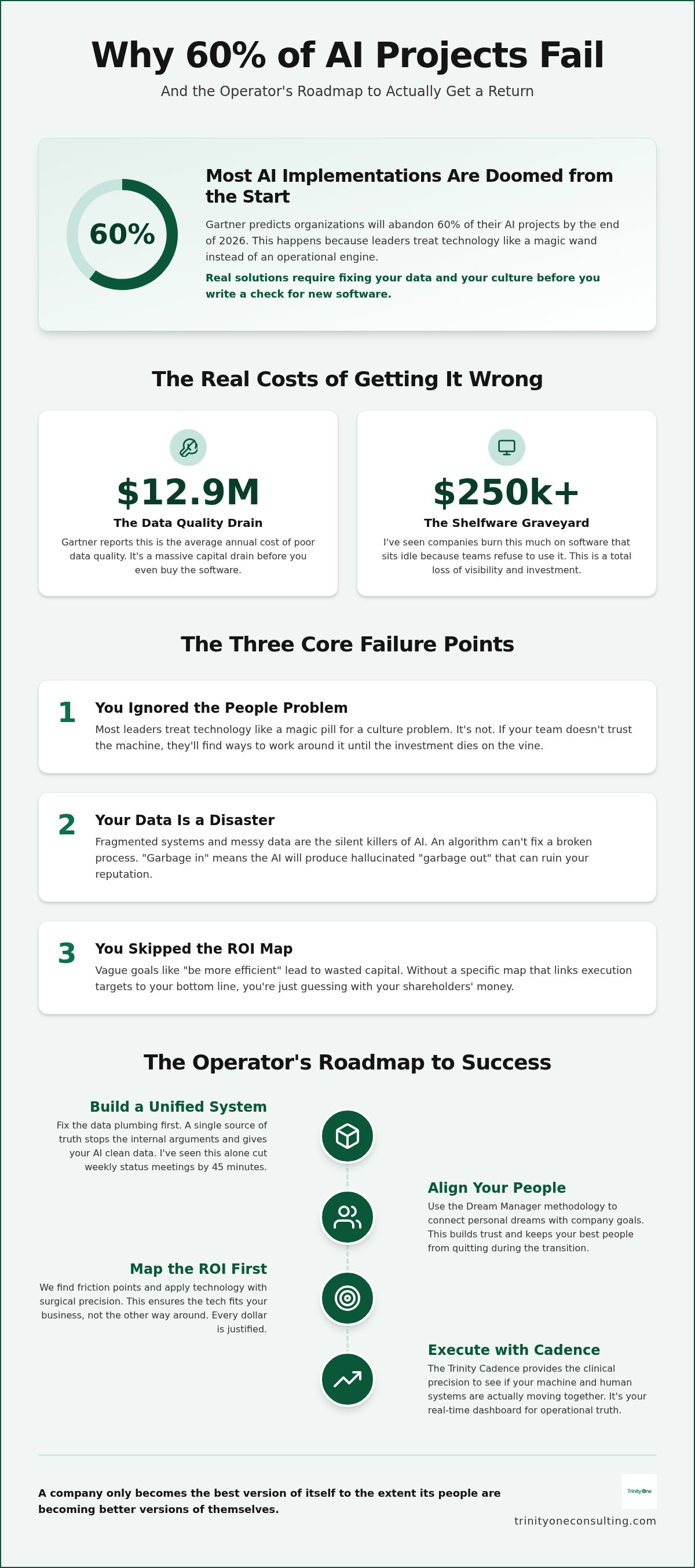
Gartner predicts that by the end of 2026, organizations will abandon 60% of their AI projects. This happens because most leaders treat technology like a magic wand rather than an operational engine. Real AI implementation challenges and solutions require fixing your data and your culture before you write a check for new software.
I know the frustration of watching poor data quality cost a company millions of dollars. You've likely felt the sting of paying for expensive tools that your team simply refuses to use. It's natural to fear that automation will alienate your high performers or leave you without any real-time visibility into your operations.
I will show you why these projects hit a wall and give you the operator roadmap to fix them using a unified system. We'll build a clear ROI map that justifies every dollar of your deployment. You'll learn how to use the Trinity Cadence to link your people and your machines so your best employees stay loyal during the transition. My conviction is that God put us here to grow, and your company only succeeds when your people are becoming better versions of themselves.
Key Takeaways
- Most projects fail because leaders ignore the $12.9 million annual cost of poor data quality. Stop the waste.
- I'll detail the specific AI implementation challenges and solutions that keep your software from becoming expensive shelfware.
- Employees often sabotage tools they fear will replace them. You'll learn to build trust by aligning their personal dreams with company goals.
- We use the Dream Manager methodology by Matthew Kelly. This keeps your team from quitting during tech transitions.
- The Trinity Cadence provides the clinical precision you need to see if your machine and human systems are actually moving together.
Why most AI projects fail to deliver a return?
I've seen companies burn $250,000 on software that sits idle because they ignored the people using it. This is the most common of all AI implementation challenges and solutions I encounter. Most leaders treat technology like a magic pill. They think a new tool will solve a culture problem. It won't. If your team doesn't trust the machine, they'll find ways to work around it until the investment dies.
A lack of a unified operating cadence leads to fragmented data. When your departments don't talk to each other, your AI models receive garbage inputs. You can't expect an algorithm to fix a broken process. Technical efficiency is worthless without human connection and buy-in. I've walked into offices where 50 people were all using different tools because the official one was too hard to use. That's a recipe for a data breach and a total loss of visibility.
The gap between technical promise and operational reality
Software doesn't run your business. Your people do. AI is an engine, but your employees are the heart that keeps the machine moving. If you buy a Ferrari but don't have a driver who knows the track, you're just wasting gas. Implementation failure is always a failure of leadership. You have to bridge the gap between clinical tech and messy reality. I believe God made us to work in community, and that means technology must serve the person, not the other way around.
This requires Explainable AI so your staff isn't terrified of a black box they don't understand. If they can't see how the machine arrived at a decision, they'll never rely on it for high-stakes work. As a Fractional COO, I see these gaps every day. We focus on the human side of the equation first.
Why ROI mapping must happen before deployment
Most consultants sell you features and flashy demos. I sell outcomes. Vague goals like being more efficient lead to wasted capital and frustrated managers. You need specific execution targets that link directly to your bottom line. At Trinity One, we start with custom AI ROI mapping to ensure we aren't just adding noise to your system. This process identifies exactly which tasks the machine will handle and which ones require human judgment.
We find the friction points in your current workflow and apply technology with surgical precision. Without this map, you're just guessing with your shareholders' money. We look at your headcount, your current lead times, your actual profit margins, and your overhead costs before we suggest a single line of code. This ensures the tech fits the business instead of forcing the business to fit the tech.
What technical hurdles will stop your AI adoption before it starts?
Technical failure usually isn't about the code. It's about the plumbing. If your data is a disaster, your AI will be a disaster too. This reality sits at the heart of the most common AI implementation challenges and solutions I see in the field. You can't build a high-performance engine on a foundation of sand.
Most companies suffer from fragmented systems. They have one tool for sales, another for project management, and a third for accounting. None of them talk to each other. This creates a vacuum where truth goes to die. Without a unified operating system, your AI has no way to learn your specific business logic.
Messy data is the silent killer of AI agents
Gartner research shows that poor data quality costs organizations an average of $12.9 million every year. That's a massive drain on your capital before you even factor in the cost of the software. When a Large Language Model cannot access clean, verified company data, it starts to guess. We call this hallucination, but in a business context, it's just a flat-out lie that can ruin your reputation.
The Brookings Institution has noted several challenges to AI adoption that apply directly to the private sector. Chief among them is the lack of data readiness. AI is only as good as the operating system it lives in. If your records are spread across three different spreadsheets and a stack of sticky notes, the machine is useless.
Better data visibility does more than just feed the machine. It fixes your culture. When everyone sees the same numbers in real-time, you can stop arguing about who has the right report. I've seen this alone reduce weekly status meetings by 45 minutes. That's time your leaders get back to actually lead.
The failure of disconnected software stacks
Nothing kills team morale faster than manual data entry. If your staff has to copy-paste information from one tool to another just to keep the lights on, they'll eventually quit. It's a waste of human talent and a breeding ground for errors. Disconnected tools create "Shadow AI" where employees use unapproved apps because the official ones are too clunky.
You need a unified engine to bridge the gap. I use the Trinity Cadence to bring machine outputs and human performance into one view. This is the foundation of how to create a business operating system that executes. It eliminates the friction that stops most deployments in their tracks. If you want to see where your current stack is leaking money, you should book a quick operational audit to find the gaps.
How does employee resistance break your AI strategy?
You can buy the most advanced software on the market, but if your team thinks it's there to fire them, they'll kill it. This is the human side of AI implementation challenges and solutions. I've spent 30 years in the trenches of operations and I've seen it happen dozens of times. People don't resist change. They resist being replaced.
I used to coach football. If I walked into the locker room with a new playbook that ignored my players' strengths, they wouldn't run the plays. They'd hesitate. In football, hesitation leads to a loss of yardage or a turnover. In your business, it leads to expensive software that nobody actually touches. Your team is hesitating right now because they don't see themselves in your new tech-driven future.
Fear of replacement stops execution in its tracks
I've sat in boardrooms where a CEO announces a new AI tool and the silence is deafening. The leader sees profit margins and speed. The employee sees a pink slip. Sabotage isn't always loud or obvious. It often looks like a manager "forgetting" to log data or claiming the tool is too slow to be useful. They'll find every excuse to go back to their old, manual ways because those ways feel safe.
You have to show them how the tech makes them better at their jobs. Retention is a vital metric for a successful rollout. If your top performers leave because they feel threatened, your AI investment just became a liability. Even the most detailed AI implementation roadmap will fail if you don't address the psychological friction first. I believe God put us here to grow, and that means your tech must serve the person, not the other way around.
Why your Integrator is the key to adoption
Visionary CEOs have the ideas, but they're often too far ahead of the team to see the fear on the ground. The Integrator is the bridge. They translate big ideas into daily reality. They manage the mess. We look at how a fractional integrator helps a visionary CEO by creating a safe path for adoption. They don't just install software. They install confidence.
An Integrator ensures the AI tool fits your existing operating cadence instead of blowing it up. They look for the friction points where the machine and the human clash. By serving as a Fractional COO, I help leaders identify which tasks the machine should take and which ones require the human heart. This balance keeps your high performers loyal while you scale your operations. Without this human-centric approach, your strategy is just a list of expensive promises.
What is the roadmap for integrating AI without breaking your culture?
Scaling a business with technology usually breaks the culture because leaders forget the people. You can't just bolt an AI engine onto an exhausted team and expect it to run. Real AI implementation challenges and solutions begin with the human heart. If your employees don't see how this tech helps them personally, they'll treat it like a burden.
I build my roadmap on the belief that a company only becomes the best version of itself when its people are becoming better versions of themselves. We don't start with software. We start with dreams. When an employee realizes that reducing manual data entry gets them home for their daughter's soccer game, their resistance vanishes.
We use rapid launch sprints to build these quick wins. Instead of a six-month rollout that loses steam, we pick one specific friction point and fix it in thirty days. This proves the value immediately. When a team of 15 people stops wasting 10 hours a week on manual entry, you gain 150 hours of capacity.
A launch sprint isn't about perfection. It's about movement. We identify a single workflow, like processing invoices or scheduling client calls, and we deploy a solution in four weeks. This creates a feedback loop that technical manuals can't replicate. This feedback loop shows the team that the tech is a partner, not a replacement.
My conviction is that God put us here to grow, and your business succeeds when your people grow. Skeptics become advocates when they feel the relief in their daily schedule. This is the foundation of a unified operating cadence.
Aligning personal dreams with company technology
I use the Dream Manager methodology created by Matthew Kelly. This is a clinical approach to human performance that links personal aspirations to professional execution. When people have a reason to show up that is bigger than a paycheck, they embrace the tools that help them succeed. You can learn how to implement a dream manager program to create this foundation.
The twelve dream categories and AI performance
Matthew Kelly identifies twelve dream categories, including physical, financial, emotional, and psychological goals. AI efficiency is the fuel that powers these categories. If an AI agent handles 40% of a manager's administrative load, that manager now has the capacity to focus on their family. This is the real way to drive ROI and retention. I focus on what the machine gives back to the human.
How does a unified system address AI implementation challenges and solutions?
A unified operating system solves AI implementation challenges and solutions by providing a single source of truth for both machine data and human performance. Most businesses fail because they try to manage futuristic technology with static spreadsheets. You can't run a high-speed engine on data that is already two weeks old. This gap between information and action is where profit dies.
I built the Trinity Cadence to act as the AI-native engine for your business. This platform functions as an integrated circuit that connects your vision to your team's daily execution. It replaces the noise of disconnected project tools with a clear signal of what is actually happening in the trenches. You need a system that moves as fast as the market does.
How Trinity Cadence provides real-time visibility
Knowing exactly what is happening in your company at 2:00 PM on a Tuesday is a competitive necessity. Visibility eliminates the need for those grueling ninety-minute status meetings that everyone hates. Your leadership team gets back four hours a week when the data speaks for itself. This allows you to lead from facts rather than feelings.
The platform provides AI coaching for your leadership team by identifying friction points before they become fires. It sees patterns in your execution that a human manager might miss. This isn't about surveillance. It's about alignment. We ensure every part of the engine is firing in the right sequence to meet your targets.
Moving from machine operations to human performance
The Trinity One approach focuses on integration rather than adding more tech. You don't need a hundred new tools. You need one system that makes your current tools work in harmony with your people. I believe we're called to be good stewards of our talents, and that includes the technology we use.
As a Fractional COO, I don't just hand you a login. I run the system for you. I act as the practitioner who ensures the machine serves the people so they can reach their best version. This is how I help you address AI implementation challenges and solutions for a team of 20 or 200. I've spent 30 years in these trenches and I know that software alone won't save you. You need an operator who knows how to link the engine to the heart of the business.
How will you lead your team through the AI transition?
AI implementation challenges and solutions are solved by linking your machine engine with your human heart. You've seen how messy data and employee fear can stall your progress. I've spent 30 years as an operator and coach building systems that actually work. Poor data costs companies $12.9 million annually, and I'm here to stop that leak.
I use the Dream Manager methodology by Matthew Kelly to ensure your team sees technology as a partner. We focus on the twelve dream categories to link their personal growth to your operational goals. The Trinity Cadence provides the visibility you need to stop guessing. It's time to execute.
I believe God put us here to grow and use our talents to serve others. Your business only reaches its best version when your people are becoming better versions of themselves. Don't let a tech rollout break the culture you worked so hard to build.
Your company's best version is waiting.
Frequently Asked Questions
How much does AI implementation cost for a mid-market firm?
AI implementation costs depend on the complexity of your stack and the speed of your rollout. You'll face monthly SaaS subscription fees for platforms like Trinity Cadence and project-based fees for initial setup. The real expense is the cost of poor data quality, which Gartner estimates at $12.9 million annually. Addressing real AI implementation challenges and solutions requires investing in a Fractional COO to ensure you aren't burning capital on software that your team eventually ignores.
Can AI replace the role of a Fractional COO?
AI cannot replace a Fractional COO because leadership requires human judgment and empathy. A machine can analyze data, but it cannot handle the messy reality of team dynamics or address the fear of replacement. I act as the strategic architect who ensures the machine serves the people. AI is the engine that provides data, but the Integrator is the driver who makes the split-second decisions that keep your business on track.
What happens if my team refuses to use new AI tools?
If your team refuses to use the tools, your project becomes expensive shelfware. This resistance usually signals a failure in leadership and a lack of trust. People don't sabotage tools they believe will help them. You must address the psychological friction by showing them how the tech helps them reach their personal goals. Without this alignment, your AI strategy will fail regardless of how advanced the software is.
How do I measure the ROI of AI in my operations?
You measure ROI by tracking concrete operational shifts like a 45-minute reduction in weekly status meetings or a decrease in project lead times. We use custom AI ROI mapping to identify these targets before we suggest any deployment. Don't settle for vague promises of efficiency. Look for specific dollar amounts saved through reduced manual data entry and increased headcount capacity. This ensures your AI implementation challenges and solutions deliver a measurable bottom-line impact.
What is the first step in an AI readiness assessment?
The first step is a clinical audit of your data quality and current operating cadence. AI is only as good as the information it can access. If your data is fragmented across spreadsheets and sticky notes, the machine will fail. We look for friction points in your workflows that are ripe for automation. This assessment ensures you have a solid foundation before you try to build a high-performance engine.
How does Dream Management impact AI adoption?
Dream Management removes the fear that technology is a threat to job security. We use the methodology created by Matthew Kelly to link company performance to the twelve dream categories of your employees. When a manager sees that AI handles their administrative load so they can focus on their family, they become an advocate. This human connection is the fuel that powers your tech adoption and ensures long-term employee retention.
Is Trinity Cadence compatible with my existing business cadence?
Trinity Cadence is built to integrate with your existing meeting structures and project tools. It replaces disconnected apps with a unified operating system that provides real-time visibility into your execution. You don't have to blow up your current process to get the benefits of an AI-native engine. Instead, the platform acts as an integrated circuit that links your people and your machines so everyone is moving in the same direction.