
Most employees aren't actually working for your company. They're working for themselves. You can align these interests by learning how to implement a dream manager program, which turns their personal wins into the fuel for your corporate engine. Right now, they're likely doing the bare minimum because they don't see how your profit helps them buy their first home. You're tired of being the only person who cares about the future while your turnover rate climbs.
It's frustrating to watch talented people walk out the door for a small raise elsewhere. You know that a paycheck isn't enough to buy loyalty anymore. You want a team that shows up with fire because they know their work here is the fastest path to their own personal dreams. You're right to want that alignment.
I'll show you the exact steps to build a program that connects your employees' personal goals to your business results. We'll look at the twelve dream categories defined by Matthew Kelly and how to use the DreamCompass app to keep everyone on track. This isn't about soft HR perks. It's about a disciplined system that turns personal growth into company profit.
Key Takeaways
- You'll understand why employees stop caring when their personal goals don't align with your profit margins.
- I'll explain how to implement a dream manager program using Matthew Kelly's methodology to turn your company into a vehicle for employee dreams.
- You'll see why starting with your leadership team is the only way to prove the program works before you roll it out to the whole staff.
- We'll weigh the heavy payroll cost of a full-time hire against the confidentiality benefits of using an outside facilitator.
- You'll learn to track ROI using concrete metrics like employee retention and the caliber of new people applying for your open roles.
Why do employees stop caring about your business goals?
Most employees quit in their heads months before they hand you a resignation letter. They show up, log their hours, and do exactly enough to avoid being fired. This isn't laziness. It's a rational response to a job that feels like a dead end for their personal ambitions. If you want to know how to implement a dream manager program, you have to start by admitting that your current retention strategy isn't working.
If your business goals don't help them buy a house or pay for their kid's tuition, they won't treat those goals as their own. You can't expect a team member to bleed for your profit margins if they're struggling to pay their rent. Loyalty is a two-way street that starts with you knowing what they actually want. Learning how to implement a dream manager program is the first step toward fixing this disconnect.
The high cost of a disengaged team
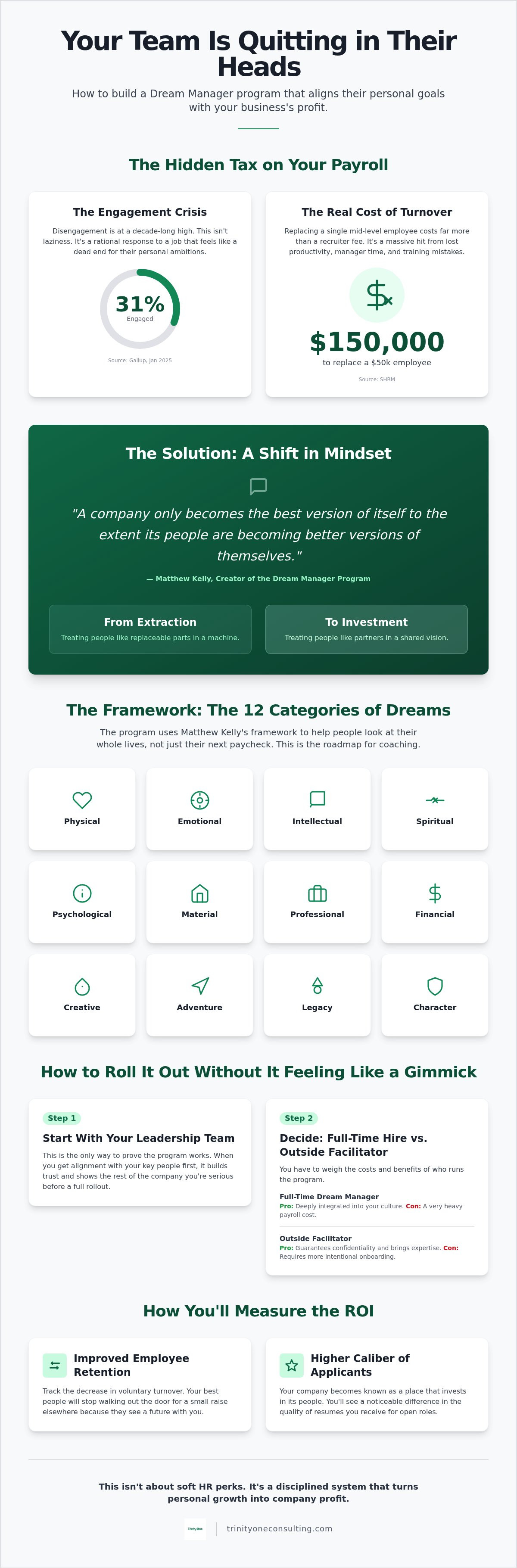
Disengagement is a hidden tax on your payroll. As of January 2025, Gallup reports only 31% of U.S. employees are engaged at work. This is the lowest level in a decade. When a $50,000 employee leaves, the SHRM reports it can cost three to four times their salary to replace them. That is a $150,000 hit to your bottom line for one mid-level departure.
The cost of replacing a $50,000 employee goes far beyond the recruiter fee. You pay for three months of lost productivity while the seat is empty. Your managers spend their time interviewing instead of executing. The training period brings mistakes that cost you even more money. Quiet quitting is just a symptom of a team that has no vision for their own future within your walls.
The link between personal and professional growth
A company is simply a group of people chasing a common goal. If their personal lives are in chaos, their performance at work will reflect that disorder. Matthew Kelly, the creator of the Dream Manager methodology, teaches that a company only becomes the best version of itself to the extent its people are becoming better versions of themselves. This is the foundation of the dream manager program.
Matthew Kelly's methodology focuses on twelve dream categories, ranging from physical health to financial security. By addressing these areas, you're not just being kind. You're building a more resilient workforce. A team member who finally gets their debt under control is a team member who isn't distracted by bill collectors during your Level 10 meetings, which is a meeting format from EOS. You stop being a boss who just demands tasks and start being a leader who supports progress.
What is the Dream Manager concept?
A Dream Manager is a life coach who works inside your company. Their job isn't to teach your sales team how to close more deals or your engineers how to write cleaner code. Instead, they focus on the person doing the work. This methodology was created by Matthew Kelly to solve a specific problem: the fact that most employees feel their personal lives are disconnected from their professional efforts.
Traditional HR departments focus on compliance, benefits administration, and risk management. They're there to protect the company. A Dream Manager is there to protect the employee's future. When you understand how to implement a dream manager program, you're shifting from a culture of extraction to a culture of investment. You stop treating people like replaceable parts in a machine and start treating them like partners in a shared vision.
This isn't about sitting in a circle and sharing feelings. It's a structured process designed to identify what your people actually want out of life. If you're struggling with high turnover, let's talk about how this fits your specific team size.
The twelve categories of dreams
Matthew Kelly identifies twelve distinct categories of dreams that every human has. These include physical, emotional, intellectual, and spiritual goals. They also cover psychological, material, and professional aspirations. By categorizing dreams this way, the program ensures that employees look at their lives through a wide lens rather than just focusing on their next paycheck.
Financial dreams are often the first priority for most people. It's hard to dream about running a marathon or learning a new language when you're worried about your car being repossessed. In my 30 years of experience, I've seen that helping an employee get their finances in order is the fastest way to get them focused at work. These categories come directly from Matthew Kelly's framework and provide a roadmap for the coaching sessions.
How it differs from standard coaching
Professional coaching usually focuses on your job skills. It's about hitting your Rocks or improving your Scorecard, which are terms used in EOS. While that's valuable for the business, it doesn't always touch the heart of the employee. Dream management focuses on the life they live when they leave your office at 5:00 PM.
The Dream Manager program provides a structured framework to manage this process. It bridges the gap between who the employee is today and who they want to become. When you help someone achieve a personal goal, they don't just become a better person. They become a more loyal and productive member of your team because they know you're the one who helped them get there. Knowing how to implement a dream manager program gives you a competitive advantage that a higher salary alone can't buy.
Should you hire a full-time Dream Manager or use a facilitator?
Hiring a full-time employee for this role is a massive commitment. In a company with 50 people, a full-time salary plus benefits could easily top $80,000. You have to decide if that person generates enough retention ROI to justify the expense. Most small to mid-market firms can't carry that overhead. This is the first hurdle when deciding how to implement a dream manager program in your own shop. You aren't just buying a coach. You're adding a permanent line item to your P&L.
The pros and cons of internal certification
You can send an existing team member to get certified through an official training program. A certification session is scheduled for October 22-23, 2026, in North Palm Beach, FL. This keeps the methodology in your building. However, you lose a high-level operator. If your best manager spends 20 hours a week coaching, who is running their department? You are essentially paying for a coach and losing a producer at the same time.
There is also the trust factor. An employee will rarely admit their marriage is failing or they are $30,000 in debt to the person who decides their year-end bonus. Confidentiality is the engine of this program. Without it, the system stalls. If the person being coached feels judged by their supervisor, they will lie about their dreams. They will give you safe, boring answers that don't lead to real change.
Using a fractional Dream Manager facilitator
A fractional Dream Manager offers a middle ground. You get the expertise of a battle-tested practitioner without the burden of a full-time payroll. They provide an outside perspective that builds trust faster because they aren't part of your internal politics. They don't care about the drama in the breakroom. They only care about the employee's progress. This model allows you to scale the program as your headcount grows.
A facilitator fits into your existing cadence. If you use EOS, they can align their work with your Rocks and Scorecards, which are tools from the EOS framework. They use tools like the DreamCompass app to track progress without you having to manage the data. This keeps the program disciplined and measurable. It ensures the investment actually moves the needle on your retention numbers. Deciding how to implement a dream manager program requires looking at these trade-offs clearly before you sign a contract. You need to know if you want a permanent staffer or a surgical expert.
How do you roll out a dream program without it feeling like a gimmick?
Your employees are cynical. They have seen wellness initiatives and corporate retreats come and go without making a dent in their daily lives. If you want to know how to implement a dream manager program that actually sticks, you must treat it like a core operating system. It cannot be the flavor of the month. It requires a disciplined rollout that proves you are serious about their personal growth.
Trust is the only currency that matters here. If your team thinks this is a clever way to squeeze more work out of them, they will shut down. You have to demonstrate that the company exists to serve the people as much as the people serve the company. This starts with a pilot program that builds internal evidence of success.
Step 1 Lead by example with the leadership team
If you are not willing to share your own dreams, your team will never share theirs. Vulnerability starts at the top. I recommend running a pilot with your top three leaders for at least 90 days before taking it to the rest of the staff. This gives you time to fix any friction in the process and ensures your leadership is fully aligned with the methodology.
During this pilot, use the same tools your employees will eventually use. See how it feels to track your progress toward the twelve dream categories defined by Matthew Kelly. When your leadership team can point to their own wins, the rest of the company will see the program as a benefit rather than a burden. You are building a track record of execution before you ask for their buy-in.
Step 2 The first employee meeting
The announcement meeting is the most dangerous moment of the rollout. Do not talk about how this will help your profit margins or your retention stats. Focus entirely on their future. Use a script that invites them to think about what they want their lives to look like in three years. You can find specific questions for this conversation in my guide on talking to employees about personal goals.
Address the skepticism about prying into their lives immediately. Be blunt about the fact that their dreams are private. The company only sees what they choose to share through the DreamCompass app. Explain that this is an investment in them becoming the best version of themselves, a concept attributed to Matthew Kelly. If you don't address the "creepy" factor head-on, you'll spend months fighting invisible resistance.
Step 3 Establishing a rhythm for coaching
Consistency is the only way to build trust with an operator. Schedule monthly 60-minute sessions and do not cancel them for anything short of a building fire. If you cancel a dream session to talk about a client project, you have just told the employee that their life is less important than your revenue. That is a mistake that takes months to fix.
Keep these sessions entirely separate from performance reviews. A dream session is not the time to talk about their Scorecard or their Rocks, which are terms used in EOS. Use the DreamCompass app to keep the focus on their personal strategic plan. This creates a safe space where the only agenda is their progress toward the twelve categories. When the rhythm is predictable, the results become inevitable.
How do you track the ROI of a dream program?
If you don't track the numbers, you aren't running a program. You are running a charity. To understand how to implement a dream manager program successfully, you must treat it like any other capital expenditure. You track your customer acquisition cost with clinical precision. You should track your employee retention cost with that same focus.
Compare your turnover rate from the twelve months before the rollout to the twelve months after. If you lose three fewer $50,000 employees, you've saved $450,000 based on SHRM replacement cost data. That pays for a lot of coaching. You should also monitor the quality of new applicants. When word gets out that you invest in your people's lives, you stop begging for resumes.
Linking personal goals to business objectives
Linking employee personal goals to business objectives is a tactical move. It is not a soft HR exercise. If an employee needs a raise to buy a house, they need a promotion. You show them exactly how hitting their Rocks or achieving a promotion is the fastest way to get that house. This is a concept from EOS where individual goals support the V/TO. You are turning their private ambition into a fuel source for your company targets.
Using Trinity One Cadence to monitor engagement
Integration is where most programs fail. You can use Trinity One Cadence, an AI-native operating system, to keep this data visible without violating privacy. By monitoring engagement scores during your Level 10 meetings, which is an EOS term, you can see in real-time who is falling behind. You are looking at the health of the engine. This visibility allows you to intervene before a star player quits.
The DreamCompass app acts as the tracking mechanism for the twelve dream categories defined by Matthew Kelly. It provides the data needed to prove the program's value to your board. When you can show a direct link between a personal win and a business result, the skepticism disappears. This disciplined approach ensures that knowing how to implement a dream manager program leads to a measurable increase in your bottom line.
Turn your team into your greatest competitive advantage
You can't keep running your business with a team that has one foot out the door. Turnover is a drag on your growth. Learning how to implement a dream manager program is a strategic move to ensure your company becomes the best version of itself. This is the core belief of the methodology developed by Matthew Kelly.
I've spent 30 years in the trenches of leadership and coaching. I provide Certified Dream Manager facilitation because I've seen that when you help a team member achieve a personal win, they show up to work differently. They stop doing the bare minimum and start acting like owners of their own future. This works because it aligns their personal strategic plan with your business results.
You have the steps. You understand the twelve categories and the importance of a disciplined monthly rhythm that doesn't get canceled. Now you just need to decide if you're ready to lead your people to their own finish lines.
Book a discovery call to see how a Dream Manager program fits your current operating cadence.
Your people are waiting for a reason to care. Give them one.
Frequently Asked Questions
Is the Dream Manager program only for large corporations?
Small teams often see faster results because the culture shift is more immediate. Company size doesn't dictate success. The depth of your commitment to the people on your payroll does. I've seen teams of 10 people use this to cut their turnover in half in six months. It turns a group of employees into a focused unit of partners.
How much time does a Dream Manager program take each month?
Participants spend about 60 to 90 minutes per month in a coaching session. This is a non-negotiable block on the calendar. If you can't spare 90 minutes to ensure a $60,000 employee stays for three years instead of one, you have a time management problem. The system requires a disciplined rhythm to stay effective over the long haul.
What if an employee has a dream to leave the company?
This happens and it's actually a win for your operations. If someone wants to start their own firm, they are already halfway out the door. By knowing this, you can plan a graceful transition over 12 months instead of a frantic two-week scramble. You get a loyal operator who works harder during their exit period because you are helping them reach their next finish line.
Do I have to pay for my employees' dreams?
The company does not pay for the dreams. You pay for the coaching and the system that helps the employee achieve them. If a person wants to buy a $400,000 house, they need to earn the income to support it. You provide the roadmap and the business targets they must hit to reach that income level. The employee does the work.
How do I ensure confidentiality in the coaching sessions?
Confidentiality is protected by using an outside facilitator or a private app like DreamCompass. Employees don't share their private data with their direct supervisor. They only share what they want the company to know. If you are learning how to implement a dream manager program, you'll see that trust is the engine. Without a firewall between coaching and performance reviews, the program will fail.
Can I use EOS terms like Rocks with the Dream Manager program?
The program integrates perfectly with EOS. You can link a personal dream to a business Rock, which is an EOS term for a 90-day priority. If someone wants a promotion to fund their child's tuition, they must hit their Scorecard numbers and complete their Rocks. This creates a clear link between personal growth and company profit. It makes the EOS framework feel more human.
What are the twelve categories of dreams in the Matthew Kelly book?
The twelve categories come from Matthew Kelly's methodology and cover every aspect of a human life. They include physical, emotional, intellectual, and spiritual goals. There are also categories for psychological, material, professional, and financial dreams. Others cover creative, adventure, legacy, and character aspirations. This structure ensures that your people are working on more than just their bank accounts and job titles.