
More than 80% of enterprise AI projects fail to deliver their intended business value. The role of a fractional COO in AI implementation is to ensure your company stays on the right side of that statistic. You likely feel that weight every time you look at your software bills or see your team's skeptical faces.
It's frustrating to watch your people toggle between fifty tabs while the expensive tools you bought gather digital dust. You know the tech has potential. But the friction of changing how your team actually works feels like a heavy anchor. Your staff is worried about their seats and your data is scattered across too many systems.
I've spent decades in the trenches as an operator and a coach. I know that software doesn't fix a broken rhythm. You need a way to connect high-level AI ideas to the daily grind of your business without burning out your best people.
You can get a measurable return on your technology spend while keeping your culture intact. I'll show you the specific steps to build an operating cadence that works for both the machine and the humans. My conviction is that a business only thrives when the people inside it are becoming the best versions of themselves.
Key Takeaways
- Stop buying software that sits on a shelf. Implementation fails when there is no owner to weave new tools into your daily operating cadence.
- Understand the role of a fractional COO in AI implementation as the integrator who translates visionary goals into specific machine prompts and human tasks.
- Protect your culture by using AI to remove busywork. A company only becomes its best version when its people are becoming better versions of themselves through Matthew Kelly's Dream Management methodology.
- Identify the signs that your roadmap is stalling. If no one person is accountable for your AI output, your technology spend is likely creating more friction than profit.
- Use the Trinity Cadence to get real time visibility into your execution. This platform holds the whole engine together so you can see your team's engagement and output in one place.
Why do most AI implementation projects stall before they create ROI?
AI implementation is 20% software selection and 80% operational integration. Most leaders spend their entire budget and energy on that first 20%. They buy a shiny new tool after seeing a demo and expect the business to change overnight. It doesn't happen. Instead, the software sits on a digital shelf while the monthly subscription fee drains the bank account.
The project stalls because nobody owns the integration. A Visionary sees the engine's potential but rarely the maintenance required. This is where the role of fractional COO in AI implementation becomes the deciding factor. You need a Chief Operating Officer (COO) mindset to bridge the gap between software logic and your team's workflow.
The gap between vision and execution
Visionaries are great at spotting opportunities. They see how AI can summarize a meeting or forecast demand. But implementation requires someone to live in the details. Without changing the daily operating cadence, the new tool is just one more tab in a crowded browser.
Disconnected systems create more work. Your team ends up copying data from one window to another just to satisfy the new software. Without a dedicated owner, the AI roadmap becomes a list of expensive experiments. An operator ensures the tech fits the actual engine of the business.
The data backs this up. 84% of AI project failures are caused by leadership and process issues (not the technology). When 95% of generative AI pilots show no measurable financial return, the problem isn't the code. It's the absence of the role of fractional COO in AI implementation to drive the execution.
The tradeoff is that real implementation is slow and boring compared to the excitement of a software demo. It requires grinding through every step of a workflow to find the friction. AI is bad at fixing a broken culture or a team that doesn't talk to each other.
The human friction point
People don't use what they don't trust. If your team thinks the machine is there to replace them, they'll find a thousand ways to sabotage it. Fear of job security is the silent killer of any technological shift. I've seen it in corporate boardrooms and on football fields alike.
Technology must serve the person. My conviction is that a company only grows to the extent its people are becoming better versions of themselves. We use the Dream Management methodology (created by Matthew Kelly) to align individual growth with company goals. If AI removes the busywork, it should give your people the space to chase their own dreams. Otherwise, they'll just see it as a threat to their paycheck.
What is the specific role of a fractional COO in AI implementation?
The role of fractional COO in AI implementation is to act as the Integrator who owns the roadmap from start to finish. You don't need a coder to tell you how to run your business. You need an operator who knows how to make the code work for your people. I look at your business as an engine where every part must fit together or the whole thing breaks.
The fractional COO performs four specific functions during this technological shift:
- Auditing every workflow to find where AI actually saves money instead of just looking cool.
- Translating your high-level vision into specific machine prompts and human tasks.
- Managing technical vendors to ensure what they build actually matches what you need.
- Setting the cadence so that AI output is measured just like any other employee.
An audit isn't just a list of tools. It's a calculation of the hours your team spends on manual data entry or hunting for files across disparate systems. If a software subscription doesn't save significant labor or prevent an expensive mistake, I'll tell you to cut it. I've seen companies waste thousands on "agentic AI" that their team doesn't even know how to turn on.
Translating logic into workflows
I've spent years in meeting huddles where data was missing or people were guessing. An operator bridges the gap between software logic and your staff's daily habits. It's not enough to install a tool. You have to integrate it into the rhythm of the day so it becomes a natural part of the workflow.
The AI Guide for Government highlights that organizations must structure themselves for the entire AI lifecycle. This isn't a "set it and forget it" task. If you want to see how a Fractional Integrator builds this engine, you have to look at the daily habits of your team. We focus on the small wins that keep the momentum moving forward.
Owning the AI-native operating system
The fractional COO ensures the machine side of the business stays aligned with the people side. I use the Trinity Cadence to give you real-time visibility into what's actually happening. You can't manage what you can't see. Without this visibility, you're just guessing and hoping for the best.
If you're tired of guessing which tools are working, we should discuss your current operating rhythm. We'll look at the cost of your current software spend and the tradeoff of moving toward an AI-native model. The role of fractional COO in AI implementation is to provide that steady hand on the wheel while the tech changes around you.
How do you keep your people engaged when the machine is changing?
If your team thinks the machine's there to replace them, they'll fight it every step of the way. You can't blame them. The role of fractional COO in AI implementation is to reframe the technology as a tool for their personal growth. I believe a company only becomes its best version when its people are becoming better versions of themselves.
We don't just talk about software. We talk about dreams. While a technical Chief AI Officer might focus on the model's accuracy, an operator focuses on how the model helps a project manager get home in time for their kid's baseball game. If AI removes three hours of soul-crushing data entry, that's three hours of energy returned to the human.
I've seen this play out on football fields and in corporate offices. When people see that the machine's an ally, adoption happens naturally. It's not about forcing a tool on them. It's about showing them how the tool clears the path for what they actually care about.
The Dream Manager link
We use the Dream Manager methodology created by Matthew Kelly to link personal goals to the daily grind. We look at the twelve dream categories, ranging from physical health to financial stability, to understand what actually moves your people. This creates a level of loyalty that a higher salary or a new piece of tech cannot buy on its own.
When an employee realizes that using AI helps the company hit targets that fund their own dreams, the friction disappears. They stop seeing the machine as a threat and start seeing it as a partner. You can learn more about how to implement a dream manager program in your company to build this foundation.
Personal growth isn't a "soft" concept. It drives professional ROI by reducing the cost of turnover and training. If you lose a key player because they're burnt out by manual tasks, that's a five-figure hit to your bottom line.
Making people measurable
Retention is an operational metric. It's not just a feeling in the HR department. We track engagement with the same precision we use for machine output or lead conversion rates.
An operator ensures the people engine's running as hot as the AI engine. If your team engagement scores drop while your AI output rises, your business is on a collision course with a talent crisis. I've spent 30 years in operations and I know that the machine only wins when the people are winning too.
I'm convinced that God put us here to grow and help others do the same. That conviction is what drives every implementation I lead.
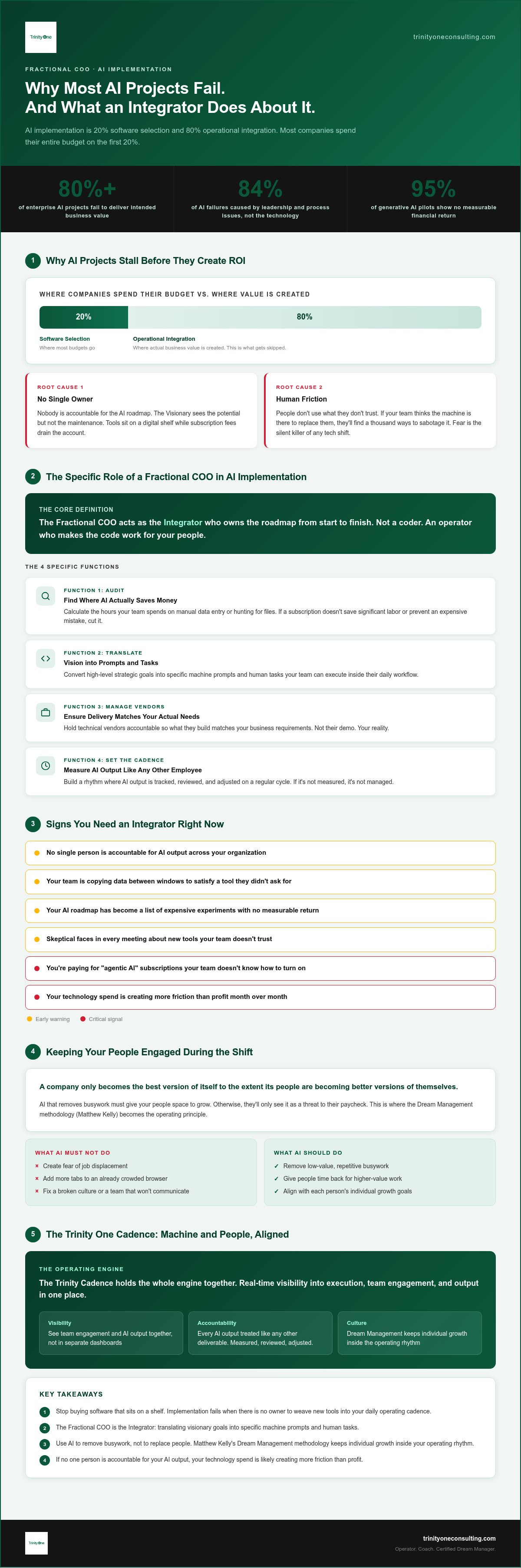
What are the signs you need an integrator to manage your AI roadmap?
If you have a growing list of software subscriptions but no single person owns the results, you're just bleeding cash. It's a common trap for fast-growing companies. The role of fractional COO in AI implementation is to take that burden off your plate so you can lead again.
You're in the danger zone when your weekly meetings feel like a boring status report. Instead of discussing strategy, you're arguing about why the data in your CRM doesn't match your project management tool. If you are a CEO spending ten hours every week troubleshooting software connections, you've stopped being a leader and started being an IT tech.
Watch your team's body language. If retention is dropping as you introduce more automation, your people feel like the machine is winning. We use the Dream Manager methodology (attributed to Matthew Kelly) to ensure people don't feel like cogs in a wheel. I believe we are called to use our talents to help others grow, and that includes protecting the dignity of your staff.
The 90-day AI implementation roadmap
We don't guess. We follow a specific rhythm to get you moving. The role of fractional COO in AI implementation during the first 30 days is to conduct a deep audit of your current machine and people systems. We find exactly where the friction is before we write a single prompt.
Days 31 through 60 focus on building the first AI loops and training your team to trust the new output. We identify specific tasks, like summarizing client calls or generating initial report drafts, to prove the ROI early. By days 61 through 90, we establish the permanent operating cadence that keeps the whole engine running smoothly. This ensures the change sticks long after the initial excitement fades.
What a fractional COO is bad at
I'll be blunt about what I can't do. I'm not a replacement for a full-time software developer or a specialized coder. If you need someone to build a custom neural network from scratch, you need an engineer, not an operator.
I also won't fix a broken business model that lacks basic product-market fit. I'm an architect and a practitioner, not a magic wand. If a Visionary refuses to focus on a single direction, no amount of operational logic will create a win. You have to be willing to commit to the rhythm of the business.
How does the Trinity One Cadence align your machine and your people?
The Trinity Cadence is the AI-native operating system that holds your whole engine together. It's not a generic dashboard or a project management app. It is the rhythm that ensures your technology and your staff are moving in the same direction at the same speed. The role of fractional COO in AI implementation is to take this framework and bake it into the DNA of your company.
I've seen too many Visionaries build a disconnected system of tools. They have one app for chat, one for tasks, and another for AI prompts. None of them talk to each other. Trinity Cadence provides real-time visibility into execution and team engagement in one place. You stop guessing if the work is getting done and start seeing the proof.
The AI coaching inside the platform nudges your team toward high-value activities throughout the week. It prevents them from getting stuck in the busywork trap. We want them focused on strategy and growth, not hunting for lost files. This ensures your meetings actually move the needle instead of being a waste of everyone's time.
One system for the machine and the people
We find the specific places where AI creates a measurable return and run those loops inside your cadence. The platform makes the human side of the equation visible. If a team member is struggling or disengaged, the system flags it before it becomes a resignation letter. You can read more about how to create a business operating system that executes in 2026 to see the full architecture.
Strategy stays put when it's built into the daily workflow. We don't believe in static plans that sit in a drawer. The system tracks machine output and human engagement simultaneously. This balance is what prevents burnout while you scale your technical capabilities.
The practitioner advantage
My methodology is built on thirty years in the operator seat. I'm not a theorist who read a book about AI last weekend. I've been in the trenches of corporate operations and on the sidelines of football games. I know that a plan is only as good as the people executing it.
We provide the software and the fractional leadership to make the system work. This is about building an engine that runs without the CEO in every gear. You should be able to step away for a week without the whole machine grinding to a halt. When the role of fractional COO in AI implementation is done correctly, you get your freedom back while your team grows into the best versions of themselves.
Build an engine that honors your people
AI implementation isn't a software project. It's a leadership challenge that requires a steady hand on the operational gears. The role of fractional COO in AI implementation is to ensure your vision doesn't burn out your team or drain your bank account without a return. You need someone who speaks the language of both software logic and human motivation.
I've spent 30 years in the trenches making complex systems work. I've learned that a company only wins when its people are becoming better versions of themselves. As a Certified Dream Manager, I use the methodology created by Matthew Kelly to keep that human fire burning while the machine takes over the soul-crushing busywork.
You don't have to choose between technical efficiency and human connection. You can have both with a unified operating rhythm. Let's build an engine that runs without you having to be in every gear. It's time to build a business that honors your people and your purpose.
I'm ready to help you turn your AI potential into an operational reality. Let's get to work. God bless.
Frequently Asked Questions
What is the difference between a fractional COO and an AI consultant?
An AI consultant usually hands you a technical report or a list of tools and then leaves the building. The role of fractional COO in AI implementation is to stay in the seat and actually run the engine. I don't just give advice. I build the workflows, manage the staff, and ensure the technology creates a measurable win. It's the difference between a playbook and a coach who calls the plays.
How much does a fractional COO cost for AI implementation in 2026?
Industry data for 2026 shows that a fractional COO typically costs between $8,000 and $20,000 per month on a retainer basis. Some earlier stage companies might find advisory rates between $150 and $400 per hour. You must consider the tradeoff of this expense against the fact that AI project costs often run 3 to 5 times higher than vendor quotes. An operator prevents that waste by managing the technical lifecycle.
Can a fractional COO help with EOS implementation and AI at the same time?
Yes, a fractional COO is often the Integrator who makes EOS work. The Trinity Cadence is built to sit right alongside your Level 10 meetings and Scorecards. It adds the AI native layer that traditional systems lack. We don't replace your existing rhythm. We give it the technical engine it needs to execute faster in a modern environment without losing the human connection.
How do I know if my company is ready for an AI-native operating system?
You are ready when your data is scattered across fifty tabs and your CEO is spending ten hours a week playing IT support. The role of fractional COO in AI implementation is to step in when your software spend isn't creating a clear return. If you've bought the tools but your team isn't using them, your engine is stalled. You can't scale a broken process by just adding more software.
What happens if my team is resistant to the new AI tools?
Resistance usually comes from fear of replacement. I handle this by using the Dream Management methodology created by Matthew Kelly. We show your team that AI is there to remove the soul-crushing tasks so they can focus on their own growth. When an employee sees that the machine helps them hit personal goals, they stop fighting the change. I'm convinced that we are called to help others grow.
Will a fractional COO manage my outsourced technical developers?
I will manage your technical vendors and developers to ensure they deliver what you actually need. Most Visionaries get lost in the tech speak and end up with custom software that doesn't fit the business logic. I act as the translator who holds them accountable to the roadmap. This prevents the typical cost overruns seen in most unmanaged projects. You need someone who speaks both code and commerce.
How do you measure the ROI of a fractional leader during technology shifts?
We measure ROI through hard metrics like meeting time reduction, employee retention rates, and the speed of project execution. If your team saves five hours a week on data entry, that is a direct labor win. We also track engagement scores because a business only thrives when its people are becoming better versions of themselves. ROI isn't just a number on a spreadsheet. It's a healthy and growing culture.
What are the twelve dream categories in the Dream Manager program?
The Dream Manager program, created by Matthew Kelly, focuses on twelve specific areas of a person's life to drive engagement. These categories include:
- Physical and Emotional
- Intellectual and Spiritual
- Psychological and Material
- Professional and Financial
- Creative and Adventure
- Legacy and Character
By supporting these goals, we build a level of loyalty that technology alone cannot buy.