
Nearly a third of organizations reported a voluntary turnover rate of 20% or higher last year. This manager's guide to employee career pathing is the tactical fix for that revolving door. It's painful. Watching talented people walk out because they feel stuck costs you more than just morale.
You probably worry that talking about the future will lead to demands for raises or promotions you can't give. It's a common trap. Most managers stay silent to avoid over-promising. Silence is exactly what drives your best people to look at other job postings.
I'll show you how to build a repeatable system that links personal dreams to daily business execution. We'll use the Dream Manager methodology, created by Matthew Kelly, to turn your company into an engine for human growth. You'll learn to align individual staff goals with company ROI to drive real performance.
A company only becomes the best version of itself to the extent its people are becoming better versions of themselves. My faith tells me every person has a purpose. Your job is to help them find it within your walls. We're moving from vague chats to a structured cadence that stops turnover cold.
Key Takeaways
- Replace vertical ladders with a collaborative map that connects personal ambition to business execution.
- This manager's guide to employee career pathing shows how to use the Dream Manager program by Matthew Kelly to find the real reasons your people work.
- Design development plans based on where your business engine is headed over the next three years.
- Create a repeatable operating cadence so development conversations actually happen even when the schedule gets crowded.
- Learn how an integrator builds the internal systems that make career planning a permanent part of your company culture.
What is employee career pathing?
Career pathing is a collaborative map drawn by a leader and an individual contributor. It is a shared blueprint that connects personal ambition to operational requirements. This manager's guide to employee career pathing defines the process as a strategic commitment to skill acquisition. It is about building the human engine of your company.
Traditional models focus on titles and pay grades. Real pathing focuses on personal growth and psychological well-being. It is a dialogue, not a decree. If you do not provide a clear trajectory within your walls, your competitors will provide one outside of them.
Talent does not sit still in a soft market. They look for the next port where they can actually improve. I believe a company only becomes the best version of itself to the extent its people are becoming better versions of themselves. That starts with a plan.
Why traditional career ladders are failing
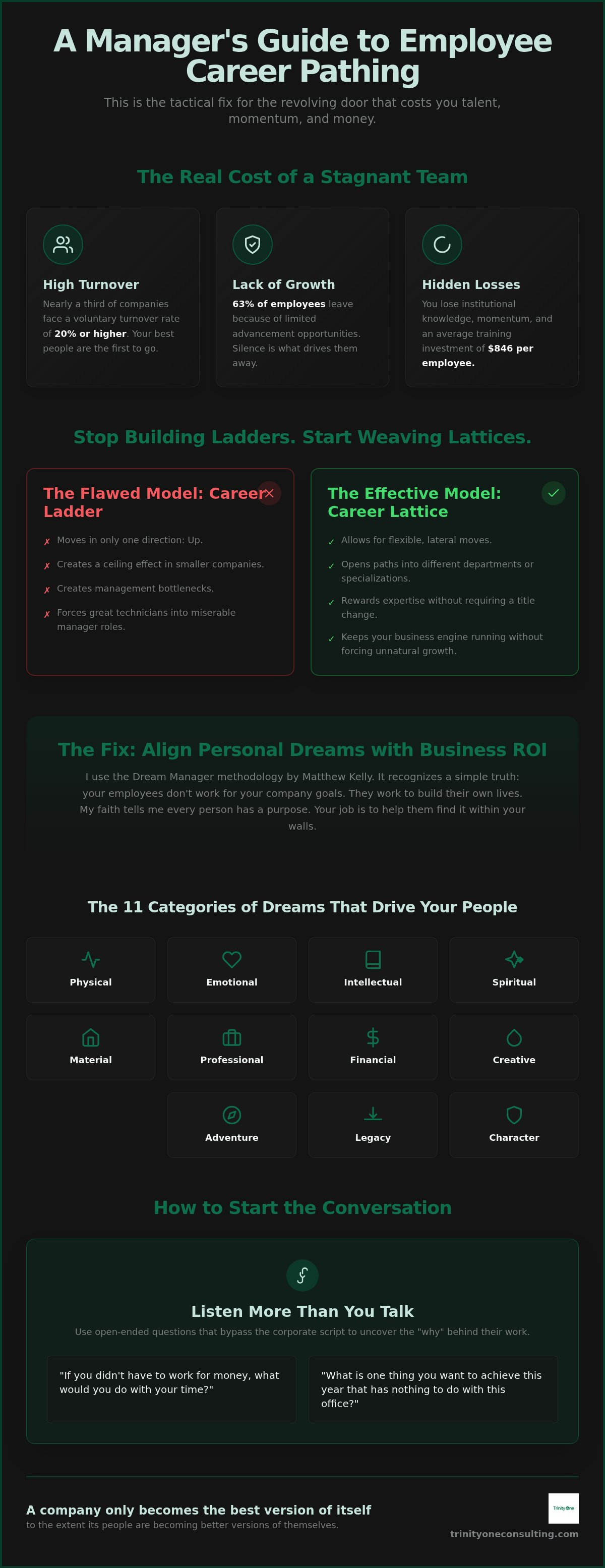
Ladders only move in one direction. Up. In small to mid-sized companies, this creates a ceiling effect. There are only so many director or VP seats available at the top. When the ladder is full, your best people stop climbing and start looking for a new building.
Vertical growth creates management bottlenecks. Not everyone wants to manage a team, and forcing them into leadership roles often backfires. You lose a great technician and gain a miserable manager. It is a double loss for the business.
A career lattice provides a more flexible alternative. It allows for lateral moves into different departments or deeper technical specializations. It removes the bottleneck by rewarding expertise without requiring a title change. This keeps the engine running without forcing unnatural growth.
The real cost of ignoring development
Losing a manager is a massive financial hit. The HR.com State of Employee Retention 2025-26 report shows that 63% of employees leave due to limited advancement opportunities. You lose the direct training investment, which averaged $846 per employee in 2025 according to ATD. You also lose momentum.
Quiet quitting is the silent killer of ROI. It happens the moment an employee feels stuck. They stay on the payroll but check out mentally. They do the bare minimum because they don't see a future within your organization. This manager's guide to employee career pathing is the tool to prevent that disengagement.
Institutional knowledge walks out the door with every veteran employee. When growth stops, your most experienced staff members take their expertise to your rivals. Our Dream Manager program acts as the engine for retention by identifying these risks early. It ensures that personal dreams and business execution stay aligned.
How do you find out what your employees actually want?
Engagement surveys are a waste of time. They are impersonal, clinical, and they rarely get to the truth of why a person shows up at 8:00 AM. If you want to stop turnover, you have to stop treating people like data points. You need to have a real conversation about their lives.
I use the Dream Manager methodology created by Matthew Kelly. This approach recognizes that your employees don't work for your company goals. They work to satisfy their own personal needs. This manager's guide to employee career pathing is about finding where those two paths intersect.
I believe every person has a God-given desire to grow. When a leader takes an interest in that growth, loyalty follows. It's not about being soft. It's about being effective.
The 12 categories of dreams
Matthew Kelly organizes human aspirations into twelve distinct areas. These include physical, emotional, intellectual, and spiritual dreams. Other categories cover material, professional, and financial goals. We also look at creative, adventure, legacy, and character dreams.
Legacy and character dreams often tell you the most about an employee's long-term fit. A person who wants to be known for their integrity will handle your clients differently than someone just chasing a bonus. If an employee's dream is to buy a home, that financial goal becomes the engine for their daily output. You aren't just managing a task. You're helping them build a life.
Asking the right questions
You must listen more than you talk in these meetings. Use open-ended questions that bypass the standard corporate script. Ask them: "If you didn't have to work for money, what would you do with your time?" or "What is one thing you want to achieve this year that has nothing to do with this office?"
I've provided a deeper breakdown on talking to employees about personal goals and dreams for those who need a script. The goal is to uncover the "why" behind the work. If you know their "why," you can show them how their current role gets them closer to it.
The cost of this approach is your time. It requires roughly one hour of focused attention per month for each direct report. It's bad at fixing people who are fundamentally lazy. But for your high performers, it is the most powerful retention tool in your kit. To see how this might work for your specific headcount, you can book a 30-minute cadence call with me.
How to create an employee development plan that lasts?
Most development plans are a collection of vague intentions. They sit in a digital folder and collect dust because they lack a connection to reality. A plan only lasts when it ties the company's future to the individual's personal hunger. This manager's guide to employee career pathing requires a document that lists specific actions with hard deadlines.
Start with the business engine. Where is this company going in the next 36 months? If your goal is to double your client base, you need a staff capable of handling that volume. You must identify the specific skills required to reach that future state before you sit down with an employee. If you don't know the destination, you can't build the road.
I've seen too many plans fail because they are one-sided. A lasting plan must balance these two forces:
- Business Requirements: The technical competencies needed to keep the engine running.
- Personal Aspirations: The reasons why the employee wants to succeed in the first place.
Building the competency framework
A framework must be built on concrete metrics. Avoid using "leadership skills" as a goal. It's too soft. Use "managing a $1M budget" or "reducing fulfillment errors by 15%." These are binary. Either they happened or they didn't.
Define the hard skills and soft skills needed for every role in your department. Once the gaps are clear, identify stretch assignments to test new abilities. A stretch assignment isn't just more work. It is a specific project that forces a person to use a skill they haven't mastered yet. It's the trenches where real learning occurs.
Linking dreams to business objectives
This is where the Dream Manager methodology bridges the gap. If an employee wants to take their family to Italy, that dream has a price tag. A promotion or a performance bonus isn't just a corporate milestone. It is the fuel for that trip. You are showing them how their hard work at your desk funds their life at home.
I focus on Linking Employee Personal Goals to Business Objectives to ensure the plan has teeth. We use the DreamCompass approach to track these dual goals side by side. It provides real-time visibility into whether an employee is actually moving toward their 12 categories of dreams. When people see that their personal win is tied to a company win, they don't leave for a 5% raise elsewhere. They stay because you're the only leader who knows what they're actually working for.
How do you keep career paths on track during busy weeks?
Execution is the graveyard of good intentions. You build a plan, but then a project deadline slips or a key client calls with a crisis. The career pathing document gets buried under a stack of urgent emails. This manager's guide to employee career pathing is useless if it doesn't survive the friction of a standard Tuesday.
The operating cadence is the heartbeat of your business. It is a fixed schedule of meetings and reviews that never moves. Development plans usually die in the second month because the urgent crowds out the important. Without a rigid structure, human development is the first thing you'll sacrifice to save an afternoon.
A fractional integrator acts as the guardian of this rhythm. While a Visionary founder is busy chasing the next big idea, the Integrator ensures the internal systems actually function. They hold managers accountable for the growth of their teams. I also use AI implementation to provide real-time prompts that keep leaders focused on their people.
The monthly dream huddle
You must protect a 30-minute window every month for a dedicated growth meeting. This is not a performance review. If you start talking about missed KPIs or quarterly targets, the employee will stop being honest about their dreams. Keep these two conversations in separate rooms.
The agenda is simple. Review the individual's progress toward their 12 categories of dreams. Ask what roadblocks they hit since the last huddle. Identify one specific action they will take before the next meeting to move their personal or professional path forward. It is a short, punchy session designed for momentum.
Using Trinity Cadence for visibility
Software should track more than just machine execution. Our Trinity Cadence system provides real-time visibility into both operational output and human engagement. It prevents your best people from feeling ignored during the busiest weeks of the year. When an employee sees their growth tracked as a vital business metric, they feel valued.
I focus on using technology to boost employee engagement to keep the connection strong. The goal is to use data to highlight where a person is stuck before they decide to quit. Technology should serve the human connection, not replace it. My conviction is that we are called to lead people, not just manage processes.
How can a fractional integrator help you manage this growth?
Visionary founders are usually the worst people to handle the day-to-day execution of a career pathing system. They see the future clearly. They can describe the destination with passion. But they often lack the patience to sit through twelve monthly dream huddles per employee. This is where a fractional integrator steps in to build the systems that make development automatic.
An Integrator functions as more than an extra pair of hands. They serve as the tactical architect of your culture. This manager's guide to employee career pathing requires a rigid structure to survive the friction of a growing business. I build the operating cadence that ensures these conversations actually happen. Without an Integrator, your development plans will likely die the first time a major client project goes sideways.
The Dream Manager Program works best as a managed service. I take the burden of running the program off your plate. We treat human growth like an integrated circuit. Every connection must be precise. There is a real tradeoff here. Hiring a fractional leader costs more upfront than buying a generic HR software subscription. But software doesn't stop people from leaving. Systems do. Replacing a mid-level manager can cost you 150% of their annual salary in recruitment and lost momentum. Investing in the engine is always cheaper than replacing the whole car.
The Integrator as a coach
An HR manager often focuses on compliance and policy. An operational Integrator focuses on execution and performance. I provide 1-on-1 coaching for your managers to help them handle these career talks without over-promising. Most managers are afraid of these meetings because they don't want to answer for why a promotion isn't available today. I remove that friction by giving them a repeatable script and a clear boundary.
I believe a company only becomes the best version of itself to the extent its people are becoming better versions of themselves. That requires leadership, not just administration. My faith tells me we are responsible for the people under our care. Coaching your managers to be better leaders is the fastest way to improve the output of the entire team.
Getting started with a pilot program
You don't need to overhaul your entire company overnight. Start with one department. Pick the team with the highest turnover or the lowest engagement scores. Use them as a laboratory to prove the ROI of this manager's guide to employee career pathing. Once you see the turnover numbers drop and the performance metrics climb, you can expand the system across the organization.
If you want to see the specific steps, read how to implement a Dream Manager program in your company. It provides the technical breakdown for a successful rollout. The next step is simple. Decide if you are willing to invest in your people or if you are willing to keep paying the high price of turnover. I'm here to help you build the system that makes the choice easy.
Build a business where people want to stay
Stop the revolving door of mid-level talent by using this framework. This manager's guide to employee career pathing focuses on building a culture where personal dreams fund professional excellence. The Dream Manager methodology by Matthew Kelly and a rigid operating cadence protect your most valuable assets.
I've spent 30 years as an operator and a football coach. I know that games are won in the trenches, not in the marketing department. As a Certified Dream Manager and fractional COO, I help you install the systems that make growth automatic. My faith tells me that every person has a purpose, and your business is a place where they can fulfill it.
Execution is the only thing that separates a visionary from a dreamer. You can continue to pay the high cost of turnover, or you can start building your engine today. I'm here to ensure these plans actually happen.
Your people are waiting for a leader who sees their future. I am ready to help when you are.
Frequently Asked Questions
What is the difference between career pathing and career mapping?
Mapping is the static chart of roles while pathing is the active process of moving through them. Mapping shows the destination. Pathing builds the road. I view mapping as the blueprint and pathing as the construction crew. You need both to build a functional team. One is a document. The other is a lifestyle. Without the active pathing, the map is just a piece of paper that nobody reads.
How much time should a manager spend on career pathing each month?
Budget one hour per month for each direct report. This manager's guide to employee career pathing recommends a 30-minute dream huddle and 30 minutes of prep and follow-up. It seems like a lot until you lose a key player. Replacing a veteran costs thousands in training and lost momentum. Spend the time now or pay the exit price later. It is the only way to keep your best people from looking at your competitors.
Can you have career pathing in a small company with few roles?
You can. Growth doesn't require a new title. In small firms, you use a career lattice to move people sideways into new skills. A marketing coordinator might learn data analysis or project management. They become more valuable to the engine without needing a VP seat. It keeps the work fresh and the turnover low. You are building a more versatile team that can handle any market shift without breaking.
What happens if an employee's dream is to leave the company?
You should support them. It sounds counterintuitive. But if an employee knows you care about their life beyond your walls, they'll work harder while they're inside them. I believe every person has a God-given desire to grow. If their purpose leads them elsewhere, let them go with your blessing. They will be your best recruiters in the market and will give you their best effort until their last day.
Is career pathing part of a performance review?
Never mix these two conversations. Performance reviews are about business metrics and past results. Career pathing is about personal dreams and future potential. If you combine them, the employee will hide their true goals to protect their bonus. Honesty requires a safe space. Keep the growth talk separate from the salary talk. This ensures that the employee feels seen as a human being, not just a line on a spreadsheet.
How do I measure the ROI of an employee development plan?
Look at your retention numbers. If your turnover rate drops from 20% to 10%, you've saved half of your recruitment budget. Use the ATD 2025 data showing an average training cost of $846 per person as a baseline. The real win is the institutional knowledge that stays in the building. Engagement scores are the scoreboard for this game. Profitability is the natural result of a team that actually wants to be there.
What are the twelve categories of dreams in the Dream Manager program?
Matthew Kelly defines twelve areas for human growth. These are physical, emotional, intellectual, and spiritual. They also include psychological, material, professional, and financial. The list finishes with creative, adventure, legacy, and character. This manager's guide to employee career pathing uses these categories to find the why behind every task. It turns a job into a mission. This clarity keeps your staff focused on long-term results rather than short-term distractions.
Do I need special software to manage employee career paths?
You need a system more than you need software. A simple document can work if your operating cadence is strong. But manual tracking often fails when the office gets busy. Our Trinity Cadence provides the visibility needed to keep these plans from gathering dust. It ensures the human engine stays as tuned as the machine operations. Technology should serve the human connection, not act as a replacement for real leadership.