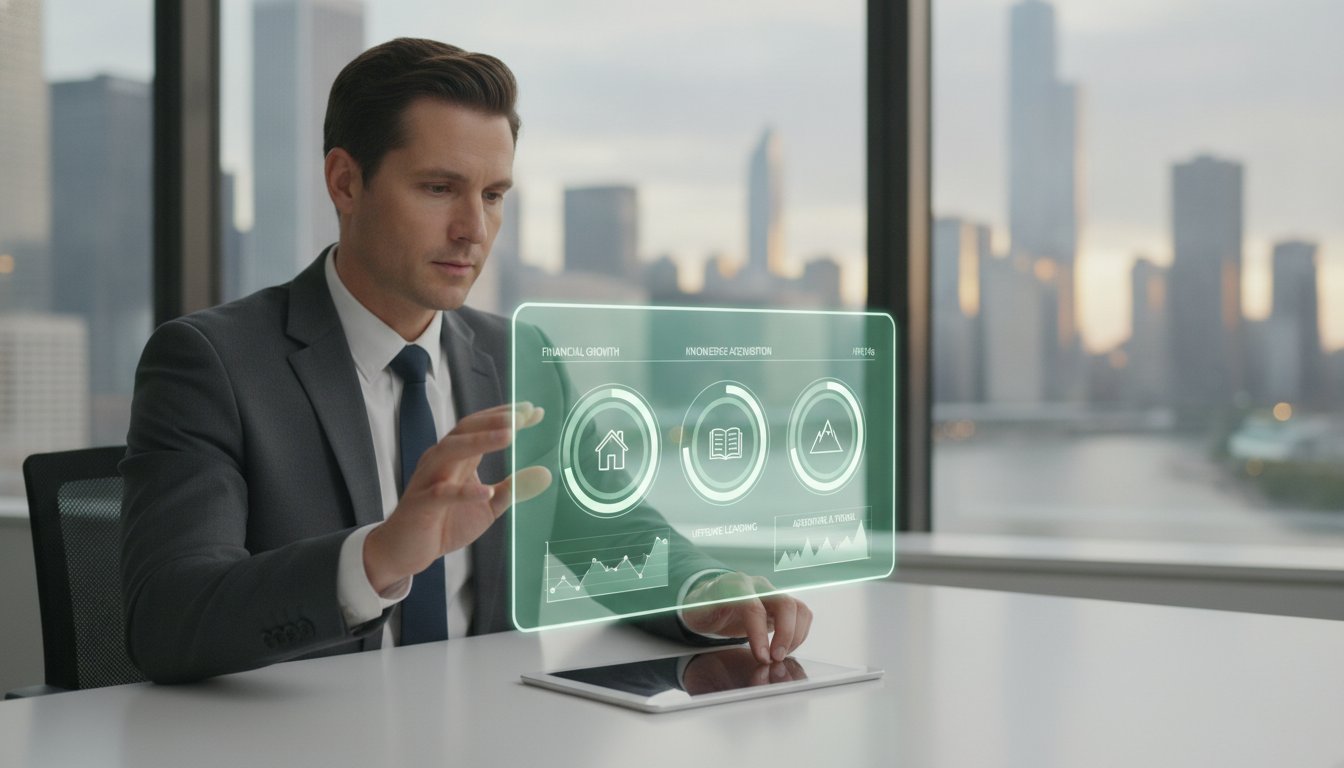
Most software stacks are just expensive ways to annoy your best people. You've likely spent thousands on platforms that promised a culture shift but only delivered notification fatigue and a 31% engagement rate. Using technology to boost employee engagement only works when you align operational systems with the personal dreams of your people. Real success requires integration instead of just installation.
I know you're tired of seeing low participation in company initiatives. You worry that adding more AI will strip the soul out of your business. It's a valid fear. Most systems are designed to extract profit rather than build people. You want a team that's aligned and executing at a high level, not a group of robots waiting for a prompt.
I will show you how to integrate AI and operational systems to drive real performance while helping your people achieve their personal goals. We'll explore how to turn your tech stack into an engine for growth that supports the Dream Manager process by Matthew Kelly. You'll learn to stop wasting money on disconnected apps and start seeing a clear ROI on your software spend.
Key Takeaways
- Stop buying software to fix leadership problems. Technology functions as an accelerator for your existing processes, not a replacement for a broken culture.
- Learn why using technology to boost employee engagement requires a unified cadence instead of a drawer full of disconnected apps.
- Shift from dead-end annual reviews to AI-assisted coaching that helps managers identify and fix performance blocks in real time.
- Connect company goals to the personal aspirations of your staff using the Dream Manager framework by Matthew Kelly.
- Reduce software fatigue by moving to a single system like Trinity Cadence that tracks both business execution and individual growth.
Why most engagement software ends up as digital clutter
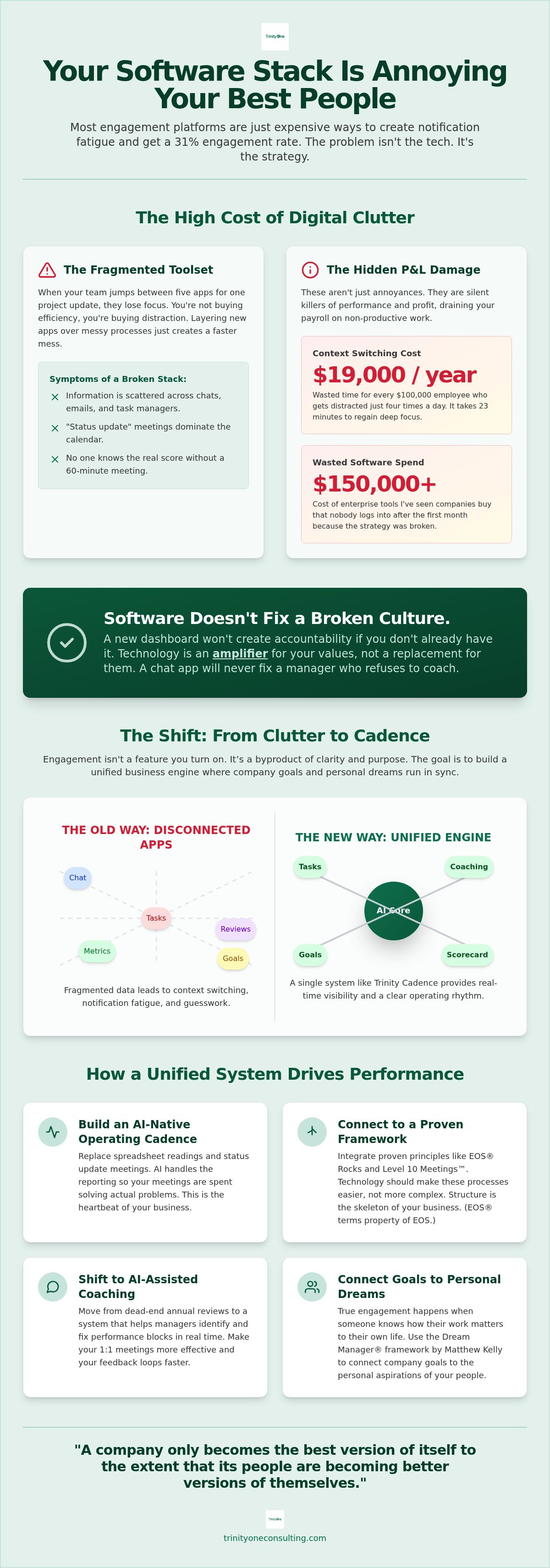
Founders often treat software like a magic pill. They buy a platform to fix a culture problem and then get frustrated when the numbers don't move. I have seen companies spend $150,000 on enterprise tools that nobody logs into after the first month. These systems aren't broken. The strategy behind them is.
Engagement is not a software feature you turn on. It is a byproduct of clarity and purpose. True employee engagement happens when a person knows exactly what they need to do and why it matters to their own life. Using technology to boost employee engagement only works when the tech clears the path for execution instead of adding more hurdles.
Tech often creates more noise than value. When you layer a new app over a messy process, you just get a faster version of the mess. Most engagement tools focus on "perks" or "shout-outs" rather than the actual work. If your people are drowning in notifications, they don't feel engaged. They feel overwhelmed.
The hidden cost of fragmented toolsets
Context switching is a silent killer of high performance. When your best performers have to jump between five different apps to find one project update, they lose focus. Research shows it takes an average of 23 minutes to get back into a deep work state after a distraction. If your team does this four times a day, you are losing roughly $19,000 a year in wasted time for every $100,000 employee on your payroll.
Scattered information creates friction. People stop looking for the right data when it is buried in a chat thread or a disconnected task manager. They start making guesses instead. This is how mistakes happen. You don't need more tools. You need a unified business engine like Trinity Cadence that keeps everyone on the same page.
Software cannot replace a missing leadership culture
A chat app will never fix a manager who refuses to coach their team. You cannot automate trust with a digital recognition badge or a virtual high-five. These are cheap substitutes for real human connection. If your leadership culture is broken, tech will only make the cracks wider and more visible.
Technology should function as an amplifier for your existing values. It should make your 1:1 meetings more effective and your feedback loops faster. If you don't have a culture of accountability, a new dashboard won't create one. It will just give you a more expensive way to track your failures.
I've spent 30 years in the trenches of leadership as a football coach and an EOS Integrator. I know that a company only becomes the best version of itself when its people are becoming better versions of themselves. This belief is the foundation of the Dream Manager program by Matthew Kelly. Your tools must support this personal growth or they are just digital clutter.
Building an AI-native operating cadence that people actually like
Using technology to boost employee engagement starts with your operating cadence. This is the heartbeat of your business. It includes your meetings, your reporting, and your feedback loops. I believe AI should sit at the center of this rhythm to provide real-time visibility. Trinity Cadence provides an AI-native system that keeps everyone in sync and eliminates the status update meetings people hate.
Most founders think engagement comes from a pizza party. It doesn't. It comes from knowing the score. Using technology to boost employee engagement is about giving your team a clear view of the field. When your people know exactly how they contribute to the win, they show up differently. They stop guessing and start executing.
AI should sit at the center of your rhythm. It handles the manual tracking that drains your energy. You don't need a 60-minute meeting to hear someone read a spreadsheet. The AI does the reporting for you. This allows you to spend your time solving problems instead of just listing them. If your current meeting rhythm feels like a chore, it's time to fix your operating cadence.
Integrating EOS principles with modern technology
We use EOS terms like Rocks and Level 10 meetings to create a clear structure. All EOS terms are the property of EOS. Structure is the skeleton of your business. Technology should make running a Level 10 meeting easier. It shouldn't add three more steps to your workflow. If your software makes a meeting more complex, throw it out. Good tech stays out of the way until it is needed.
The power of real-time visibility into execution
Engagement drops the moment people don't know if they are winning or losing. Imagine playing a football game without a scoreboard. You'd stop trying by the second quarter. An AI-driven dashboard shows everyone their impact on the Scorecard in real time. Scorecard is an EOS term. This level of transparency transforms the employee experience from a guessing game into a focused mission. When a team member sees their numbers turn green, they feel the win. That's real engagement. It's the difference between a job and a career.
Using AI coaching to replace generic performance reviews
Annual reviews are a waste of time for both the manager and the employee. They are reactive post-mortems that usually focus on things that happened six months ago. By the time you sit down to talk, the context is gone and the frustration has already set in. Using technology to boost employee engagement requires moving away from these outdated rituals.
AI coaching provides immediate feedback when it actually matters. It allows for a 1-on-1 coaching style that scales across your whole company without burning out your leadership team. I've spent three decades as a football coach and an EOS Integrator. On the field, you don't wait until the end of the season to tell a player their stance is wrong. You fix it in the moment.
Business should work the same way. If a team member is struggling with a specific task, they need a solution today, not next quarter. Technology should bridge the gap between identifying a problem and providing a remedy. This is how you build a team that executes at a high level.
Moving from monitoring to mentorship
Nobody wants to be watched by Big Brother software. If your team thinks you are just tracking their keystrokes, they will find ways to game the system. That's not engagement. It's compliance driven by fear. You want performers, not actors.
Use AI to identify where a person is struggling and offer a resource or a tip. This shifts the tech from a surveillance tool to a supportive partner. It helps your people win instead of just catching them losing. When technology supports their success, they stop resenting the tools and start using them.
Creating a culture of continuous improvement
When feedback is constant and small, it is less intimidating. It becomes part of the daily work instead of a high-stakes event. Employees stay engaged when they see they are becoming better at their jobs every week. This creates a sense of mastery that drives long-term loyalty.
My fractional COO services help companies implement these coaching rhythms. We build systems where technology supports personal growth, not just company profit. This approach ensures your team is always improving without the stress of a traditional review cycle. It turns your operating system into a mentorship engine.
Connecting personal dreams to daily work through digital tools
I've spent 30 years leading teams and I've learned one hard truth. A company only becomes the best version of itself when its people are becoming better versions of themselves. This is the core of the Dream Manager concept by Matthew Kelly. If you ignore the personal lives of your staff, you'll never get their best work.
Most founders think using technology to boost employee engagement means adding another dashboard for sales numbers. I disagree. Real engagement happens when a person sees that working for you is the fastest way to get what they want in life. We use technology to help employees track their personal goals right alongside their professional ones. It changes the dynamic from a transaction to a partnership.
If your team feels like they are just cogs in a machine, they will act like it. They will do the bare minimum to keep their jobs. But when you use tech to support their private aspirations, they start to see the business as an engine for their own success. This is how you build loyalty that lasts through the tough quarters.
The role of the DreamCompass app
DreamCompass is an invitation-only app we use for the Dream Manager process. It provides a secure, private space for employees to define what they actually want. It isn't a surveillance tool. It is a digital home for their future.
Managers can use the high-level insights from the app to support their people. You don't need to know every detail of a person's private life to be a good leader. You just need to know that they have a target they are shooting for. This allows for a coaching relationship that is supportive instead of intrusive.
Supporting the twelve dream categories
Dreams are rarely just about career advancement. Matthew Kelly identifies twelve dream categories that include physical, emotional, and spiritual goals. Your employees are whole people with lives outside your four walls. Using technology to boost employee engagement should account for this variety.
One person might be focused on saving for a wedding. Another might be trying to improve their physical health. I've seen how powerful it is when a leader takes an interest in these areas. You can learn more about talking to employees about personal goals and dreams to see how this works in practice.
This approach has a clear tradeoff. It takes more time than a standard performance review. You have to be willing to listen to things that have nothing to do with your bottom line. If you aren't prepared to care about your people as humans, this tech won't save you. It's bad at fixing leaders who only see employees as expenses on a P&L.
Implementing the right technology stack for your business engine
Don't try to install five new tools at once. You'll paralyze your team and waste money. Using technology to boost employee engagement requires focus instead of volume. I've seen founders drop $50,000 on software suites that only created confusion and resentment among their staff.
Start with one unified operating system like Trinity Cadence. This approach reduces the friction that kills productivity. You want tools that stay out of the way until they're needed. Engagement follows execution. When your team sees results, they lean in.
I recommend a rapid launch sprint to get your system running in weeks. You don't have months to wait for a culture shift. Speed builds momentum. A slow rollout is a dead rollout because people lose interest before the value is proven.
Why you might need a fractional integrator
Most founders are visionaries who are bad at the details of tech implementation. They see the mountain but forget the hiking boots. An integrator, which is a role defined by EOS, makes sure the technology actually serves the business strategy. They turn the vision into a functional circuit.
I have spent 30 years in the trenches of leadership. I know that a founder's greatest strength is their vision, but it is also their greatest liability when it comes to systems. You need someone to build the engine while you point the way. This is why the integrator role is non-negotiable for scaling.
This role bridges the gap between your big ideas and the daily reality of your staff. They ensure the tools are used correctly and consistently. You can read more in our fractional integrator pillar article. Without this oversight, software becomes shelfware.
The ROI of a tech-enabled culture
High engagement leads to better retention and higher profit margins. There's a specific tradeoff you must accept. You'll spend more on tech and coaching. However, you'll spend significantly less on turnover and training.
Replacing a mid-level manager can cost up to 150% of their annual salary in lost productivity and recruiting fees. Using technology to boost employee engagement protects your bottom line. It builds a business engine that runs without your constant intervention. I believe we are called to steward our businesses with this level of precision.
Schedule a discovery call to see how we can build your business engine. Visit this link to find a time that works for you.
Build a business engine that serves your people
You've seen why most software stacks fail. They focus on tracking numbers instead of supporting human growth. Using technology to boost employee engagement requires a shift from surveillance to partnership. A company only becomes its best version when the individuals inside it are growing.
Success comes from the integration of your business goals with the personal dreams of your team. I use an AI-native operating system called Trinity Cadence to give you the visibility you need without the noise. When you combine this with Certified Dream Manager coaching, you build a culture that lasts through any market shift.
You don't have to choose between technical efficiency and human connection. You can have both. It's time to stop installing disconnected apps and start building a real engine for your business.
I'm ready to help you get your team aligned and executing at a high level. Let's get to work.
Common questions about tech and engagement
How does technology actually increase employee engagement?
Technology increases engagement by providing radical clarity and removing operational friction. Using technology to boost employee engagement works by automating the status update noise so people can focus on high value work. When a team member sees their impact on a Scorecard, an EOS term, in real time, they feel like they are winning. This visibility turns a vague job description into a focused mission with a clear scoreboard.
What are the best tools for remote employee engagement?
The best tools are those that unify your operating cadence rather than fragmenting it. I recommend an AI native system like Trinity Cadence to keep remote teams in sync without constant video calls. For personal growth, the DreamCompass app provides a private space for employees to track their twelve dream categories by Matthew Kelly. Avoid adding more chat apps that just create notification fatigue and kill deep work.
Can AI coaching replace human managers?
No. AI coaching is a tool for scale, not a replacement for leadership. It handles the repetitive feedback and data analysis so a manager can focus on the human connection. A machine can identify a performance block, but it cannot provide the empathy or mentorship required to build a loyal team. Think of it as a specialized assistant that makes your 1 on 1 meetings more effective.
What is the Dream Manager program and how does it use tech?
The Dream Manager program is a methodology by Matthew Kelly that aligns personal aspirations with company goals. We use the DreamCompass app to give employees a private digital home for their dreams. This technology allows managers to support their people's growth without being intrusive. It turns the business into an engine that helps employees become better versions of themselves while they drive company profit.
How do you get employees to actually use new software?
You make the software the only path to getting work done. If the system reduces friction and helps them hit their Rocks, an EOS term, they will use it. Adoption fails when tech is an extra task instead of the core operating system. Show them how the tool helps them achieve their personal goals and they will stop seeing it as a chore.
Is it possible for technology to decrease engagement?
Yes. Technology decreases engagement when it becomes a surveillance tool or a source of digital clutter. Using technology to boost employee engagement requires trust. If you use software to monitor keystrokes instead of supporting mentorship, you destroy loyalty. Fragmented toolsets also lead to app fatigue where employees spend more time searching for info than executing.
How much does it cost to implement an AI native operating system?
The cost depends on your headcount and the complexity of your current stack. While I don't quote fixed prices here, the real cost is the turnover you face without a solid system. High performing companies often spend more on tech and coaching to save hundreds of thousands in recruiting fees. You are trading a monthly software expense for the stability of a battle tested business engine.