
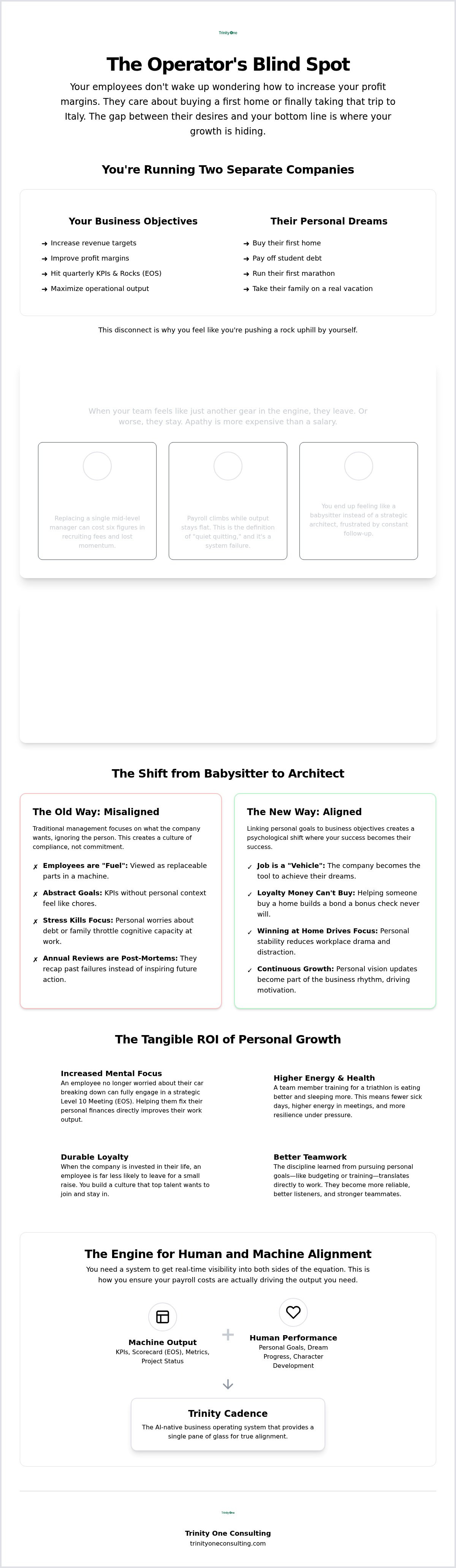
Your employees don't wake up at 6:00 AM wondering how to increase your profit margins. They care about buying a first home or finally taking that trip to Italy. You can close the gap between their desires and your bottom line by linking employee personal goals to business objectives.
It's exhausting to feel like a babysitter instead of a leader. You see the low engagement in your remote team and watch your payroll costs climb while output stays flat. A common friction point. The company engine is misaligned with the people who run it.
I've spent 30 years as a coach and operator. I've learned that a company only becomes its best version when its people are becoming better versions of themselves. I'll show you how to use the Dream Manager program, a methodology created by Matthew Kelly, to drive retention and ROI. This is a practical strategy, not HR fluff.
Key Takeaways
- Stop treating employees like tools for execution and start seeing them as individuals with mortgages and families. Linking employee personal goals to business objectives turns a standard job into a vehicle for their personal success.
- Adopt the Dream Manager program by Matthew Kelly to help your people achieve what matters most to them. This builds a culture of loyalty that keeps your best talent from jumping ship for a small raise elsewhere.
- Recognize that personal stability directly reduces workplace drama and absenteeism. When an employee is winning at home, they bring more focus and productivity to your office.
- Integrate personal vision updates into your regular business rhythm rather than keeping them separate. This ensures your payroll costs are actually driving the output you need to grow.
- Use Trinity Cadence to get real-time visibility into both machine output and human performance. It is the engine that aligns your business operating system with the people who power it.
Why companies fail to link personal dreams to targets?
Most leaders view their staff as components in a machine. They want execution and results. They forget they are hiring a whole person. When you ignore the person, you get a culture of apathy. People trade their time for a paycheck and nothing else. They don't care about your growth targets because those numbers don't fix their personal problems.
Corporate goals are often abstract numbers. They don't pay the mortgage. They don't fix a marriage. Traditional management focuses on what the company wants from the person but ignores what the person wants from life. This disconnect is why linking employee personal goals to business objectives is so rare in the average office.
I have spent three decades in the trenches as an operator. I see the same mistake everywhere. Leaders treat the business like an engine and the people like fuel. Fuel is replaceable. People are not. If you want a loyal team, you have to understand what drives them when they aren't at their desks.
The cost of treating people like machines
Apathy is expensive. It leads to quiet quitting and eventually to turnover. Replacing a mid-level manager often costs six figures when you factor in lost momentum and recruiting fees. Machines need maintenance, but humans need a reason to show up that goes beyond survival.
If your team feels like just another gear in the engine, they'll leave as soon as a higher bidder comes along. You can't build loyalty on a spreadsheet alone. This is why I often recommend a fractional Dream Manager to bridge the gap between corporate output and human desire.
Why your current goal-setting process is broken
Your annual reviews are post-mortems. They don't inspire future action. They just recap past failures. Most leaders use the SMART goal-setting framework for business targets but leave it out of the human side of the equation. KPIs without personal context feel like chores.
I've seen founders set massive revenue targets while their staff struggles with basic financial literacy. If you want people to care about your Rocks, which is a term used in EOS, you have to care about their lives. EOS Rocks are vital for business direction. But they only work if the person sitting in the seat is motivated.
Without that alignment, you're just pushing a heavy rock uphill by yourself. It's exhausting for the leader and frustrating for the team. You end up feeling like a babysitter instead of a strategic architect. That's a failure of system design, not just a people problem.
How does personal goal achievement impact work performance?
Linking employee personal goals to business objectives creates a psychological shift where your success becomes their success. When an employee sees their job as the vehicle to their dream, they work with more focus. They aren't just punching a clock. They are building their future using the Dream Manager methodology created by Matthew Kelly.
I've seen this play out on the football field and in the boardroom. A person becoming a better version of themselves at home naturally brings that energy to the office. They don't leave their character at the front door. Helping a staff member buy their first home or run their first marathon builds a level of loyalty that money cannot buy.
The psychology of the performance link
Stress kills productivity. I've worked with leaders who wonder why their team is distracted during a Level 10 Meeting, which is a term used in EOS. Often, it's because the employee is worried about their car breaking down or their marriage failing. If a staff member is drowning in debt, their cognitive capacity is throttled.
Helping them achieve a financial dream reduces that mental noise. They can actually focus on their work because their survival is no longer in question. Physical health goals work the same way. An employee training for a triathlon is eating better and sleeping more. That means fewer sick days and higher energy during your strategy sessions.
Character development is the quiet engine of a good culture. When an employee works on their personal vision, they practice the same discipline required to hit their business targets. They become better listeners and more reliable teammates. This is about building a more resilient workforce that can handle the pressure of a growing company.
Measuring the ROI of personal growth
You can track this on your Scorecard, which is a tool used in EOS. Look at the correlation between personal goal progress and business output. When people are winning personally, the numbers on your Scorecard usually trend green. You'll see a noticeable drop in absenteeism and workplace drama.
Retention is the clearest metric for ROI. Replacing a skilled employee costs about 33% of their annual salary according to industry averages. If you lose a manager making $90,000, you just flushed $30,000 down the drain. That doesn't include the lost momentum or the stress on the remaining team. Helping them achieve a personal milestone is a much cheaper way to keep that talent in-house.
If you want to see how this fits into your specific operation, let's talk about your current team structure. It's a simple conversation to see if your people are actually aligned with your vision or just waiting for the weekend.
What is the Dream Manager concept and how does it work?
Matthew Kelly created the Dream Manager concept to solve a specific business problem. Most companies struggle with engagement because they ignore the human engine. This methodology provides a dedicated coaching system for personal visions. It is the most direct path I have found for linking employee personal goals to business objectives without the usual HR fluff.
I have spent my career as an operator. I know that a stagnant team is usually just a group of people who have stopped dreaming. When you implement this process, you turn those individuals into a high-performing engine. You are giving them a reason to win that is bigger than your quarterly targets.
The twelve categories of dreams
Matthew Kelly defines twelve categories to ensure a person grows in every direction. These include Physical, Financial, Intellectual, Emotional, Spiritual, and Psychological. The list continues with Professional, Creative, Adventure, Legacy, Character, and Material dreams. A balanced life leads to a balanced approach to work.
Professional goals are only one small piece of a full life. If you only talk about work, you are only reaching a fraction of your employee's potential. When a leader supports a financial dream like paying off a credit card, the employee brings more focus to their seat. They aren't distracted by debt collectors while they are trying to hit their Rocks, which is a term used in EOS.
DreamCompass and the path to execution
Visibility is the biggest hurdle for personal growth. Most people have dreams but no plan. I use DreamCompass to solve this. It is an invitation-only app designed to keep personal milestones visible in a busy world. It functions as the dashboard for their life.
The app ensures that dreams don't get lost in the daily grind. It provides a structured way to track progress and stay accountable to the vision. Without a tool like this, most personal goals are forgotten by February. You can see how this works in practice on the Dream Manager Coaching page.
This isn't about being soft. It is about being effective. A person who is winning in all twelve categories is a person who will stay with your company for years. They become loyal because you helped them achieve what they couldn't do on their own. That is the ultimate competitive advantage.
How can you implement a goal-alignment system without losing control?
Implementation is where most founders get nervous. They worry about losing control of the production schedule or turning the office into a therapy lounge. But you don't lose control by caring about your people. You lose control by having a team that is mentally checked out and looking for the exit. Linking employee personal goals to business objectives requires a structured operating cadence, not a soft heart.
I recommend assigning a dedicated coach or facilitator to manage the process. This keeps the conversation professional and focused on measurable progress. It prevents the sessions from turning into aimless complaints. A facilitator acts as the architect of the process, ensuring dreams are categorized according to the twelve categories defined by Matthew Kelly. Without this structure, the program fails and becomes a distraction instead of a driver.
I've seen leaders try to do this alone and get sucked into the personal drama of their staff. It's better to use a fractional Dream Manager to provide the distance needed to keep the process objective. They focus on human development while you focus on hitting your business targets. This separation of concerns keeps the business engine running at peak efficiency.
Starting the conversation
Ask your team about their lives outside the office. Use specific questions to ask employees about their goals to get the engine turning. Don't force people to share before they are ready. Trust is earned through consistent action, not mandated by a memo. If you push too hard, you'll get fake answers that don't drive real motivation.
Start with your leadership team first. If your department heads won't share their dreams, the rest of the staff won't either. Vulnerability is required from the top down. You have to be willing to show that you are also working on becoming a better version of yourself. This builds the psychological safety needed for a high-performing culture.
Managing the trade-offs
This approach is not free. It takes time and focus away from pure production in the short term. You are trading minutes of output today for years of loyalty tomorrow. When you commit to linking employee personal goals to business objectives, you are telling your team that their future matters as much as your profit. That is a heavy commitment that requires real discipline.
Sometimes, an employee may realize their dream belongs in another industry. This is good data. You shouldn't want someone in a seat if they are dreaming of being somewhere else. Losing the wrong people is a win for your business engine. It stops the friction and clears a seat for someone who actually wants to win with you. It is better to have a smaller, aligned team than a large, disconnected one.
Why is Trinity Cadence the right engine for human and machine alignment?
Business is an engine. If the human components are misaligned, the machine breaks down. Trinity Cadence is the AI-native business operating system I built to solve this friction. It ensures that linking employee personal goals to business objectives is a daily operational reality rather than a quarterly wish.
Most systems focus only on machine output. They track the numbers on a spreadsheet but ignore the person responsible for hitting them. Trinity Cadence provides real-time visibility into both technical output and human performance. It bridges the gap between technical efficiency and human purpose so your team stays focused in the heat of daily tasks.
I designed this system to act as a strategic architect for your growth. It doesn't just store data. It interprets the pulse of your organization. When you see that a team member is hitting their business targets but failing their personal ones, you have the data to intervene before they burn out.
Integrating dreams into the daily huddle
You cannot manage what you do not measure. Trinity Cadence tracks Rocks, which is a term used in EOS, alongside personal wins. This keeps the scoreboard balanced and relevant to the individual. The AI coach within the platform supports the Dream Manager process by flagging when progress stalls on personal milestones.
If you don't have the time to lead these conversations yourself, a Fractional Dream Manager can lead this effort for you. They use the platform to ensure every employee is moving toward their twelve dream categories as defined by Matthew Kelly. This turns your weekly huddle into a high-performance ritual that people actually want to attend.
Building the best version of your company
My core belief is simple. A company only becomes the best version of itself to the extent its people are becoming better versions of themselves. Linking employee personal goals to business objectives creates a competitive advantage that cannot be copied by your rivals. They can steal your pricing or your software, but they cannot replicate a culture of people pursuing excellence together.
This alignment creates a community of people who are committed to each other's success. It's the difference between having employees who watch the clock and a team that watches the vision. I have seen this work for 30 years on the field and in the office. It starts with the conviction that your people are your greatest asset, not your greatest expense.
Faith in your people is a conviction that pays dividends. When you invest in their dreams, they invest in your business. This is how you build a loyal team that stays for years and drives measurable ROI through personal motivation.
Ready to align your team's dreams with your business targets? Book a discovery call to see how Trinity Cadence can power your growth.
Build a company people never want to leave
Linking employee personal goals to business objectives is the most effective way to protect your business from the high costs of turnover. When your team sees their seat as the vehicle to their own dreams, they stop looking for the exit. You transition from a manager of tasks to an architect of human potential.
I draw on 30 years of operational leadership and my status as a Certified Dream Manager to help leaders find this alignment. We use the methodology created by Matthew Kelly to ensure your people are winning at home so they can win at work. This is the only path to a truly loyal workforce.
Faith in the potential of your people is a conviction that builds a lasting legacy. You have the strategy and the tools like Trinity Cadence to make this real. It is time to build the best version of your company by investing in the best version of your people.
Common questions about goal alignment
Is it appropriate to talk about personal goals in a professional setting?
It is entirely appropriate when you realize you are hiring a human being rather than a machine. If an employee is drowning in debt or struggling with health, they can't perform at their peak. I have found that acknowledging these realities builds a bridge of trust that traditional management ignores. You aren't being a therapist. You are being a leader who understands what drives performance.
How much time does the Dream Manager program take each week?
The Dream Manager program typically requires one hour of coaching per month for each employee. It isn't a massive drain on your weekly schedule. You are trading a few hours of production for a significant increase in long-term engagement and focus. Most operators find this small investment saves them dozens of hours in conflict resolution and hiring later in the year.
Will employees leave the company once they achieve their personal dreams?
Some employees will outgrow their seats and that is okay. It is a cost of doing business. However, most stay for years because you helped them achieve something life-changing like buying a home. Loyalty is built when the company serves the person as much as the person serves the company. You'll keep your best talent much longer than a competitor who only offers a paycheck.
What if an employee does not have any dreams or goals?
Most people haven't been asked what they want for a long time. They might be stuck in survival mode. The twelve categories of dreams defined by Matthew Kelly provide a framework to help them start thinking again. I've seen the most cynical employees light up once they realize their manager actually cares about their future. Everyone has dreams. They just need a safe system to rediscover them.
How do you track personal goals without invading privacy?
Privacy is maintained through structured boundaries and tools like DreamCompass. This is an invitation-only app where the employee decides what to share with their coach. You don't need to know every detail of their life to support their progress. The focus remains on their growth and the discipline required to reach their milestones. The system is designed to respect the individual while encouraging their best effort.
Can a small business afford a Dream Manager program?
Small businesses actually can't afford to ignore this. Turnover is a silent killer of small margins. If losing one key player costs you $25,000 in recruiting and training, a coaching program is a cheap insurance policy. It keeps your core team intact and focused on the mission. You are spending money to stabilize your engine and prevent expensive breakdowns in your workforce.
How do personal goals relate to EOS Rocks or KPIs?
Personal goals are the fuel for business targets. Linking employee personal goals to business objectives gives them a reason to care about their Rocks, which is a term used in EOS. If hitting a business KPI helps them fund a family vacation, they will work with much higher intensity. The business goal becomes the means to their personal end. This creates a natural drive that no management memo can replicate.
What happens if an employee fails to reach their personal goal?
Failure is just a data point in the coaching process. The goal is character development and becoming a better version of yourself. If they miss a target, the facilitator helps them adjust the plan and try again. It is about the discipline of the pursuit rather than just the trophy. You are teaching them how to win in life, which makes them much better at winning for your company.