
Buying a dozen ChatGPT Plus seats isn't an AI strategy. It's a donation to a tech giant. The role of fractional COO in AI adoption starts with stopping the waste of money on subscriptions that nobody uses. You're likely watching capital drain away while your staff sticks to old habits. It's frustrating to see software sit idle because there's no system to make it run.
I understand the pressure to keep up. This transition requires a battle-tested operator rather than a tech genius who writes code. You need a roadmap that connects these tools to your bottom line instead of just adding more noise to the day. A clear plan ensures your team isn't resisting the change but actually using the tools to win.
I'll show you how a fractional integrator moves AI from a messy experiment to a core part of your business. We'll look at how to build a predictable operating rhythm that includes these tools. You'll learn how to get high employee engagement during technical shifts and gain real-time visibility into whether the software is actually helping your business grow.
Key Takeaways
- Understand the specific role of fractional COO in AI adoption as the operator who turns expensive software subscriptions into functional business systems.
- Implement a structured approach to address employee fears of irrelevance and align personal growth with company goals.
- Build a predictable cadence using Trinity Cadence to ensure AI tools actually advance your key strategic objectives.
- Get AI workflows live in weeks with Launch Sprints and define clear ownership within your organizational accountability framework.
- Stop the software shopping cycle. Identify one specific workflow where AI can save your team ten hours every single week.
Why does AI implementation fail without an Integrator?
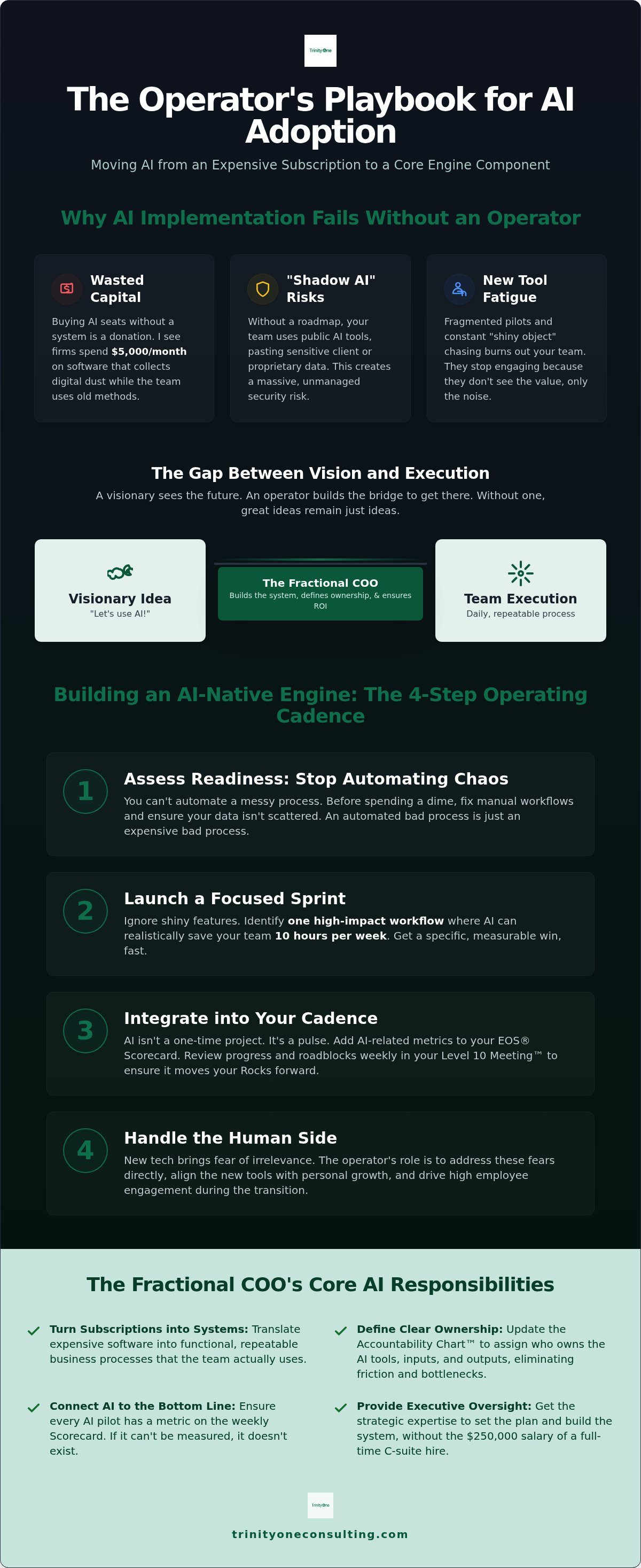
AI isn't magic. It's an engine component. Most founders treat it like a silver bullet that will fix their messy operations. They see a headline about a new LLM and buy ten seats before lunch. By Tuesday, those seats are collecting digital dust. This is where the role of fractional COO in AI adoption becomes critical. Without an operator to build the system, your AI investment is just another line item on the credit card statement that yields zero return.
I've seen companies spend $5,000 a month on AI seats while their team still manually enters data into spreadsheets. It's a failure of leadership, not technology. Visionaries often buy software based on a headline without a plan for the how. They expect the tool to figure itself out. It won't. An integrator is the person who turns a visionary idea into a repeatable process. They look at the current workflows and see where the gears are grinding.
The gap between visionary ideas and team execution
Visionaries are great at seeing the future. They're usually terrible at building the bridge to get there. When a founder pushes a new tool onto the team without updating the Accountability Chart, which is a key tool in EOS, they create immediate friction. People don't know who owns the output or how it changes their daily work. The founder becomes a bottleneck by demanding results from tools the team hasn't been trained to use. An Integrator functions as the essential bridge between AI potential and the actual daily output of your staff.
Moving beyond the shadow AI problem
Your employees are likely already using AI. They're pasting sensitive client data or proprietary code into public models to save time. This shadow AI is a massive security risk that happens when there's no official roadmap. A fractional COO provides the oversight you need without the $250,000 salary of a full-time hire. For a mid-market firm, paying for a full-time executive to manage a handful of software integrations is a waste of capital. You need the expertise to set the strategy and then get out of the way.
The Chief Operating Officer is the one who ensures the business engine stays in sync. In an AI context, the role of fractional COO in AI adoption means moving beyond scattered pilots. If a pilot program doesn't reach the Scorecard, which is an EOS metric, it doesn't exist. Fragmented activity costs you more than just subscription fees. It costs you the trust of your team. They get new tool fatigue and start tuning you out because they don't see the value in the noise.
How do you build an AI-native operating cadence?
AI adoption fails when it is treated as a one-time setup. It's a pulse. The role of fractional COO in AI adoption is to build that pulse into your existing business engine. If you just bolt software onto a broken system, you'll just break things faster.
You need a roadmap that ignores shiny features and focuses on high-impact workflows that actually move your Rocks, which is a term used in the EOS framework. This requires a strategic shift of the COO role in the AI era where the operator becomes an architect of intelligence. We don't chase trends. We build systems.
Assessing your business engine for AI readiness
Your business isn't ready for AI if your data is scattered across five different spreadsheets that don't talk to each other. It's not ready if your team can't describe their daily workflows without using the word "usually." You can't automate chaos.
I recommend using this AI readiness assessment checklist to see where you stand before spending a dime. High turnover or low trust will also stall your progress. You must fix your manual processes first because an automated bad process is just an expensive bad process.
Integrating AI into your weekly Level 10 meetings
A Level 10 meeting, as defined by EOS, is the perfect place to track AI progress. We don't just talk about "using AI." We track specific metrics on the weekly Scorecard, which is an EOS tool. If a tool was supposed to save the sales team five hours a week, we look at the data to see if it happened.
I use Trinity Cadence to provide this real-time visibility into your operations. It shows us exactly where the bottlenecks are in the execution. The fractional COO runs these meetings to ensure the team stays focused on the output rather than the tech. If you want to see how this rhythm works in a real business, let's talk about your current operating cadence.
The role of fractional COO in AI adoption also involves auditing your current Rocks to see which ones AI can actually move. This isn't about replacing people. It's about giving your people better tools to hit their targets. The goal is a unified operating rhythm where AI is as invisible and essential as the electricity in your office.
How do you handle the human side of AI change management?
People aren't actually afraid of a software update. They're afraid of losing their mortgage payments. The role of fractional COO in AI adoption includes managing this psychological friction. If your team thinks AI is coming for their jobs, they will sabotage the implementation every single time. It's not malice. It's survival.
I believe a company only becomes the best version of itself when its people are becoming better versions of themselves. This isn't fluff. It's the core of how we drive performance. You have to be blunt about what AI replaces and honest about what it amplifies. If you ignore the human element, you'll pay for it in turnover and resentment.
Replacing a mid-level manager can cost up to 150% of their annual salary. That's a massive hit to the bottom line that no AI subscription can fix. You have to be an architect who cares about the people living in the building, not just the blueprints. AI implementation is a technical shift that requires a human solution.
Using Dream Management to drive tech adoption
We use the Dream Manager methodology, created by Matthew Kelly, to bridge the gap between company goals and personal lives. If AI saves a marketing manager ten hours a week, what does she do with that time? If that time allows her to leave at 5:00 PM to coach her daughter's soccer team, she has a reason to make the tech work. The software becomes a vehicle for her personal success.
Matthew Kelly defines twelve dream categories, including physical, emotional, and intellectual dreams. When we implement AI, we look for ways the efficiency gains can fuel these personal targets. My fractional Dream Manager services help align these interests so the team pulls in the same direction as the visionary. This creates a culture where people want the business to win because they win too.
Eliminating the fear of replacement
You owe your team "real talk." I've sat in rooms with twenty people who were terrified that a bot would replace their entire department. The truth is usually that AI replaces the boring parts of their jobs so they can do more human work. If you don't say that out loud, the silence will kill your culture. The role of fractional COO in AI adoption is to lead these conversations with empathy and authority.
We show them how using AI for employee coaching can actually make them more valuable to the firm. It turns a threat into a tool for professional growth. This approach improves retention because people feel invested in, not just automated over. I've coached enough football teams to know that players don't play for a playbook. They play for a coach who understands their personal stakes.
What does a fractional COO actually do during AI deployment?
A fractional COO doesn't just sit in meetings and look at slide decks. They are the ones with the wrench in their hand. The role of fractional COO in AI adoption means taking ownership of the Accountability Chart, which is an EOS tool, to ensure every new AI-driven seat is filled by the right person. If you don't know who is responsible for the output of a bot, you don't have a system. You have a mess.
I act as the buffer between the visionary's 'next big thing' and the team's actual capacity. Founders often see a new tool and want it implemented by Friday. That's a recipe for burnout and broken processes. I filter those ideas through our current Rocks, which is an EOS term for our 90-day priorities, to see if they actually fit the engine.
Managing the rapid launch sprint
We don't do six-month planning phases that lead nowhere. We use Launch Sprints. These are fixed-fee engagements designed to get specific AI workflows live and functional in weeks. I oversee the brand systems and custom AI mapping to ensure the tech actually fits your unique business engine.
This is the opposite of a consultant who hands over a report and leaves. I stay in the trenches to make sure the software is integrated into your daily habits. If a tool isn't helping your people become better versions of themselves, it doesn't belong in the building. We prioritize execution over theory every time.
Measuring ROI and performance
The role of fractional COO in AI adoption is about more than just picking software. It's about accountability. If you can't prove the software is paying for itself, you should cancel the subscription. I track three concrete metrics: time saved on repetitive data tasks, reduction in manual error rates, and the impact on your weekly Scorecard, which is an EOS measurement.
You can read more about measuring ROI of AI implementation to see how we verify these numbers. Visibility into employee engagement is just as important as the execution stats. If your team hates the tool, they will find ways to work around it. That hidden resistance is a silent killer of ROI. I use Trinity Cadence to see exactly how these tools are performing in real-time so we can pivot before wasting another month of fees.
How do you start integrating AI into your business engine?
Stop buying new software. Your credit card statement is likely already cluttered with "pro" versions of tools that your team doesn't understand. The role of fractional COO in AI adoption starts with an audit of your current operating cadence. You have to know how the gears turn before you try to grease them with AI. Most leaders skip this step and wonder why their $20 monthly subscriptions aren't generating $20,000 in value.
Identify one specific workflow where AI can save your team ten hours every week. Don't try to fix the whole company at once. If you can automate the first draft of your client reports or the initial sorting of support tickets, you've won. That single victory builds the confidence needed for bigger shifts across the organization.
You need a fractional integrator to build the roadmap and hold the team accountable. Without someone to own the process, your AI initiatives will die in the middle of a busy Tuesday. I use Trinity Cadence to maintain the rhythm of business once the initial Launch Sprint is over. It keeps the execution visible and the goals clear for everyone involved.
Choosing the right fractional partner
You need an operator who understands both software logic and human motivation. Most tech consultants know the code but don't know why a project manager is crying in the breakroom. I bring 30 years of experience in the trenches to every engagement. I've coached football teams and led companies through massive shifts, and I know that the tech is only as good as the person using it.
Check out my fractional COO services if you're tired of theoretical advice. I don't give you a report and walk away. I stay until the system works and the ROI is visible on your Scorecard, which is an EOS tool. You need someone who speaks the language of your bottom line, not just the language of Silicon Valley.
Your first 90 days of AI-native operations
The first three months are about moving from operational chaos to a steady cadence. In the first 30 days, we audit the engine and set your AI Rocks, a term used in the EOS framework. By day 60, we've completed a Launch Sprint and your team is using a new workflow. By day 90, we're measuring the results in your Level 10 meetings, which are part of the EOS process.
This shift isn't always easy. It requires discipline and a willingness to stop doing things the "old way" just because it's comfortable. Technology is the engine, but your people are the fuel. A company only becomes the best version of itself when its people are becoming better versions of themselves, which is why the Dream Manager process, created by Matthew Kelly, is so vital to this transition. We keep the human element at the center of every technical update to ensure long-term success.
Building your AI-native future
Integrating AI is a technical challenge that requires a human solution. I've shown you why the role of fractional COO in AI adoption is about building systems rather than just buying software. We build systems. We stop the waste of money on idle subscriptions and start moving your Rocks, which is a term used in the EOS framework.
As a Certified Dream Manager and former EOS Integrator, I know that your people must win for the business to win. We use Trinity Cadence to ensure the new operating rhythm stays on track. It works. You can move from operational chaos to a steady, predictable cadence in 90 days.
It takes discipline and a battle-tested operator to lead the way. You can build a business that runs on high-level logic and deep human connection. You don't have to deal with this technical shift alone.
Let's get your business engine running at full capacity.
Frequently Asked Questions
Is a fractional COO different from an AI consultant?
Yes. A consultant gives you a report and a bill. A fractional COO builds the system and stays to run it. The role of fractional COO in AI adoption is about execution and accountability. I stay in the trenches of your business to ensure the tools actually work within your daily operations. Consultants often leave before the first bug appears. I own the results.
How much does a fractional COO cost compared to a full-time hire?
You save roughly $150,000 to $200,000 annually by avoiding a full-time executive salary and benefits package. A full-time COO in the mid-market can easily cost $250,000 plus equity. A fractional retainer is a fraction of that cost for the same level of experience. You get 30 years of operational expertise without the long-term overhead of a permanent C-suite hire. It is a more efficient use of capital for growing firms.
Can AI really help with employee retention and engagement?
It can if you use it to remove the work your team hates. If AI saves an employee ten hours of manual data entry, they can focus on higher-value tasks that they actually enjoy. We use the Dream Manager process, a methodology by Matthew Kelly, to connect these time savings to their personal goals. People stay when their work helps them become better versions of themselves. Efficiency becomes a tool for retention.
What happens if my team refuses to use the new AI tools?
Resistance usually comes from fear or a lack of clarity. I address this by updating the Accountability Chart, an EOS tool, so everyone knows who owns the new workflows. If someone refuses to adapt after we've provided training and clear expectations, it becomes a performance issue. I help you have those blunt conversations to protect the health of the business engine. We prioritize the team over individual ego.
Do I need to be using EOS to hire a fractional integrator?
You don't have to be a current EOS user, but I will bring that level of discipline to your business. I use EOS terms like Rocks and Scorecards because they create clarity and drive results. If you don't have a system, we will build one together. The role of fractional COO in AI adoption requires a structured operating rhythm to be successful. We will implement the parts of the framework that fit your needs.
How does the Dream Manager program fit into a technical AI rollout?
It provides the human why behind the technical what. A technical rollout often feels cold and threatening to a staff member. The Dream Manager program, created by Matthew Kelly, focuses on the twelve dream categories to show employees how technical efficiency helps them personally. When people see that AI helps them reach their own dreams, they stop fighting the software. They start using it to win back their time.
What is the difference between Trinity Cadence and other operating systems?
Trinity Cadence is built specifically to handle AI-native workflows and real-time execution visibility. Most systems are just static task lists or generic project managers. My system integrates your operating cadence with the specific tools you use daily. It allows me to see exactly where the engine is stalling. You get a live view of whether your AI investments are actually hitting your targets on the Scorecard.
How long does a rapid launch sprint for AI usually take?
A Launch Sprint typically takes two to four weeks to get a specific workflow live. We don't do six-month studies or endless planning sessions that lead nowhere. We pick one high-impact area, map the custom AI requirements, and build the process. This speed prevents the initiative fatigue that kills most technical projects. You see a measurable return on your investment before the next software billing cycle hits your account.