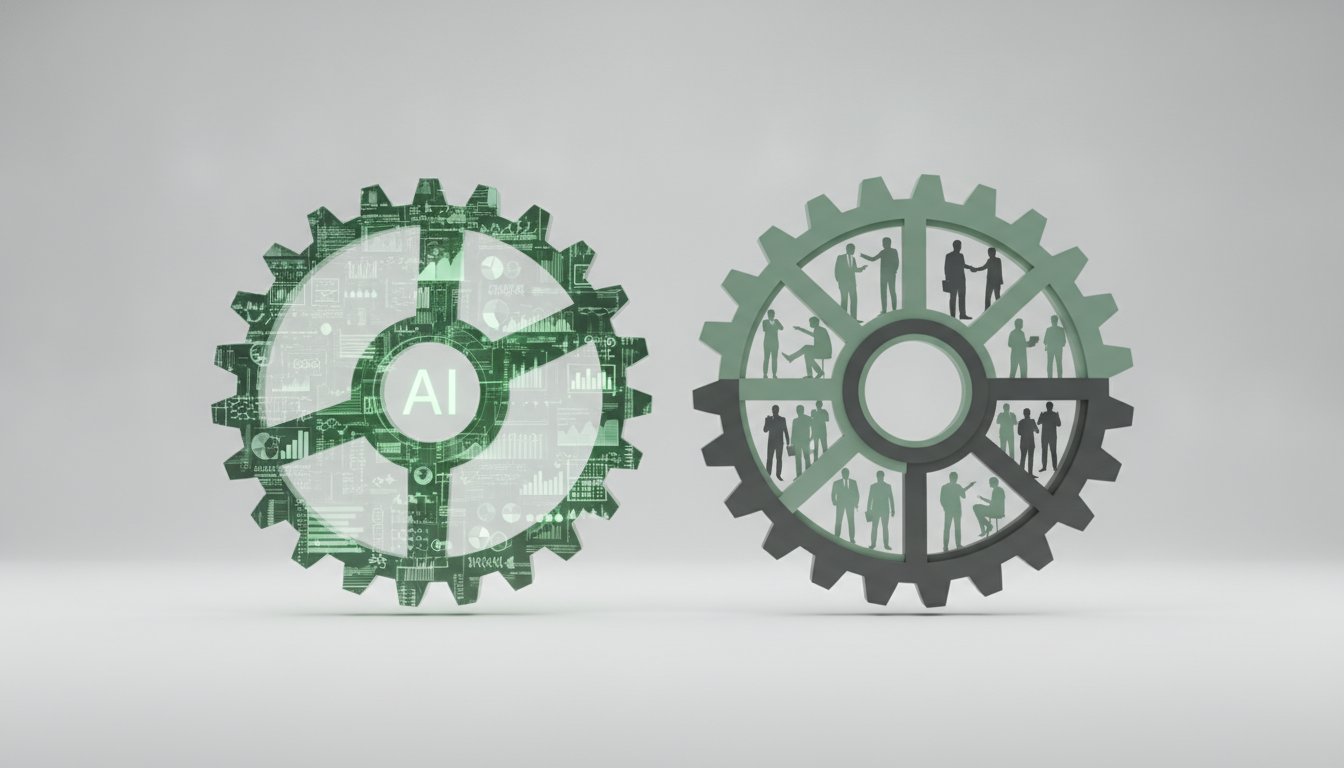
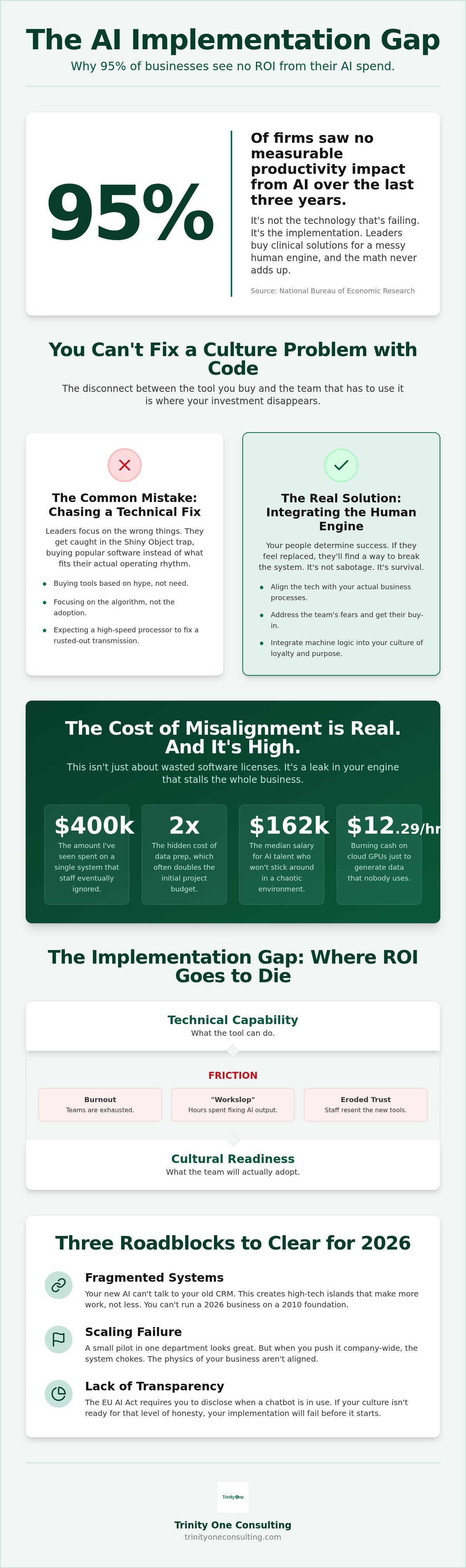
National Bureau of Economic Research data shows that up to 95% of firms saw no measurable productivity impact from AI over the last three years. Most leaders stumble over common AI implementation challenges because they focus on the code instead of the culture. I've watched operators spend $400,000 on systems that their teams eventually ignore or resent.
You likely feel the tension of tools being bought but not used. It's a heavy cost when the median AI salary is now $162,240 and your team feels threatened by every new login you create. Technology shouldn't be a source of friction that stalls your engine.
This checklist identifies the exact human and operational gaps in your strategy to ensure you're ready for 2026. You'll get a roadmap to align technical efficiency with employee engagement. We'll look at the systems needed to turn AI from an expensive experiment into a measurable driver of ROI.
Key Takeaways
- Move past experimentation and start running AI as a core part of your business engine.
- Identify common AI implementation challenges like fragmented data and the lack of a clear operating cadence.
- Address the human side of automation so your people don't feel threatened by the tools you buy.
- Map your technical efficiency to employee engagement to protect your culture while you scale.
- Follow a structured roadmap to ensure your business is ready for the operational shifts coming in 2026.
The Modern Landscape of Common AI Implementation Challenges
The era of treating AI like a science fair project is over. In 2026, 91% of businesses report using AI in some capacity. Yet, the National Bureau of Economic Research found that up to 95% of firms saw zero measurable productivity impact over the last three years. This happens because leaders buy tools without a plan for their people. It's a clinical solution applied to a messy human engine. I've seen it happen in companies with ten employees and those with five hundred.
Most common AI implementation challenges stem from this disconnect. I've watched founders drop $400,000 on enterprise systems only to realize their staff is still using Excel to get the real work done. They fall into the Shiny Object trap. They buy the software because it's popular, not because it fits their operating rhythm. You can't just plug a high-speed processor into a rusted out transmission and expect to win a race.
The technical precision of an algorithm doesn't matter if the human depth of the team is ignored. If your staff feels like they're being replaced, they'll find ways to break the system. It's not sabotage. It's survival. You're trying to integrate machine logic into a culture built on loyalty and purpose. That requires a steady hand, not just a bigger cloud budget.
Defining the AI Implementation Gap
There's a massive distance between what a tool can do and what a team will actually adopt. This is the gap where ROI goes to die. When technical capability outpaces cultural readiness, you get friction. That friction looks like burnout. It looks like "workslop," where employees spend hours fixing low-quality AI outputs just to keep up. This is a massive waste of time and money.
You need a battle-tested practitioner to close this space. It's not about the code. It's about how the code talks to the person at the desk. We also have to face the ethical and social challenges of AI, specifically regarding transparency. As of August 2, 2026, Article 50 of the EU AI Act requires you to disclose when chatbots are in use. If you aren't ready for that level of honesty, your implementation will fail before it starts. A Fractional COO or Integrator can help bridge this divide by aligning the tech with your actual business processes.
The Cost of Misalignment in 2026
Misalignment is expensive. Initial AI projects usually cost between $40,000 and $400,000, but the hidden costs of data prep often double that number. You end up paying for "ghost" features in your software stack that nobody touches. This wastes money and erodes trust. You might be paying $12.29 per hour for NVIDIA H100 GPUs on AWS just to generate data that no one uses. That's a leak in your engine that will eventually stall the whole business.
When leadership pushes automation without clarity, staff start looking for the exit. The median AI professional salary is $162,240. These people won't stick around in a chaotic environment where the goals change every Tuesday. The AI implementation gap is a failure of operational integration, not software. You can't fix a broken process by adding an expensive algorithm to it.
Technical and Operational Roadblocks: Data, Talent, and Scaling
Your business engine is likely a collection of legacy systems. Most leaders find that their AI tools can't talk to their CRM or project management software. This fragmentation is one of the most common AI implementation challenges I see. You end up with a high-tech island that doesn't share data with the rest of the company. It creates more work for your team instead of less. You can't run a 2026 business on a 2010 foundation.
Imagine your company is a high-performance car. Your legacy software is the frame. Your new AI tool is a jet engine. If you don't have the right brackets to hold them together, the engine will just rip itself out of the chassis. This is why most firms see no productivity gains. They have the power but no way to transfer it to the wheels. You need a system that allows AI to talk to your legacy engine without requiring a total rebuild.
The Integrator’s Challenge: Bridging Legacy and AI
Scaling a pilot project is where the wheels usually fall off. A small test in one department might look great. Then you try to push it into the main workflow and the system chokes. This is another of the common AI implementation challenges that stalls growth. Harvard Business School identifies three common challenges organizations face when they try to scale. They often invest in tools that aren't built for the long haul. You need to manage the physics of your business. That means aligning the speed of AI with the actual speed of your people.
If you want real-time visibility into execution, you need a unified operating system. You can learn more about engineering your business engine for 2026. Without this alignment, you're just guessing. You won't know if the machine is actually helping or if your staff is just working around it. This lack of visibility is a silent killer for ROI.
Overcoming the AI Talent Gap
The talent market is a mess right now. AI vacancies increased by 36% last year. Senior engineers are asking for $240,000 to $520,000. Most small to mid-sized businesses can't afford that overhead. But here's the reality. You don't need a room full of coders. You need better Integrators, the leaders who manage the day to day operations. They are the surge protector for your team. While a developer focuses on the code, an Integrator focuses on the output. You can schedule a call to discuss your talent gaps.
Data quality is the final trap. If your data is messy, your AI will just produce automated garbage. You can't skip the dirty work of cleaning up your records. It's a tradeoff. You spend the time now on data hygiene. Or you spend ten times as much later fixing the mistakes your AI made. Data preparation often costs as much as the software itself. If your customer names are misspelled, AI will fail. It won't tell you the data is bad. It will just give you a confident, wrong answer. This creates "workslop" that wastes 5.4% of your team's week.
The Human Element: Overcoming Resistance and Misalignment
If your team thinks the new software is there to take their seat, they will fight it. This fear is one of the most significant common AI implementation challenges I see in the field. You can't lead a team that is looking over their shoulder. When people feel threatened, they stop innovating and start protecting their territory. This survival instinct will stall your implementation faster than any technical bug.
Transparency is a requirement, not a suggestion. On August 2, 2026, core user transparency rules under the EU AI Act went into effect. This means you must disclose when AI is in use. If you hide the machine behind the curtain, trust evaporates. Workers who use AI tools save an average of 5.4% of their work hours each week. If they think that saved time just leads to a pink slip, they will hide their productivity gains from you.
You have to align corporate ROI with personal aspirations. It is cold logic. If the company wins, the person must win too. I've spent 30 years learning that a business only grows to the extent its people grow. If you use AI to grind more out of your staff for the same pay, your culture will rot. You must show them how the tech makes their lives better, not just your margins thinner.
Driving Team Buy-In through Dream Management
Connecting professional efficiency to personal life goals is the secret to adoption. We use the Dream Manager Program to reduce friction. This methodology, created by Matthew Kelly, focuses on the twelve dream categories of your employees. When you show a staff member that AI handles the data entry they hate so they can leave on time to pursue a personal goal, the resistance vanishes. They start to see the tool as a partner in their success.
I've seen this drive operational ROI in real time. One operator used AI to automate scheduling, which saved his manager six hours a week. Instead of giving her more spreadsheets, he helped her use that time to finish her degree. Her loyalty to the company tripled. The implementation succeeded because it served the person, not just the process.
Change Management as a Logical Proof
You can identify friction points during your daily huddle or weekly leadership meetings. Don't guess what's wrong. Ask the people in the trenches where the machine is making their day harder. Use AI coaching to support the workforce rather than micromanaging them. Employee buy-in is a byproduct of aligning tech with the Dream Manager concept. When the logic of the system supports the heart of the human, the engine finally runs smooth.
The AI Readiness Assessment Checklist: Evaluating Your Business Engine
Most technical assessments fail because they ignore the leadership structure. If a Visionary wants an autonomous AI agent but the Integrator lacks the capacity to monitor the output, the project will fail. This mismatch is a primary source of common AI implementation challenges. I've seen founders drop $10,000 a month on software without checking if their operations team could handle the data cleanup. You can't out-tech a broken leadership dynamic.
Strategic alignment requires a clear map between big ideas and daily execution. You need to know if your current operating cadence can handle real-time feedback from machine operations. If your weekly leadership meetings don't include AI performance metrics, you're flying blind. Data integrity is also a binary issue. Your business logic is either clean enough to automate or it's a liability that will produce expensive workslop.
Human capital is the final piece of the logic proof. Your employees shouldn't just be notified of a new tool. They need to be coached on how to use it to reclaim their time. Security and ethics aren't just for the IT department. Guardrails must be built into the daily workflow so your team stays compliant with the transparency rules of the EU AI Act.
Operational Readiness Questions
- Do we have a unified operating cadence for machine and people operations?
- Is our current Fractional COO equipped to manage AI-native workflows?
- Can we track execution and engagement in a single dashboard to see the true ROI?
Human Readiness Questions
- Has every team member identified how AI helps their DreamCompass, which is part of the Dream Manager methodology by Matthew Kelly?
- Is there a safe environment for staff to report AI inaccuracies without fear of looking incompetent?
- Are we using 1-on-1 coaching to manage the psychological transition of automation?
Your business engine needs a tune-up before you add the turbocharger. If your people feel like they are being replaced, they will find ways to break the system. You must ensure the technical efficiency of the machine serves the personal growth of the human. This is how you protect your culture while you scale.
Bridging the Gap: Integrating AI into Your Operating Cadence
Common AI implementation challenges don't go away just because you bought a new software subscription. You have to change the way your business breathes. Most firms fail because they treat AI as a standalone island. It must become the nervous system of your entire company. I've spent 30 years in the trenches of leadership and I know that a tool without a rhythm is just noise.
Trinity Cadence is the unified operating system we built for the 2026 market. It brings machine logic and human motivation together in a single flow. I believe every company only becomes the best version of itself to the extent its people are becoming better versions of themselves. That is why our cadence includes the Dream Manager methodology created by Matthew Kelly. You stop guessing about ROI and start seeing it in your weekly scorecard.
A Fractional COO acts as the Integrator who executes this roadmap. You get the experience of a thirty-year operator without the $300,000 price tag of a full-time executive. This isn't about software development. It is about leadership and execution. I've coached enough football to know that the best playbook is useless if the players don't know their assignments.
The fractional approach has a specific tradeoff. It is bad at being a full-time babysitter for your team. If you want someone to sit in every meeting and manage every personality conflict, hire a full-time COO. But if you want a system that runs without you, the fractional model works. You pay for the result and the methodology, not the hours at a desk.
The Role of Trinity Cadence
We put AI coaching where it belongs. It lives in your daily huddles and weekly meetings. You stop looking at AI as a mystery and start looking at it as a tool for real-time visibility. When you can see every friction point in the engine, implementation anxiety disappears. This rhythm ensures that your tech stack serves your people, which protects your culture while you scale.
Your Path to AI Integration
Turning AI theory into tactical reality requires a specific set of skills. A Visionary founder often lacks the patience for the granular work of integration. That is where we come in. You can look at our fractional leadership services to understand how we turn high-level goals into a roadmap. We don't just give you a checklist. We build the engine with you.
Your next step is a deep audit of your business engine. We look at your data, your people, and your current cadence. If the foundation is cracked, we fix it before we add the AI. It is a blunt approach, but it is the only one that lasts in a high-speed market. You can't run a 2026 company on a 2010 operating system.
Schedule a call to see how Trinity Cadence can align your AI and your people. Book your AI Readiness Strategy Session here.
Prepare Your Business Engine for the 2026 Shift
Most leaders are stalling because they treat AI like a bolt-on accessory. Solving common AI implementation challenges requires a total alignment of your technical engine and your human culture. A software update alone won't fix a broken process. I've spent three decades in operations and I know that a machine is only as good as the person running it.
You need an ROI-focused AI implementation roadmap that doesn't ignore the psychological impact on your team. Using Trinity Cadence allows you to maintain visibility while battle-tested Fractional Integrators handle the heavy lifting. This approach avoids the $400,000 mistakes that stall most firms. We focus on the output so you can focus on the vision.
A company only becomes the best version of itself when its people are becoming better versions of themselves. We use the Dream Manager methodology by Matthew Kelly to ensure your staff sees AI as a partner rather than a threat. When their personal dreams align with your operational goals, the friction disappears.
Your business can be the best version of itself. It just takes the right cadence.
Frequently Asked Questions
What are the most common AI implementation challenges for small businesses?
Most small firms fail because they buy software before they fix their internal processes. These common AI implementation challenges usually stem from fragmented data and a lack of leadership alignment. You can't automate a mess and expect it to run smooth. You end up with expensive "workslop" that your team has to spend hours correcting.
How do I know if my business is ready for AI integration?
Your business is ready when your operating logic is clean and your team trust is high. If your current manual workflows are chaotic, adding AI will only accelerate the confusion. You need a unified rhythm, like a daily huddle, to catch friction points before they stall your engine. Clean data is a requirement, not a luxury.
What is the difference between an AI tool and an AI-native operating system?
An AI tool is a standalone part, like a chatbot or a generator. An AI-native operating system, such as Trinity Cadence, is the entire chassis that connects your people and your tech in one rhythm. One is a bolt-on accessory. The other is the integrated circuit that runs your whole company.
How can a Fractional COO help with AI implementation?
A Fractional COO acts as the Integrator who turns big AI ideas into tactical reality. I manage the daily execution and the weekly meetings to ensure the machine isn't breaking the culture. You get thirty years of operational experience without the overhead of a full-time executive salary. It's about execution, not just theory.
Why do employees resist AI, and how can I fix it?
Employees resist because they fear being replaced by a machine they don't understand. You fix this by being transparent about your goals and showing them how the tech helps their personal growth. When people see that AI handles the tasks they hate, they stop fighting the change. Honesty is the only way to protect your culture.
How do I calculate the ROI of AI in my operations?
Track the time saved on low-value tasks and the increase in output per headcount. If your team saves 5.4% of their work hours each week, that is time you can put toward growth or personal development. ROI is measured by the health of your engine and the clarity of your weekly scorecard. Don't just look at the SaaS bill.
What is the Dream Manager concept in the context of AI?
The Dream Manager methodology, created by Matthew Kelly, focuses on helping your people become the best versions of themselves. In an AI context, we use automation to free up time for their twelve dream categories. If the machine helps an employee leave on time to pursue a personal goal, they will support the implementation. The company only grows when the people grow.
Can AI help with my company's operating cadence?
AI provides real-time visibility that makes your operating cadence more decisive. You stop waiting for end-of-month reports to see if you hit your quarterly priorities. The machine identifies common AI implementation challenges in your workflow so you can fix them during your weekly leadership meeting. It turns your meeting rhythm into a high-speed feedback loop.