Most managers waste ten hours every week on coaching that doesn't actually change behavior. They spend their time digging through spreadsheets and old emails instead of talking to their people. Learning how to use AI for employee coaching isn't about replacing the human touch with a cold machine. It's about offloading the mechanical data work so you can finally do your real job.
You're likely exhausted by the 60-hour work week. Performance reviews often feel like a post-mortem instead of a proactive fix. It's a grind that leaves no room for the personal development your team actually craves. I've spent 30 years as an operator and football coach. I've learned that a company only becomes the best version of itself to the extent its people are becoming better versions of themselves.
This article shows you how to integrate AI into your daily operations to handle performance data while you focus on the human aspirations that drive your business. We'll explore how AI-powered tools, like those offered by Trinity One, can provide real-time visibility into team engagement. You'll see how to drive higher retention and build a business engine that runs without your constant input.
Key Takeaways
- Stop treating AI like a replacement for your leadership. You'll learn how to use AI for employee coaching to provide real-time feedback while closing the trust gap that makes teams fear layoffs.
- A company only improves when its people grow. I'll show you how to connect technical performance to personal dreams using the Dream Manager methodology created by Matthew Kelly.
- Coaching fails when it sits outside your normal schedule. We'll integrate these tools directly into your Level 10 meeting cadence (EOS) to make them part of the business heartbeat.
- Implementation is a sprint rather than a marathon. You need to use a sandbox phase where your team can fail and learn without breaking the engine.
- Visibility is the key to retention. Trinity Cadence acts as an AI-native operating system that gives you a clear view of both execution and human engagement.
Why does AI coaching fail when you ignore the trust gap?
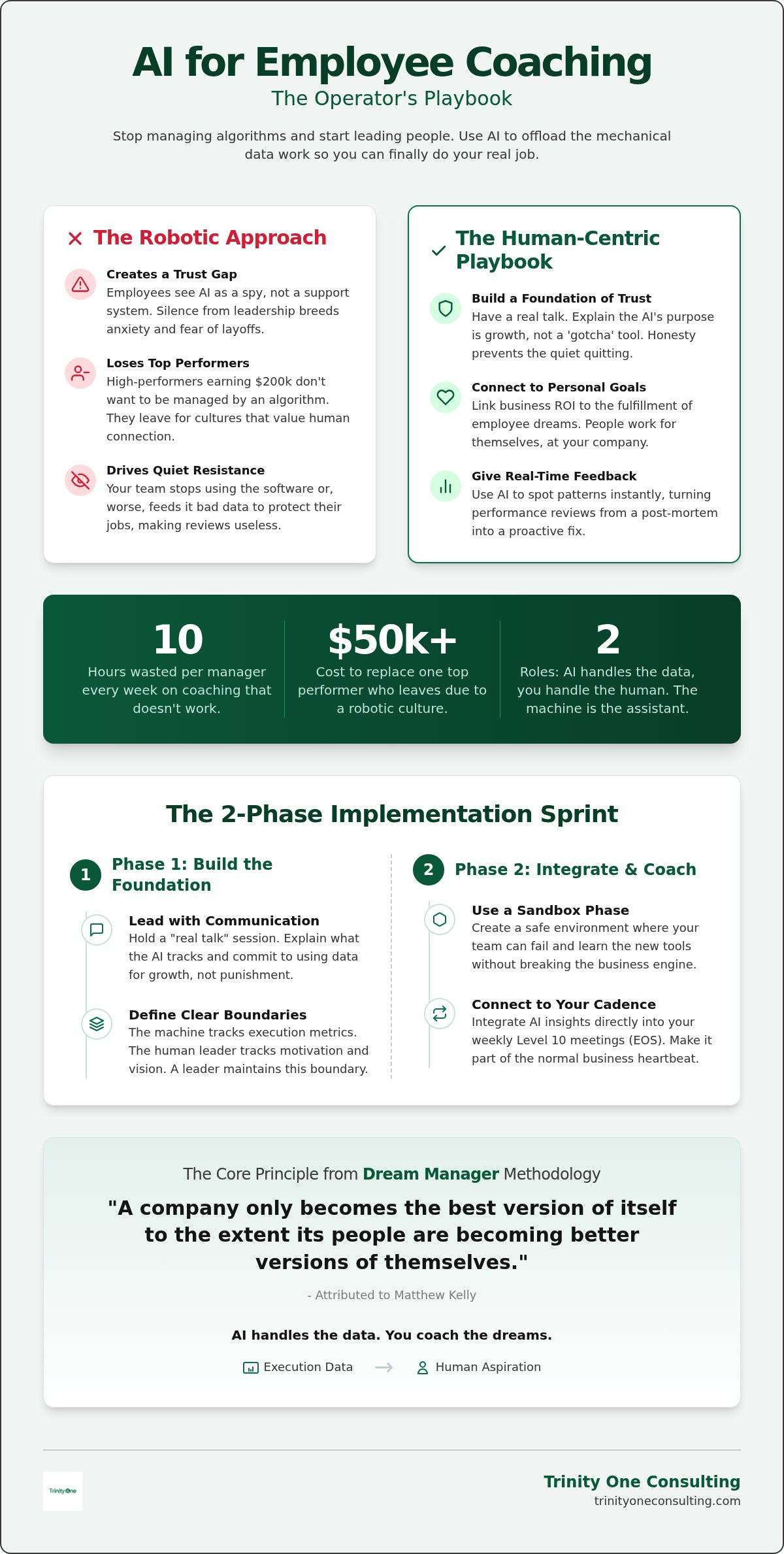
AI coaching is a tool for real-time feedback. It is not a replacement for human mentorship. If you want to know how to use AI for employee coaching successfully, you must address the trust gap first. Employees often view new tech as a precursor to layoffs. Without clear communication, your team will see the AI as a spy rather than a support system. Silence from leadership regarding your intent creates a culture of anxiety.
I've spent 30 years as an operator and a football coach. I know that if the players don't trust the playbook, they won't run the routes. AI provides clinical precision with performance data. It can spot a pattern in a sales call or a delay in a project timeline instantly. But it lacks the empathetic depth of a human manager who knows why a team member is struggling at home.
We can trace the technical roots of these tools back to Intelligent Tutoring Systems. These systems were designed to support the learner through specific feedback loops. In your business, the AI handles the mechanical performance data while you focus on the human dreams. This follows the Dream Manager methodology created by Matthew Kelly. You use the machine to clear the clutter so you can focus on the person.
The cost of the robotic approach
A tech-first rollout leads to quiet resistance. Your team won't tell you they hate the new software. They'll just stop using it. Or worse, they will feed the AI bad data. If employees think the AI is a tool for punishment, they will manipulate the inputs to protect their jobs. Performance reviews then become a post-mortem of lies instead of a proactive fix.
You risk losing your top performers first. A high-performing sales rep making $200,000 a year doesn't want to be managed by an algorithm. They value human connection and professional respect. If the culture feels robotic, they will take their talents to a competitor who treats them like a person. The cost of replacing that one rep can easily exceed $50,000 in recruiting and lost momentum.
Building a foundation of transparency
You must have a real talk conversation with your team before the rollout. Tell them exactly what the AI tracks and why you are using it. Commit to a policy where AI data is used for personal growth and not as a gotcha tool. I tell my clients that the AI is there to highlight the gaps so we can fix them together. This honesty prevents the quiet quitting that happens when people feel watched.
The Fractional COO or Integrator (EOS) maintains this cultural boundary. They make sure the machine stays in its lane. The machine tracks the execution metrics. The human leader tracks the motivation and the vision. This balance keeps the business engine running without grinding your culture into the dirt. It turns the AI into a coach's assistant rather than a digital overseer.
How do you connect AI coaching to employee personal goals?
I've seen founders lose their best people because they treated them like parts of a machine. A business is an engine, but it is fueled by human desire. Matthew Kelly's Dream Manager methodology teaches us that a company only becomes the best version of itself to the extent its people are becoming better versions of themselves. When you are deciding how to use AI for employee coaching, you should use the tech to protect your team's time.
AI is perfect for tracking the boring, repetitive tasks that keep your people at their desks too late. If the machine can handle the data scrubbing that takes three hours a day, your team gets those three hours back for their personal lives. You must link your business ROI to the fulfillment of employee dreams. It works because people don't work for your company. They work for themselves, and they happen to do that at your company.
The twelve categories of engagement
Matthew Kelly breaks down human needs into twelve dream categories. These include physical, emotional, spiritual, and financial goals. AI coaching systems identify when an employee is burning out by spotting subtle changes in their execution speed or communication frequency. If a top performer starts dragging, it is usually because they have stopped pursuing their personal goals. You can use these insights during Dream Manager coaching sessions to get them back on track before they quit. Even large organizations are shifting toward this model, with new AI training for government employees designed to move workers into more meaningful roles.
Trading drudgery for dreams
AI coaching identifies specific low-value tasks that your team can automate right now. This forces a shift in mindset. Your people stop being task-doers and start being the strategic architects of their own departments. We use the DreamCompass app to track personal progress alongside professional Rocks (EOS). This makes the workplace a tool for their personal success. If you're ready to stop the turnover cycle, we can discuss your team's specific needs during a brief call.
Burnout is expensive. Replacing a mid-level manager often costs $30,000 or more when you factor in lost productivity and recruiting fees. AI coaching flags the dip in engagement before the resignation letter hits your desk. It gives you the data to have a human conversation about what really matters to that employee. You focus on the person, and the machine focuses on the metrics.
How do you integrate AI coaching into your Level 10 meeting cadence?
Your operating cadence is the heartbeat of your business engine. If you try to bolt on coaching as a separate, monthly event, it will fail. Learning how to use AI for employee coaching works best when you embed the technology into the rhythms you already have. I've spent years facilitating Level 10 meetings (EOS) and I know that adding more meetings to a calendar is a recipe for burnout. You don't need more time on Zoom. You need more clarity during the 90 minutes you already spend together.
The machine handles the mechanical data so you can handle the human development. AI provides the Scorecard data (EOS) that makes coaching objective rather than emotional. It removes the "I feel like" from the conversation and replaces it with "The data shows." This objectivity is the only way to have a blunt, fair discussion about performance without destroying morale. When you master how to use AI for employee coaching within a Level 10 meeting (EOS), you stop guessing and start leading.
The AI-powered Scorecard
Collecting weekly numbers for a Scorecard (EOS) is a manual grind that most managers hate. AI can automate this collection by pulling data directly from your CRM or project management tools. This gives you a real-time view of your business engine before you even walk into the room. If a Rock (EOS) is off-track, the AI flags it 48 hours early so you can prepare a solution instead of reacting to a surprise. I often help founders set up these systems through my Fractional COO services to ensure the technical engine matches the human vision.
Solving friction with IDS
The IDS (Identify, Discuss, Solve) process (EOS) is where most teams get stuck. They spend 40 minutes discussing the symptoms and never find the root cause. AI coaching insights can highlight the real problem behind a missed goal by comparing execution patterns across the team. It might show that a missed sales target isn't a lack of effort, but a technical bottleneck in the lead routing system. The Integrator uses this data to facilitate a blunt discussion that actually solves the issue. It saves you from wasting $1,000 in billable hours on a meeting that goes nowhere.
What does an actual AI coaching implementation look like?
I've seen too many leaders treat software rollouts like a long march. Implementation is a sprint, not a marathon. If you don't show value in the first thirty days, the team will check out. Learning how to use AI for employee coaching starts with a pilot program that proves the concept quickly.
You need a Sandbox phase where failure is expected. This isn't about perfection. It's about testing the business engine under pressure without breaking the whole company. You don't need a massive headcount to start. You need one champion who understands the vision and three to five tech-forward team members.
This small group spends two hours a week for a month testing the workflows. It's better to find the friction points with five people than to frustrate fifty. Avoid building a Frankenstein system of disjointed apps that don't talk to each other. A unified operating system like Trinity Cadence keeps the data clean and the coaching relevant.
The launch sprint methodology
A thirty day plan works best for introducing AI coaching to a single department. I recommend starting with your sales team or customer success group. These roles are already data driven and comfortable with performance targets. You must update your Accountability Chart (EOS) to clearly define who owns the AI implementation.
If nobody is accountable for the data, the machine will spit out junk. During this sprint, you're teaching the team how to use AI for employee coaching as a way to win back their time. We look for the "drudgery" tasks that steal hours. If the AI can handle the CRM entry, the rep can focus on the human connection.
Measuring the human ROI
You have to know how to measure the actual ROI of AI implementation in your business beyond just dollar amounts. Watch for red flags like increased silence in meetings or a drop in Scorecard (EOS) accuracy. These suggest the tech is causing more friction than it solves. If the team feels managed by a bot, they will stop being honest with you.
We track "Dream" progress as a lead indicator for work performance. This methodology, created by Matthew Kelly, shows that a person who is winning at home will win at work. If an employee is hitting their personal savings goals or fitness targets, their professional execution almost always follows. The AI helps us see these patterns before the annual review happens.
How can Trinity Cadence serve as an AI coach for your operations?
Trinity Cadence is the AI-native operating system built for the 2026 business environment. It is not a collection of disjointed tools. It is a unified circuit where your execution data and human engagement meet. If you want to know how to use AI for employee coaching effectively, you have to stop looking at software and culture as separate silos. Trinity Cadence provides real-time visibility into the health of your business engine by monitoring both performance and people.
The platform reduces the management burden by providing automated coaching prompts based on real-time data. Instead of you digging through emails to see who is falling behind, the machine flags the friction point. It tells you exactly where a process is breaking before it affects your bottom line. You can step in as a mentor rather than a micromanager because the machine has already done the heavy lifting of data analysis. This is how to use AI for employee coaching to win back five to ten hours of your week.
Having your operating cadence and coaching in one unified circuit eliminates the lag between identifying a problem and fixing it. When your Rocks (EOS) and your coaching conversations live in the same place, the business runs with clinical precision. You stop guessing which employees are disengaged and start seeing the patterns in their execution. This integration ensures that every part of the engine is moving in the same direction at the same speed.
Visibility for the Visionary and Integrator
Managing through spreadsheets and Slack is a slow death for a growing company. It is noisy, inaccurate, and leads to constant interruptions. The Visionary needs to see the health of the engine from 30,000 feet without having to ask for a manual report. Trinity Cadence gives that high-level view instantly so you can focus on the next big move for the company.
The Integrator (EOS) uses the platform to keep the business rhythm precise and predictable. They don't have to wonder if the Scorecard (EOS) is updated or if the Level 10 meetings (EOS) are actually solving issues. The data is already there, highlighting the gaps in real time. This creates a level of accountability that is impossible to achieve with manual systems and allows for a blunt, fair discussion about results.
Getting started with a discovery call
Technology is only half the battle, and leadership is the other half. You can have the best AI in the world, but if your leadership is soft, the engine won't run. I focus on the human side of the equation to ensure the tech supports your specific vision. We help you map out your specific ROI so you know exactly how the implementation will pay for itself in saved time and higher retention.
A discovery call is the first step to seeing how these tools fit your specific headcount and operational goals. We look at your current friction points and decide if a Fractional Dream Manager is the right move for your culture. We align the machine with the man. You get a business engine that runs smoothly without your constant input, and your people get a leader who finally has the time to care about their personal success.
Book a discovery call to see how Trinity Cadence can align your business engine with your team's dreams. Schedule your session at this link: https://calendly.com/kevin-trinityone/discovery-call
Building a business engine that runs on dreams and data
Building a company that scales without your constant intervention requires a balance of clinical precision and human depth. You've seen that AI is not a replacement for your leadership. It's a high-speed assistant for your business engine. By offloading the Scorecard (EOS) data and mechanical tracking to the machine, you win back the time needed to be a mentor.
Successful leaders understand how to use AI for employee coaching by focusing on the personal dreams of their team. I've spent three decades as an operator and coach. I know that people only give their best when they're becoming better versions of themselves. This is the core of the Dream Manager methodology created by Matthew Kelly. It works.
Trinity Cadence provides the real-time visibility you need to keep the rhythm of your business precise. As a Fractional COO, I help you architect this engine so you don't have to manage through the chaos of disjointed spreadsheets. You get a unified circuit where performance data and human fulfillment work in harmony. The result is clarity.
Your team is waiting for a leader who values their future as much as their output. It is time to get to work.
Frequently Asked Questions
What is the first step to take before introducing AI coaching to employees?
The first step is a real talk conversation with your team to define the intent of the technology. You must explain that the AI is a tool for their personal growth rather than a precursor to layoffs. If you skip this step, the trust gap will cause employees to feed the machine bad data to protect their jobs. You have to be blunt about how the tech will win back their time.
How do I handle employees who are afraid AI will replace their jobs?
You handle this by being honest about the costs of inefficiency in your business engine. Explain that the AI handles the mechanical drudgery that currently keeps them at their desks too late. This allows them to focus on the high value work that a machine cannot do. When they see the AI as an assistant that helps them achieve their personal dreams, the resistance stops.
Can AI coaching replace a human manager or mentor?
AI cannot replace a human mentor because it lacks empathetic depth. It is excellent at spotting execution patterns in a Scorecard (EOS). But it cannot understand the human motivation or the family crisis behind a missed goal. You use the machine to handle the data work so you can spend your time on the coaching that requires a soul.
What is the Dream Manager methodology and how does it relate to AI?
The Dream Manager methodology, created by Matthew Kelly, focuses on helping employees become the best version of themselves. AI relates to this by identifying low value tasks that your team can automate right now. When you learn how to use AI for employee coaching, you are essentially using technology to clear the clutter from their schedule. This gives them the time to pursue the things that actually matter to them.
How often should I check the coaching data provided by an AI system?
You should check the coaching data once a week to align with your Level 10 meeting (EOS). Checking it every day leads to micromanagement which kills morale and slows down the engine. A weekly rhythm allows you to see real trends without overreacting to a single bad afternoon. This keeps your operating cadence predictable and your team focused on their Rocks (EOS).
What are the twelve dream categories mentioned in the Dream Manager program?
Matthew Kelly identifies twelve categories in the Dream Manager program to help people define their goals. These include physical, emotional, intellectual, spiritual, psychological, material, professional, financial, creative, adventure, legacy, and character dreams. AI helps track the efficiency gains that allow your people to actually pursue these areas. A company only improves to the extent its people are becoming better versions of themselves.
How does AI coaching fit into an EOS Level 10 meeting?
AI coaching fits into the Scorecard and IDS portions of the Level 10 meeting (EOS). The machine automates the collection of weekly numbers so you spend zero time on manual reporting. It also highlights the technical friction behind a missed Rock (EOS) so your discussion is based on facts instead of feelings. This is a core part of how to use AI for employee coaching to drive real performance.
What should I do if the AI coaching data contradicts my personal judgment?
Your personal judgment always takes precedence over the machine. AI is a sensor in your business engine, but you are the operator who makes the final call. If the data says a team member is failing but your gut tells you they are just in the wrong seat on the Accountability Chart (EOS), trust your gut. The machine provides the "what" while you provide the "why."