A 2026 survey of 1,800 executives found that only 26% report tangible value from generative AI. You are likely staring at an implementation bill between $40,000 and $400,000 while wondering why your P&L is flat. Forget counting software seats. You start measuring ROI of AI implementation by tracking the operational delta in execution velocity.
You feel the pressure to adopt these tools but you're tired of hearing about vague efficiency gains that don't show up in your bank account. It's difficult to track time savings across a distributed team when everyone is using different apps. You need to know if your tech spend is actually fueling your business engine or just adding more noise to the system.
I'm going to give you a blunt, operator-led framework for calculating the real dollar value of your AI investment. You'll learn how to measure execution velocity and human performance using a spreadsheet-ready formula. I'll show you how we use Trinity Cadence to get real-time visibility into these numbers. This approach relies on the core belief that a company's success and improvement are fundamentally tied to the growth and enhanced performance of its people.
Key Takeaways
- Calculate true value by measuring the gap between current execution speed and post-AI velocity. Subtract the friction tax of team confusion and technical debt.
- Budget for the heavy cost of data cleanup. Software licenses are often less than 10% of your total project spend.
- Integrate your findings into your existing operating rhythm. You start measuring ROI of AI implementation by adding specific metrics to your EOS Scorecard.
- Align technical tools with human growth. Use Matthew Kelly's Dream Manager program to ensure your team sees AI as a tool for their own development.
- Execute a 90-day launch sprint. Focus on one high-impact process to establish a baseline before you commit to enterprise-wide scaling.
How do you calculate the actual ROI of an AI project?
You have likely seen the pitch for AI. It usually sounds like magic. But magic does not pay the payroll. I look at AI through the lens of an operator who has spent 30 years in the trenches. To me, Return on Investment (ROI) isn't a vague feeling of being faster. It's a hard calculation of execution velocity.
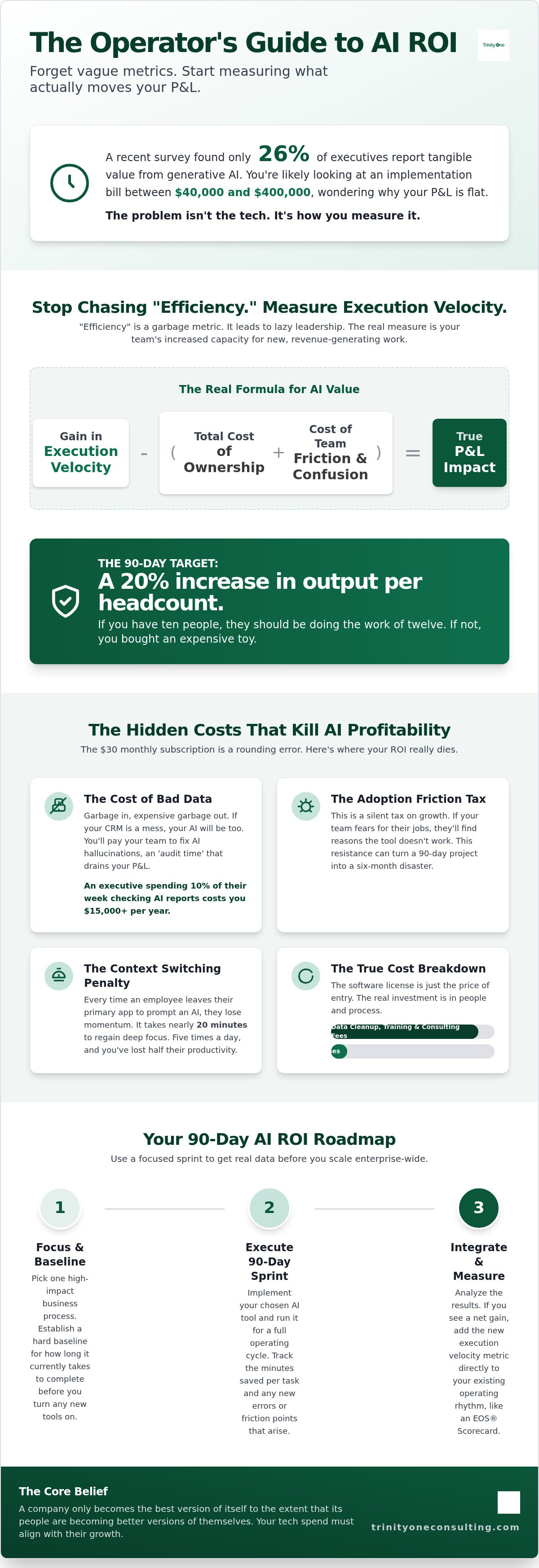
When measuring ROI of AI implementation, you must look at the net gain in execution velocity minus the total cost of ownership and the friction tax. Most people forget the friction tax. That is the cost of your team being confused or workflows breaking during the transition. If you spend $50,000 to save ten hours a week but your team spends five hours fixing errors, your ROI is dying. You measure success by comparing the time to complete a specific business process before and after you turn the tools on.
Stop looking at efficiency. It is a garbage metric that leads to lazy leadership. Start looking at capacity for new revenue-generating work instead. A successful implementation should show a 20% increase in output per headcount within 90 days. If you have ten people, they should be doing the work of twelve. If they aren't, you've just bought an expensive toy that provides no real value to the P&L.
The basic formula for AI value
I keep my math simple and blunt. First, calculate the hourly cost of every employee involved in a specific process. If a manager making $100 an hour spends four hours a week on reporting, that is $1,600 a month in labor. Track the minutes saved per task across a full operating cycle. Subtract the monthly license fee and the prorated cost of training. If the tool costs $50 per seat but saves $400 in labor, you have a winner. If the setup costs $10,000 and only saves five minutes a day, kill the project immediately.
Why efficiency is a trap for founders
Saved time has zero value if it is just spent on longer lunch breaks or more internal meetings. It only counts if it is reinvested into high-value work. This is where a plan for extra capacity is required. I tell my clients to measure how many more Rocks their team completes in a quarter. Rocks, as defined by EOS, are the 90-day priorities that move the needle. If your team has more time but isn't hitting more Rocks, your AI implementation is a sunk cost. You need a Fractional COO to ensure that extra time turns into actual profit.
What are the hidden costs that kill AI profitability?
Most founders get seduced by a $30 monthly subscription. They think that is the price of entry. It isn't. When measuring ROI of AI implementation, you have to account for the $150 to $350 per hour you pay external consultants to get the system running. Your software license is a rounding error. The real investment is the time your team spends away from revenue-generating work to learn a new system.
The cost of bad data
Messy data is the primary profit killer. If your CRM is a disaster, your AI will be a disaster. You will pay your team to fix hallucinations. This 'audit time' is a hidden drain on your P&L. If a $150,000-a-year executive spends 10% of their week checking AI-generated reports for accuracy, that costs you $15,000 a year. That is just one tool. Multiply that across your entire leadership team. Garbage in leads to expensive garbage out. Data cleanup is the most expensive and overlooked part of the engine.
The adoption friction tax
Adoption friction is a silent tax on your growth. If your team fears for their jobs, they will find reasons why the tool doesn't work. They will spend hours in meetings debating the ethics of the tool instead of clicking the buttons. I have seen 90-day projects stretch into six months because of this resistance. This is where the implementation strategy matters most. You need a system that integrates with their daily work, not one that adds another layer of complexity. If you want to review your operational costs, we can identify where these leaks are happening.
Context switching costs your team hours of focus every week. Every time an employee leaves their primary workspace to prompt an AI, they lose momentum. It takes nearly 20 minutes to regain deep focus after a distraction. If they do this five times a day, you've lost half their productivity. This is why tools that aren't integrated into your existing operating system are so dangerous to your bottom line.
Training is also an ongoing expense. You don't just 'train' a team on AI once. You maintain their skills like you maintain an engine. If you don't budget for monthly skill updates, your team will fall back into old, manual habits. You also risk the cost of Shadow AI. This happens when employees use unapproved tools that create security risks and fragmented data. You end up paying for a software subscription that nobody actually uses while your data security leaks profit through the back door.
How does your operating rhythm reveal AI value?
Your operating cadence is the heartbeat of your business. If your AI initiatives live outside your weekly pulse, they will die. I've seen leaders spend $400,000 on custom models only to have them sit idle because they weren't part of the team's daily habits. You stop measuring ROI of AI implementation as a quarterly post-mortem and start tracking it as a weekly reality.
Your Level 10 meetings, which are a core part of EOS, are where the truth comes out. If the AI is working, your numbers should move. If they don't move, the tool is a distraction. I use these meetings to compare the velocity of your Rocks from previous quarters to the current AI-enabled quarter. Rocks is an EOS term for your 90-day priorities. If your team used to hit three Rocks and now they hit five, you have a clear answer on value.
Integrating AI into the Scorecard
You must identify one primary metric for each AI tool you deploy. This goes directly on your Scorecard, another essential EOS tool. If you use a coding assistant, track the bug fix rates. If it's a customer service bot, track the reduction in human ticket touches. Review these numbers weekly to spot adoption laggards early. Don't wait 90 days to find out half your team hasn't logged in.
Real-time visibility with Trinity Cadence
Trinity Cadence is an AI-native operating system that shows you the friction points in your workflow. It eliminates the need for manual status updates. You don't have to ask your team if they are using the new tools because you can see it. Visibility is the only way to confirm if the ROI is real or just projected on a consultant's slide deck. It turns a "gut feeling" into a hard data point.
This system shows you exactly where the engine is stalling. Maybe the data cleanup I mentioned earlier wasn't thorough enough. Perhaps a specific manager is creating a bottleneck by refusing to trust the AI output. Trinity Cadence turns these invisible problems into clear evidence. You can't lead what you can't see. This real-time view ensures your tech spend actually translates into team output.
Why does employee engagement matter for AI returns?
A company only becomes the best version of itself to the extent its people are becoming better versions of themselves. This is the foundation of everything I do. When measuring ROI of AI implementation, most leaders look at the software logic. They ignore the human motivation. If your people are disengaged, your AI project will fail before the first API call is made. High engagement leads to faster adoption and higher returns because your team actually wants the tools to work.
People use AI when they see it as a tool for their own growth, not a threat to their mortgage payments. If your team thinks a new software tool is just a high-tech way to eliminate their jobs, they will sabotage the rollout. This is a simple truth of human nature. You can't force people to be creative with a tool they fear. You have to show them how it makes their lives better.
Linking personal dreams to technical tools
Matthew Kelly created the Dream Manager process to solve this exact problem of alignment. It connects personal aspirations with company output. We use Dream Manager coaching to build trust during these big technical transitions. I show employees how AI can give them back time for their personal dream categories. Matthew Kelly defines twelve dream categories, such as physical, emotional, and intellectual dreams, that help people identify what they truly want.
When a team member realizes that saving two hours a day on data entry means they can leave on time to coach their kid's soccer team, their perspective shifts. They stop resisting and start finding new ways to use the technology that management hasn't even considered. Engaged employees are your best source of innovation. They will find the shortcuts and the value that a consultant will miss every time.
Overcoming the fear of replacement
Be blunt with your team about what AI is good at and what it is bad at. AI is a machine for drudgery. It is incredible at sorting data and drafting basic reports. But it has no soul. It lacks the human judgment required for high-level strategy and deep human connection. Position the machine as the engine for the boring stuff so your people can handle the work that requires a human heart. You can read more about change management for AI adoption to see how to handle these hard conversations.
How do you build a 90-day AI ROI roadmap?
I don't believe in year-long planning cycles for technology that changes every week. You need a rapid Launch Sprint to deploy a single high-impact use case immediately. This is how you avoid the sunk cost trap. Measuring ROI of AI implementation requires a baseline set in your current operating cadence before you spend a single dollar on new licenses.
You start by reviewing your progress every 30 days. If the friction tax is too high, you pivot. I have seen founders dump $100,000 into tools that their team hates. Don't be that leader. Standardize the workflow only after the ROI is proven in the trenches by your actual operators.
The first 30 days: Baseline and Launch
Pick one department with the highest headcount and lowest output. This is usually where the most drudgery lives. Deploy the tool and track the learning curve in real-time using Trinity Cadence. You need to see who is struggling and who is flying. Visibility is the only way to ensure your investment isn't being wasted on a tool that sits idle.
Focus on one specific KPI from your Accountability Chart, which is an EOS tool for defining roles. If your customer service team has a headcount of five and they handle 500 tickets, that is your baseline. If the AI doesn't move that number to 600 or 700 within the first month, something is wrong. You are looking for a clear operational delta, not a theoretical improvement.
Days 31 to 90: Calibration and Scaling
Identify the top 20% of users who have mastered the tool. Have them coach the rest of the team. This peer-to-peer training is more effective than any external consultant charging $300 an hour. It builds a culture of growth rather than a culture of fear. When people see their peers succeeding, they are more likely to adopt the new workflow themselves.
Calculate the dollar value of the capacity you have gained. If your team saved 40 hours this month, what did they do with it? Did they hit more Rocks? Did they close more deals? This is the moment where you decide whether to scale the tool or cut the investment based on the math. Rocks is an EOS term for your most important quarterly priorities.
If the numbers don't show a clear path to profit, kill the project. There is no shame in stopping a project that doesn't work. The shame is in continuing to pay for a tool that adds noise instead of value. You are a business leader, not a software collector. Use the data from your operating system to make the hard call.
If you want to see the math behind your own AI roadmap, let's talk. Book a discovery call here.
Stop Guessing and Start Executing
You have seen how to move beyond vague promises of efficiency. Real value is found in the delta between your old execution speed and your new AI-enabled velocity. I use my 30 years of operational experience and the Trinity Cadence platform to provide the real-time visibility you need to confirm these gains are actually hitting your P&L.
Technical tools only work if your people are engaged. Aligning personal aspirations through Matthew Kelly's Dream Manager program ensures your team doesn't sabotage the rollout. You are building an engine where human purpose fuels technical precision. This balance is what separates a successful Fractional COO strategy from an expensive software experiment.
Stop treating this as a side project for your IT department. Measuring ROI of AI implementation is a core leadership responsibility that requires an operator's perspective. You now have the 90-day roadmap to turn tech spend into team output. Trust the math and hold your systems accountable to the numbers on your Scorecard.
You have the tools and the framework to stop the bleeding. It's time to build a business that is the best version of itself. I look forward to seeing what your team can achieve when the engine is finally tuned for speed.
Frequently Asked Questions
How long does it take to see a positive ROI from AI?
You should see task-level speed increases within the first 30 days of a Launch Sprint. A full positive return on your initial investment typically takes 90 to 120 days. This timeline depends heavily on how fast you can clean your data and move past the initial learning curve. If you don't see a measurable shift in your Scorecard by the second quarter, your implementation is likely stalled.
What is the most important metric for AI implementation?
Execution velocity is the only metric that truly matters to an operator. You want to know how much faster your team is completing their Rocks compared to previous quarters. Measuring ROI of AI implementation isn't about counting clicks or logins. It's about seeing a 20% or higher increase in output per headcount without increasing your payroll costs.
Can a fractional COO help with AI ROI mapping?
I act as the architect for your ROI map by ensuring technical tools serve your business goals. A Fractional COO looks at the Accountability Chart to see which roles are actually being augmented by the technology. I don't care about the software features. I care about whether the tool is helping your team hit their weekly numbers in your Level 10 meetings.
Is AI ROI different for small businesses compared to large enterprises?
Small businesses often see a faster return because they have less data to clean and fewer layers of bureaucracy to fight. A small team can pivot in a single afternoon. Large enterprises face massive implementation costs that can exceed $500,000 and take years to recoup. Your advantage as a smaller operator is your ability to deploy a tool and see the results in real-time.
What happens if the team refuses to use the AI tools?
Your ROI will drop to zero the moment your team stops using the tools. You cannot force adoption through memos or threats. I use the Dream Manager program, developed by Matthew Kelly, to show employees how these tools help them reach their personal dreams. When they see that AI saves them time for their own lives, the resistance disappears.
How much should I budget for AI training versus the software cost?
Budget at least three times the software cost for training and data preparation. Most founders spend $3,000 on a subscription and $0 on training. This is a mistake that leads to expensive shelfware. You are better off spending more on the people using the tool than on the tool itself.
Can I measure the ROI of AI without a formal operating system like EOS?
You can try, but measuring ROI of AI implementation is much harder without a baseline. You need a Scorecard to track your weekly performance before and after the rollout. Without a structured rhythm like EOS, you are just making a gut-level guess about your profitability. Trinity Cadence provides this visibility even if you don't have a formal system in place yet.
What is the 'friction tax' in AI implementation?
The friction tax is the invisible cost of confusion and manual errors that occur during a rollout. It is the time your team spends fixing AI hallucinations or debating which tool to use. If you don't account for this drain on your P&L, your ROI calculations will be wrong. You must minimize this tax by picking one high-impact use case and mastering it before moving to the next one.