
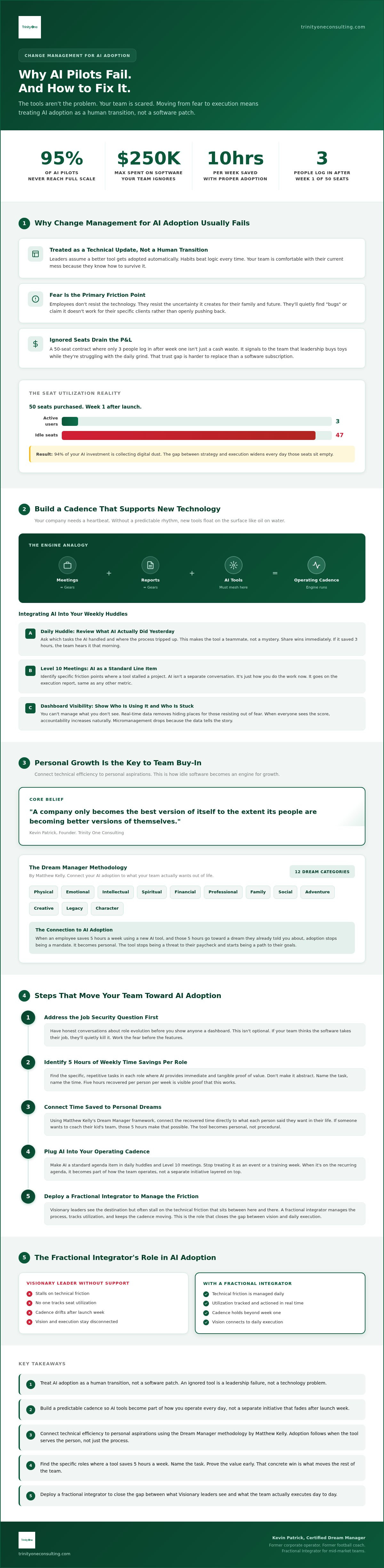
Ninety-five percent of generative AI pilot projects fail to reach full scale. You've likely spent anywhere from $15,000 to $250,000 on software that your team ignores because they're worried about being replaced. Successful change management for AI adoption requires a shift from technical focus to human focus. I'll show you how to move your team from fear to execution by aligning AI tools with their personal goals and your company cadence.
I've seen this play out in locker rooms and boardrooms for thirty years. You buy the best gear, but the players won't wear it because it feels foreign. Right now, your team sees AI as a competitor for their paycheck rather than a tool for their performance. That mismatch creates operational chaos and fragmented workflows that break your systems.
We're going to bridge that gap by connecting technical outputs to personal aspirations. This approach empowers your team to use AI, potentially saving 10 hours a week, and fosters a predictable operating cadence that keeps your people focused and your business growing.
I'm convinced that a company only becomes the best version of itself when its people are becoming better versions of themselves. We'll explore how to ensure your tech stack truly supports their lives and goals instead of complicating them. This approach turns idle software into an engine for growth.
Key Takeaways
- Treat AI adoption as a human transition rather than a software patch to prevent your investment from sitting idle.
- Build a company heartbeat through a predictable cadence that makes change management for AI adoption a natural part of your daily huddles.
- Connect technical efficiency with the personal aspirations of your staff by using the Dream Manager methodology by Matthew Kelly.
- Identify specific roles where new tools can save five hours a week to provide immediate, tangible proof of value for the team.
- Deploy a fractional integrator to manage the technical friction that often stalls progress for Visionary leaders.
Why does change management for AI adoption usually fail?
I've walked into offices where $50,000 of AI software is collecting digital dust. The licenses are active. The logins work. But the seats are empty. This happens because leaders treat the rollout as a technical update rather than a human transition.
Most leaders assume that if a tool is better, people will use it. That's a mistake. Habits are stronger than logic. Your team is comfortable with their current mess because they know how to survive it.
Successful change management for AI adoption requires you to stop selling the features and start solving the friction. If a tool feels like an extra chore, it will die. It has to feel like a way to win back time for things they actually care about.
The cost of ignored software seats
Buying a license is not the same as changing a workflow. I see this every month with mid-market companies. They sign a contract for 50 seats of a new tool, but only three people log in after the first week.
Those unused seats aren't just a waste of cash. They represent a widening gap between your strategy and your execution. Unused tools create a drag on your profit and loss statement that most CEOs ignore until the end of the quarter.
When you ignore this gap, you lose the team's respect. They see a leader who buys toys while they're struggling with the daily grind. You lose their trust in your vision, and that's much harder to replace than a software subscription.
Fear is the primary friction point
Your employees are scared. They worry that AI is a tool for their replacement. If an operator thinks a piece of software will take their job, they'll sabotage it. They won't do it loudly. They'll just find "bugs" or claim it doesn't work for their specific clients.
You're dealing with the Technology Adoption Life Cycle in real time. Your laggards aren't just slow. They're defensive. You have to address the job security question before you show them the dashboard.
If you don't talk about the human cost, the software won't matter. People don't resist the technology. They resist the uncertainty that the technology creates for their family and their future. I've found that honest conversations about role evolution work better than any technical training manual.
How do you build a cadence that supports new technology?
Your company needs a heartbeat. Without a predictable rhythm, new tools just float on the surface like oil on water. Effective change management for AI adoption happens when you stop treating software as an event and start treating it as a pulse.
I've found that a clear operating cadence ensures that technology serves your schedule instead of dictating it. If you don't integrate these tools into your existing flow, they'll be forgotten by the next payroll cycle. You need a system where the machine operations align with your human performance every single day.
Think of your business as an engine. Every meeting and every report is a gear. If you drop a new AI tool into the mix without timing it to the other gears, you'll strip the threads. We want the technology to plug into the rhythm you already have.
Integrating AI into your weekly huddles
Stop talking about what you might do with AI. Start reviewing what it actually did yesterday. In your daily huddles, ask which tasks the AI handled and where the process tripped up. This makes the tool a teammate rather than a mystery.
If your marketing assistant saved three hours using a prompt, share that win immediately. If the tool hallucinated a client report, fix the process right there. Real talk in a huddle beats a theoretical training manual every time.
Use your Level 10 meetings to identify specific friction points where a tool stalled a project. AI should be a standard line item in your execution report. It's not a separate conversation. It's just how you do the work now.
The role of real-time visibility
You cannot manage what you do not see in your business engine. AI adoption requires a dashboard that shows who is actually using the tool and who is stuck. I recommend using Trinity Cadence to track how AI tasks actually move the needle for your team.
Visibility reduces the need for micromanagement because the data tells the story. When everyone sees the score, team accountability increases naturally. It removes the hiding places for those who are resisting the change out of fear or habit.
I've seen operators flourish when they see their output climb without their hours increasing. If you're struggling to see the output of your tech stack, we can look at your current meeting rhythm together to find the gaps. This isn't about being a robo-boss. It's about having the clarity to lead your people well.
Why is personal growth the key to team buy-in?
A company only gets better when the people in it get better. You can't separate the operator from the person. If you want your team to care about your AI ROI, you must care about their personal goals. I believe that every person is created with a purpose that extends far beyond their job description.
I use the Dream Manager methodology, created by Matthew Kelly, to bridge this gap. This isn't fluff. It's a strategic way to align individual desires with corporate objectives. Change management for AI adoption fails when the team thinks the technology only serves the owner's bank account.
Imagine an employee sees that a new tool saves them two hours every Tuesday. If those two hours help them get home early for their kid's soccer game, they'll adopt the tool every time. They aren't doing it for your bottom line. They're doing it for their life. This is the only way to make change management for AI adoption stick long-term.
The twelve dream categories
Matthew Kelly identifies twelve categories of dreams in his work. These range from financial and physical dreams to character and legacy dreams. Helping an employee buy their first home is a better motivator than a 5% efficiency gain. If the software makes that dream possible, the software stays.
When AI handles the grunt work, your team has more space for professional growth. They can focus on creative problem solving instead of data entry. This shift makes them more valuable to the company and more satisfied in their roles. It turns a job into a career.
Linking AI ROI to employee retention
Replacing a trained employee costs roughly 1.5 times their annual salary. If you lose a $70,000 operator because they're burnt out, that's a $105,000 hit to your business. AI should be sold as a tool that prevents burnout by removing the repetitive tasks that drain energy.
Most people don't quit because the work is hard. They quit because the work is mindless. When you replace the mindless tasks with machine logic, you preserve the human spirit for the work that actually matters. This is where the real ROI lives.
Engagement spikes when the team knows you are invested in their life outside the office. Use technical tools to create margin in their schedule. This is how you win the talent war. If you show them that AI is the path to their own personal progress, they will lead the adoption for you.
What steps will move your team toward AI adoption?
Start by mapping where AI can save at least five hours a week for a specific role. If you can't find five hours, you're looking at the wrong role or the wrong tool. Effective change management for AI adoption starts with a win that an operator can feel in their bones.
Once you have that map, you must review the ROI of AI implementation every thirty days. Skeptics don't care about your vision. They care about whether the work got easier or the profit went up. I've seen too many leaders hide the data because the results were messy. Don't do that.
You also need the courage to kill the tools that don't work. Do not force the team to use clunky software just because you signed a year-long contract. If a tool creates more friction than it removes, cut it loose immediately. Your team's trust is worth more than a $2,000 subscription fee.
The rapid launch sprint
Do not try to change the whole company in a week. Pick one high-friction process, like client onboarding, and apply AI there first. I've seen teams get bogged down in strategic planning for six months while their competitors are already executing. A launch sprint forces you to move from theory to a live environment in days.
Success in one small area creates the social proof needed for the rest of the team. When the onboarding team stops staying late on Fridays, the rest of the office will notice. They'll start asking how they can get the same results for their own departments.
This approach is bad at creating a massive, overnight culture shift across 500 employees. It's a slow burn. But it's a sustainable burn that doesn't exhaust your leadership team or break your existing systems. You're building a foundation, not a facade.
Measuring what matters
Track time saved instead of abstract concepts like digital transformation. If a weekly project meeting went from 90 minutes to 60 minutes because of AI-driven prep, that is a win you can bank. Those 30 minutes represent real capacity returned to your business engine.
Share these wins publicly during your company huddles. Use specific names and numbers. I once had a COO tell me, "Kevin, if this takes one more click than the old way, the team will riot." He was right. Highlighting that Sarah saved four hours on reporting this week proves the tool actually works for the operator.
How can a fractional integrator run this process for you?
Most Visionary CEOs have the ideas but lack the patience to manage the technical transition. You see the massive potential of machine intelligence but you don't want to spend your Tuesday morning debugging a workflow. Change management for AI adoption requires a level of detail that usually kills a Visionary's spirit.
A fractional COO acts as the integrator who makes the AI tools and people work together. I focus on the 'how' so you can stay focused on the 'what' and 'why' of your business. You provide the fuel and I ensure the engine doesn't seize up when we add new components.
The integrator ensures that your AI-native operating system actually runs without you having to touch it. We build the systems that verify the work is getting done. This allows you to lead from a place of clarity rather than a place of constant technical firefighting.
Visionary vs. Integrator in the AI age
The Visionary sees the potential of AI. The Integrator sees the friction in the daily workflow. You need both to succeed, but the Integrator is the one who actually drives adoption across the departments. Without an integrator, your AI strategy is just a series of expensive experiments that never quite stick.
Read more about the visionary integrator relationship to see where you fit in this dynamic. If you're the one constantly suggesting new tools, you're the Visionary. You need someone to protect the team from your own enthusiasm by vetting the tools before they break the current rhythm.
Professional services for AI deployment
A fractional executive provides the high-level authority of a COO at a fraction of the cost of a full-time hire. We manage the vendor relationships, the team training, and the monthly ROI mapping. You get the results of a sophisticated tech stack without having to become a software expert yourself.
This approach is bad for companies that want a 'yes man' instead of an operator who tells the truth. I've told clients to stop spending money on tools that were too complex for their current staff. My loyalty is to the health of your business engine and the growth of your people, not the software vendor.
I believe that my work is an expression of service. Helping you align your tech with your human purpose is how I help your company become its best version. We don't just add software. We integrate life and work into a single, functional whole.
Moving from technical friction to human performance
AI isn't a threat to your business engine. It's a high-performance component that requires a specific rhythm to run. Successful change management for AI adoption happens when you stop managing code and start leading people.
I've spent 30 years in operational leadership and as a Certified Dream Manager. I use the methodology created by Matthew Kelly to bridge the gap between technical efficiency and human desire. When you align their personal dreams with your data, the resistance will evaporate. This is how you turn fragmented tools into a system that saves 10 hours a week.
You need a predictable cadence to keep the gears turning. A fractional integrator can manage the technical friction so you can focus on the vision. If you're tired of paying for AI tools your team ignores, we should talk. We'll find the five-hour wins for your specific roles.
God has given you the vision to grow. Now let's build the cadence to make it happen.
Frequently Asked Questions
What is the biggest mistake leaders make during AI adoption?
The biggest failure is treating this as a software update rather than a leadership challenge. Leaders often dump $50,000 into licenses without identifying a single role-based win. Effective change management for AI adoption requires you to map technical outputs to human outcomes. If your team doesn't see how the tool helps them win, they'll find ways to make it fail. You must lead with the person, not the platform.
How do I deal with employees who are afraid AI will replace them?
You have to have a blunt conversation about job security immediately. If an employee thinks the machine is their replacement, they'll sabotage the rollout. I use the Dream Manager methodology to show them that AI is a tool for their personal progress. It handles the data entry so they can handle the creative work. When they see the tool saves them 10 hours a week for their own goals, the fear dies.
How long does it take to see a real ROI from AI tools?
You should see a tangible return within the first thirty days if you use a rapid launch sprint. Don't wait six months for a massive technical shift that never arrives. We track specific wins, like reducing a client onboarding process by four hours or cutting meeting prep time by 50%. Regular ROI mapping ensures you aren't paying for software that sits idle. If it doesn't move the needle in a month, it's the wrong tool.
What is the Dream Manager program and how does it help with tech?
This is a proprietary methodology created by Matthew Kelly that focuses on the personal dreams of your employees. I'm a Certified Dream Manager because I've seen that a company only grows when its people grow. In a tech shift, this program bridges the gap by making the software a vehicle for their life goals. It turns a work chore into a way to achieve something meaningful outside the office. It's the engine for engagement.
Do I need a full-time COO to manage my AI integration?
Most mid-market companies don't need a full-time executive salary on their P&L for this transition. A fractional COO acts as the integrator who manages the vendor relationships and the team training. I focus on the "how" so you can stay focused on the vision. You get the high-level authority of a seasoned operator at a fraction of the cost. It's about getting the execution right without the overhead.
What are the twelve dream categories mentioned by Matthew Kelly?
Matthew Kelly identifies twelve specific areas where people have aspirations. These include:
- Physical and Emotional
- Intellectual and Spiritual
- Psychological and Material
- Professional and Financial
- Creative and Adventure
- Legacy and Character
When you help an employee achieve a dream in one of these categories, their loyalty to your vision becomes unbreakable. It's a retention tool that works because it values the whole person.
How does Trinity Cadence help with change management?
Trinity Cadence is an AI-native operating system that provides real-time visibility into your business engine. It creates a predictable heartbeat through structured huddles and execution reports. This visibility is vital for change management for AI adoption because you can see who is using the tools and who is stuck. It removes the hiding places for resistance. It ensures your tech stack and your people are moving in the same direction.
Can AI really improve employee retention?
Retention improves when you use technology to remove the mindless tasks that cause burnout. Replacing an operator costs roughly 1.5 times their annual salary, so keeping your team is a massive financial win. AI should be positioned as a tool that creates margin in their schedule. Engagement spikes when the team knows you're invested in their life outside the office. When work feels purposeful instead of repetitive, people stay. I believe we're called to serve our people well.