
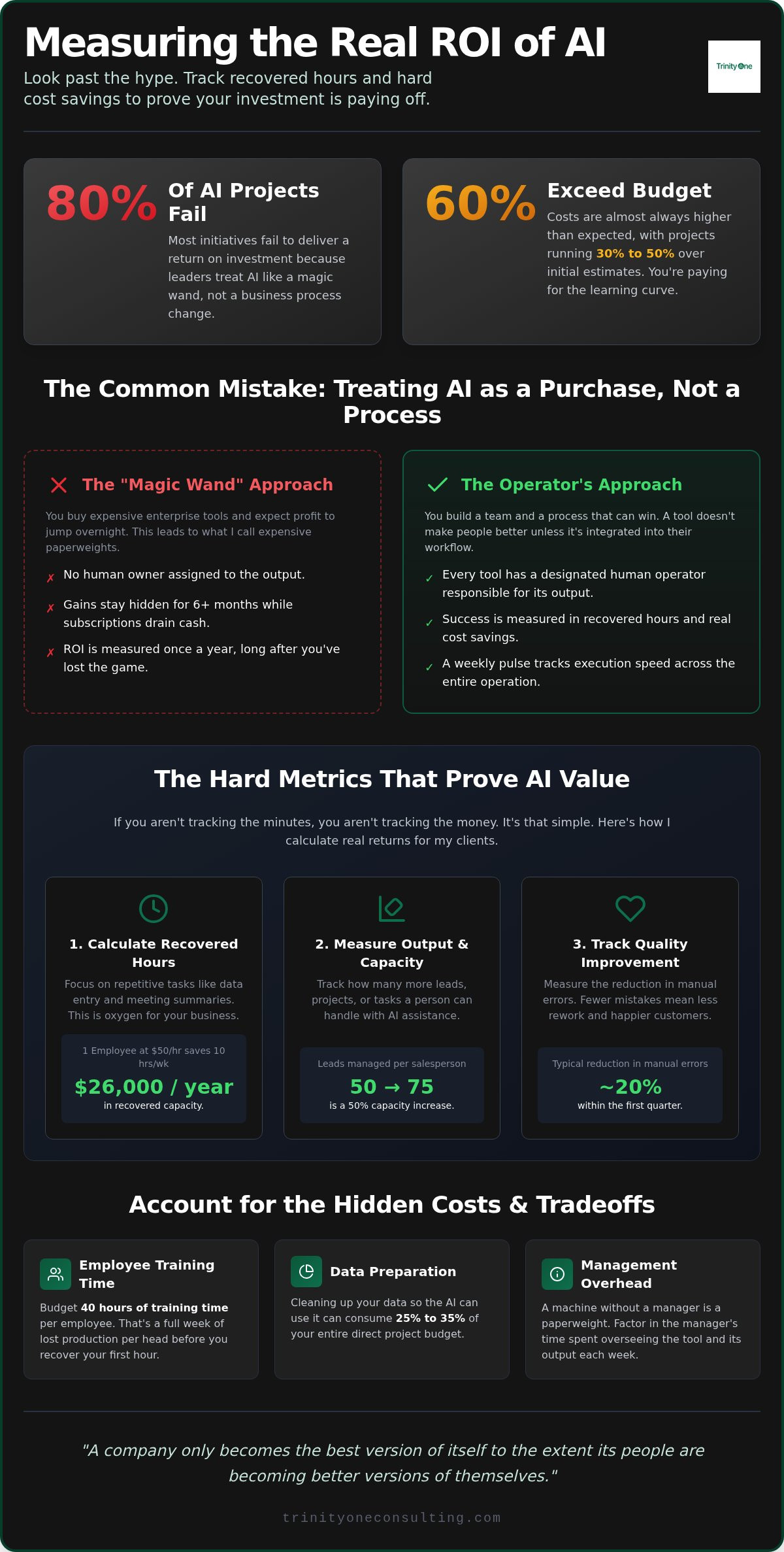
Over 80% of AI projects fail to deliver a return on investment. With 60% of these initiatives exceeding cost estimates by up to 50%, you're likely writing checks for software subscriptions that feel like expensive paperweights. Measuring ROI of AI implementation requires looking past the hype and tracking actual recovered hours and hard cost savings.
It's frustrating to watch your overhead climb while your team complains that new tools just add more work to their plates. You need the engine to run faster. You don't need more chrome on the hood. I've spent decades in the trenches as an operator and a coach.
I know that if a tool doesn't make your people better, it's just noise. You can track the hard financial gains and human performance metrics that prove your AI investment is actually paying off. We'll use the Trinity Cadence to gain real-time visibility into recovered hours and the actual cost of your operational engine.
Forget the theory. Focus on execution. I believe we are called to steward our resources and our people with equal care. A company only becomes the best version of itself to the extent its people are becoming better versions of themselves.
Key Takeaways
- Measuring ROI of AI implementation requires moving past vague software costs to track recovered hours and specific dollar amounts saved per employee.
- I'll show you why every AI tool needs a designated human operator responsible for its output to prevent monthly subscriptions from draining your profit.
- You'll learn to use Matthew Kelly's Dream Manager methodology to connect tool adoption with personal growth so your team doesn't sabotage new systems.
- We'll establish a weekly huddle rhythm that turns abstract data into a clear operating engine, making your technical debt visible and manageable.
- I'll explain how the Trinity Cadence platform integrates machine efficiency with human motivation to provide the real-time visibility your leadership team currently lacks.
Why is calculating the return on AI so difficult for leaders?
Leaders often treat AI like a magic wand. They buy the software and expect the profit to jump overnight. It doesn't work that way. Measuring ROI of AI implementation is difficult because most executives treat it as a tech purchase instead of a business process. I've seen this mistake in boardrooms and on the field. You can't just buy the trophy. You have to build the team that can win it.
I see companies shell out $5000 every month for enterprise tools without assigning a single human to own the output. If nobody is responsible for the machine, the machine is just a drain on your cash flow. You're paying for the code today, but the actual gains might stay hidden for six months or more. A standard calculation for Return on Investment (ROI) usually focuses on simple inputs and outputs. AI is different because it carries heavy technical debt when you force tools into a workflow that isn't ready for them.
This friction acts like a governor on a racing engine. It slows down your entire business. Research from 2024 shows that over 80% of AI projects fail to deliver their promised value. Much of that failure comes from a lack of accountability. If you don't have an Integrator looking at the gears, the engine will eventually seize up.
Identifying the time discrepancy between cost and gain
You have to account for the 40 hours of training time each employee needs to actually use these systems. That's a full week of lost production per head. I recommend tracking the time to value for every new tool you bring into the building. Short term costs almost always spike before you recover your first hour. Data shows 60% of projects exceed their initial cost estimates by 30% to 50%. You're paying for the learning curve and the data cleanup long before you see the dividend. In fact, data preparation can consume 25% to 35% of your direct project budget.
Moving beyond the trap of single point in time measurements
Measuring ROI once a year is a recipe for failure. If you wait twelve months to check the scoreboard, you've already lost the game. If you are serious about measuring ROI of AI implementation, you need a weekly pulse on how these tools are changing your actual workflows. I look for trends in execution speed rather than one-off wins. A single fast task doesn't prove the system works. Consistent, repeatable speed across your entire operation is the only metric that matters for the bottom line. It requires a disciplined cadence to see the truth.
What are the hard metrics for measuring ROI of AI implementation?
Measuring ROI of AI implementation starts with recovered hours. If you aren't tracking the minutes, you aren't tracking the money. It's that simple. I believe we are called to be good stewards of every hour we are given.
Consider a single employee earning $50 an hour. If an AI tool saves them 10 hours a week, that is $500 a week in recovered capacity. Over a year, that adds up to $26,000. This isn't "found money." It's oxygen for your business.
This recovered capacity allows you to scale without the immediate need for another $70,000 salary plus benefits. You must subtract the subscription costs and the actual time spent managing the tool. If the software costs $200 a month but requires five hours of manual oversight from a manager, your net gain shrinks. I track the reduction in headcount needs as the business scales to see if the engine is actually getting leaner.
I tell my clients that a machine without a manager is just an expensive paperweight. If you want to see how these numbers apply to your specific shop, let's talk about your operational engine.
Calculating recovered hours and labor cost reductions
I use a simple time tracking audit before and after implementation. You can't manage what you don't measure. Focus on repetitive tasks like data entry and meeting summaries. These are the low-hanging fruit of automation. Multiply the recovered hours by the fully burdened labor rate (which includes taxes, benefits, and overhead). This gives you the true cost of the work you've shifted to the machine.
Measuring the impact on output and error rates
Track how many more leads a salesperson can handle with AI assistance. If they used to manage 50 leads a month and now they handle 75, that's a 50% increase in capacity. I also look for a 20% reduction in manual errors within the first 90 days. Mistakes cost money in rework and lost reputation. Compare the cost of AI-driven output against your traditional manual methods to see where the friction is disappearing.
Identifying the hidden costs of training and infrastructure
Do not forget the cost of the Fractional COO or Integrator who manages the system. Every engine needs a mechanic. I include the price of API tokens and extra storage in the math. AI reduces labor costs but it increases your technical management needs. You're trading human muscle for machine logic, but that logic still requires a human architect to keep it aligned with your goals.
How does employee engagement dictate the success of your AI tools?
Your AI strategy will die on the vine if your team thinks it is there to replace them. Fear is a powerful decelerator. If an employee believes a new tool is a threat to their mortgage, they will find ways to make it fail. Measuring ROI of AI implementation is impossible when your staff is actively sabotaging the data or refusing to log their hours correctly.
I use the Dream Manager concept by Matthew Kelly to build genuine buy-in. I show the team that the machine serves the man. When an employee sees that AI saves them two hours of soul-crushing data entry, they start to listen. But they only care if those two hours help them achieve something they actually value outside of these four walls.
Retention is a massive ROI driver that most CFOs completely overlook. They look at the software bill and the output speed, but they ignore the cost of a revolving door. A company only becomes the best version of itself to the extent its people are becoming better versions of themselves. I believe we are called to steward our people's potential as much as our profit.
Linking personal dreams to professional performance
I ask employees a simple question. What would you do with two extra hours every day?
I use the twelve dream categories defined by Matthew Kelly to align their personal goals with company efficiency. These categories include things like physical health, emotional well-being, and financial stability.
If a mother wants to get home in time for her son's football practice, she will adopt any tool that gets her work done faster. You can read more about our Dream Manager program to see exactly how this works. We stop talking about "efficiency" and start talking about "time for what matters."
Tracking retention costs and recruitment savings
Replacing a $100,000 employee often costs you $150,000 in lost productivity, recruiting fees, and training time. That is a massive leak in your boat.
If your AI implementation reduces burnout and improves retention by even 10%, the ROI is clear.
I track the engagement score of the team alongside technical metrics like tokens used or prompts generated. Technical efficiency means nothing if your best people are walking out the door because they feel like a cog in a machine. I want to see the human engine running as smoothly as the software engine.
What steps create an operating cadence that tracks AI performance?
Metrics only matter if you look at them in a disciplined rhythm. If you don't have a schedule for review, your data is just a pile of numbers. Measuring ROI of AI implementation requires more than a spreadsheet. It requires a heartbeat for your business.
Without a clear cadence, AI tools become "shelfware" that you pay for but never use. You're essentially burning cash every month for code that sits idle. I see this happen most often when a business lacks a fractional COO to own the execution. You need someone to ensure the machine is actually running.
Integrating AI metrics into your weekly huddle
Review the "hours saved" metric every Tuesday morning. This isn't a long meeting. It's a quick pulse check to see if the tools are doing what we bought them to do. If a tool isn't saving time, we either fix the process or cut the subscription.
Identify which team members are struggling with adoption during this time. Some people move faster than others. You can see how a fractional COO leads your AI adoption strategy by keeping the team aligned and moving forward. We don't leave people behind.
Assigning an Integrator to manage the technical debt
The Visionary finds the tools, but the Integrator makes them work. I see too many owners trying to manage the software themselves. You're a leader, not a systems admin. When you spend your time fixing API connections, you aren't leading your people.
The cost of an Integrator is an investment in protecting your profit. They manage the technical debt and ensure the tools talk to each other. This keeps your business engine from grinding to a halt under the weight of poorly integrated tech. It's a trade of money for focus.
Calibrating your business rhythm for 2026
Your operating cadence must be fast enough to catch technical friction before it becomes a crisis. Use real-time data instead of waiting for monthly reports. By the time a monthly report hits your desk, the damage is already done. You need to see the smoke before the fire starts.
I believe a company only grows when its people are becoming better versions of themselves. This growth happens in the small, daily wins. A disciplined rhythm provides the space for that growth to occur. It keeps the machine efficient and the humans focused on their purpose.
How does Trinity Cadence help you prove AI value?
I built Trinity Cadence to provide the real-time visibility you are currently missing. Most leaders fly blind when it comes to their tech stack. Measuring ROI of AI implementation is impossible if you can't see the gears turning in your business engine. This platform provides the clinical precision needed to verify that your software is actually producing a profit.
It combines machine operations with human management in one place. This isn't just another dashboard for the IT department. It's an operating system for the entire company. You can see exactly where execution is stalling and which AI tools are helping your people move faster. We move from theory to execution by tracking the actual movement of work through your systems.
We apply the twelve dream categories directly to the coaching modules. This connects the cold logic of the machine to the warm reality of human motivation. A company only becomes the best version of itself to the extent its people are becoming better versions of themselves. I believe we are called to lead with both strength and conviction.
Using real time visibility to see execution gaps
Stop guessing if your team is using the new software. I provide a dashboard that shows exactly how AI is impacting your cadence. This eliminates the "fog of war" that happens during rapid growth. When you can see the friction points in real time, you can fix them before they cost you a client or a talented employee. We look for the "red lights" on the dashboard so the Integrator can clear the path for the rest of the team.
This visibility allows you to manage the technical debt before it becomes a liability. If a tool isn't being used, we cut it. If a process is broken, we fix it. There is no room for vanity metrics in a high-performing engine. We only care about what moves the needle on your bottom line.
Applying the twelve dream categories to drive buy-in
Our software includes AI coaching that helps employees track their personal goals. We use the methodology created by Matthew Kelly to ensure that work serves the person. This creates a culture of loyalty that makes measuring ROI of AI implementation much easier. When people see that the company cares about their dreams, they stop fighting the technology and start using it to win.
This approach solves the problem of team resistance. We connect the recovery of hours to the pursuit of personal growth. If AI saves a manager five hours a week, and those five hours go toward their physical health or family life, they become an advocate for the system. You get a faster business and a more committed team at the same time.
Book your 30 minute Trinity One cadence call with Kevin Patrick
Stop guessing and start leading your AI implementation
You've seen that measuring ROI of AI implementation isn't just about software bills. It's about discipline. It requires tracking recovered hours and managing the technical debt that threatens your profit. I've spent decades in the trenches of corporate leadership and on the football field. I know that an engine only performs when every component is aligned.
We use the Certified Dream Manager methodology by Matthew Kelly to ensure your team sees AI as a partner. This human connection is the only way to protect your investment. Without a weekly cadence and a dedicated Integrator, your tools will eventually become expensive shelfware. I'm convinced that we are called to be faithful stewards of both the machines we build and the people we lead.
You can stop the leaks in your operational engine today. Let's look at your systems and your people together.
I look forward to hearing your story and helping your team reach its full potential.
Frequently Asked Questions
Is it possible to measure the ROI of AI implementation for small teams?
Yes, measuring ROI of AI implementation is actually easier for small teams because the impact of every recovered hour is more visible. If a three-person operation saves 15 hours a week, that's a 12% increase in total capacity without adding a single salary. You can see the shift in execution speed immediately in your weekly huddle. Small teams don't have the luxury of waste, so the math is always more urgent and direct.
How long does it take to see a positive return on AI investments?
Positive cash flow typically surfaces after the first six months once the team moves past the learning curve. Research shows that enterprise grade systems can take 2 to 4 years to mature fully. Top performing companies achieve returns as high as 10x their initial investment, but they are the exception. It takes patience and a disciplined process to build a winning season.
What are the most common AI implementation challenges that hurt ROI?
42% of companies abandoned most of their AI initiatives in 2025 because they couldn't see the value. 80% to 95% of AI projects fail to deliver a return because leaders treat them as technical pilots instead of operational changes. Poor data quality and weak integration are the most common killers of profit. If your data is a mess, the machine will just produce mistakes at a faster rate.
Should I hire a fractional COO to manage my AI strategy?
You need a fractional COO if you're currently acting as the systems admin for your own tools. A leader's time is too expensive for technical troubleshooting. An Integrator ensures that the machine actually serves the business goals instead of just adding complexity. They manage the technical debt and protect your profit by holding the team accountable to the new cadence. They keep the engine running so you can stay focused.
How does the Dream Manager program impact my company's bottom line?
The Dream Manager program, based on Matthew Kelly's methodology, protects your profit by reducing the cost of employee turnover. Replacing a $100,000 employee costs about $150,000 in lost production and recruitment fees. When you help people achieve their personal dreams using the twelve dream categories, they stay longer and work harder. Loyalty is a massive profit driver that doesn't appear on a standard balance sheet.
What are the hidden costs of AI that most consultants do not mention?
Consultants often hide the cost of data preparation, which can eat up 35% of your direct project budget. You also have to account for API tokens and the extra storage required to keep the systems running. The biggest hidden cost is the 40 hours of training time needed for every employee to become proficient. You must include these lost production hours when measuring ROI of AI implementation.
Can AI coaching really improve employee performance and retention?
AI coaching improves retention by personalizing the growth of your staff. When a tool helps an employee achieve a personal goal, like finishing work in time for a child's soccer game, their engagement spikes. This isn't about being soft. It's about recognizing that a company only becomes the best version of itself when its people are becoming better versions of themselves. High engagement leads to lower recruitment costs.
How do I know if my team is actually using the AI tools I pay for?
I suggest using a real-time dashboard like Trinity Cadence to see exactly who is using the tools. You shouldn't have to guess if your team is logging in or if the software is sitting idle. If usage drops, it usually means the tool is adding more friction than it is worth. Constant visibility allows you to cut the shelfware before the next billing cycle. I believe that real-time data beats a monthly report.