
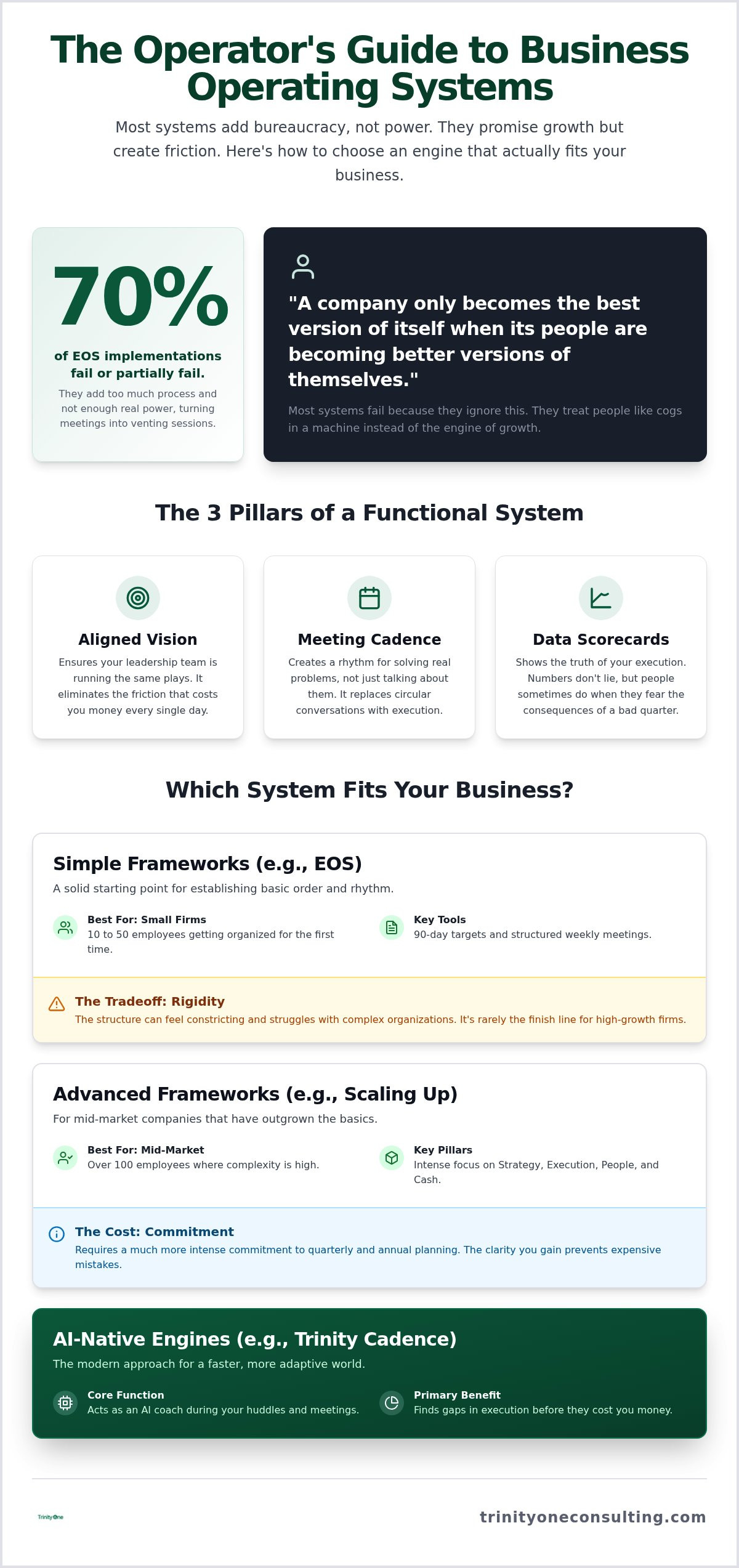
A business operating system is either the engine that drives your growth or the weight that sinks your profit. Seventy percent of EOS implementations fail or partially fail because they add too much bureaucracy and not enough power. When you look at business operating system examples, you have to look past the marketing gloss. You need a system that fits your current headcount and your actual growth goals.
I've spent 30 years in the trenches as an operator and a coach. I know the frustration of a Level 10 meeting, a term used in EOS, that turns into a ninety-minute venting session. You want a rhythm that runs itself. I believe a company only becomes the best version of itself when its people are becoming better versions of themselves.
You will learn the specific differences between the popular systems on the market today. I'll show you which ones scale with you and which ones will break under the weight of a growing team. We'll look at the costs and the tradeoffs of each approach. This includes a hard look at where these systems fail.
We will compare methodology-heavy options like EOS against AI-native engines, including Trinity One's Trinity Cadence, to find your perfect fit. This isn't about theory. It's about finding the right mechanics for your business.
Key Takeaways
- A business operating system is the mechanical engine that dictates how you meet and measure success. It replaces daily firefighting with a predictable rhythm that runs itself.
- Compare business operating system examples like EOS for small firms and Scaling Up for mid-market companies to see which fits your current headcount.
- Identify why most systems fail by neglecting the human element and the personal dreams of your employees.
- Learn how AI can act as a coach during your huddles to find gaps in execution before they cost you money.
- Use a clear framework to choose between a manual methodology and an AI-integrated engine based on your specific growth goals.
What is a business operating system?
A Business Operating System (BOS) is the mechanical engine under your company hood. It consists of the repeatable processes that dictate how you meet and how you measure success. Most founders start with heroics. They hire talented people and hope those individuals figure out how to win. That works for a while. But eventually, the friction of unorganized work burns everyone out. You need a system that runs without your constant intervention.
I've seen many business operating system examples that look good on a whiteboard but fail in the field. A real system isn't just a set of rules. It's the cadence of your business life. It's the difference between a team that executes and a team that just stays busy. When you rely on heroics, you're paying for talent but wasting it on friction. You're gambling on your people's ability to endure chaos instead of building a structure that supports them.
The core components of any functional system
A functional system must align your vision across the leadership team. If your VP of Sales and your COO are running different plays, you're losing money every day. You also need a meeting cadence that prevents circular conversations. These are the meetings where you actually solve problems instead of just talking about them. Finally, you need data scorecards that show the truth of your execution. Numbers don't lie. People often do when they're afraid of the consequences of a bad quarter.
Execution requires a clear rhythm. This rhythm ensures that every person in the company knows exactly what success looks like for their role. It eliminates the ambiguity that leads to "constant firefighting." When the system is working, the business has a heartbeat you can feel. It moves forward with a steady, predictable pressure.
Why manual systems are starting to fail
Traditional frameworks were built for a slower world. They don't account for how AI has changed the speed of work. These systems often treat people like cogs in a machine. They ignore the psychological needs of the team. If your people don't feel like they're growing, they won't care about your ROI. You need a fractional integrator to maintain the system. An integrator is the operational leader who manages the system and ensures every team member follows the established processes. Without that oversight, the engine eventually stalls.
Which business operating system examples are worth your time?
Choosing the wrong framework is a fast way to waste six figures on coaching fees and software licenses. You need a system that matches your headcount and your complexity. For small firms with ten to fifty employees, a popular introductory framework often provides a simple language for execution. However, if you're managing a mid-market company with over one hundred people, you'll likely outgrow such a basic approach. Looking at different business operating system examples helps you avoid the generic frameworks that kill many growth plans.
A simple framework for execution
A common simple framework is built for clarity and straightforward implementation. It often utilizes specific tools such as short-term goals (e.g., 90-day targets) and structured weekly meetings (e.g., a 90-minute pulse session). These tools are excellent for teams getting organized for the first time and establishing foundational rhythms. The tradeoff is that such frameworks can feel rigid. They may struggle with complex organizations that need more than a basic scorecard or a limited set of metrics. While a great starting point for establishing order, they are rarely the finish line for high-growth firms seeking nuanced control and advanced strategic alignment.
Advanced frameworks for high-growth organizations
For companies with high growth targets, more advanced frameworks offer a robust approach. These systems often build upon core pillars like Strategy, Execution, People, and Cash, requiring a much more intense commitment to strategic planning than simpler introductory systems. They are better suited for companies with over one hundred employees where the complexity is high and detailed planning is crucial. There is significant academic research on business management frameworks that supports these structured approaches for enterprise growth. You'll spend more time in quarterly and annual planning sessions, but the clarity you gain prevents expensive mistakes.
The E-Myth and Toyota Production System
Michael Gerber's E-Myth focuses on the transition from technician to manager. It's the classic philosophy of working on the business not in it. This is perfect for the founder who is currently doing all the work themselves. However, it often lacks the specific meeting rhythm found in modern systems. For manufacturing leaders, the Toyota Production System remains the foundation for lean efficiency. It focuses on eliminating waste and continuous improvement. Both are solid business operating system examples, but they require a lot of manual work to maintain in a digital office.
Trinity Cadence and AI-native alternatives
Modern leaders are moving toward AI-native systems. Trinity Cadence is built for this shift. It takes the best parts of traditional frameworks and integrates machine intelligence into your daily work. Instead of just tracking data, the system helps you identify execution gaps in real time. It's the next evolution for leaders who are tired of manual spreadsheets. If you want to see how this fits your specific team, you can book a discovery call to discuss your current operational friction.
Why do most business operating systems eventually fail?
Most business operating system examples focus entirely on the mechanics of the machine. They give you a Scorecard, a term used in EOS, and tell you to track the numbers until your eyes bleed. But numbers don't move themselves. People do. If your system is too clinical, your team will eventually view it as a burden rather than a tool. I've seen leaders install the most expensive frameworks only to watch their best people walk out the door because they felt like cogs in a gearbox.
Your people will not care about your ROI if you do not care about their dreams. It's that simple. Systems fail when they ignore the human spirit. You can have the best meeting rhythm in the world, but if your team is burnt out, that rhythm just becomes a march toward a cliff. A system that only tracks output eventually leads to high turnover and a toxic culture where everyone is just "doing their time."
The link between personal growth and company output
I am a Certified Dream Manager. I follow the methodology created by Matthew Kelly. His core belief is that a company only becomes the best version of itself to the extent its people are becoming better versions of themselves. This isn't soft talk. It's a hard operational truth. When you help an employee achieve a personal goal, like buying their first home or finishing a marathon, they bring that same energy to your shop floor. They become more engaged because they see their job as the vehicle for their life success.
Matthew Kelly identifies twelve dream categories that cover everything from physical health to financial stability. You can learn more about how to implement a dream manager program to start this process. By integrating these personal milestones into your weekly checks, you create a bond that goes deeper than a paycheck. You're no longer just a boss. You're a partner in their growth. This alignment is the only way to sustain high performance over the long haul.
The cost of ignoring the human element
High turnover is the most expensive line item on your P&L. It costs roughly thirty three percent of an employee’s annual salary to replace them. If your operating system is so rigid that it crushes individual initiative, you're throwing money away. A system must build loyalty through genuine human development. This means your Accountability Chart, another term from EOS, shouldn't just list business functions. It should reflect the growth path of the human being sitting in that seat. If you don't measure personal progress, you aren't running a business. You're running a factory for burnout.
How do you build an AI-native operating system?
AI is no longer a bolt-on feature for your software. It's the foundation of how you scale. Most business operating system examples rely on human memory and manual entry. This creates operational bottlenecks when scaling because your data is always stale by the time you see it. You need a system that processes information in real time.
Trinity Cadence is an AI-native engine. It acts as a coach during your huddles. It identifies execution gaps that a human integrator might miss during a busy week. This shift moves your leadership team from reactive firefighting to actual visibility. You stop wondering what happened and start knowing what to do. I believe work is a calling, and a system should honor the person doing the work.
Integrating AI into your meeting cadence
We use machine intelligence to summarize execution and employee engagement. Instead of looking at last week's data, the system helps you predict next week's issues. It functions like a radar rather than a rearview mirror. Manual scorecards, a term used in EOS, often require hours of data entry. We've replaced those with automated dashboards that pull truth directly from your workflows and integrated circuits.
This automation saves your leadership team roughly six hours of administrative work every month. You get a full day back. The machine handles the tracking while you handle the human motivation. It's a logical proof: less manual entry equals more strategic output. This is how you stop wasting time in meetings that go nowhere.
Using software to drive the Dream Manager process
Human development often feels too abstract for an operator. We fixed that with the DreamCompass app. This tool tracks the personal aspirations of your team using the methodology from Matthew Kelly. It makes the twelve dream categories a visible part of your company culture. It turns the "soft stuff" into a hard operational advantage.
Digital tools make human development measurable and repeatable across your entire headcount. You can see which dreams are being met and where your team needs more support. Combining this software with Dream Manager coaching ensures your people are growing alongside the business. It turns personal growth into a trackable metric that drives long-term loyalty.
How do you choose the right system for your team?
Choosing a framework is an investment in your future sanity. You must start by assessing your current headcount and the complexity of your work. If you have under twenty employees, you might survive on a manual system for a year or two. Once you cross that fifty-person mark, the friction of manual tracking will cost you thousands in lost productivity. Most business operating system examples are marketed as one-size-fits-all solutions. They aren't.
You need to decide if you want a manual framework or an AI-native engine like Trinity Cadence. A manual system requires a high level of administrative discipline from every manager. If your leadership team is already drowning in emails, adding more manual reporting will likely fail. You're asking for more work from people who have no more to give. An AI-native system handles the heavy lifting of data collection so your people can focus on solving problems.
The role of the fractional COO in implementation
Founders are often the worst people to install their own system. I've seen it happen dozens of times. A founder gets excited about a new book, buys copies for the whole team, and then gets bored with the details three weeks later. This kills morale. It makes your team cynical about the next "big idea." You need an integrator to take your vision and turn it into a functional engine. An integrator is the operational leader who manages the system and ensures every team member follows the established processes.
I provide fractional COO services to act as that steady hand. We install the mechanics of the system while you stay in your unique ability. This prevents the "flavor of the month" syndrome that plagues many small businesses. The cost of a professional implementer can range from $3,000 to $5,000 per month. That's a real expense. But the cost of a failed implementation is much higher in terms of wasted time and team turnover.
Making the final decision
Look for a system that balances technology with human performance. You want a rhythm that makes people better, not just busier. Avoid systems that require you to change your core values to fit their mold. If your culture values autonomy, don't buy a system that micro-manages every minute of the day. You can start by testing a Level 10 meeting agenda template, which is a core tool from EOS. It will give you a taste of the discipline required to run a high-performance team without the circular talk.
The right system should feel like it's clearing the path, not adding hurdles. It should use machine intelligence to give you the truth of your execution. If you're ready to stop firefighting and start building a business that runs itself, let's talk. Every business operating system examples evaluation should end with a clear path forward.
Schedule a discovery call to find the right engine for your business. You can book a time at this Calendly link.
Install the engine your business deserves
You've seen the business operating system examples that drive real results. The difference is always in the execution and the human connection. A system that ignores the dreams of your people will eventually fail. I've spent 30 years in the trenches and I know that profit follows purpose. You need a framework that respects your headcount and your specific goals.
We designed Trinity Cadence to be the next evolution for tech-forward leaders. It combines the clinical precision of AI with the empathetic depth of the Dream Manager program. This isn't about adding more work to your plate. It's about creating a rhythm that runs itself. You can move from manual tracking to real-time visibility.
I've seen founders struggle with the weight of operational chaos for far too long. It's time to install an engine that supports your vision instead of slowing it down. We can build a business that becomes the best version of itself. I'm ready to help you find the right path forward.
You've done the hard work of building a company from nothing. Now let's build the engine that lets you lead it without burning out.
Frequently Asked Questions
What is the most popular business operating system for small businesses?
EOS is the most popular choice for small firms with ten to fifty employees. It provides a simple set of tools like Rocks and Level 10 meetings, which are trademarks of EOS. These tools help teams get on the same page quickly. However, it can feel too basic for complex firms. I've used it for years and it's a solid starting point for any operator looking at business operating system examples.
How much does it cost to implement a business operating system like EOS?
Implementing a system like EOS typically costs between $3,000 and $5,000 per month for a professional implementer. The total investment can reach $60,000 to $100,000 over the course of the full implementation. This is a significant expense for a small firm. You are paying for the discipline and the outside perspective that a founder usually lacks. It’s a high price but the cost of staying stuck is higher.
Can I build my own business operating system from scratch?
You can build your own system, but it's usually a mistake for a growing company. Founders often spend hundreds of hours tinkering with spreadsheets instead of leading their people. You end up with a fragmented mess that only you understand. It’s better to start with a proven framework and customize it. This keeps you focused on your unique ability instead of becoming a part-time software developer.
What is the difference between EOS and Scaling Up?
EOS focuses on simple execution for small teams. Scaling Up, created by Verne Harnish, is built for mid-market companies with over one hundred employees. Scaling Up requires a much deeper commitment to strategic planning and cash management. If your business is simple, Scaling Up is overkill. If your business is complex, EOS will eventually break under the pressure of your growth.
How long does it take to see results from a new operating system?
You should expect to see the first real results within ninety days. This is one full quarter of using the new meeting cadence and tracking your Rocks, a term used in EOS. By the end of the first year, the system should feel like a natural heartbeat for the business. It takes time for the team to stop fighting the new discipline and start trusting the data.
Do I need a full-time COO to run an operating system?
You don't need a full-time COO until you reach a certain level of scale, usually around $10 million in revenue. A fractional integrator can install and manage your system for a fraction of the cost. This gives you the expertise of a battle-tested operator without the $250,000 salary. It’s the most efficient way to get your engine running without bloating your overhead.
How does the Dream Manager concept fit into a business operating system?
The Dream Manager program, created by Matthew Kelly, handles the human side of your system. It ensures your people are becoming better versions of themselves while they work for you. Most business operating system examples treat employees like cogs. We integrate personal dreams into the weekly checks to build genuine loyalty. When your people win at home, they bring that winning energy to your shop floor.
What are the benefits of an AI-native operating system?
An AI-native system like Trinity Cadence eliminates the manual labor of tracking data. It provides real-time visibility instead of waiting for a weekly report that is already stale. The system acts as a coach during your huddles to find execution gaps before they turn into expensive mistakes. This moves your leadership team from reactive firefighting to proactive growth. It’s the logical next step for modern operators.