Most leadership teams spend ninety minutes every week digging a hole they can't climb out of. You know the feeling. This level 10 meeting agenda template, a tool from the Entrepreneurial Operating System (EOS), is designed to stop the bleed and turn your operational friction into execution by solving issues once and for all.
We've all sat through sessions where the loudest person wins and nothing actually changes on the ground. You need a rhythm that forces accountability without killing morale. Forget about talking more. Focus on solving problems once so they never come back. I've seen this shift save teams from total burnout in companies with ten employees and those with five hundred.
I'll show you how to move through your Scorecard and Rocks, which are specific EOS terms, without going over time. I will break down exactly how to spend every minute to ensure your team stays in sync. You'll get a clear path to high-speed issue resolution. You'll get total alignment across your leadership group.
Key Takeaways
- Learn why the Level 10 meeting, an EOS process, uses a strict 90-minute block. This stops leadership teams from drifting into useless talk.
- Use a precise level 10 meeting agenda template to transition from personal wins to hard Scorecard numbers, an EOS tool, in under ten minutes.
- Identify the friction points that stop teams from solving real issues during the EOS Identify, Discuss, and Solve process.
- Discover how Trinity Cadence uses AI to flag when your numbers are trending toward a failure. This happens before it actually hurts your bottom line.
- Determine if your business needs the discipline of a Fractional Integrator, an EOS role, to keep the operational engine running at a high level.
What is a Level 10 meeting agenda?
A Level 10 meeting is a 90-minute weekly synchronization for leadership teams. It is a core component of the Entrepreneurial Operating System, which functions as a business operating system for companies that want to scale without losing their minds. The name is simple. At the end of every session, every person in the room rates the quality of that meeting on a scale of one to ten. If the average is below an eight, something is broken.
I have seen these meetings save companies from total operational collapse. Without a rigid structure, leadership teams drift into "business as usual" mode where they talk about problems but never kill them. A level 10 meeting agenda template ensures that you stay on track and do not waste the most expensive 90 minutes of your week. It forces a discipline that most founders naturally resist.
This isn't just another calendar invite. It is a precision tool for operators who are tired of circular conversations. You are there to solve problems. You are there to keep the company moving. If you aren't doing those two things, you should cancel the meeting and go back to work.
The core components of the EOS framework
Transitioning from a messy morning huddle to a precise cadence requires specific tools. The EOS framework uses Scorecards to track weekly numbers and Rocks to track 90-day priorities. These terms belong to EOS and are designed to provide absolute clarity. You cannot manage what you do not measure. The Scorecard gives you the data, and the Rocks give you the focus.
The Integrator is the person responsible for keeping this rhythm. In the EOS model, the Integrator is the glue that holds the leadership team together. They facilitate the meeting and ensure it doesn't turn into a social hour or a theoretical debate. Without an Integrator, the meeting will likely fail because nobody is holding the team to the clock. I've acted as an Integrator for years, and the biggest hurdle is always the temptation to go off script.
Why your current meetings are likely a Level 3
Most leadership meetings lack a clear objective. You walk in, complain for an hour, and walk out without a single documented action item. This is how you end up with meeting fatigue. It isn't a result of having too many meetings. It is a symptom of poor structure. I've sat in rooms where five executives spent forty minutes discussing a broken coffee machine while a six-figure client was walking out the door.
Think about the cost. If you have five executives in a room for 90 minutes, you are burning thousands of dollars in payroll. A Level 3 meeting provides zero ROI because issues remain unresolved. A structured level 10 meeting agenda template turns that expense into a high-performance engine. It stops the drift and forces your team to face the hard truths about the business.
How do you structure the 90-minute Level 10 meeting?
Every second of your leadership meeting has a price tag. An effective meeting agenda isn't about filling 90 minutes with noise. It's about generating a return on your payroll. I've used the EOS level 10 meeting agenda template for decades because it forces a specific, high-speed rhythm that keeps operators focused on the work that actually moves the needle.
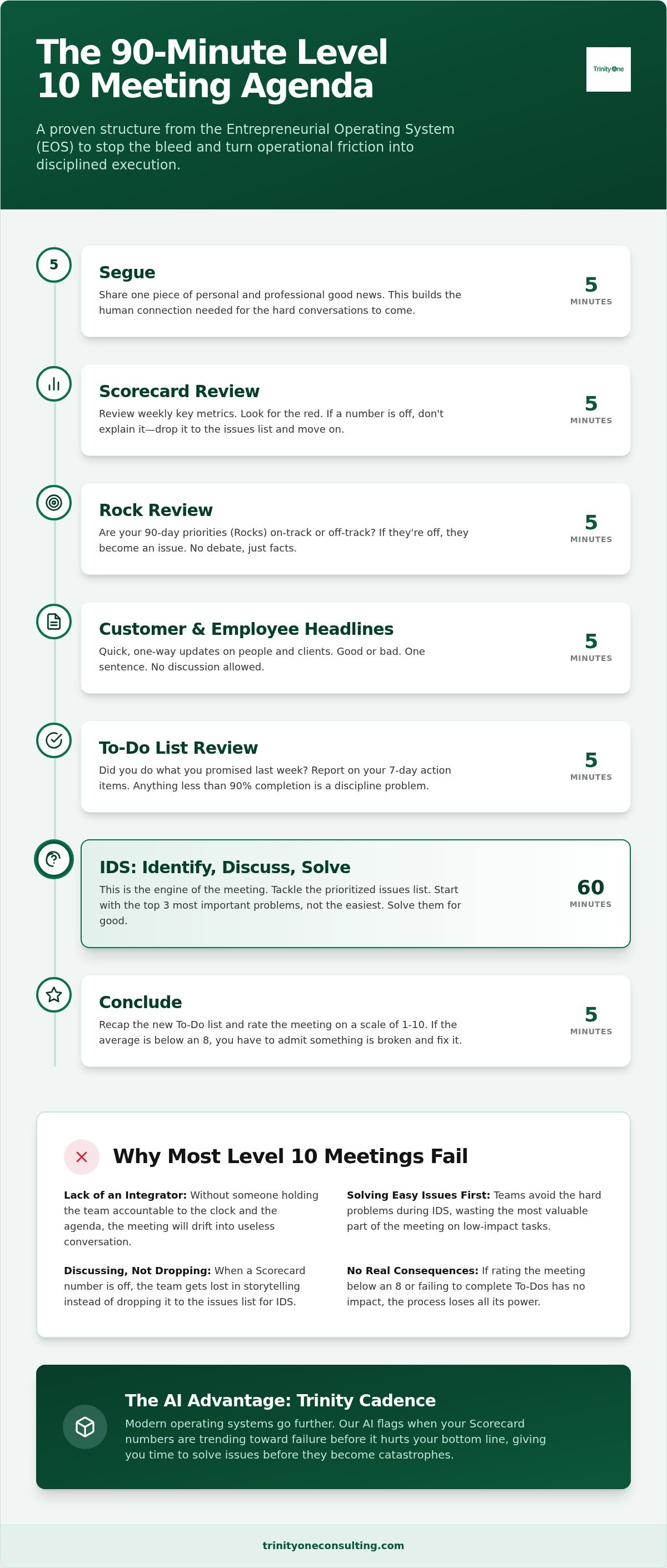
The meeting starts with a five-minute segue. Share one piece of personal good news and one piece of professional good news. This builds the human connection needed to survive the hard conversations coming later. We're not just parts in a machine. We're people who need to trust each other before we can solve problems together.
Next, spend five minutes on the Scorecard. This is an EOS tool for tracking your weekly numbers. Look for the red. If a number is off, don't explain it. Drop it to the issues list and move on. Speed is the priority here. You don't have time for stories in the first twenty minutes.
Follow this with five minutes for Rock review. Rocks are your 90-day goals as defined by EOS. They are either on track or off track. If they're off, they go to the issues list. Headlines take another five minutes for quick updates on customers or employees. Finally, spend five minutes on the To-Do list. Did you do what you said you'd do last week? If your completion rate is below 90 percent, your team has a discipline problem.
Mastering the IDS process
This is the engine of the meeting. IDS stands for Identify, Discuss, and Solve as defined by EOS. You have 60 minutes for this section. Most teams waste this hour by starting at the top of the list and talking about easy things. That's a mistake. You must pick the three most important issues first. If you solve the big problems, the small ones often disappear. If you run out of time before getting to the bottom of the list, that's fine. You handled what mattered most.
The concluding five minutes
Don't just walk out when the clock hits 90 minutes. Recap the new To-Do list so everyone leaves the room with total clarity on their next steps. Then, rate the meeting on a scale of one to ten. If your average is consistently low, your engine is misfiring. Maintaining this level of discipline is hard for a visionary founder. You might consider fractional COO services to act as the Integrator and keep the rhythm tight. You can book a discovery call to see how we can tighten up your operational cadence.
Why do most Level 10 meetings fail to solve real issues?
A static level 10 meeting agenda template is a map, but it isn't the engine. You can follow the 90-minute clock with clinical precision and still walk out of the room with the same elephants in the room. I've seen teams hit every mark on their Scorecards while the people behind the numbers were ready to quit. The document doesn't solve the problem. The people do.
The most common friction point happens between the Visionary and the Integrator. These are specific roles within the Entrepreneurial Operating System (EOS) model that often pull in opposite directions. During the IDS process, which stands for Identify, Discuss, and Solve as defined by EOS, the Visionary wants to talk about the five-year vision. The Integrator is trying to fix a production bottleneck that happened yesterday. This clash can derail the entire rhythm if you don't have a facilitator who knows how to ground the conversation in immediate execution.
Leadership teams also fail when they treat the meeting like a clinical trial. They ignore the human energy. You can't separate the operator from the person. If there is tension between your Head of Sales and your Head of Operations, no template in the world will fix your conversion rate. You have to be willing to have the "real talk" that most founders avoid to keep the peace.
The human element and the Dream Manager
A company only becomes the best version of itself to the extent its people are becoming better versions of themselves. This is the core of the Dream Manager methodology, a concept created by Matthew Kelly. I find that unresolved personal dreams often block professional output. If your lead developer is struggling with one of the twelve dream categories, like physical health or financial stability, they won't be fully present for your quarterly Rocks. You need to integrate personal growth into your professional expectations. Our Dream Manager program helps teams align their personal "why" with the company's "what" to stop the quiet quitting that kills productivity.
Common technical friction points
Outdated Scorecards are a silent killer of meeting momentum. If you spend twenty minutes arguing over whether the data is accurate, you've already lost the room. Static spreadsheets are too slow for high-speed leadership. They lack the real-time visibility needed to make fast decisions. You need data that is live and undisputed before the meeting starts.
You also have to watch out for "tangenting." This happens when one issue turns into a long story about a client from three years ago. It kills the rhythm and wastes thousands of dollars in executive time. If an issue isn't on the list, it doesn't exist for those 90 minutes. You have to be brutal about the clock to stay at a Level 10. This discipline is the difference between a high-performance engine and a messy huddle.
How can AI and integrated software run your meetings better?
A static level 10 meeting agenda template is a solid foundation, but manual data entry is a hidden tax on your leadership team. If your executives spend thirty minutes every Monday morning hunting for numbers in different spreadsheets, you are burning money. Trinity Cadence changes this by providing an AI-native operating system for your leadership. It moves the data for you so you can spend your time solving problems instead of finding them.
AI doesn't just record the past. It flags when a Scorecard metric is trending toward a future issue. Scorecards are an EOS tool, and they work best when the data is live. If your sales numbers are dipping on Tuesday, the system should tell you before Wednesday. This real-time visibility reduces the need for manual status updates. It connects your weekly huddle to your long-term vision with clinical precision.
Automating the business engine
Let machines handle the data entry. AI-native operations are the next logical stage of the EOS framework. You stop tracking history and start predicting performance. I've seen teams save five hours of preparation time every week by letting the system pull the data. That's time they can use to actually talk to their people.
Predicting performance means you can see a cash flow crunch thirty days before it hits. It means you know your hiring needs before your current team hits the breaking point. This isn't magic. It is the result of connecting your business operating system to live data feeds. It removes the guesswork that keeps founders awake at night. You can trust the engine to give you the truth.
AI coaching for the Integrator
The Integrator is an EOS role that requires intense focus. You have to manage the clock, the issues list, and the personalities in the room. Digital tools can now provide prompts to keep the meeting on track. Trinity Cadence helps maintain the operating cadence by highlighting when you are spending too much time on a minor issue. It keeps the pressure on the right points to ensure you hit that Level 10 rating.
Using technology this way turns a simple meeting into a high-performance engine. You can read more about how this works in The Fractional Integrator: Engineering Your Business Engine for 2026. This isn't a theory. It's how modern operators are winning. You get the discipline of the system without the fatigue of manual tracking.
Is it time to bring in a fractional integrator to run your engine?
Most visionary CEOs are terrible at running their own meetings. It is a fact of biology. You are wired to create and disrupt, not to facilitate a 90-minute clock. I've seen brilliant founders try to use a level 10 meeting agenda template only to have the session devolve into a three-hour brainstorming huddle that leaves the team exhausted. This is where the operational engine stalls.
A Fractional Integrator, an EOS role, provides the discipline your business needs to maintain a high-speed rhythm. You get the expertise of a seasoned operator who has spent thirty years in the trenches without the six-figure burden of a full-time salary. I have seen these roles turn operational chaos into a predictable machine. It's about moving from a messy huddle to a precise cadence that drives real revenue.
The cost of a bad meeting isn't just the hourly rate of the people in the room. It's the cost of the unresolved issues that appear on the list week after week. If you're still talking about the same production bottleneck you discussed in July, your system is broken. You need an operator who isn't afraid to have the blunt conversations required to kill those problems for good.
The difference between an Implementer and an Integrator
There is a fundamental difference between someone who teaches a system and someone who runs it. An Implementer is a teacher who shows you the EOS tools. An Integrator, like a fractional COO, is an engineer who stays in the room to ensure the work gets done. One is a coach on the sidelines, while the other is the quarterback calling the plays.
Having an outside perspective in the room prevents the internal politics that often stop real issues from being solved. When I sit in a Level 10 meeting, I don't care about the ego of the Head of Sales. I care about the Scorecard numbers and the Rocks. This level of detachment allows an Integrator to hold everyone accountable to the level 10 meeting agenda template without the emotional baggage of being a long-term employee.
Taking the next step for your leadership team
You need to evaluate if your current meeting rhythm is actually driving growth. If your team feels drained rather than energized after 90 minutes, you are losing the war of attrition. Consider how a rapid launch sprint could reset your operations. It provides a concentrated burst of execution that can clear months of backlog in a single week.
Execution is a muscle that needs to be trained. If your leadership team is out of shape, you can't expect them to win a marathon. Bring in the discipline needed to build that strength. Stop settling for Level 3 meetings and start running your business like the high-performance engine it was meant to be.
Build a meeting rhythm that fuels your growth
A level 10 meeting agenda template is a tool for operators who value their time. You can't scale on circular talk. Success requires a rigid cadence where issues are identified and killed in 90 minutes. I've spent 30 years as a Certified Dream Manager, a methodology by Matthew Kelly, and a former Integrator helping founders find this discipline.
Your business needs an engine that tracks the human element as closely as the Scorecard, an EOS tool. Trinity Cadence provides an AI-native platform that flags issues before they hit your bottom line. It removes the manual tax of data entry. It keeps your team focused on their Rocks, an EOS term. My conviction is that your company only becomes the best version of itself when your people are growing too.
You have the framework. Now you need the execution. Your team deserves a leadership rhythm that drives results without the usual burnout.
Frequently Asked Questions
How long should a Level 10 meeting last?
A Level 10 meeting must last exactly 90 minutes. Start on time and end on time. This creates a predictable rhythm for your leadership team. If you finish early, you likely didn't dig deep enough into the issues. If you go over, you're disrespecting your team's time and killing their productivity for the rest of the day. Discipline on the clock is non-negotiable.
Who should attend the Level 10 meeting?
Only your leadership team should be in the room. This usually includes the Visionary, the Integrator, and the heads of your core departments like Sales, Operations, and Finance. Keep the group small. Five to seven people is the sweet spot. This is a high-level meeting for operators, not a town hall for the entire staff. Too many voices will only create noise and slow down your decision-making process.
What is the difference between a Rock and a To-Do?
A Rock is a 90-day priority as defined by EOS. It is a major project that moves the needle for the company. A To-Do is a task that must be completed within seven days. Think of Rocks as the destination and To-Dos as the individual steps you take this week to get there. If a To-Do takes longer than two weeks, it should probably be broken down into smaller pieces.
How do you rate a Level 10 meeting?
Every attendee gives the meeting a score from one to ten at the very end. The goal is an average of eight or higher. If someone gives a low score, they must explain why. This isn't a time for hurt feelings. It is an operational audit. Use a level 10 meeting agenda template to ensure you're hitting the marks that lead to a high rating every single week.
Can you run a Level 10 meeting without EOS?
You can use the structure, but the Level 10 meeting is a specific tool from the Entrepreneurial Operating System (EOS). The terminology like Rocks and Scorecards comes directly from that framework. I've seen teams try to build their own version. It usually ends in a messy huddle because they lack the underlying discipline of the full system. You need the whole engine to get the full power.
What happens if we do not finish the IDS section?
You won't always finish the list, and that is okay. The IDS process, which stands for Identify, Discuss, and Solve as defined by EOS, is about quality over quantity. You must solve the three most important issues first. If you only get through two big problems but solve them forever, the meeting was a success. Don't rush through ten small issues just to check boxes on a list.
How often should the Scorecard be updated?
Your Scorecard must be updated weekly before the meeting starts. This is a hard rule. Looking at old data is like trying to drive a car by only looking in the rearview mirror. You need the numbers from the last seven days to see if your engine is actually running. If you use Trinity Cadence, the AI handles this data pull so your team can focus on solving the problems the data reveals.
Is a Level 10 meeting the same as a daily huddle?
No. A daily huddle is a ten-minute tactical check-in to clear immediate roadblocks. A Level 10 meeting is a 90-minute strategic session focused on the health of the business and long-term execution. One keeps the lights on today. The other ensures you're still in business next year. Mixing these two up will leave your team feeling drained and confused about their actual priorities.