
Scaling a company doesn't require more of your time. It requires a system that functions when you aren't in the room. Operational bottlenecks when scaling occur when the founder remains the engine of every decision. I've spent 30 years in the trenches as an operator and a coach seeing this exact friction point. If you're the one answering every Slack message and approving every expense, you aren't a CEO. You're a traffic cop.
I know how it feels to watch your team stay busy for ten hours a day while the needle barely moves. It's frustrating to see the culture you worked hard to build start to dilute as you add more heads. You want a company that runs itself. Right now, it feels like the whole thing might collapse if you take a week off.
You'll learn how to build a repeatable operating system that aligns your people and technology for sustainable growth. I'll show you how to move from founder-led chaos to a structured cadence where performance metrics are clear. We'll look at the tools needed to turn your business into a high-performance engine that doesn't rely on your constant intervention.
Key Takeaways
- Resolve operational bottlenecks when scaling by removing yourself as the sole decision maker for every small task.
- Establish a rigid operating cadence of daily and weekly meetings to keep your team in sync.
- Use the Dream Manager program to drive engagement by helping your people reach their personal goals.
- Implement Trinity One to get clear visibility into performance metrics through an AI-native operating system.
- Hire a fractional integrator to turn your vision into the concrete processes that sustain growth.
Why does scaling feel like your business is falling apart?
Scaling is a physics problem. Most founders treat it like a sales problem, but more revenue won't fix a structural defect. If you add ten employees and keep the same communication habits, you're creating a house of cards. True growth happens when your systems grow faster than your problems. When they don't, you hit operational bottlenecks when scaling that can stall your momentum for years.
Managing 50 people is nothing like managing five. At five people, you can manage by walking around. You know what everyone is doing. At 50 people, that's impossible. If you try to use the same "heroics-based" model that got you to $1 million, you'll break at $5 million. You can't just work more hours to compensate for a lack of structure. I've seen businesses hit this wall at specific headcounts, usually 10, 30, and 100 employees, where the old way of doing things simply stops working.
The communication tax on your growing team
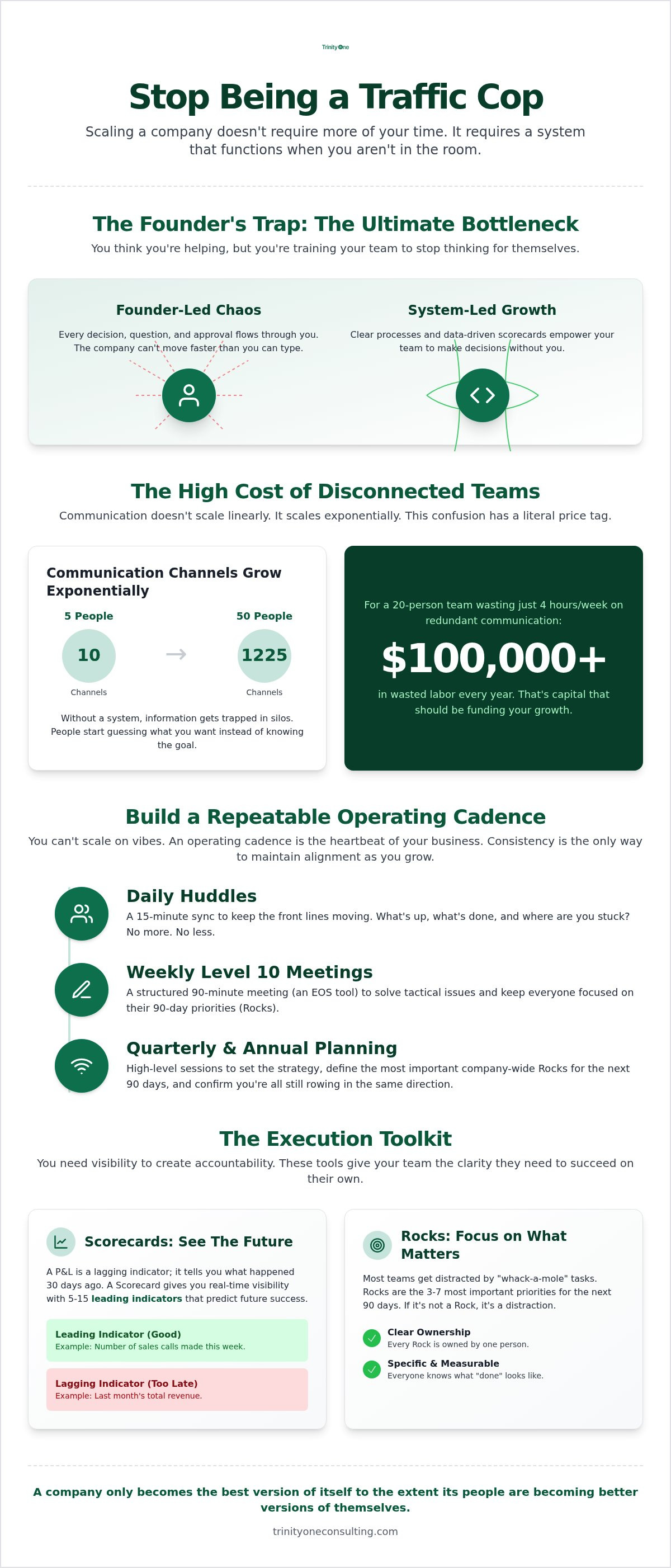
Communication doesn't scale linearly. It scales exponentially. For a 20-person staff, the number of potential communication channels is massive. If your team lacks a clear operating rhythm, information gets trapped in silos. People start guessing what you want instead of knowing what the goal is. This creates friction that slows down every project you touch.
This confusion has a literal price tag. If a 20-person team wastes just four hours a week on redundant emails or circular meetings, you're losing over $100,000 in wasted labor every year. That's capital that should be going toward your Scalability and market expansion. Instead, you're paying people to be busy but not productive. You don't need more meetings. You need a system that makes meetings unnecessary.
The founder as the ultimate scaling bottleneck
I see it every day. The founder is the smartest person in the room and the ultimate bottleneck for every decision. This is the Founder's Trap. You spend your day fixing small fires in departments you shouldn't even be in. You think you're helping, but you're actually training your team to stop thinking for themselves. If they have to ask you for permission for everything, you've built a cage, not a company.
There's a heavy tradeoff here. Every minute you spend deciding which software to buy or how to word an email is a minute you aren't looking at the horizon. Your intuition is a gift, but it doesn't scale to a hundred employees. You need a system that makes decisions based on data, not just your gut feeling. If the business can't breathe without your permission, you'll never achieve sustainable growth. You'll just be the person holding everyone else back.
How do you build a repeatable operating cadence?
You can't scale on vibes. An operating cadence is the heartbeat of your business. It's the difference between a team that reacts to every crisis and one that executes with precision. When you lack a rhythm, you create operational bottlenecks when scaling and lose the ability to wing a $10 million company.
Consistency is the only way to maintain alignment as you grow. This requires a predictable cycle of execution. Daily huddles keep the front lines moving. Weekly meetings solve tactical issues while quarterly sessions set the strategy for the next 90 days.
Level 10 meetings and execution through EOS
Execution requires a specific structure. In the EOS framework, the Level 10 meeting is the gold standard. It's a 90-minute weekly meeting designed to keep teams focused on their Rocks, which are the 90-day priorities that move the needle. This agenda stops circular discussions and forces you to solve problems rather than just talking about them.
If your meetings feel like a waste of time, you need a Level 10 Meeting Agenda Template to get back on track. Rocks are the big goals that actually grow the business. Most teams get distracted by "whack-a-mole" tasks that feel urgent but don't matter. By assigning clear Rocks to every leader, you ensure that the most important work gets done first.
Scorecards and real time visibility into performance
You need to know if you're winning or losing before you see the monthly P&L statement. A P&L is a lagging indicator. It tells you what happened thirty days ago. To fix operational bottlenecks when scaling, you need a Scorecard (another EOS term) with 5 to 15 leading indicators. These are the numbers that predict your future success, like sales calls made or units shipped today.
If you wait until the end of the month to check your progress, you're already too late to fix the problem. Visibility creates accountability. When every team member has a number they own, they don't need you to breathe down their neck. This isn't about micromanagement. It's about giving your people the clarity they need to succeed on their own. If you're struggling to find the right metrics for your team, we can discuss your specific operational rhythm to see where the friction is.
Why is employee engagement the primary bottleneck during growth?
You can have the best software in the world, but if your people don't care, you'll fail. Disengaged employees are the silent killers of a scaling business. They do just enough to not get fired while your operational bottlenecks when scaling multiply. A company only becomes the best version of itself to the extent its people are becoming better versions of themselves.
Most founders try to buy loyalty with cheap perks like free snacks or office games. These don't drive long-term retention. Real talk: your team doesn't stay for the coffee. They stay because they feel like they're actually going somewhere in their own lives. If they're stagnating, your business is stagnating too.
The Dream Manager concept by Matthew Kelly
I use the Dream Manager Program to solve this human friction. This methodology, created by Matthew Kelly, identifies twelve categories of dreams, including physical, emotional, and financial goals. It treats the employee as a whole person rather than a replaceable part in a machine.
Helping employees achieve personal dreams drives professional ROI. When you show a team member that you care about their life outside of the office, their engagement at work shifts. They stop watching the clock and start owning their results. It's a simple exchange of value that creates a culture of high performance.
Connecting personal dreams to business goals
Consider a manager who wants to buy their first home. If they're constantly stressed about credit scores and down payments, they aren't fully focused on your quarterly goals. A coach helps them build a concrete financial plan to reach that dream. This stability at home translates directly to better decision making at work.
The cost of ignoring this is massive. Replacing an employee costs between 50% and 200% of their annual salary. If you lose a key manager making $120,000, you're looking at a potential $240,000 loss in recruiting, training, and lost momentum. Coaching them is a much smaller investment with a much higher ceiling.
You can't scale a business on the backs of people who are looking for the exit. By connecting their personal success to the company's growth, you build a team that is personally invested in the outcome. This is how you eliminate the human operational bottlenecks when scaling that kill most companies before they hit their stride.
How can you use AI to manage scaling friction?
AI isn't a magic wand. It's a tool for offloading the mechanical tasks that slow your business down. You shouldn't be spending your time chasing down status reports or checking if someone finished their task. AI should manage the machine so you can manage the people. This is how you clear operational bottlenecks when scaling without hiring a fleet of administrative assistants.
Trinity Cadence acts as an AI-native operating system for your team. It integrates your workflows and ensures that every Rock is on track. It doesn't just store data. It analyzes execution in real time. It's the difference between guessing where you stand and knowing the exact status of every priority.
Automating the operational huddle
Manual reporting is a massive bottleneck for 50-person firms. If your managers spend three hours a week preparing for a meeting, you're losing 150 hours of leadership capacity every year. That's a massive drain on your resources. Trinity Cadence tracks execution without manual reporting. It pulls data directly from your workflows so your huddles can focus on solving problems rather than just sharing information.
The system identifies execution gaps before they become crises. If a key metric falls behind on a Tuesday, the AI flags it immediately. You don't have to wait for a weekly Level 10 meeting to find out that a project is off the rails. It gives you the speed you need to fix operational bottlenecks when scaling before they cost you a client or a deadline.
AI coaching for managers and staff
New managers often feel like they're drowning. They have the title but lack the 30 years of experience needed to handle every human conflict or technical hurdle. AI-driven coaching provides real-time feedback to help them lead better. It's like having a seasoned operator looking over their shoulder to offer tactical advice on how to handle a difficult conversation or a missed target.
We use DreamCompass to track personal growth goals within this system. It's an invitation-only app that keeps the Dream Manager process alive for every employee. By integrating machine operations with human performance, you ensure that your people are growing alongside the technology. This alignment is the only way to sustain growth without burning out your best talent. You can't scale a business if your people feel like they're just another gear in a cold machine.
When do you need a fractional integrator to scale?
You can't be the architect and the lead carpenter at the same time. Most founders try to hold onto every lever of the business while simultaneously trying to invent the future. This is how you create operational bottlenecks when scaling. I've seen founders burn out and lose their passion because they tried to play both roles for too long. I believe we're called to use our talents to build things that last, but you can't do that if you're stuck in the mud of daily tasks.
Hiring a full-time COO too early is a $250,000 mistake. Between the high base salary, benefits, and equity, you're burning cash before your processes are stable enough to support the role. A fractional integrator provides the gearbox for your business engine without the massive overhead. It's about getting the execution you need right now so you can focus on the big picture.
The Visionary and Integrator relationship
In the EOS framework by Gino Wickman, the Visionary is the person with ten new ideas every week. They're great at culture and big deals, but they're usually terrible at the day to day details. The Integrator is the person who filters those ideas and turns them into a plan. They're the ones who make sure the Rocks get done and the Scorecard stays green. This is a partnership of opposing forces that creates balance.
Friction happens when these two roles aren't aligned. If the Visionary keeps jumping over the Integrator to give orders to the team, the system breaks. You end up with a confused staff and a frustrated leader. Read more about The Fractional Integrator to see how this dynamic works in practice. It requires humility from the founder to let someone else handle the steering wheel.
Implementing a business operating system
Onboarding a fractional executive isn't an overnight fix. It starts with a 90-day plan to audit your current rhythm and identify where the gears are grinding. I spend the first month learning the people and the data. By month three, we're running Level 10 meetings and resolving the operational bottlenecks when scaling that were previously ignored.
There's a tradeoff here. You have to be willing to lose some control to gain massive freedom. You can't hire an integrator and then micromanage their process. It won't work. If you're ready to step out of the weeds and lead from the front, my Fractional COO services can help you build the structure you need. It's about building a business that can run without your constant intervention.
Build a business that runs without you
Scaling is about building a machine that doesn't need you to turn every screw. You've learned that a repeatable cadence and real-time visibility are the only ways to stay ahead of the chaos. I believe we're called to build things that last, and that requires a foundation of order.
I've spent 30 years in the trenches helping operators move from founder-led friction to systemic execution. We'll use the AI-native Trinity Cadence platform to track your metrics and Certified Dream Manager facilitation to keep your team focused. This is the path to clearing operational bottlenecks when scaling for good.
Stop playing traffic cop. Start being the CEO your company needs. You can have a high-performance team and a life outside the office. It just takes the right gearbox to turn your vision into a reality.
Frequently Asked Questions
How much does it cost to scale a business without a system?
Scaling without a system costs you at least $100,000 in wasted labor for every 20 employees you have. You're paying for redundant emails and circular meetings that don't produce results. Turnover is expensive. It costs between 50% and 200% of an annual salary to fix. You can't afford to ignore operational bottlenecks when scaling because they eat your profit margins from the inside out.
What happens if I don't have an operating cadence?
Without an operating cadence, your business has no heartbeat. Meetings become social hours or gripe sessions instead of execution engines. Your team starts guessing what matters most. You end up fixing the same problems every week. This lack of rhythm creates a culture where everything depends on your personal intervention. It's exhausting for you and frustrating for your high performers.
Is a fractional integrator better than a full-time COO?
A fractional integrator is often better for companies between 10 and 100 employees because it avoids the $250,000 cost of a full-time executive. You get a strategic architect for a fraction of the price. This approach is bad for companies that need a manager in the office 40 hours a week for basic tasks. It's meant for high-level execution and building systems that sustain growth.
Can AI really help with employee engagement?
AI helps with engagement by taking mechanical tasks off your people's plates. When Trinity Cadence handles status updates and reporting, your managers can actually talk to their team about their personal goals. We use DreamCompass to track the twelve dream categories defined by Matthew Kelly. This ensures your people are growing as individuals while the technology handles the repetitive parts of the work.
How long does it take to implement the Dream Manager program?
You'll see a shift in culture within the first 90 days of implementing the Dream Manager program. It's not a quick fix for a toxic environment. It requires a genuine commitment to helping your people achieve their personal dreams as described by Matthew Kelly. If you aren't willing to invest in their growth, the program won't work. It's a long-term exchange of value.
What are the first steps to stop operational chaos?
Start by auditing your calendar to see where you are the bottleneck. Identify the five numbers that drive your revenue and put them on a Scorecard, a term used in the EOS framework. Then, set a non-negotiable weekly meeting with your leadership team to solve issues. These steps provide the first layer of defense against operational bottlenecks when scaling. You have to stop being a traffic cop.
Do I need to be using EOS to benefit from Trinity Cadence?
You don't need to be a pure EOS company to use Trinity Cadence. While it supports EOS terms like Rocks and Scorecards, it's designed for any operator who needs real-time visibility. It's an AI-native system that works for anyone tired of manual data entry and status chasing. It provides the structure needed for consistent execution across your entire team. It works where manual spreadsheets fail.
How do I know if I am a Visionary or an Integrator?
Visionaries usually have ten new ideas before breakfast and love the big picture. Integrators are the ones who ask how the company will pay for that and who will do the work. These roles are core to the EOS framework. If you feel drained by spreadsheets, you're likely a Visionary. If you love building systems and organizing teams, you're an Integrator. Every business needs both to scale.
Turn insight into execution
Bring your real operating bottleneck to one practical conversation.
Book a discovery call →