
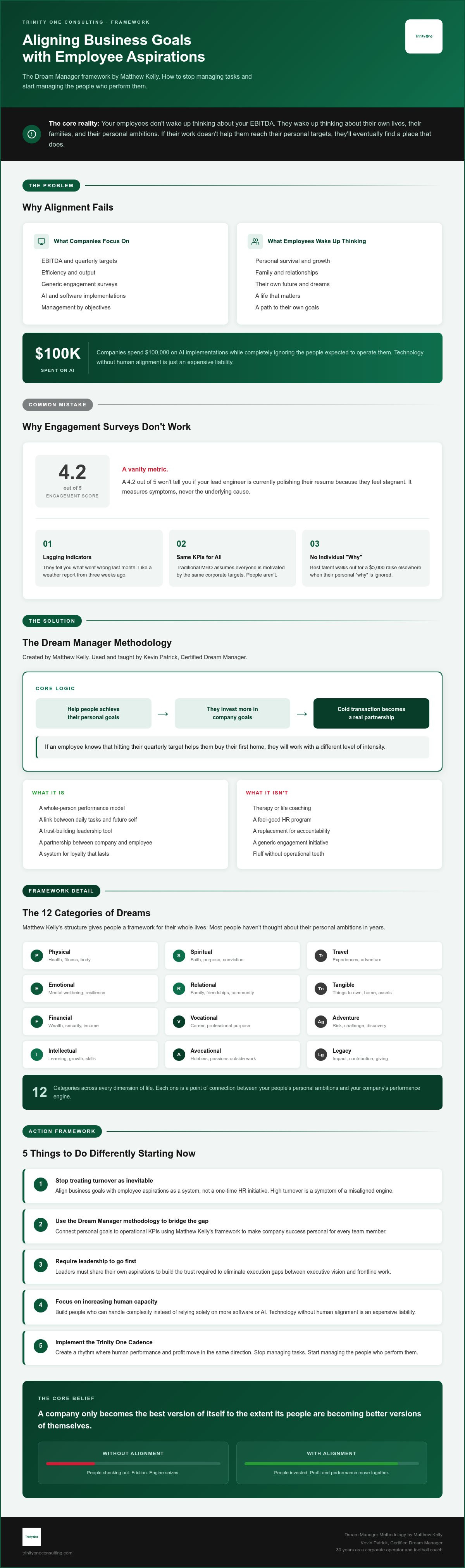
Your employees don't wake up thinking about your EBITDA. They wake up thinking about their own lives, their families, and their personal ambitions. Aligning business goals with employee aspirations is the only way to build a company that lasts beyond the next quarter. If their work doesn't help them reach their personal targets, they'll eventually find a place that does.
I've spent 30 years in the trenches as a corporate operator and a football coach. I've seen leaders try to buy loyalty with generic engagement surveys that never lead to real change. It doesn't work. True loyalty comes when a person sees your company success as the fastest vehicle for their own success.
You're likely tired of the high cost of turnover and the disconnect between your executive vision and frontline execution. This article provides a practical framework to bridge that gap. You'll learn how to use the Dream Manager methodology, created by Matthew Kelly, to turn individual dreams into fuel for company performance.
We'll examine the twelve categories of dreams and how to integrate them into your daily operations. I'll explain how the Trinity One Cadence creates a rhythm where human performance and profit move in the same direction. It's time to stop managing tasks and start managing the people who perform them.
Key Takeaways
- Learn why aligning business goals with employee aspirations is the only way to stop high turnover and build a high-performance engine.
- I use the Dream Manager methodology by Matthew Kelly to bridge the gap between corporate targets and individual dreams.
- Connect personal goals to operational KPIs to make company success personal for every member of your team.
- Require your leadership team to go first by sharing their own aspirations to build trust and eliminate execution gaps.
- Focus on increasing human capacity to handle complexity instead of relying solely on more software or AI.
Why is aligning business goals with employee aspirations so difficult?
Most leaders treat their org chart like a technical schematic. They see boxes and lines instead of humans with mortgages and private ambitions. As a former football coach, I know that players don't run through brick walls for the scoreboard. They do it for the person next to them and the future they want to build. I've seen companies spend $100,000 on AI implementations while completely ignoring the people expected to operate them.
There is a natural tension between a company's need for profit and a person's need for purpose. Executives often focus on the bottom line while employees focus on their own survival and growth. Aligning business goals with employee aspirations requires a level of vulnerability that many leaders find uncomfortable. It's easier to look at a spreadsheet than it is to look a person in the eye and ask what they want for their life.
The friction between company output and human desire
Your business wants efficiency and your people want a life that matters. These two forces often pull in opposite directions. When they do, you get friction. In a high-performance engine, friction creates heat that eventually leads to a total breakdown.
Heat in your business looks like high turnover and missed deadlines. It shows up when a key manager quits without warning because they didn't see a path to their own dreams within your walls. Without a clear system for aligning business goals with employee aspirations, you're just running the engine until it seizes up.
Why traditional engagement surveys fail to close the gap
Most engagement surveys are lagging indicators. They tell you what went wrong last month or last quarter. This is about as useful as a weather report from three weeks ago. They measure symptoms, but they never treat the underlying cause of why people are checking out.
A survey might give you a respectable score of 4.2 out of 5. That number is a vanity metric. It won't tell you if your lead engineer is currently polishing their resume because they feel stagnant. It doesn't address the individual "Why" that gets a person out of bed on a rainy Monday morning.
Traditional management by objectives works for tasks, but it fails for people. It assumes that everyone is motivated by the same corporate KPIs. The truth is that people are motivated by their own dreams, not your quarterly targets. If you don't connect the two, you'll continue to see your best talent walk out the door for a $5,000 raise somewhere else.
What is the Dream Manager methodology?
I became a Certified Dream Manager because I've seen the alternative fail too many times in the corporate trenches. Most leadership models treat people like disposable tools. This methodology flips that script. It treats the company as a vehicle for the dreams of its employees.
The logic is simple and grounded in operational reality. When you help people achieve their personal goals, they become more invested in the company goals. It shifts the relationship from a cold transaction to a partnership. This is the mechanical link required for aligning business goals with employee aspirations.
I believe every person has a unique purpose, but that purpose shouldn't be checked at the office door. Research on employee engagement and business growth shows that fulfilled employees drive better outcomes. If an employee knows that hitting their quarterly target helps them buy their first home, they will work with a different level of intensity.
A framework for personal and professional growth
This methodology focuses on the whole person rather than acting as a therapist or life coach. I use it to help teams find the direct connection between their daily tasks and their future selves. It requires a manager to actually know their people. You can't lead someone you don't understand.
This approach prioritizes performance over fluff. It acknowledges that a person's life outside of work affects their output inside of work. When a team member feels supported in their personal life, their loyalty to the business increases. You get a team that stays because they want to, not because they have to.
The twelve categories of dreams that drive performance
The Dream Manager methodology identifies twelve categories of dreams to give people a structure for their lives. These include physical, emotional, and financial goals, as well as intellectual and spiritual ones. Most people haven't thought about their personal ambitions in years. Giving them these categories helps them see a future that exists beyond a simple paycheck.
At Trinity One, we use these categories to build a structured employee aspiration program that actually sticks. It provides a common language for the team to discuss growth. If you want to see how this framework fits your current team structure, you can schedule a brief conversation to explore the specifics. It's a practical way to start aligning business goals with employee aspirations without losing focus on your bottom line.
How do you map personal aspirations to operational KPIs?
You can't align what you don't measure. I start every engagement by asking a simple question: what do you actually want? Most leaders are afraid of the answer because they think it always involves a massive raise. In my experience, that's rarely the case.
I once worked with a manager who was drowning in $5,000 of high-interest credit card debt. She wasn't motivated by the company's 15% growth target or our new market entry. She was motivated by the crushing stress of those monthly statements. She was an excellent operator, but her personal life was red-lining.
We linked her quarterly performance bonuses and efficiency targets directly to that debt reduction. Suddenly, the company's profit goals became her personal financial freedom goals. This is the mechanical reality of aligning business goals with employee aspirations. When she hit her numbers, she wasn't just helping the company, she was helping herself breathe again.
I believe leadership is a stewardship of the lives entrusted to us. If your people are failing at home, they will eventually fail at work. You have to bridge that gap with logic and math.
Identifying the individual "Why" behind the work
Most employees say they work because they need a job. That's a surface level answer that leads to mediocre performance. You have to find the specific dream that drives them. This requires consistent one on one coaching and honest conversations where you actually listen.
You need to create a space where it's safe for a person to admit they want to retire early or pay for their kid's private school. Without this clarity, your KPIs are just numbers on a screen. They have no soul and no sticking power. Once you know the "Why," the "How" of the daily work becomes much easier to manage.
Creating a logical link between dreams and daily execution
If a team member dreams of buying a house, the business must provide the income and the stability to reach that milestone. You have to show them the math. If the business hits its quarterly target, their bonus covers the closing costs. This makes the work personal.
I use a specific operating cadence to track these personal wins alongside the business wins. We don't just talk about revenue in our weekly meetings. We talk about progress toward those twelve categories of dreams mentioned by Matthew Kelly. This is the only way to maintain the rhythm of aligning business goals with employee aspirations over the long haul.
This approach changes the energy in the room. Every meeting is about more than just the bottom line. It's about the humans who are building that bottom line. When people see that you care about their future, they will fight for yours. It's a fair trade that pays dividends in both profit and peace of mind.
How can you implement this alignment in your company?
Implementation isn't about a fancy software rollout. It's about a shift in how you view the people on your payroll. I've found that aligning business goals with employee aspirations only works when the process is transparent and consistent.
Step one is for the leadership team to go first. You cannot ask your employees to share their dreams if you are hiding yours. If you want a culture of growth, you have to show that you are growing too.
Starting the conversation with your leadership team
I recommend a launch sprint to get everyone on the same page. This isn't a retreat with trust falls. It's a hard look at whether your leaders believe people are the primary asset of the business.
Your leaders must lead by example. If your VPs see aligning business goals with employee aspirations as a chore, the rest of the team will smell the insincerity from a mile away. I've sat in rooms where CEOs were terrified to admit they wanted to take a two-week vacation without their laptop, and that fear always trickles down.
You have to be blunt about the trade-offs. This approach takes time away from traditional task management. It requires leaders to develop emotional intelligence they might not have used in years. It's difficult work that can feel slow at first.
Integrating personal goals into your operating cadence
Use a tool like Trinity Cadence to keep dreams visible across the organization. I advocate for dedicating five minutes in your weekly huddles to personal progress. This is how you implement a dream manager program that lasts.
Step three is to provide the actual resources for people to take action. If an employee's dream is to become debt-free, offer a financial planning workshop. If they want to improve their health, let them leave at 4:00 PM on Tuesdays to hit the gym. Practical support beats a motivational poster every time.
Step four is to celebrate personal wins as loudly as business wins. When an employee hits a personal milestone, recognize it in front of the team. This reinforces the idea that the company is a vehicle for their success.
This creates a feedback loop of loyalty. People don't leave companies that are actively helping them become the best version of themselves. I believe we are called to help the people around us grow, and business is the best platform to do it. It's a simple truth I've seen play out on the football field and in the boardroom.
Why does a business engine need human dreams to scale?
Scaling a business requires more than just adding more software or more AI. It requires increasing the capacity of your people to handle more complexity. If your team is distracted by personal failures or unfulfilled dreams, they cannot focus on your growth targets.
By aligning business goals with employee aspirations, you ensure that the people operating your systems have the mental and emotional space to perform. A person who is actively achieving their dreams has more energy for the business. They aren't just showing up for a paycheck anymore.
Retention is the silent killer of growth. Every time a key player leaves, your momentum stalls and your institutional knowledge walks out the door. Dreams are the best defense against turnover because they create a bond that money alone cannot buy.
The role of the Integrator in human performance
A fractional COO acts as the architect of this system. I ensure the technical engine and the human engine are perfectly timed. Without this alignment, the engine eventually seizes up under the pressure of scale.
I look for the friction points where human performance is dragging down operational efficiency. Often, the solution isn't a new piece of software. It's a conversation about where that employee wants to be in five years.
Scaling retention through personal development
The math on retention is brutal. It costs roughly 33% of an employee's salary to replace them when you factor in recruiting, onboarding, and lost productivity. For a manager making $100,000, that's a $33,000 hit to your bottom line.
Helping that same manager achieve a personal dream might cost you a fraction of that amount. The ROI is undeniable. You save the replacement cost and gain a loyal high-performer who sees your company as their greatest ally.
I believe a company only becomes the best version of itself to the extent its people are becoming better versions of themselves. This is the only way to build an engine that actually scales.
How will you build your high-performance engine?
You've seen the math. Aligning business goals with employee aspirations is a hard-nosed operational strategy to protect your profit and your sanity. It isn't a soft HR initiative.
I use the Trinity Cadence AI-native operating system to keep these two forces in sync. As a Certified Dream Manager, I've seen that people will do the hard work of scaling when they see their own future in the results. I believe we're called to help the people around us grow.
The cost of doing nothing is another 33% of a salary lost to the next resignation. You can keep running the engine until it seizes, or you can start timing the human and technical components perfectly.
If you want to see how this framework can change your retention numbers, let's talk.
Let's get to work on the version of your company that actually lasts.
Frequently Asked Questions
How do you align personal goals with company goals?
You start by having honest conversations about what your people actually want. I use the Trinity Cadence to map company KPIs to the resources employees need for their dreams. This might mean linking a performance bonus to a specific debt reduction target. When a person sees that hitting a business goal helps them buy their first home, their motivation shifts from a paycheck to a purpose.
What are the 12 categories of the Dream Manager program?
Matthew Kelly identifies twelve categories to help people think about their lives in a structured way. These include physical, emotional, intellectual, and spiritual dreams. They also cover psychological, material, professional, and financial aspirations. The remaining categories focus on creative, adventure, legacy, and character goals. This framework ensures that aligning business goals with employee aspirations covers the whole person rather than just their bank account.
Is a Dream Manager program expensive to implement?
The cost is much lower than the price of constant turnover. Replacing a key manager typically costs 33% of their annual salary in lost productivity and recruiting fees. A Dream Management engagement is a fraction of that loss. You're investing in the human engine to prevent it from seizing up. It's a practical capital expenditure that pays for itself through increased retention and higher performance.
Can a small business benefit from aligning employee aspirations?
Small businesses often benefit the most because every single hire is vital to the operation. In a team of ten, one person checking out is a 10% drop in your total capacity. Aligning business goals with employee aspirations creates a culture that can out-execute larger companies with massive HR departments. You don't need a huge budget to care about what your people want for their future.
How does a fractional COO help with employee engagement?
I act as the architect who connects your technical systems with the humans who run them. I ensure that your operating rhythm includes regular check-ins on both business KPIs and personal growth. A fractional COO doesn't just watch the cash flow. I watch the people who produce that cash flow to ensure the entire business engine stays in time and runs at peak efficiency.
What is the difference between a life coach and a Dream Manager?
A life coach often works in a vacuum outside of your business operations. A Dream Manager operates directly within the context of your company's performance and culture. I help employees see how their daily execution at work is the vehicle for their personal life. It's a professional partnership where the company's success and the individual's dreams are linked by a shared set of targets.
Does aligning business goals with dreams really reduce turnover?
Yes, because it changes the relationship from a cold transaction into a mutual partnership. People don't leave organizations that are actively helping them achieve their financial or personal milestones. Loyalty is the byproduct of growth. When you invest in their version of a better life, they invest their best energy and focus back into your business growth. The math on retention proves it works.
How do I start a Dream Manager program in my company?
You must have the leadership team go first to build trust. I recommend a launch sprint to define the company's operational rhythm and then introduce the twelve categories from Matthew Kelly to the staff. You need a consistent cadence to keep these conversations alive. Don't make it a one-time event or your team will see it as another empty corporate initiative that leads to no change.