
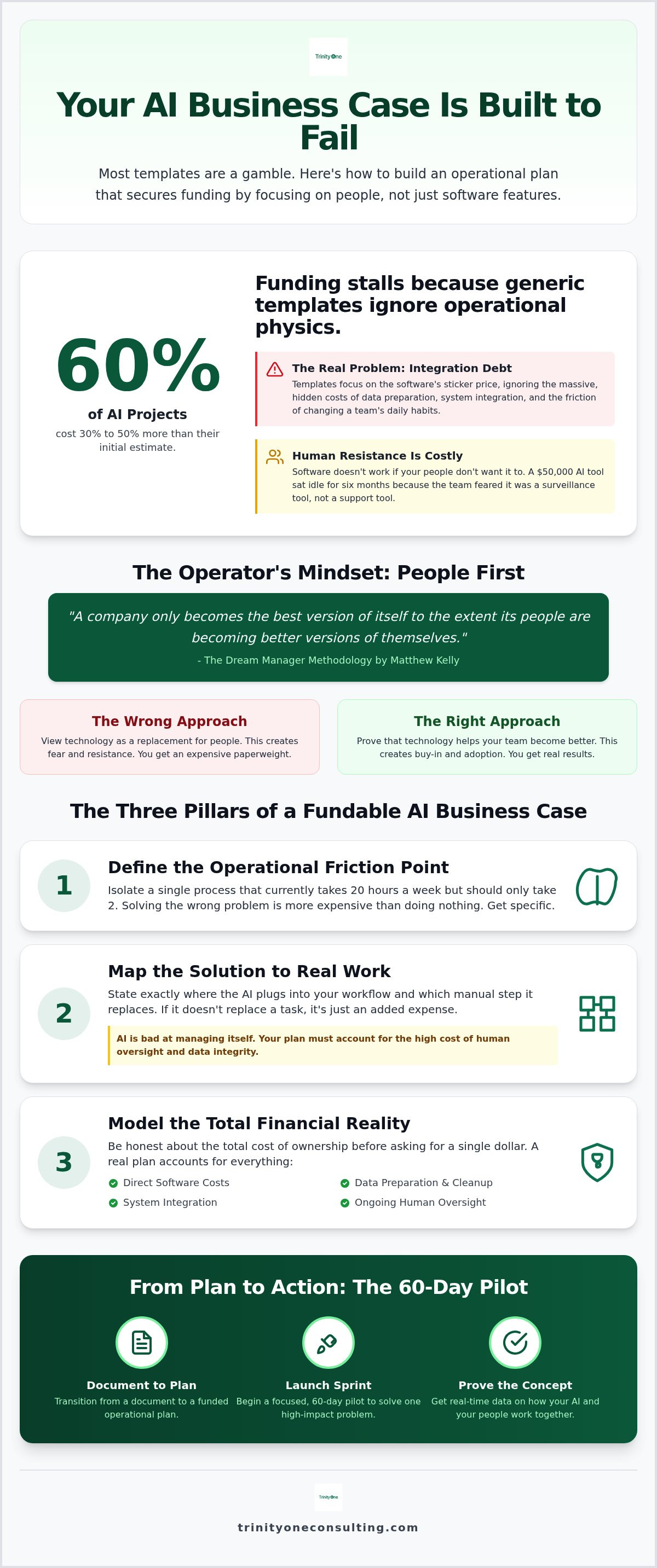
Sixty percent of AI projects cost 30% to 50% more than the initial estimate. Most of that waste happens because leaders treat technology like a magic pill rather than an engine that needs fuel and a driver. A successful AI business case template must account for human ROI and real-time execution data to prevent capital waste.
You've seen the hype, but you've also felt the friction. It's exhausting to pitch a vision when you can't quantify how automation helps a tired employee finish their work and get home to their family.
I've spent decades in the trenches as an operator and a coach. I follow the Dream Manager methodology created by Matthew Kelly. It's built on the belief that a company only becomes the best version of itself to the extent its people are becoming better versions of themselves. I believe we are called to be good stewards of both our capital and our people.
We'll build a case that secures funding by focusing on the people who actually run the machines. I'll show you the real costs of data preparation and the necessity of the Trinity Cadence for execution. You'll also see the exact milestones your board needs to see.
Key Takeaways
- Account for the integration debt that causes 60% of projects to exceed their budgets instead of only focusing on software costs.
- Build an AI business case template that identifies specific operational friction points rather than chasing generic efficiency gains.
- Use Matthew Kelly's Dream Manager methodology to ensure your team feels supported by new technology instead of threatened by it.
- Transition from a document to a pilot in 60 days by using a launch sprint to solve one high-impact problem.
- Implement the Trinity Cadence operating system to get real-time visibility into how your AI and your people work together.
Why do most AI business case templates fail to get funding?
Most leaders download a generic AI business case template expecting a shortcut to a "yes" from the board. They usually end up with a "no" because the document is a list of software features rather than an operational plan. Executives buy solutions to friction points. They don't buy software packages.
A real business case functions as a logical proof. It shows exactly how a specific input leads to a predictable outcome. If your template is full of fluff words like "complex" or "high-level," you've already lost. These words signal a lack of time in the trenches. Real operators want to see the mechanics of the work.
Funding stalls when the math doesn't account for integration debt. Research shows that 60% of AI projects cost 30% to 50% more than the first estimate. This happens because templates focus on the sticker price of the software. They ignore the cost of data preparation, system integration, and the inevitable friction of changing a team's daily habits.
I believe we're called to steward our resources with integrity. This means being honest about the total cost of ownership before asking for a single dollar. A template that hides these costs isn't a strategy. It's a gamble.
The gap between technical ROI and human buy-in
Software doesn't work if your people don't want it to work. It's that simple. I've seen a company spend $50,000 on an AI-driven scheduling tool that sat completely idle for six months. The team feared the software was there to track their bathroom breaks. They didn't see a benefit for themselves, so they ignored the tool until the subscription expired.
Resistance usually comes from a fear of replacement or a fear of an increased workload. If employees think the machine is coming for their job, they'll find ways to break the system. You have to prove that the technology helps them become better versions of themselves. I follow the Dream Manager methodology by Matthew Kelly to align corporate goals with personal aspirations. A funded project requires a team that feels supported rather than replaced.
Why spreadsheets alone are not enough
Numbers on a screen can be manipulated. Operational physics cannot. A spreadsheet might show you'll save 20 hours a week by automating reports. It often ignores the 10 hours of new meetings needed to manage the data inputs. A template must account for the time spent in huddles and the labor required to keep the engine running.
A Fractional COO bridges this gap by acting as an integrator who translates the data into actual execution. They know that a project's success depends on the rhythm of the team. Without a unified cadence, even the best AI tool becomes an expensive paperweight. They focus on the results that happen after the software is installed.
You need a system that provides real-time visibility into execution. Most templates fail because they don't name the cost of the tradeoff. The tradeoff for machine efficiency is a higher demand for human oversight and data integrity. If you don't plan for that, your engine will stall before it ever leaves the garage.
What sections must every AI business case template include?
A strong AI business case template provides the blueprints for your operational engine. It must move beyond high-level summaries to show the mechanics of execution. You need four specific sections to prove your project is a sound investment. These sections build a logical proof that your board cannot ignore.
The Solution Mapping identifies which AI tools will handle specific machine operations. It isn't enough to say you'll use a Large Language Model. You must state exactly where it plugs into your workflow. If it doesn't replace a manual step, it's just an added expense. Every new tool must have a designated seat at the table and a clear job description. AI is bad at managing itself. It requires a high level of human oversight and data integrity. If you don't plan for the labor cost of managing the software, your ROI will evaporate by the second quarter.
Defining the operational friction point
Identify a process that currently takes 20 hours a week but should only take 2. For example, manual data entry for sales leads often drains an account executive's time. This friction slows down the entire sales engine. Solving the wrong problem is more expensive than doing nothing. You must isolate where the engine is smoking before you add new parts. Focus on a single, high-impact friction point to ensure your pilot actually runs.
Building the financial and risk model
Your financial section must list direct costs like subscription fees and implementation consulting. It must also include the cost of the people managing the tool. If your operations manager spends five hours a week troubleshooting an API, that's a real cost. You also need to name the tradeoff. If you start this AI project, what existing initiative will you stop? There is no such thing as infinite capacity. You should also consult an AI Business Case Template for Executive Buy-In to ensure your risk mitigation covers data privacy and compliance costs. If you need help identifying these hidden costs, you can schedule a cadence call to review your specific numbers.
The Strategic Alignment section
Link your initiative to your annual goals and your business operating system. Technology should support your weekly meeting cadence rather than complicating it. This section proves that AI serves the people who drive the company forward. Avoid using fluff words like synergy. Stick to the logic of the work. If you can't explain the alignment in two sentences, you don't understand the problem well enough yet.
Finally, your Implementation Timeline must be aggressive. Break the work into 30 day sprints. A six-month roadmap is just a list of excuses for why nothing is happening. You need to see movement within the first month to maintain momentum. This speed forces you to confront integration issues early. It stops you from building a complex system that nobody knows how to use.
How do you measure the human impact of AI implementation?
You can't build a functional business engine by ignoring the people who turn the keys. A company only becomes the best version of itself to the extent its people are becoming better versions of themselves. Your AI business case template needs a section that proves how technology serves human growth. If you only focus on machine efficiency, your team will see AI as a threat to their livelihood.
I've spent years as an operator and a coach. I know that software adoption fails when employees feel like they are being optimized out of a job. You have to prove that the technology exists to support them. I believe we have a responsibility to help our people live better lives. AI is a tool for that mission.
Integrating the Dream Manager program
AI should be the tool that removes the drudgery from the workday. I use the Dream Manager Program methodology, created by Matthew Kelly, to help leaders connect with their team's personal aspirations. When you automate a task that an employee hates, you aren't just saving money. You're buying that person's attention back.
The methodology focuses on twelve dream categories. These include physical, emotional, and intellectual growth. If a machine handles the repetitive data entry that used to take four hours, that employee can focus on their own development. This creates a culture where people want to show up and perform. It turns a job into a partnership.
Quantifying engagement and retention
Retention is a massive line item that most leaders ignore in their budget. It costs roughly 1.5x an employee's annual salary to replace them. For a manager making $100,000, that's a $150,000 hit to your bottom line. AI adoption reduces burnout by killing the soul-crushing tasks that drive people to look for new jobs.
I once worked with a team where a marketing coordinator spent ten hours a week manually resizing images. We implemented an AI tool that did the work in seconds. She used that saved time to finish a certification in digital strategy. She stayed with the company, and her value to the firm tripled. That is a measurable human ROI.
Your AI business case template must show these concrete benefits. Hours saved are only one part of the equation. The quality of the hours remaining is what dictates your culture. A team that feels supported by technology will always outperform a team that feels replaced by it.
How do you move from a template to a functioning pilot?
Moving from the AI business case template to real work requires a 90-day execution plan. A document sitting on a hard drive doesn't generate revenue. I've seen too many leaders get paralyzed by the perfect plan while their competitors are already running. Execution is the only thing that separates a vision from a hallucination.
The first 30 days are strictly for alignment and setting up the Trinity Cadence. You need to ensure your people understand why the machine is being introduced. If you don't have a unified operating rhythm, you'll just be automating chaos. I believe we're called to be intentional with how we spend our team's time and energy.
The rapid launch sprint methodology
The next 30 days focus on a rapid launch sprint for a single use case. I recommend selecting one department, such as sales or operations, for the initial pilot. This keeps the scope narrow enough to manage and wide enough to see a result. Set a hard deadline for the first functional workflow. If it isn't running by day 60, you've over-engineered the solution.
This approach is bad at fixing a broken culture. If your team doesn't trust each other, AI will only make that lack of trust more visible. It is a tool for builders, not a band-aid for bad leadership. You must be honest about the state of your team before you bolt a machine onto their workflow.
Calibrating your business rhythm
Execution lives in the weekly huddle. You must review AI progress alongside your standard KPIs. I use real-time visibility tools in the Trinity Cadence to track engagement and find friction early. This isn't a set it and forget it installation. It's a continuous process of refinement.
Adjust the roadmap every 30 days based on actual performance data. If the tool isn't being used as planned, find out why and pivot. This is how you protect your capital and your people. The final 30 days of the pilot are for measuring the ROI of AI implementation. By day 90, you should see clear milestones. If you can't point to a specific dollar amount or time saved, your pilot has failed. Don't try to do everything at once or you'll fail.
How does Trinity Cadence simplify your AI business case?
Trinity Cadence isn't just another piece of software on your stack. It's an AI native operating system that integrates your machine operations with your human operations. When you use an AI business case template, you're making a promise to the board. Trinity Cadence is the engine that ensures you keep that promise.
Most AI initiatives fail because they lack a unified cadence. They exist in a vacuum, separated from the daily huddles and weekly meetings that actually drive the company. I've spent 30 years in leadership. I know that if a project isn't part of the regular business rhythm, it will be forgotten by the next quarter.
Trinity Cadence brings AI coaching directly into your team's workflow to keep everyone aligned. It functions as the central nervous system for your firm. This is not just another tool. It is the engine for your entire business.
Real time visibility into execution
Stop guessing if your AI strategy is working. Most leaders wait for the end of the month to see if a tool is being used. By then, you've already wasted four weeks of subscription fees and labor. Trinity Cadence provides real time visibility into how your team is interacting with the new technology.
You can see exactly where the friction is during your weekly huddles. If a specific workflow is causing a bottleneck, you'll know it on Tuesday, not three weeks later. This data strengthens your next AI business case template. It turns your projections into a track record of proven execution.
I believe that we are called to lead with truth and clarity. Having real time data allows you to be an honest steward of your company's resources. You can stop defending a failing pilot and start doubling down on what actually works.
The role of the Fractional Integrator
A template needs an owner to become a reality. I've seen great plans die because the CEO was too busy and the managers were too overwhelmed. Our Fractional Integrators manage the execution for you. They act as the bridge between your vision and the daily mechanics of the work.
We focus on the physics of leadership so you can focus on the vision. An integrator ensures that the AI implementation stays on schedule and within budget. They handle the messy details of data integrity and team buy-in. I believe a leader's highest calling is to provide direction, and our integrators provide the structure that makes that possible.
This is the difference between a document that gathers dust and an engine that runs. You don't need more theory. You need a system that works. We take the burden of execution off your plate so you can lead with confidence.
Build an engine that actually runs
You don't need a document that sits on a shelf. You need an AI business case template that accounts for the integration debt and the human friction of real work. This is the difference between a theoretical exercise and a funded project.
I've spent 30 years in the trenches as an operator and a coach. I know that a company only becomes the best version of itself when its people are becoming better versions of themselves. We've seen that 60% of AI projects cost more than planned because they ignore this human element.
You avoid these overruns by using the Trinity Cadence to get real-time visibility into your execution. Execution is the only measure. I also provide Dream Management facilitation to align your machine efficiency with the personal aspirations of your team. This is how you build a business engine that doesn't just look good on paper but actually runs.
I am here to help you steward your capital and your people with integrity. My faith tells me that our work matters. Let's make sure your next move is the right one.
Frequently Asked Questions
What is the most important part of an AI business case?
The problem definition is the foundation of your AI business case template. You must isolate a specific friction point in your business engine before you buy software. If you can't name the manual process that takes 20 hours a week, you aren't ready for a pilot. Executives reject cases that lack this clinical precision. Start with the work, not the tool.
How do I calculate the ROI of AI for a small business?
ROI is the delta between your current labor cost and the new total cost of ownership. Take the hours saved and multiply them by the fully burdened labor rate. Then subtract the software fees and the time your managers spend supervising the AI. If the machine saves $5,000 in labor but costs $6,000 in oversight, the engine is broken. Real operators focus on the net margin.
Should I include employee training costs in the template?
Every AI business case template must include training and integration costs. Research shows 60% of AI projects exceed their budgets by 30% to 50% because leaders ignore these hidden line items. You have to pay for the time your team spends learning the new rhythm. Ignoring this debt is a recipe for a stalled engine. Be honest about the price of adoption from day one.
How do I handle employee fear of AI in the business case?
You handle fear by proving that the technology exists to support the person. I use the Dream Manager methodology by Matthew Kelly to show employees how AI gives them time back for their own aspirations. Fear disappears when a team member sees that a machine is handling the drudgery they hate. Alignment is the antidote to resistance. It turns a threat into a partnership.
What are the common risks in an AI business case?
The biggest risks are integration debt and data privacy compliance. You also face the risk of a widening adoption gap if your team refuses to use the tools. A project that costs $400,000 but sits idle is a catastrophic failure. You must account for the cost of mitigation in your initial plan. Risk management is about looking at the tradeoffs without blinking and planning for the 60% chance of budget overruns.
How long should an AI pilot project take?
An AI pilot should take exactly 90 days. I break this into three 30 day sprints to maintain a brisk rhythm. The first 30 days are for alignment, the second for launching the workflow, and the third for measuring the results. If you can't see movement in three months, you've over-engineered the solution. Speed forces you to confront the real operational physics.
Do I need a consultant to build an AI business case?
You don't need a consultant to fill out a form, but you might need a Fractional Integrator to run the engine. A template is just a document. Execution is what brings the business case to life. Many leaders have the vision but lack the 30 years of operational experience needed to manage the technical and human variables. An integrator ensures the project actually hits its milestones.
How does Dream Management help with AI adoption?
Dream Management helps by connecting machine efficiency to the twelve dream categories defined by Matthew Kelly. When you automate repetitive tasks, you are buying your people's attention back. They can use that time for personal growth or family. This creates a culture of loyalty that makes technology adoption a shared victory. A company only grows when its people are becoming better versions of themselves.