
Every major operational decision still runs through your desk, which means your business can only grow as fast as your personal calendar allows. It's exhausting to feel like the primary bottleneck in the company you built. If you want to fix the friction slowing your revenue growth, you need to understand how the average fractional COO retainer works and what it delivers.
I spent years in the trenches as a corporate operator and a football coach, so I know that advice without execution is worthless. You don't need another consultant who hands you a list of recommendations and leaves. That doesn't work. You need a predictable monthly leadership cost that transfers the weight of daily management off your shoulders.
You will get a clear breakdown of fractional COO costs and engagement models to help you stop being the bottleneck in your business. I will show you how these agreements structure accountability. You will see how to build a system that runs cleanly without your constant input.
Key Takeaways
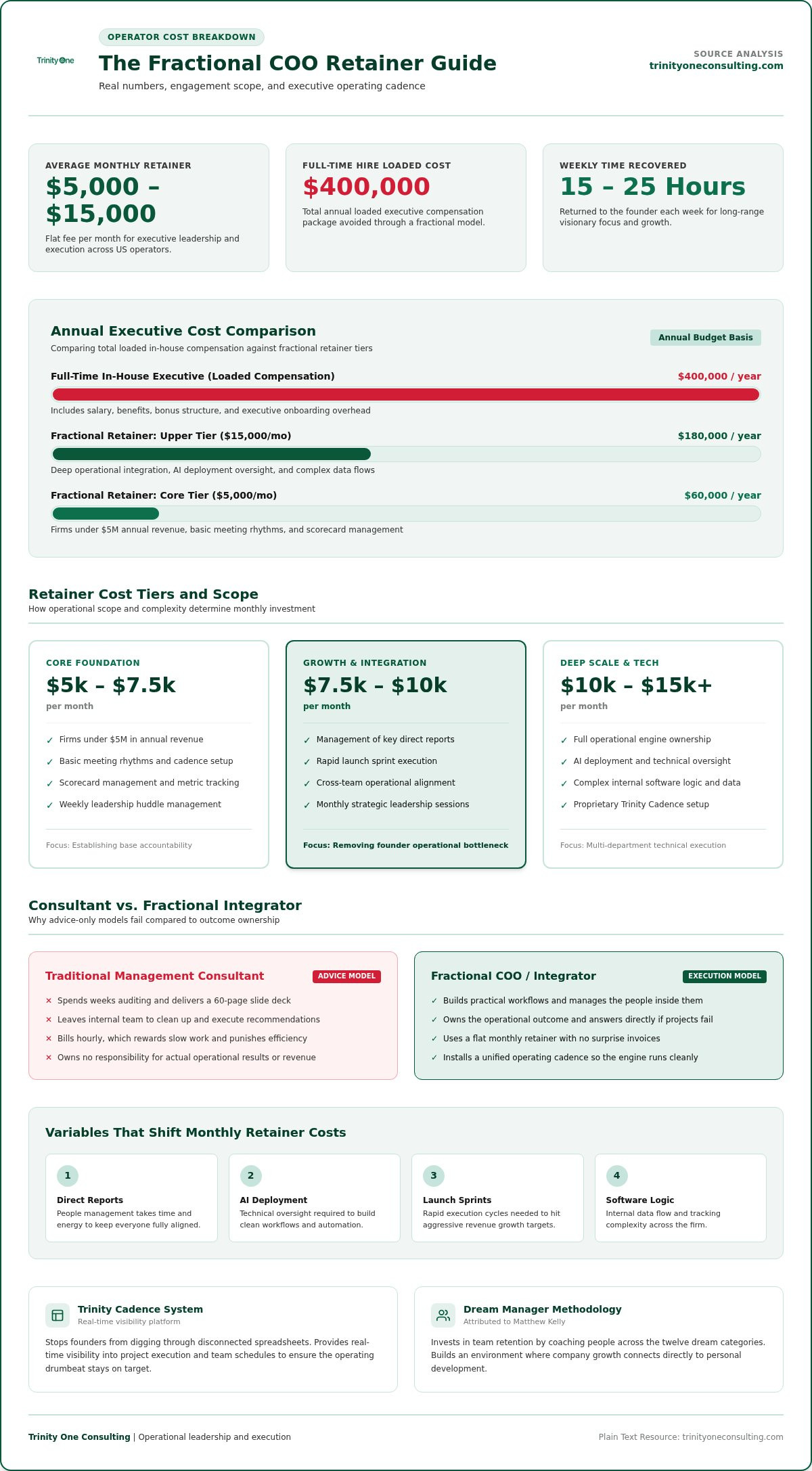
- Most experienced US operators charge an average fractional COO retainer of $5,000 to $15,000 per month. This provides executive leadership without the $400,000 total loaded cost of a full-time hire.
- A fractional leader acts as an Integrator who builds a functional engine for your business. They're bad at daily administrative firefighting but excellent at installing a unified operating cadence.
- You need real-time visibility into your team's execution through a system like Trinity Cadence. This stops you from digging through spreadsheets to find out if projects are on schedule.
- I measure your ROI by the 15 to 25 hours you'll get back each week for visionary work. Success also shows up in retention when you help employees grow through the Dream Manager methodology by Matthew Kelly.
How do fractional COO retainers actually work?
A retainer is a flat monthly fee for a set scope of leadership and execution. It's the most common way to engage the fractional executive model because it treats the operator as a member of your team. You aren't buying blocks of time. You're buying the result of a stabilized company. When you look at the average fractional COO retainer, you're seeing a commitment to operational health.
I don't use hourly billing. It's a broken system that punishes efficiency and rewards the person who takes the longest to finish a task. If I can fix your broken meeting structure in twenty minutes because I've done it a hundred times before, you shouldn't pay me less than the guy who takes five hours to figure it out. Speed is a feature, not a bug.
Most engagements include a specific rhythm. We'll have weekly leadership huddles and monthly strategy sessions. This creates a drumbeat for the business. It ensures that the fractional COO stays deeply embedded in your operations without needing a full-time office chair.
The difference between a consultant and an integrator
Consultants are professional advice-givers. They'll spend three weeks auditing your processes and hand you a sixty-page deck of recommendations. Then they leave you to fix the mess. You're left with the same friction, just a more expensive description of it.
An integrator stays to build the workflows and manage the people. I define the integrator role as the person who owns the operational outcome. If a project fails, the integrator is the one who answers for it. They turn your high-level vision into a functional engine that actually produces revenue.
Why fractional executives use a monthly fee model
Predictable costs help you manage your cash flow while you're trying to scale. You won't get a surprise invoice at the end of the month because an operational crisis required extra phone calls. The fee covers my availability and the proprietary systems I bring to the table, like the Trinity Cadence system.
This model aligns our incentives. My goal is to make your business run so cleanly that you don't need me for the small stuff anymore. I believe we're called to serve others by building environments where they can actually succeed. An average fractional COO retainer allows you to step back from the daily grind and focus on the future of the company.
What is the average fractional COO retainer cost?
Most experienced US operators charge between $5,000 and $15,000 per month. This isn't a random number. It reflects the market value of executive-level execution without the overhead of a full-time hire. If you look at Bureau of Labor Statistics data on top executive compensation, you'll see why this is a smart move for growing firms.
The range depends on the complexity of your team and your annual revenue. Companies under $5M in annual revenue typically stay in the $5,000 to $7,500 range. At this level, the operator is usually focusing on basic meeting rhythms and scorecard management. Larger firms requiring deeper integration or AI deployment often see fees above $10,000.
The average fractional COO retainer scales with the weight of the responsibility I take off your plate. It's about how much of the operational engine I'm expected to own. If you want me to manage the whole shop, the price reflects that intensity.
Variables that drive the monthly fee up or down
Headcount is the biggest factor. People management takes time and emotional energy. Several specific factors will shift your costs:
- Management of direct reports to keep everyone aligned.
- AI deployment needs that require technical oversight.
- Rapid launch sprints to hit aggressive growth targets.
- Complexity of internal software logic and data flows.
These variables increase the monthly cost but prevent the friction that kills growth. They often return 15 hours a week to your schedule. You're paying for the ability to move fast without breaking things.
The cost of 'cheap' fractional help
When you evaluate the average fractional COO retainer, you have to look at the experience behind the price tag. You can find people charging $2,000 a month. These are usually coaches who lack real corporate experience. They'll give you a lot of mindset talk, but they won't build a business engine.
You end up paying for the mistakes of an operator who is learning on your dime. A higher retainer often includes software like Trinity Cadence to speed up results. This gives you real-time visibility into your execution. I trust that when we lead with honesty, the results follow.
If you're tired of being the bottleneck, we should talk about your operational engine.
Is a fractional COO cheaper than a full-time hire?
Hiring a full-time executive is an expensive bet compared to the average fractional COO retainer. In 2026, a qualified COO asks for $250,000 to $350,000 in base salary alone. That's just the starting point before you calculate the total cost of employment.
You have to add roughly 30 percent for benefits, payroll taxes, bonuses, and insurance. This brings the real expense closer to $450,000 per year. According to Bureau of Labor Statistics data on top executive compensation, these numbers are standard for top-tier operations talent.
An average fractional COO retainer of $10,000 a month totals $120,000 a year. There are no hidden taxes, no healthcare premiums, no equity grants, and no recruiter fees. You save between $150,000 and $200,000 annually in direct overhead while keeping your cap table clean.
Comparing base salary and total compensation
A flat monthly fee is predictable. It allows you to plan your cash flow without worrying about a massive bonus payout at the end of the quarter. Full-time hires also demand a long-term commitment that might not fit your current growth phase.
Full-time COOs usually expect equity grants between 0.5 percent and 2.0 percent of the company. That's a permanent cost to your ownership that a retainer avoids. You get the same level of experience without the long-term equity commitment.
I've seen companies spend six months searching for the "perfect" hire. During those six months, the CEO remains the bottleneck. A fractional integrator starts delivering value in the first week by auditing your meeting rhythms and installing the Trinity Cadence.
The hidden costs of a full-time executive search
Recruiting an A-player is a full-time job. It takes months of your attention to interview, vet, score, and negotiate with candidates. You also have to pay recruiter fees that often reach 25 percent of the first-year salary ($40,000 to $80,000).
The cost of a vacant seat is often higher than the retainer itself. Every week you spend without an operator is a week your team lacks clear accountability. You can read more about when to hire a fractional executive to see if your timing is right.
New hires also need a ramp-up period. It usually takes three to six months for a full-time executive to become fully productive in a new environment. A fractional operator uses a proven system to hit the ground running on day one.
I believe your company only becomes the best version of itself when your people grow. This is why I use the Dream Manager methodology by Matthew Kelly to keep your team committed while we build your engine. I believe in serving the business by protecting its future, and that includes your ownership.
What deliverables must your retainer include?
An average fractional COO retainer must buy you more than just a warm body in a Zoom room. You're investing in a result. If your operator isn't delivering a clear system, you're wasting money. I've seen too many founders pay for advice that never turns into action.
You need real-time visibility into your team's execution. This isn't about micromanagement. It's about data. You should know exactly where every project stands without asking for a status update. This visibility allows you to lead with confidence instead of anxiety.
AI implementation is no longer optional in 2026. Your retainer should include a clear roadmap to reduce manual overhead across your entire workflow. We use these tools to kill the repetitive tasks that burn out your best people. If your operations aren't getting faster every month, your operator is failing you.
This roadmap identifies specific friction points in your sales or fulfillment process. We look for areas where a human is doing the work of a circuit. By replacing those manual steps, we free up your team to do work that actually requires a brain. It's about efficiency and respect for human talent.
Establishing an operating cadence with Trinity Cadence
Most companies I see are drowning in messy spreadsheets. It's a slow way to run a business. You need an AI-native operating system that does the heavy lifting for you. This is why I install the Trinity Cadence system to manage your execution.
The system automates meeting huddles and keeps strategy tracking front and center. It creates a drumbeat that the whole team can follow. You can learn how to create a business operating system that actually executes without your constant input.
Integrating human development into the fee
Your company only becomes the best version of itself when your people are becoming better versions of themselves. This is a core belief of mine. I integrate human development directly into the average fractional COO retainer because people are the engine of your growth.
We use the Dream Manager program to align your company goals with the personal dreams of your staff. Matthew Kelly created this methodology to solve the employee engagement crisis. I am a Certified Dream Manager because I know that loyalty is built on mutual growth.
The program covers the twelve dream categories defined by Matthew Kelly. We talk about physical health, financial stability, and personal relationships. When an employee knows you care about their life outside of the office, they show up differently at their desk. I believe that serving your people is the highest form of leadership.
How do you measure the ROI of a fractional retainer?
Measuring the value of an average fractional COO retainer comes down to one question: Does the business run without you? If you're still the primary firefighter, you aren't getting a return. I look for the moment when a CEO stops checking every Slack channel and starts focusing on the next three years of growth.
Success is measured by the 15 to 25 hours you recover each week. This isn't an abstract concept. It's the difference between being a stressed manager and a focused visionary. When project completion rates climb because the team has clear accountability, the retainer has already paid for itself.
I also track the health of your people. If your best employees are leaving, your operational engine is broken. We use the Dream Manager methodology by Matthew Kelly to ensure your staff is growing alongside the company. A business only becomes the best version of itself to the extent its people are becoming better versions of themselves.
Specific metrics for operational success
You need to track the reduction in your personal firefighting hours. I want to see your calendar clear of daily tactical crises within the first 90 days. We also measure the speed of AI deployment and how much manual work we've removed from your fulfillment cycle.
You can see more about measuring ROI of AI implementation to understand the technical side. We look for a direct reduction in overhead costs and a faster delivery time for your customers. If a process that used to take three hours now takes ten minutes, that's a measurable win.
I believe that true leadership is rooted in service and honesty. Faith gives me the conviction to tell you the truth about your operations, even when it's uncomfortable. We don't hide behind vague reports. We look at the cold numbers of your scorecard.
When to move from fractional to full-time
A fractional role is often a bridge to a permanent hire. As you scale toward $20M in revenue, the complexity might require a 40-hour-a-week presence. My job as an integrator is to build the system so the eventual full-time hire doesn't walk into a mess.
A good operator will tell you when the business has outgrown the average fractional COO retainer model. We build the architecture, document the processes, and help you vet the permanent replacement. This ensures a clean handoff instead of a chaotic transition.
You're paying for the ability to step away without the engine stalling. If you can take a two-week vacation and the company grows while you're gone, we've succeeded. That is the ultimate proof of a functional operating cadence.
Stop being the bottleneck and start building your engine
You now have the data on the average fractional COO retainer and how it functions as a bridge to your next stage of growth. Buying back 20 hours of your week is a better investment than paying for a full-time executive salary you don't yet need. You're buying an operating system rather than a consultant's opinion.
I've spent 30 years in the trenches of operations and coaching as a Certified Dream Manager. I know that a company only wins when its people are winning. By combining the AI-native Trinity Cadence system with the Dream Manager methodology by Matthew Kelly, we build a business that runs cleanly without your constant input. This structure creates the space you need to focus on your vision.
I trust that God has a plan for your business that doesn't involve you burning out. Execution is a habit that your team can learn if they have the right tools and leadership. My goal is to install those habits so you can step back with total confidence.
It's time to get out of the way so your team can actually lead. You've built something worth protecting. Now we can make it run like a functional machine.
Frequently Asked Questions
What is the typical length of a fractional COO contract?
Most engagements start with a three to six month commitment to stabilize your operations. This window allows me to audit your current systems. We then install a functional cadence. The average client keeps a fractional leader for roughly 14 months before transitioning the role to an internal manager. We focus on building a system that lives longer than the person running it.
Do fractional COOs take equity as part of their retainer?
Most fractional operators prefer a cash retainer to keep the relationship clean and professional. While a full-time hire might demand up to 2.0 percent of your company, a retainer avoids this long-term dilution of your ownership. You're paying for execution and results without complicating your cap table. This allows you to retain the full value of the business engine we build together.
How many hours a week does a fractional COO work for their fee?
The scope usually covers 10 to 25 hours per week depending on the complexity of your team. The average fractional COO retainer buys you roughly one to three days of executive leadership. I don't bill by the minute because that rewards slow work. We focus on hitting operational milestones like reducing meeting times and speeding up project delivery across your entire company.
Can a fractional COO manage my existing leadership team?
Managing the team is a primary duty of the integrator role. I hold weekly one-on-one huddles with your department heads to ensure everyone stays aligned with your vision. We use the Dream Manager methodology by Matthew Kelly to keep your staff engaged. This removes the weight of daily management from your desk so you can focus on high-level strategy.
What happens if the fractional engagement is not working?
Most contracts include a 30 day termination notice to protect both parties. Some operators even offer a two week exit window during the first month if the cultural fit isn't right. I believe in honest leadership and serving the business first. If we aren't moving toward the best version of your company, we stop and regroup because efficiency requires total alignment.
Is there a setup fee in addition to the monthly retainer?
Some engagements start with a fixed-fee project for initial AI deployment. This covers the heavy lifting of auditing your software logic and setting up the Trinity Cadence system. Once the foundation is built, we move into the ongoing monthly retainer. This ensures you aren't paying for maintenance before the engine is actually built and running correctly. It protects your cash flow during the build phase.
How does a fractional COO handle confidential company data?
We use standard non-disclosure agreements and secure systems to protect your intellectual property. I've spent 30 years in corporate operations and I take data integrity seriously. Your financial scorecards and personnel files remain within your controlled environment. We only use the data necessary to drive execution and measure the ROI of our operational shifts without compromising your privacy.
Does the retainer include access to specialized software like Trinity Cadence?
High-level professional service retainers typically include the Trinity Cadence platform as part of the engagement. This software replaces messy spreadsheets and provides real-time visibility into your team's execution. It serves as the mechanical engine for your operating cadence. You get the tools and the leadership needed to drive results in one unified package that keeps the team moving forward.