
A manual that sits in a shared drive but doesn’t clarify who does what is dead weight. What is a business operating manual? It’s a working reference that explains how your company runs, who owns decisions, and where employees can find current guidance for recurring work.
A folder of SOPs can explain individual tasks and still leave people unsure who approves a change or what to do when the usual steps don’t fit. The manual connects procedures to responsibilities and operating expectations. That distinction matters when your team needs consistent direction without routing every question to you.
When critical know-how stays in employees’ heads, the same questions keep coming back. You spend time repeating answers, and employees wait for decisions they could make with clearer guidance.
Keep the manual focused on information people need at work. It supports judgment and ownership, but leadership still sets direction, handles exceptions, and coaches employees as their responsibilities grow. Start with recurring processes, clarify who owns them, and update the guidance when the work changes.
Key Takeaways
- What is a business operating manual? It’s a working reference for how the company operates, makes decisions, and assigns responsibility.
- Set clear boundaries between company-wide expectations, team procedures, and supporting reference materials.
- Focus the manual on recurring friction and decisions employees need to make, rather than documenting every task.
- Link each procedure to its owner and any detailed SOP, so the manual guides work without copying every instruction.
- Use onboarding, regular reviews, and employee feedback to keep the manual aligned with how work actually gets done.
What is a business operating manual, and what problem does it solve?
A business operating manual records how a company works, makes decisions, and assigns operational responsibility. It gives employees a shared reference for recurring work, so execution doesn’t depend on one person remembering every detail or being available to answer the same question again.
Undocumented knowledge creates a bottleneck. One employee knows which request needs approval, another follows an older version of the process, and a new hire has to piece together the rules by watching whoever’s nearby. A manual makes current expectations accessible. The operations manual reference describes the document’s role in recording organizational procedures. Its value comes from tying guidance to how your company actually makes decisions and assigns work.
I see the manual as part of a working management system, not a substitute for leadership. It should clarify routine decisions and ownership, while leaving room for employees to use judgment when facts change. Documenting every possible exception takes time and makes guidance harder to maintain. Start with work that repeats and decisions that regularly cause confusion.
What should a business operating manual help an employee do?
An employee should be able to find the current expectation for recurring work without relying on a colleague’s memory. For example, a procedure can show where a customer request enters the process, who owns the next decision, and what counts as complete.
Good guidance also marks where routine steps stop. If a request falls outside the stated criteria, the employee should know who can decide what happens next. That boundary supports sound judgment. It doesn’t ask people to follow instructions blindly.
Who benefits from a business operating manual?
Founders benefit when they no longer have to repeat the same explanation for routine decisions. They still retain decisions that belong to them. The manual helps draw that line, so delegation doesn’t turn into constant approval-seeking or unclear authority. Growth advisory firms such as Co-Advisor frequently highlight this balance, helping business owners scale recurring operations without remaining the bottleneck for every task.
Managers gain a consistent basis for setting expectations across teams. New employees get context about how work moves and where their role fits, rather than having to infer the process from scattered files or informal conversations.
That context doesn’t replace coaching. A manager still needs to watch the work, answer questions, and give feedback. The manual gives people a shared starting point, while coaching helps them build the judgment to handle work well as their responsibilities grow.
What belongs in a business operating manual?
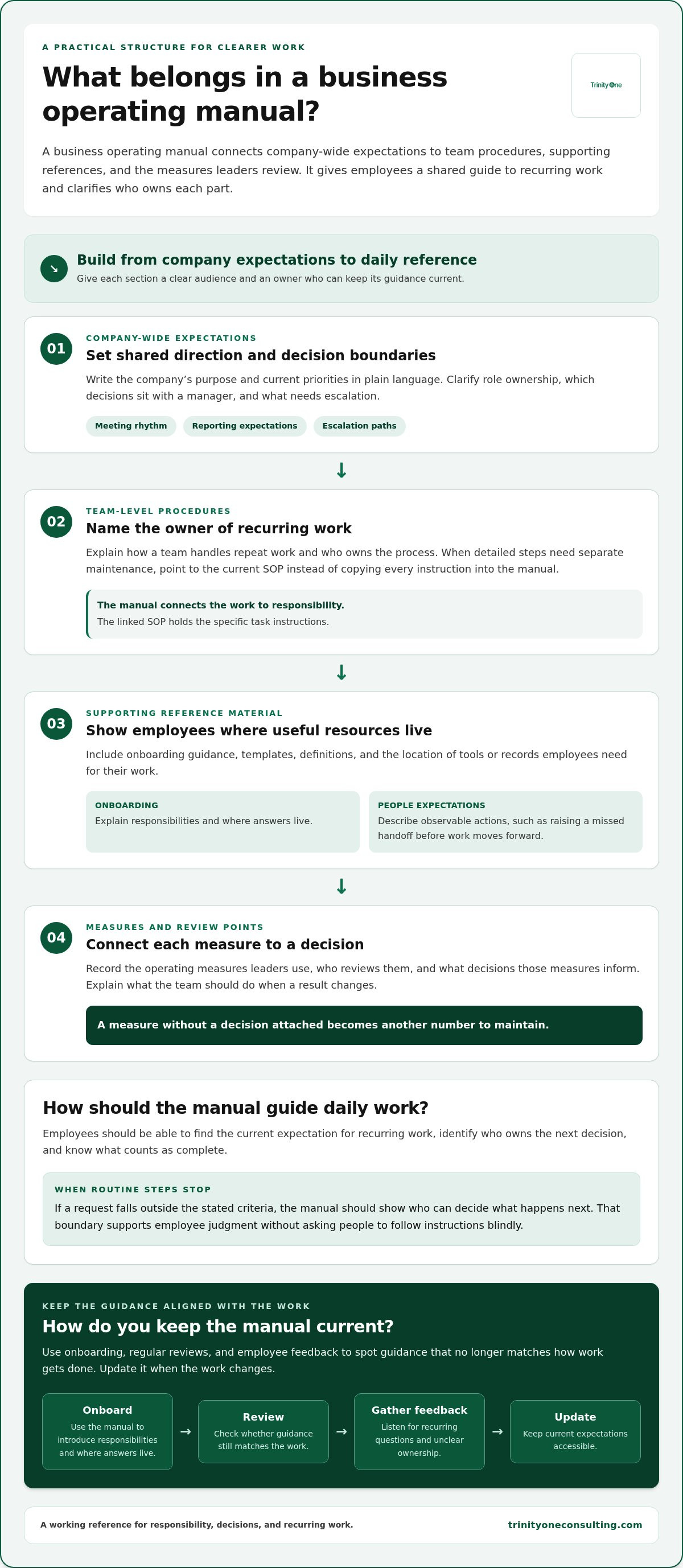
To understand what is a business operating manual in practical terms, start with its job: connect company-wide expectations to the work, decisions, and people responsible for carrying them out. The contents should fit your business. A small team with a few shared processes won’t need the same detail as a company with several departments.
An operating manual is a company’s working guide to how it runs, what employees need to know, and who owns each part. Every section needs a defined audience and an owner who can keep its guidance current. Without an owner, a once-accurate procedure can quietly become a source of rework.
A compact contents framework could include:
- Company-wide expectations: Purpose, current priorities, role ownership, decision boundaries, meeting rhythm, reporting expectations, and escalation paths.
- Team-level procedures: How a specific function handles recurring work, with links to detailed SOPs where step-by-step instructions need separate maintenance.
- Supporting reference material: Onboarding guidance, templates, definitions, and the location of tools or records employees need to do their work.
- Measures and review points: The operating measures leaders use, who reviews them, and what decisions those measures inform.
Which operating fundamentals need to be documented?
Write purpose and priorities in plain language employees can apply to a real choice. Clarify who owns a decision, which decisions sit with a manager, and what needs escalation. Record recurring meetings and reporting expectations only when they help people coordinate or act. A measure without a decision attached becomes another number to maintain. Explain what the team should do when a result changes.
Where should process instructions and employee guidance sit?
Keep detailed steps in a linked SOP when that procedure changes independently from the wider manual. The manual can state who owns the process and point employees to its current instructions, instead of duplicating them. Onboarding guidance should explain responsibilities and where answers live. Describe people expectations as observable actions, such as raising a missed handoff before work moves forward, rather than relying on slogans like “communicate well.”
Keep the framework adaptable. A rule that helps one team may burden another, and documenting every task adds upkeep without necessarily helping anyone make better decisions. Strategic advisors such as Formatour Incorporated often note that improving operational performance relies on building organizational resilience rather than layering on unnecessary bureaucracy. I’d include a section when it answers a recurring question, clarifies ownership, or helps someone understand how their work connects to company priorities.
How is a business operating manual different from SOPs or an operating system?
When people ask what is a business operating manual, they’re often picturing a stack of procedures. The distinction matters. A manual explains how the company operates across roles and teams, an SOP gives instructions for a specific repeatable task, and a business operating system sets the broader structure for priorities, meetings, accountability, and execution.
| Document or system | Purpose | Scope |
|---|---|---|
| Business operating manual | Records how the company works and assigns operational ownership. | Company-wide expectations, decision boundaries, and links to team procedures. |
| Standard operating procedure (SOP) | Shows how to complete a repeatable task or process. | A specific workflow, usually owned by a team or role. |
| Business operating system | Defines how leaders set priorities, review progress, and hold work accountable. | The recurring management structure that guides execution across the company. |
A manual can point to several SOPs without copying each instruction into one large document. That keeps the company-wide guidance readable and lets a process owner update a procedure without revising unrelated sections. The tradeoff is that linked instructions need clear titles and a reliable home. If employees can’t find the referenced SOP, the link adds a step without solving the problem.
Is a business operating manual the same as an SOP?
No. An SOP explains the steps for completing a repeatable task. The manual gives those steps context: who owns the process, when it applies, and where to find the current procedure.
Hypothetical example: A company manual says the service team owns customer refund requests and identifies who can approve an exception. A linked SOP explains how to record and process a routine refund. The manual sets the operating expectation. The SOP covers the task.
How does a manual relate to EOS or another operating system?
A business operating system sets the management structure. The manual records how that approach works inside your company, including role expectations and where employees find process instructions. One doesn’t replace the other, and no single framework or manual fits every organization. A fixed structure can clarify ownership, but it can also feel restrictive if it doesn’t fit how your team operates.
If you’re defining that broader structure, read my guide to creating an executing business operating system. If you’re comparing frameworks, see my guide to alternatives to EOS.
How do you build a business operating manual people will use?
Start with recurring friction, not a blank document and a demand to record everything. If a handoff regularly stalls or the same decision keeps returning to you, that’s a better place to begin than documenting work employees already handle without confusion.
Build around decisions and repeatable work people need to understand. A manual that tries to cover every exception takes longer to write and maintain, and can bury the guidance employees need most. I’d use this sequence:
- Choose one recurring problem. Identify a process, handoff, or decision that causes repeated questions, delays, or inconsistent results.
- Set the boundaries. Define who needs the guidance, where the process starts, which decisions it covers, and what completion looks like.
- Watch the work happen. Follow an actual instance from start to finish. Record handoffs, decisions, exceptions, and the conditions that mark the work complete.
- Draft with an accountable owner. Ask the person responsible for the process to write or review the guidance. Mark current practice separately from proposed changes.
- Test before publishing. Have the people doing the work follow the draft. Ask where they got stuck and whether they could find the right instruction without help.
Employees must validate instructions against current practice before those instructions become the company’s standard. A polished draft can still be wrong if it describes an intended process instead of what the team actually does.
How should leaders capture the work as it happens?
Observe a real process rather than relying on someone’s memory of an ideal version. Ask employees where the work stalls and which instructions are hard to find. Then compare what they describe with what you observed. If the team agrees a step should change, record it as a proposed improvement until the owner approves the new method.
How can a team keep the manual current?
Name one owner for each section and set a review trigger tied to a real change, such as a revised approval path or a new handoff. Keep the current version in one easy-to-find location, and retire superseded guidance so employees don’t have to guess which copy applies.
Pay attention to repeat questions. If employees keep asking who approves an exception, the section may be unclear, hard to find, or out of date. Their questions are evidence. Use them to improve the manual and help people build confidence in the work, rather than treating every question as a failure to read.
How can leaders connect a business operating manual to daily execution?
A manual becomes useful when leaders bring it into the work. During onboarding, use it to explain how a new employee’s responsibilities connect to other roles. In recurring reviews, point to the documented expectation when work stalls or ownership is unclear. When a process changes, update the guidance and tell the people who rely on it.
Access isn’t understanding. An employee may be able to open a document and still be unsure who owns the next decision. Ask them to find the relevant guidance and explain what they’d do in a real situation. Then listen to their feedback and have the manager close any gaps through clarification, coaching, or a change to the manual.
An operating leader connects written expectations to execution by making ownership visible. Name who acts, who approves an exception, and where a handoff goes next. If your business needs help establishing that accountability, explore fractional COO and Integrator support.
How do leaders know whether the manual is helping?
Look for signs in ordinary work. Are employees asking for the same clarification less often? Do handoffs reach the right person without the founder stepping in? During a review, ask an employee to locate the guidance and explain who owns the next decision. You’re checking whether the manual works at the point of use, not whether someone has opened it.
Missed handoffs and recurring exceptions deserve attention. They may signal that instructions are hard to find, a process has changed, or the decision owner was never clear. The document can expose the gap, but a manager still has to address its cause.
What should a manual never replace?
Written guidance can’t replace leadership judgment when a situation depends on context. It also can’t resolve unclear authority by itself. Leaders have to assign decision ownership and explain what employees should do when a case falls outside the documented steps.
I believe people do their best work when expectations are clear and they have room to grow. A manual can give employees a steady reference as they take on responsibility. It can’t promise better performance on its own. That takes manager follow-through, honest feedback, and practice.
Put your operating manual to work
A business operating manual gives your team a shared reference for how work gets done, who owns decisions, and when to ask for help. Its value comes from use, not volume. Keep guidance tied to real responsibilities, link detailed procedures where they belong, and revise instructions when the work changes.
Start with the recurring questions or handoffs that slow employees down. Then assign an owner to each section and ask the people doing the work to test the guidance. Clear documentation supports better decisions, but it still takes leaders to coach, follow through, and give employees room to grow.
I’ve spent more than 30 years working in operations. At Trinity One, Trinity Cadence brings together an operating cadence, AI coaching, and real-time visibility into execution and engagement, helping leaders keep documented expectations connected to the work.
Give your people a clear way to do good work, and keep improving the system as they grow.
Frequently Asked Questions
What is a business operating manual?
A business operating manual is a working reference that explains how a company operates, makes decisions, and assigns responsibility. In practical terms, it helps employees find current expectations for recurring work without relying on someone’s memory. It should point to detailed procedures and clarify who owns decisions. It supports judgment and leadership, but it can’t replace either.
What should be included in a business operating manual?
Include the information employees need to understand how work moves through your company. That may cover purpose and priorities, role ownership, decision boundaries, meeting and reporting expectations, and escalation paths. Add team procedures or link to separate SOPs when detailed steps need their own owner or updates. Include onboarding guidance and useful reference material, but keep examples adaptable. A manual should reflect how your business works, not follow a universal template.
How do you create a business operating manual?
Start with a recurring question, delay, or handoff that causes confusion. Set a clear boundary for the guidance, then observe the work and record who acts, what decisions come up, and what completion means. Ask the employees doing the work to review and test the draft. Separate current practice from proposed changes, assign an owner, and publish the guidance where the intended readers can find it.
Who should write and maintain a business operating manual?
The people who perform the work should help write and test its instructions. A manager or process owner should be accountable for each section, check that it reflects current practice, and approve changes. An operating leader can clarify decision rights across teams and resolve ownership gaps. The founder shouldn’t have to author every page or answer every question. Employees still need coaching to understand how the written guidance applies to their work.
How often should a business operating manual be updated?
Update a section when the process, decision authority, or handoff it describes changes. A change to who approves an exception, for example, is a clear reason to revise the guidance. Set review points that fit your operating rhythm, and ask section owners to check whether instructions still match the work. Retire outdated versions so employees don’t have to guess which copy to follow.
Can a small business benefit from an operating manual?
Yes. A small business can start with a short guide to the recurring work and decisions that currently depend on the owner’s memory. Focus on the questions employees ask repeatedly or tasks that need consistent handoffs. A large manual may take time to create and maintain without adding value, so keep the scope narrow. Add guidance as the business grows and responsibilities become more distributed.
If you’d like to connect your team’s documented expectations to its operating rhythm, book a discovery call with me.