
Alternatives to EOS include Scaling Up, Pinnacle Business Guides, Metronomics, and The 4 Disciplines of Execution (4DX), but each addresses different operating needs. A new system won’t fix missed commitments if nobody owns the next move. Start by naming the specific follow-through problem you need to solve.
You may have clear priorities and a weekly meeting, yet work still stalls afterward. Or EOS’s structure may feel too fixed, while people development sits outside the operating rhythm. Those are different problems, and they call for different responses.
I compare each approach by asking whether it turns priorities into owned commitments and helps leaders see obstacles before deadlines slip. Scaling Up adds strategic and financial depth, with greater coaching demands. 4DX concentrates on execution, but it isn’t a complete company operating system. Pinnacle and Metronomics offer other ways to shape an operating cadence.
More structure takes more leader attention. A simpler system can leave important gaps untouched. Trinity Cadence connects operating cadence with AI coaching and visibility into execution and engagement. Fractional COO or Integrator support adds hands-on operational leadership. The right fit depends on what your leaders and teams need to do differently.
Key Takeaways
- Pinpoint the execution gap before choosing alternatives to EOS. Missed follow-through and frustration with meeting habits may need different fixes.
- Compare operating approaches by cadence, accountability, visibility, adaptability, and how they connect people to the work.
- Separate a business methodology from the software, advisory support, or leadership practices used to put it into action.
- Test a change with a focused pilot while keeping current commitments visible, then review how well the new practices are adopted.
- Consider how Trinity Cadence connects operating rhythm with AI coaching and visibility into execution and engagement.
What problem should an alternative to EOS solve?
Alternatives to EOS make sense when they address a specific execution gap the current system hasn’t resolved. A different framework won’t help if leaders don’t assign owners or follow up on commitments. An EOS alternative is another approach to turning priorities into owned work and reviewing progress.
That distinction matters. A team can dislike long meetings, repeated updates, or a rigid agenda without needing a new operating framework. It may need better meeting habits. But if the structure doesn’t show who owns a priority or how work connects across teams, a different framework may be worth considering.
A Business operating system provides an organizing structure for how a company runs. It only works when leaders apply it consistently and people can see how their work contributes to priorities.
How can you tell whether the framework or the implementation is the problem?
Start with the commitments already on your team’s plate. Does each priority have a named owner, a deadline, and a visible way to track follow-through? If those pieces are missing, the immediate gap may be how leaders use the current tools, not the framework itself.
Look at the work between meetings. A customer handoff can sit in someone’s inbox because two teams each assume the other owns it. A project can slip even when everyone understands its priority, because nobody raises the obstacle or resets the commitment. Those are execution and leadership behaviors. New software or a different meeting format won’t correct them on its own.
If priorities are clear but commitments keep getting missed, examine how leaders address ownership, obstacles, and consequences. If the current structure gives them no practical way to see dependencies or progress, the framework may be part of the problem. Replacing it takes leader attention and can create confusion while people learn a new rhythm, so name what the change must fix.
What should an operating system help your team do?
It should connect company priorities to specific work and accountable owners. Each leader needs to know what their team committed to, when it is due, and what needs attention before the deadline passes. Without that link, a company priority can stay on a meeting slide instead of guiding daily decisions.
Leaders also need a dependable view of progress and obstacles. A useful status update makes it possible to say, “We’re blocked on the approval,” then name who will address it and when the team will check back. The goal is clear action, not a fuller dashboard.
Good visibility supports candid conversations. Metrics can show that a commitment is late, but a leader still needs to learn why and hear what support the person needs. People aren’t data points. An operating system should help leaders see the work and give them a reason to talk honestly with the people doing it.
How should you compare alternatives to EOS?
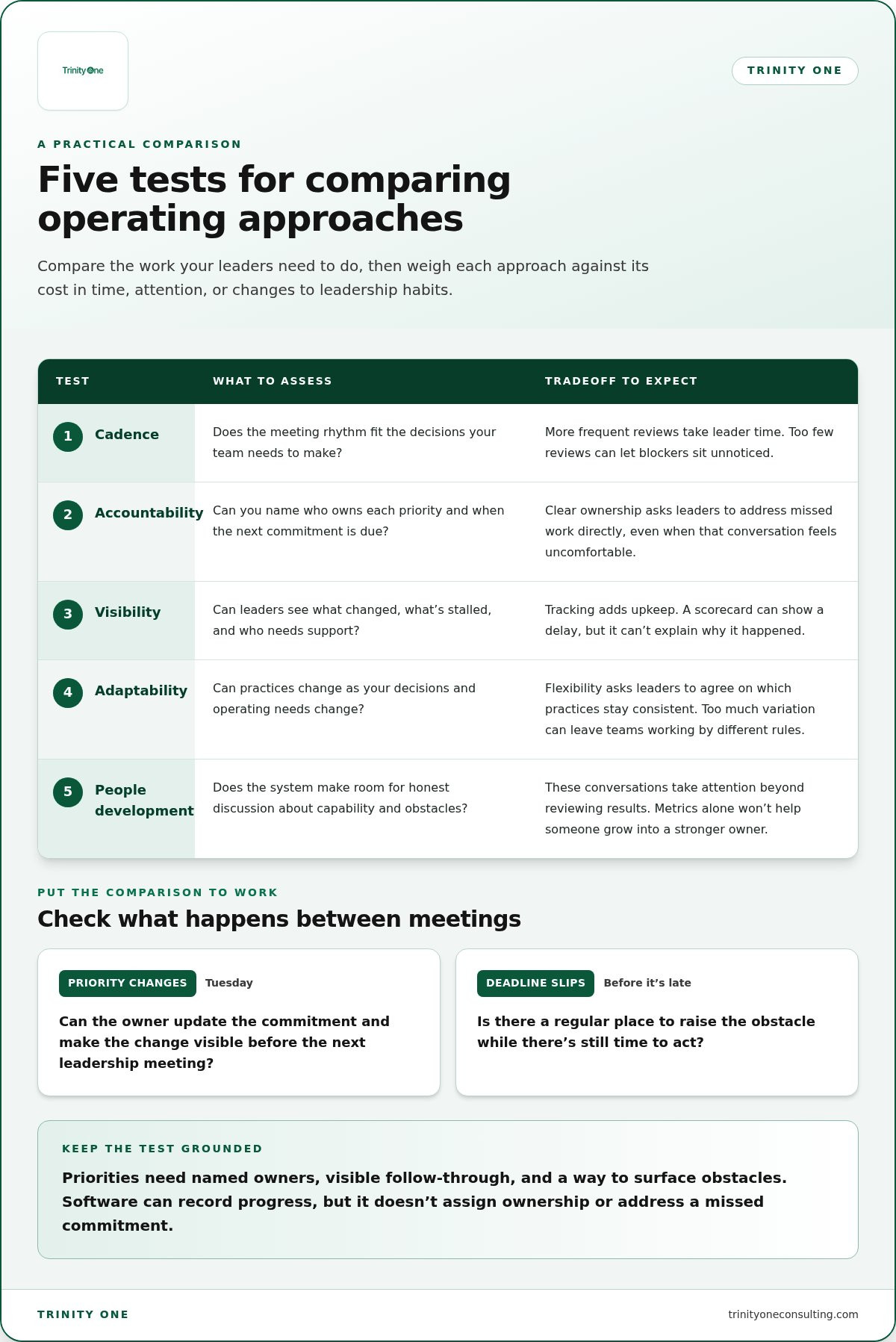
Compare alternatives to EOS against the work your leaders need to do, not the polish of a framework or the features on a software page. I use five tests: cadence, accountability, visibility, adaptability, and people development. Each one has a cost in time, management attention, or changes to how leaders behave.
| Criterion | What to assess | Tradeoff to expect |
|---|---|---|
| Cadence | Does the meeting rhythm fit the decisions your team needs to make? | More frequent reviews take leader time. Too few reviews can let blockers sit unnoticed. |
| Accountability | Can you name who owns each priority and when the next commitment is due? | Clear ownership requires leaders to address missed work directly, even when that conversation feels uncomfortable. |
| Visibility | Can leaders see what changed, what’s stalled, and who needs support? | Tracking adds upkeep. A scorecard can show a delay, but it can’t explain why it happened. |
| Adaptability | Can the practices change as your decisions and operating needs change? | More flexibility asks leaders to agree on which practices stay consistent. Too much variation can leave teams working by different rules. |
| People development | Does the system make room for honest discussion about capability and obstacles? | These conversations take attention beyond reviewing results. Metrics alone won’t help someone grow into a stronger owner. |
Check the work behind the scorecard. If a priority changes on Tuesday, can its owner update the commitment and make the change visible before the next leadership meeting? If an employee sees a deadline slipping, is there a regular place to raise the obstacle while there’s still time to act?
The operating rhythm must fit the decisions at hand. A weekly review may help leaders handle active delivery problems, while longer-range planning calls for a different discussion. People need to know what decisions belong in each forum and what follow-through is expected afterward.
How do frameworks, software, and operating support differ?
A framework is a repeatable set of management practices. Software can record priorities, meetings, or progress, but it doesn’t decide who owns a commitment or address a missed deadline. Gartner’s comparison of EOS software alternatives can inform a software search, but comparing tools won’t tell you which management practices your company needs.
Advisory support helps leaders put practices into use. An operator, such as a fractional COO or Integrator, takes active responsibility for execution and follow-through. For organizations navigating commercial and market expansion challenges alongside operations, you can learn more about Carter Strategies to explore how fractional executive leadership supports strategic growth. That support requires ongoing management attention. Internal leadership can own the same work, but only if someone has the authority and time to keep commitments in view.
No framework or platform can compensate for leaders who avoid ownership conversations. If a commitment slips, the leader still has to name the gap, agree on a next step, and follow up. The system gives that behavior a place to happen. The people in the room make it real.
Which alternatives to EOS fit different operating needs?
The right alternative depends on what’s missing from your current system. Scaling Up offers a defined playbook, coaching, and software. OKRs can clarify objectives and measurable results. A fractional COO or Integrator brings operational ownership, while an internally designed cadence leaves more room to adapt. These approaches solve different problems.
When might Scaling Up be worth considering?
Scaling Up organizes management around four decisions: People, Strategy, Execution, and Cash. Its approach includes a playbook, coaching, training, and Scoreboard software. It may fit leaders who want a defined process for company-wide scaling challenges, with outside guidance and software supporting the work.
The tradeoff is the commitment required to learn and maintain a fuller set of practices. Coaching takes leadership time, and a defined playbook can feel heavy if your immediate issue is narrower, such as missed handoffs between two teams. Software can make information easier to review, but it can’t replace leaders setting priorities and addressing commitments that slip.
When might OKRs or fractional operations leadership fit better?
OKRs help a team state an objective and track measurable results connected to it. They can sharpen focus around a goal, but they don’t automatically establish a full operating cadence. Leaders still need to decide how often progress gets reviewed, who owns follow-up, and where people raise obstacles.
A fractional COO or Integrator is a leadership model, not a packaged methodology. This operator helps own execution by translating priorities into commitments, coordinating follow-through, and keeping unresolved work visible. It can suit a company that has a framework but lacks a clear operational owner. The tradeoff is that the role requires access to decision-makers and sustained attention to day-to-day execution. For a closer look at this option, see our fractional COO support.
You can also build an operating cadence around the decisions your company actually makes. That gives leaders room to shape meeting rhythms and tracking practices to fit their work, but the company must document the approach, teach it to new team members, and keep it consistent as priorities shift. Without an owner, a homegrown system can become a set of disconnected meetings.
I’d compare each alternative by asking who will keep commitments visible after the planning session ends. A framework supplies practices. OKRs clarify goals. Software records information. An operator owns execution, while an internal cadence depends on your leaders maintaining it. None can carry the work without leadership follow-through.
How can you change operating systems without disrupting execution?
Switching to a new operating system works best as a controlled change, not a sudden reset. Before comparing alternatives to EOS in practice, keep current commitments visible and map how work moves today. Otherwise, teams can lose track of deadlines while learning new meeting rules or software.
What should leaders map before changing systems?
Write down the meetings where priorities are set, decisions are made, and work gets reviewed. For each active priority, record its owner, next commitment, and any recurring obstacle. Include informal practices too, such as a team lead who checks on a handoff before it reaches a customer.
Keep what already supports execution. If a weekly meeting surfaces risks early, preserve that useful behavior even if its agenda changes. Then identify what the new process adds or removes, such as an extra status update or a clearer decision owner. Every added step takes employee time, so it should address a visible gap.
How can a pilot limit disruption?
Choose one team or operating rhythm where the problem is easy to see. If project decisions routinely wait for leadership, pilot a meeting and tracking practice focused on decision ownership. Keep existing commitments in the same shared view while the team tests the change. Don’t make people maintain two competing records longer than necessary.
Agree on a review point before the pilot begins. Look for practical signs: are decisions still waiting on an owner, are deadlines being missed because responsibilities are unclear, and are the same obstacles returning without a decision? Ask employees where the new process creates confusion or extra work. Their feedback can show whether the practice helps execution or adds administration.
Leaders should also make behavioral expectations plain. If an owner sees a deadline at risk, they need to raise it early. If a commitment is missed, the responsible leader needs to discuss what happened and set the next action. New software can record a status change, but it can’t have that conversation.
A transition succeeds when operating habits change alongside the tools. Keep that test in view as you review the pilot. If visibility improves but leaders still avoid ownership and follow-through, the new system hasn’t addressed the full execution gap.
How can Trinity One connect operating cadence with people development?
Some alternatives to EOS put more weight on execution structure. Trinity Cadence connects operating cadence with people management in an AI-native operating system for machine operations and people management. It gives leaders a clearer view of work and engagement while supporting the people responsible for carrying out that work.
What does an AI-native operating cadence change?
A unified operating cadence gives teams a shared rhythm for setting priorities, reviewing commitments, and addressing obstacles. Trinity Cadence adds AI coaching and real-time visibility into execution and engagement. That brings operational signals and people-related context into the same view, instead of leaving leaders to piece together separate updates.
For example, a leader reviewing a delayed commitment needs to see more than a status label. They need to understand where the work stands, what obstacle is holding it up, and whether the owner needs direction or support. AI coaching can support those conversations, while visibility helps leaders keep the commitment in view. It doesn’t replace judgment or a direct conversation between a manager and employee.
The practical test is whether the system helps leaders connect priorities to daily work and notice when a person or process needs attention. It still takes management time to review the information and act on it. Software can make signals visible. Leaders have to respond.
If you’re comparing operating approaches, start with the practices that help your team set priorities, review commitments, and resolve obstacles. Those routines are the working parts of an operating system. Keep the distinction clear: a cadence organizes work, while leaders decide how to respond to what they see.
When should an operator or employee development focus be part of the model?
Trinity Cadence and fractional COO or Integrator support solve related but different needs. The system provides a shared operating rhythm and visibility. A fractional operator takes hands-on responsibility for execution, helping leaders translate priorities into owned work and maintain follow-through. That role requires access to decisions and ongoing attention to the company’s operating commitments. Learn more about fractional COO and Integrator support.
Structured coaching and personal development frameworks add a dedicated people-development practice. Firms like Simon Lead LLC provide executive coaching aimed at enhancing leadership capabilities so leaders can better guide their teams. These approaches use defined categories to help individuals identify and make progress toward meaningful personal goals. It can give leaders a structured way to understand what matters to employees beyond their job responsibilities. It doesn’t replace clear expectations or accountability at work.
A company only becomes the best version of itself as its people become better versions of themselves. That means managing commitments and paying attention to the people doing the work. A company may need an operating cadence, a hands-on operator, or a people-development practice, depending on the gap its leaders are trying to close.
What should your next operating model make possible?
Your next operating model should help leaders act on what they see and give employees room to raise obstacles early. That takes more than choosing a framework. It takes operating habits that connect daily work with how people are supported and developed.
Trinity One was founded by practitioners with over 30 years of operational experience. Trinity Cadence brings operating cadence, AI coaching, and visibility into execution and engagement together, so leaders can attend to the work and the people doing it.
The system you choose will shape how your leaders spend their time. Make sure it supports the kind of company your people are working to build.
What should you know about alternatives to EOS?
Is there a better alternative to EOS?
There’s no universal winner. The better fit depends on the execution gap, your leaders’ habits, and how much structure your company needs. Scaling Up may suit leaders seeking a defined playbook with coaching and software, while OKRs focus on setting objectives and tracking measurable results. Compare what each approach asks leaders to do. Any system still depends on clear ownership and consistent follow-through.
What are the main alternatives to EOS?
Common alternatives to EOS include Scaling Up, OKRs, an internally designed operating cadence, and fractional operations leadership. They aren’t equivalent products. Scaling Up offers a defined playbook supported by coaching and software, while OKRs organize objectives and measurable results. An internal cadence depends on leaders creating and maintaining shared practices. A fractional COO or Integrator adds operational leadership. Compare what each provides, what leaders must supply, and how it supports visibility and accountability.
How is Scaling Up different from EOS?
Scaling Up uses a playbook organized around People, Strategy, Execution, and Cash, with coaching and Scoreboard software among its supporting elements. That differs from EOS in the specific practices and support model each uses. Compare the structure your leaders will follow, the coaching involved, and how progress is tracked. Neither approach is automatically superior. Fit depends on your operating needs and the attention leaders can commit.
Can a company use OKRs instead of EOS?
A company can use OKRs to define objectives and track measurable results, but OKRs don’t automatically provide a complete operating cadence. Your team may still need regular meetings, clear owners for commitments, and a reliable way to follow up on missed work. The fit depends on what’s missing now. If objectives are unclear, OKRs may help. If execution stalls after priorities are set, leaders may need stronger operating practices too.
How do you know when EOS is no longer the right fit?
Persistent execution gaps may signal that EOS no longer fits, especially when owners are unclear, leaders can’t see progress, or the process is difficult to sustain. But inconsistent use can create similar symptoms. Review actual meetings, commitments, and obstacles that remain unresolved. If priorities are clear but follow-through repeatedly breaks down, examine leadership habits before replacing the framework. A new system takes time and attention to implement.
Can an AI operating system replace EOS?
An AI operating system can support cadence, visibility, and coaching, but it can’t replace leadership judgment or employee participation. Trinity Cadence connects machine operations with people management through a unified operating cadence, AI coaching, and real-time visibility into execution and engagement. Leaders still need to make decisions, address obstacles, and follow up on commitments. AI can help surface information. People remain responsible for acting on it.
How much do alternatives to EOS cost?
Costs depend on what the approach includes, such as software, coaching, training, or internal implementation work. There’s no single price that applies across alternatives to EOS, and a subscription fee alone won’t show the full commitment. Compare the total time leaders must spend learning and maintaining the practices, along with the effort required from employees. A lower direct cost may still require substantial internal management attention.
Book a discovery call with Kevin