
Your business is failing because your engine has two gas pedals and no steering wheel. A visionary integrator partnership is the mechanical fix for a company that's all momentum and no direction. I've watched founders burn out because they're trying to be the person who dreams the future and the person who builds the spreadsheets. It's a biological mismatch that kills growth.
You likely feel like you're shouting into a void during every Monday morning meeting. Your leadership team nods, but by Friday, the ideas are still just notes on a whiteboard. I spent years on football sidelines and in corporate offices watching talented people fail because they didn't respect their own wiring. Visionaries create the spark, but integrators build the circuit that carries the current.
I follow Matthew Kelly's Dream Manager methodology because I believe a company only becomes the best version of itself to the extent its people are becoming better versions of themselves. You'll learn to identify your natural leadership wiring and build an operating cadence that actually executes. This is how you stop the idea swirl and start scaling. Faith gives me the conviction that your business has a purpose, but only a functional engine can fulfill it.
Key Takeaways
- Stop trying to design the car while you're running the engine. You'll learn why this conflict stalls growth once you hit 10 employees.
- I'll help you identify if your high risk appetite makes you the architect of the future or the engineer of the present.
- You'll see how a visionary integrator partnership creates a circuit for your ideas to reach the ground through a disciplined operating system.
- We'll move past personality quizzes to build a weekly meeting cadence that relies on hard data and clear accountability.
- You will discover how a fractional integrator uses the Trinity Cadence platform to provide real time visibility into your business engine.
Why do you need a visionary integrator partnership?
Most founders are trying to run the engine and design the car at the same time. It's a recipe for a crash. A visionary integrator partnership is the only way to stop the mechanical friction that stalls growth when you hit 10 to 20 employees. I've seen it on football fields and in boardrooms. You can't call the plays and block the defensive end simultaneously.
Execution fails when the visionary stays stuck in the weeds. If you're spending your Tuesday morning fixing a broken software integration or checking timecards, you aren't looking at the horizon. We use assessments to identify where your natural energy flows so you can stop fighting your own biology. It's about putting the right person in the right seat to keep the machine moving forward.
The high cost of role confusion
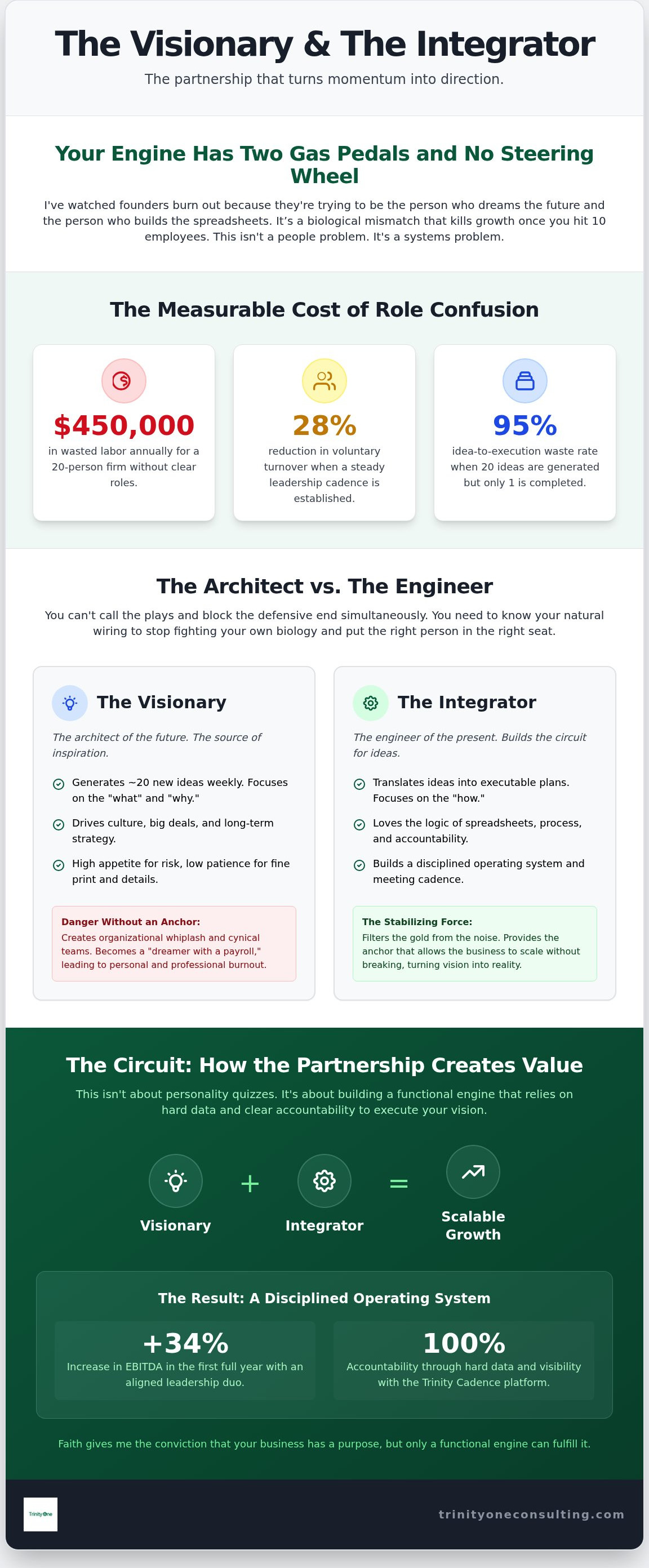
Role confusion is expensive. Without visionary and integrator alignment, you're bleeding cash. For a 20 person firm, this lack of clarity costs roughly 450,000 dollars in wasted labor annually.
Then there's the idea swirl. You walk into the office with 10 new projects on Monday. By Friday, the team has finished zero because they're dizzy from the changing priorities. This creates a culture of "wait and see" where employees stop working because they know the direction will shift by lunch.
Turnover follows the chaos. People want to win. When they lack a clear operating rhythm, high performers leave for companies that have their act together.
Identifying the friction in your current leadership
Operational friction is the measurable gap between an idea and a completed task. If you generate 20 ideas a week but your team can only execute one, you have a 95 percent waste rate. That's not a people problem. It's a systems problem.
You need someone who loves the logic of the spreadsheet as much as you love the thrill of the new. Finding that balance is what allows you to scale without breaking. I believe we're called to steward our businesses with excellence, which requires us to be honest about our limitations. You can read more about the fractional integrator: engineering your business engine for 2026 to see how this looks in practice.
How do you know if you are a visionary?
Visionaries are the architects of the future. You see what doesn't exist yet and have the guts to chase it. If you have a high appetite for risk but a low patience for the fine print, you're likely a visionary. A visionary integrator partnership is the tool that keeps your feet on the ground while your head is in the clouds.
I've found that a true visionary typically generates 20 new business ideas every single week. It's a constant stream of possibilities. Your primary value to the company is culture, big deals, and long term strategy. You are the engine of growth, but engines need a transmission to actually move the wheels.
I believe we are called to use our gifts to serve others, and a visionary's gift is the ability to see a better world. However, that gift can become a curse if it's not managed. You need a system that filters the gold from the noise.
The traits of the corporate architect
You focus on the what and why rather than the how. Details feel like lead weights on your ankles. You likely feel bored by repetitive weekly meetings that focus on incremental progress. I've sat in those meetings where the founder is checking their watch every three minutes because they want to be out in the world making things happen.
You're the primary source of inspiration for the entire organization. Your team looks to you for the big picture. They need your energy. But they also need to know that the energy is going somewhere specific instead of being sprayed in every direction.
The danger of the visionary without an anchor
An unanchored visionary creates organizational whiplash. Your team becomes cynical when priorities change every Tuesday morning. They stop giving their best because they know the target will move by lunch. I've talked to employees at 20 person firms who admit they just "smile and nod" when the boss has a new idea because they've learned it will be forgotten by Friday.
Without an integrator, you are just a dreamer with a payroll. You're paying people to watch you change your mind. This burnout affects your personal life and your health. You can't turn the brain off at 6 PM. You miss dinners and kids' games because you're chasing the next shiny object that you think will finally fix the business.
Matthew Kelly’s Dream Manager methodology reminds us that your business should serve your life, not the other way around. If your people are becoming worse versions of themselves because of your chaos, you're failing as a leader. You might need to audit your current leadership wiring to see where the friction is starting.
What defines the integrator archetype?
Integrators are the engineers who build the systems to support the vision. They love the logic of a spreadsheet and the discipline of a deadline. A visionary integrator partnership requires a person who filters the visionary’s 20 weekly ideas down to the two that matter for the bottom line. They provide the steady beat that the rest of the company follows.
While the visionary is looking at the horizon, the integrator is looking at the dashboard. They translate big dreams into a sequence of tasks that employees can actually complete. Without this role, your organization is just a collection of talented people running in opposite directions. This partnership creates the alignment needed to turn a startup into a scaleup.
I’ve spent years in the trenches of leadership and I know that execution is not a happy accident. It is a mechanical certainty when the right systems are in place. You need someone who is comfortable with the "how" so you can stay focused on the "why".
Execution as a technical discipline
Integrators manage the people and the processes while keeping a close eye on the P and L. They function as the glue that holds different departments together. If sales is promising something that operations can't deliver, the integrator steps in to fix the circuit. They use tools like Trinity Cadence to provide real time visibility into every gear of the business engine.
I've seen this on the football field where the offensive coordinator ensures every player knows their assignment for the next play. In business, this looks like my Fractional COO services. We focus on the hard data rather than just the feelings of the leadership team. Every department must work in harmony for the engine to produce power.
This role is also about human development. Following Matthew Kelly’s Dream Manager methodology, the integrator ensures that company goals align with the personal aspirations of the staff. When people see that their daily tasks help them reach their own dreams, their productivity spikes. It turns a job into a mission.
The rise of the fractional integrator
Most companies under 5 million dollars in revenue cannot afford a full time COO. A high-level operator often commands a salary between 250,000 and 400,000 dollars annually. This is a massive hit to the cash flow of a growing firm. A fractional integrator provides the same discipline at a fraction of that cost.
You can find more details in my When to Hire a Fractional Executive: 2026 Scaling Guide. One major advantage of this model is the objectivity of an outside expert. A fractional integrator is better at saying no to a founder than a full time subordinate. They aren't worried about their career path within your company. They are only worried about the health of your business engine.
I believe we should work with people who tell us what we need to hear, not what we want to hear. This honesty is the foundation of a functional leadership team. It allows the visionary to stay in their zone of genius while the integrator keeps the lights on and the gears turning. Faith gives me the conviction that truth always leads to better results than comfort.
How do you evaluate the visionary integrator partnership?
Alignment is not a one time event from a quiz. It is a continuous mechanical adjustment. You need a weekly meeting cadence that focuses on hard data rather than feelings. Success is measured by the velocity of task completion and team engagement within the visionary integrator partnership.
The integrator must have the authority to say no to the visionary. Without this power, the partnership is just a title on a business card. I've seen this dynamic fail in companies with 50 employees because the founder couldn't stop meddling. You're paying for an operator, so let them operate.
I believe we are called to lead with clarity and truth. This requires us to look at the numbers even when they are uncomfortable. Trust is built on results, not just intentions.
Scoring your operational alignment
Rate your trust level on a scale of 1 to 10 every single week. Be blunt. If the score is a six, you have a friction point that will eventually break the engine. You can't fix what you don't measure.
Identify the number of undone items on your weekly to-do list. High numbers of carries mean your engine is misfiring or overloaded. It shows that the team is busy but not productive. Execution is the only metric that matters at the end of the day.
Check if the visionary is still jumping into the integrator’s sandbox. This boundary crossing is a primary cause of organizational whiplash. When the architect starts trying to lay the bricks, the whole structure becomes unstable. Keep the vision and the execution in their own circuits.
Building a functional operating cadence
A cadence is the heartbeat of the business engine. It keeps every department in sync. Use a structured agenda to ensure every meeting produces a result. Vague discussions are a waste of payroll.
I recommend a specific 90 minute meeting structure that saves 10 hours of slack messages every week. This structure forces issues to the surface before they become crises. It gives the team a predictable rhythm they can rely on. You can read more about how to improve your visionary and integrator relationship in 2026.
Matthew Kelly’s Dream Manager methodology teaches us that people thrive when they have clear expectations. A functional cadence provides that clarity. It allows employees to focus on their work instead of guessing what the boss wants today.
How does a fractional integrator solve the execution gap?
A fractional integrator brings an outside perspective to your internal chaos. They don't have the emotional baggage of being a founder or a long term employee. This objectivity allows them to see the friction points in your visionary integrator partnership that you've grown blind to. They function as the lead mechanic for your business engine.
A fractional operator can see where the gears are grinding because they've fixed the same problem in ten other companies. This experience saves you the 18 months of trial and error that usually comes with a first time COO hire. It's a way to get veteran leadership without the 300,000 dollar salary commitment.
We use tools like Trinity Cadence to provide real time visibility into your operations. It's about moving from "I think we're on track" to "the data shows we're on track." This visibility stops the idea swirl. It moves the visionary back to their zone of genius where they can focus on big deals and long term strategy.
I've seen founders regain 15 hours of their week just by stepping out of the daily management loop. They stop answering 50 slack messages a day and start thinking about the next three years. This shift is what allows a company to move past the 20 employee ceiling.
The human fuel of the business engine
A company only grows as much as its people grow. If your staff is stagnant, your revenue will eventually follow. I use the Dream Manager program to drive employee retention and engagement. This isn't about soft feelings. It's about hard results.
We use the Dream Manager Coaching methodology to align company goals with the team’s personal aspirations. Matthew Kelly identified twelve dream categories that help people define what they actually want from life. These categories range from physical health to financial stability.
When a worker sees that their performance at your firm helps them buy their first home or pay for their kid's college, their loyalty becomes unbreakable. It turns a paycheck into a partnership. You stop being a boss and start being a mentor who helps them achieve their own dreams.
Integrating AI into your operating system
AI is the machine logic that supports the human integrator. We use AI implementation to coach your team on operational efficiency in real time. It identifies bottlenecks before they stop the production line. This technology doesn't replace the human element. It amplifies it.
It acts as the integrated circuit that connects your strategy to your execution. It keeps the visionary integrator partnership focused on the data that matters. You stop guessing and start knowing. This creates a sense of calm in the office because everyone knows the score.
Developing your people is the highest calling of a leader. You aren't just building a company. You are building humans. Faith in your team is the only way to scale without losing your soul. It requires a belief that people want to do good work when they have the right tools and a clear operating cadence.
Stop the idea swirl and start scaling
You now have the mechanical plan to fix the friction in your leadership team. A visionary integrator partnership is the only way to move from constant operational chaos to a steady, predictable rhythm. It's about respecting your own wiring. Focus on the big deals that drive your company forward.
As a fractional COO and Certified Dream Manager, I've built the Trinity Cadence platform to provide real-time visibility. It gives you the data you need to stop guessing about your team's output. By integrating Matthew Kelly's methodology, you ensure that your business growth also fuels the personal growth of your people.
Execution is a technical discipline. It requires the right gear in the right place. You don't have to carry the burden of the how alone anymore. I believe that your business has a high purpose, and I want to help you build the engine that fulfills it.
You are one solid partnership away from the freedom you expected when you started this business. It's time to build.
Frequently Asked Questions
Can one person be both a visionary and an integrator?
Technically yes, but you cannot do both effectively as you scale. I've seen founders try to play both roles, but they usually end up as the primary bottleneck in their own company. A visionary integrator partnership works because it separates the architect from the engineer. You can't design the future while you're auditing the current week's payroll. One role will always suffer at the expense of the other.
How long does a visionary vs integrator assessment take?
A professional leadership assessment usually takes between 20 and 45 minutes to complete. The real work happens during the debrief session, which typically lasts about 90 minutes. I use this time to look at the hard data of your wiring. We identify where your energy flows and where it gets blocked. This clarity is the starting point for building a functional operating cadence that actually produces results.
What is the most common reason the visionary and integrator relationship fails?
The lack of clear boundaries is the primary cause of failure. Friction starts when the visionary jumps back into the integrator's sandbox to micromanage a project. It breaks the trust and the circuit of accountability. Without the authority to say no to the founder, the integrator becomes just a high priced assistant. I believe that honesty is the only foundation for a lasting partnership.
How much does it cost to hire a fractional integrator in 2026?
A full time executive salary often ranges from 250,000 to 400,000 dollars per year. This is a heavy burden for a firm with 20 employees. Hiring a fractional integrator allows you to pay for the expertise you need without the full time overhead. You get the same senior strategy on a part time schedule. This model is bad at providing constant on site supervision but excellent at installing an operating cadence that runs itself.
What are the twelve dream categories in the Dream Manager program?
Matthew Kelly identifies twelve specific areas that drive human motivation:
- Physical
- Emotional
- Intellectual
- Spiritual
- Psychological
- Material
- Professional
- Financial
- Creative
- Adventure
- Legacy
- Character
I use these categories to align the personal aspirations of your people with the goals of your business engine. It turns employees into invested partners who care about the bottom line.
How does Trinity Cadence help with the visionary vs integrator relationship?
Trinity Cadence provides the real time visibility needed to maintain alignment. It functions as an AI native operating system that tracks execution and engagement in one place. The platform eliminates the need for constant status updates. It allows the integrator to manage the machine logic while the visionary focuses on the high level strategy. This visionary integrator partnership ensures the gears are always turning in sync.
Do I need an integrator if my company has fewer than ten employees?
You might not need a dedicated role yet, but you definitely need the discipline. Most founders can manage both roles until they hit roughly 10 employees. After that point, the complexity of the engine becomes too much for one person to handle alone. I suggest starting with a fractional integrator early to build the systems before the chaos becomes unmanageable. It's easier to install the wiring before you finish the walls.
What is the difference between a COO and an integrator?
A COO is a traditional corporate title, while an integrator is a specific role within a business operating system. The integrator is the glue that holds the major functions of the business together. They focus specifically on the visionary integrator partnership to ensure ideas become reality. While a COO might focus on broad operations, an integrator is the tie breaker for the leadership team and the guardian of the weekly meeting cadence.