
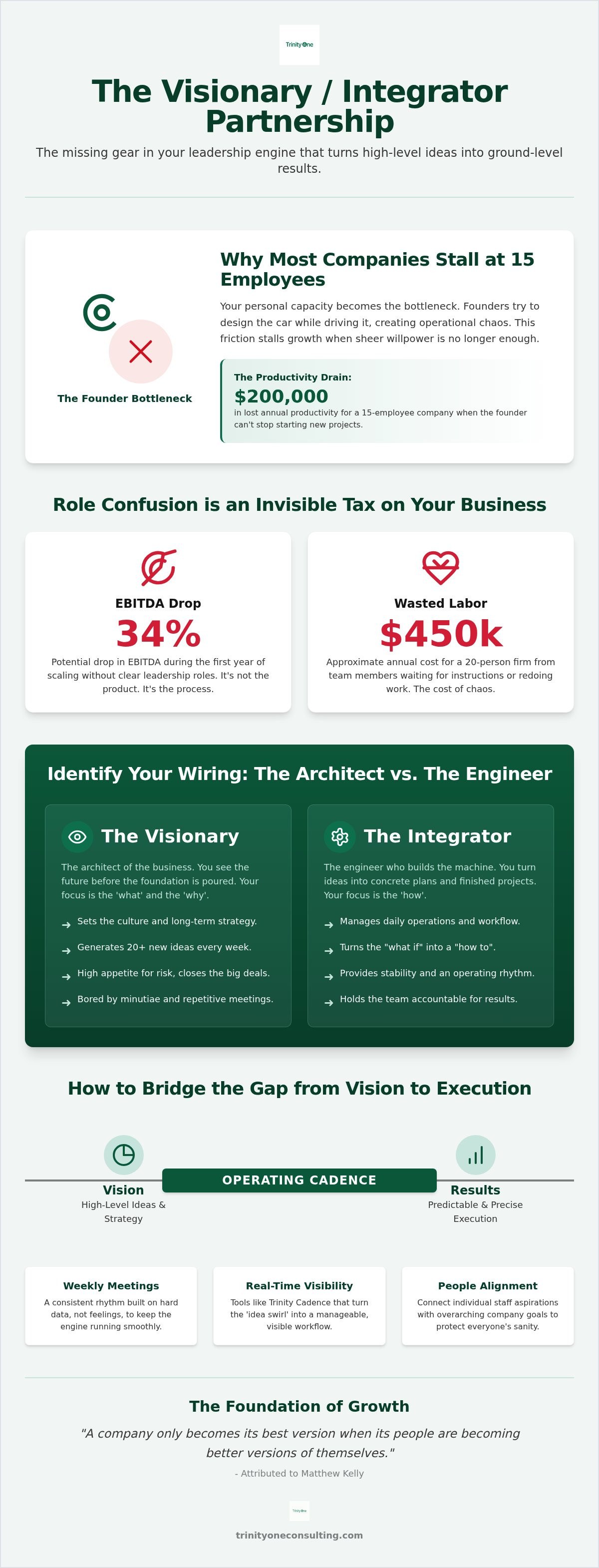
Your business is stalling because your leadership engine has a missing gear. A visionary integrator partnership is the mechanical solution to operational chaos. I've seen companies with 15 employees lose $200,000 in annual productivity because the founder couldn't stop starting new projects. You need a way to turn high-level ideas into ground-level results without burning out your staff.
You likely feel the friction every Monday morning. You walk in with ten new directions. Your team looks at you with glazed eyes. They're still trying to finish the three things you asked for last Tuesday.
This disconnect creates a permanent state of frustration for everyone. I'm going to help you identify your natural leadership wiring. You'll learn how to build an operating cadence that moves beyond theory and into actual execution. Forget working harder.
You need the right systems to handle the load. We'll build a roadmap for operational scale. I'll explain how to stop the idea swirl and start hitting your targets with clinical precision. I believe your business only becomes its best version when you and your people are becoming your best versions too.
Key Takeaways
- Stop trying to design the car while you're driving it. Founders often hit a wall at 15 employees because they lack the mechanical support to execute.
- Identify whether you are the architect seeing the future or the engineer building the system. Knowing your wiring prevents the friction that stalls growth.
- A successful visionary integrator partnership depends on more than a personality quiz. You need a weekly meeting cadence built on hard data to keep the engine running.
- Implement real-time visibility tools like Trinity Cadence to bridge the gap between vision and reality. This operating system turns your idea swirl into predictable results.
- Cultivate an environment that aligns individual staff aspirations with overarching company goals. Businesses thrive when their people are empowered to become better versions of themselves.
Why do you need a visionary integrator partnership?
Most founders try to run the engine and design the car at the same time. You can't spend your morning sketching the next five years and your afternoon fixing a broken CRM workflow without losing your mind. A visionary integrator partnership is the mechanical necessity that keeps your business from rattling apart as you accelerate. It's the difference between a controlled burn and a house fire.
I've watched companies hit a hard ceiling at 10 to 20 employees. Up until that point, you can brute force your way to success through sheer willpower. Once you cross that headcount, your personal capacity becomes the bottleneck. You stop being the leader and start being the obstacle. An assessment identifies where your natural energy flows, and for most founders, it isn't in the weeds of daily operations.
Execution fails when the visionary stays stuck in the dirt. You're meant to be the architect, not the person swinging the hammer every hour. If you don't find someone to handle the build, your best ideas will sit on the shelf gathering dust. You need a partner who speaks the language of execution.
The high cost of role confusion
Role confusion is an invisible tax on your bank account. Research shows that companies scaling without clear leadership roles often see a 34 percent drop in EBITDA during that first year. It's not because the product is bad. It's because nobody knows who is actually in charge of the finish line. This leads to the idea swirl, where your team starts 10 different projects but finishes zero.
Your employees want an operating rhythm, not a chaotic guessing game. When they don't have it, they leave. For a 20 person firm, this role confusion costs roughly 450,000 dollars in wasted labor annually. That's nearly half a million dollars spent on people waiting for instructions or redoing work that didn't matter.
The Chief Operating Officer role, or the integrator in our world, provides the stability your team craves. They turn your "what if" into a "how to." Without that bridge, you're just paying people to be frustrated.
Identifying the friction in your current leadership
Operational friction is the gap between an idea and a completed task. If you're pitching 20 ideas a week but your team can only execute one, you have a friction problem. You're spinning at 5,000 RPM while the wheels are barely turning. This is why The Fractional Integrator: Engineering Your Business Engine for 2026 is a critical shift for modern firms.
Hiring an integrator has a cost beyond the retainer. It takes months to sync their execution style with your brain. They aren't a magic wand for your bad habits. If you aren't ready to let go of the steering wheel, you're just paying for an expensive passenger who can't help you drive.
I do this work because I believe we are called to be good stewards of the talents and people we've been given. Matthew Kelly notes that a company only becomes its best version when its people are becoming better versions of themselves. You need a system that filters your vision into a manageable workflow to protect your energy and their sanity.
How do you know if you are a visionary?
Visionaries are the architects of the business world. You see the future before the foundation is even poured. If you have a high appetite for risk and zero patience for the minutiae of a spreadsheet, you're likely the visionary. I've worked with founders who generate 20 new business ideas every single week. This creative output is your greatest strength, but it can also be your biggest liability in a visionary integrator partnership.
Your primary value to the company is setting the culture, closing the big deals, and defining the long term strategy. You provide the fuel that keeps the engine running. Without your constant push for what's next, the business would eventually stagnate and die. I believe work is a place where we should find fulfillment, not just a paycheck.
The traits of the corporate architect
You focus on the what and the why. The how is someone else's problem. Details feel like lead weights. Visionaries often feel bored or even trapped by repetitive weekly meetings. You'd rather be out in the world finding the next opportunity than sitting in a conference room discussing project timelines.
You are the primary source of inspiration for the entire organization. People follow you because you see the mountain top. Maintaining the visionary-integrator dynamic allows you to stay in that high-energy space without crashing the car. If you feel like your ideas are being ignored, you might just need a better system to capture them. You can book a discovery call to see where your energy is currently being wasted.
The danger of the visionary without an anchor
An unanchored visionary creates organizational whiplash. I've seen teams become completely cynical because their priorities change every Tuesday morning. When you throw ten new ideas at a team that is already at capacity, they stop listening to all of them. This is the friction that breaks a visionary integrator partnership before it even starts.
This constant state of idea swirl eventually bleeds into your personal life. You stop sleeping because your brain won't turn off. Your dreams for the company start to feel like a burden instead of a gift. Matthew Kelly teaches us that our personal dreams matter. If your business is killing your dreams, the system is broken.
A visionary without an integrator is just a dreamer with a payroll. You're paying people to watch you change your mind. It's an expensive way to run a company and a fast way to burn out your best talent. You need a gear that fits your engine to turn that creative energy into actual momentum.
What defines the integrator archetype?
Integrators are the engineers who build the systems to support your vision. I see them as the mechanical balance in a visionary integrator partnership. They don't just "do things." They build the infrastructure that allows things to be done repeatedly and profitably. Just as Quintec Conveyors provides the specialized integration needed for physical material handling, a business integrator ensures that while you are out chasing the next big contract, the current ones don't fall through the cracks.
Integrators manage the people and the processes. They also keep a sharp eye on the P&L. They are the glue that holds the different departments together. You might think of them as a Fractional COO who translates your abstract goals into concrete tasks.
The Visionary and Integrator roles work because they are total opposites. An integrator filters your 20 weekly ideas down to the two that actually matter. They protect the team from your own enthusiasm. It sounds blunt, but it's the only way to get anything finished.
They provide the steady beat that the rest of the company follows. Your staff stops wondering what the priority is today. They just look at the system the integrator built and get to work. This clarity reduces the 450,000 dollars in wasted labor I mentioned in the previous section.
The rise of the fractional integrator
Most companies under 5 million dollars in revenue cannot afford a full-time COO. A high-level operator often commands a salary of 225,000 dollars or more. That's a massive hit to your cash flow that most small firms can't justify. A fractional integrator provides the same discipline at a fraction of that cost.
I've found that a fractional leader is often better at saying no to a founder than a full-time subordinate. They aren't worried about their next performance review or corporate politics. Their only incentive is the health of your business engine. This is why many founders use the When to Hire a Fractional Executive: 2026 Scaling Guide to time their next move.
They bring an outside perspective that cuts through your internal chaos. They aren't blinded by "the way we've always done it." They just want to see the numbers move in the right direction. Matthew Kelly teaches us that a company only becomes its best version when its people are becoming better versions of themselves. Every company deserves a clear path to its goals.
How do you evaluate the visionary integrator partnership?
Alignment isn't something you find once in a personality quiz and then forget. It's a mechanical setting that requires constant calibration. A visionary integrator partnership only stays healthy if you measure the friction levels every week. You can't manage what you don't measure with hard data.
The integrator must have the absolute authority to say no to the visionary. If the founder can override every operational decision, the partnership is a sham. You're just paying for an expensive assistant who eventually quits out of frustration. I've seen this dynamic destroy companies with 15 employees because the founder couldn't stop tinkering with the engine while it was running.
Success is measured by the velocity of task completion and team engagement. When your team stops asking what to do next, you know the partnership is working. Matthew Kelly notes that companies thrive when their people are becoming better versions of themselves. I believe we are called to lead with clarity and integrity.
Scoring your operational alignment
I recommend rating your trust level on a scale of 1 to 10 every single Friday. If that number drops below an 8, you have a mechanical failure in the relationship. You also need to look at the number of undone items on your weekly list. A growing pile of unfinished tasks means your visionary integrator partnership is out of sync.
Check if the visionary is still jumping into the integrator's sandbox. If you're the founder and you're still Slack messaging the marketing team about a font change, you're the problem. You're causing the very whiplash you hired someone to prevent. You have to let the operator operate.
Building a functional operating cadence
A cadence is the heartbeat of your business engine. Without it, the organization has an arrhythmia that leads to total failure. You need a structured agenda that ensures every single meeting produces a measurable result. This is why I focus on How to Improve Your Visionary and Integrator Relationship in 2026 as a core discipline.
I use a specific 90 minute meeting structure that saves about 10 hours of back and forth Slack messages every week. We spend 10 minutes on headlines. Then we spend 20 minutes on the numbers. The final 60 minutes are for solving the biggest obstacles. It's blunt and fast.
How does a fractional integrator solve the execution gap?
A fractional integrator solves the execution gap by installing an objective operating system that removes the founder from daily friction. This specific visionary integrator partnership provides the machine logic needed to turn ideas into tasks. It gives you real-time visibility into every department without requiring you to sit in every single meeting. You get the results without the micromanagement.
I bring an outside perspective to your internal chaos. You're often too close to the gears to see where the teeth are grinding. I perform an audit of your current workflows to identify why your team is stalled. We implement tools like Trinity Cadence to provide real-time visibility into project velocity and team output.
The goal is to move you back to your zone of genius. You shouldn't be worrying about why a specific email didn't go out on time. You should be focused on the next big strategic move for the company. When the integrator handles the how, you are free to expand the what. This shift allows you to focus on long-term growth, where firms like 41 Legacy can help you understand and protect your enterprise value.
A company only grows as much as its people grow. I integrate the Dream Manager Coaching program to drive employee retention. We attribute the twelve dream categories to Matthew Kelly. This program aligns the company’s goals with the team’s personal dreams.
I've seen team engagement spike when leaders actually care about what their staff wants outside of the office. If a team member wants to buy their first home or run a marathon, we help them build a plan to get there. Their personal growth becomes the fuel for your business growth. It's a simple alignment that most corporate offices completely ignore.
Integrating AI into your operating system
AI is the machine logic that supports the human integrator. I use AI to coach your team on operational efficiency in real time. It monitors project timelines and flags delays before they become disasters. This isn't about replacing the human element with a computer program.
It's about giving your people the data they need to make better decisions. I believe developing your people is the highest calling of a leader. Faith in your team is the only way to scale without losing your soul. When you combine human dreams with AI logic, the visionary integrator partnership becomes an unstoppable force.
Stop the idea swirl and start executing
You've identified your wiring. You know that trying to design the car while driving it is costing you nearly half a million dollars in wasted labor annually. A visionary integrator partnership requires a mechanical opposite who loves the spreadsheets you hate.
I use my experience as a former corporate operator and football coach to build these bridges. My Trinity Cadence AI native OS provides the real-time visibility you've been missing. As a Certified Dream Manager, I also ensure your team's personal aspirations align with your operational goals using Matthew Kelly's methodology.
The friction you feel today is just a sign that your engine needs a new gear. You can scale your business without losing your soul or your sanity. I'm here to help you build the system that actually works for you and your people.
I believe we are called to be good stewards of the talents we've been given. You don't have to carry the operational load alone anymore. Let's get your business moving with precision.
Frequently Asked Questions
Can one person be both a visionary and an integrator?
Yes, you can be both, but it's a fast track to burnout. Most founders start as both out of necessity. You end up wearing too many hats and dropping the most important ones. Scaling requires you to pick a lane. If you try to design the future while managing the daily tasks, you'll eventually stall the entire business engine. You need a partner to handle the how.
How long does a visionary vs integrator assessment take?
A standard assessment usually takes about 20 minutes to complete. I use these results to identify your natural leadership wiring. The test is just the starting line. The real work happens during a 90 minute deep dive where we look at your current friction points. This helps us see if you're truly ready to let go of the daily operations and trust a partner.
What is the most common reason the visionary and integrator relationship fails?
The most common failure point in a visionary integrator partnership is a lack of trust. If the visionary keeps jumping back into the integrator's sandbox, the system breaks. This micromanagement creates whiplash for the team. They stop knowing who is in charge. The integrator eventually loses their authority and leaves, which leaves the business right back where it started. You have to let the operator operate.
How much does it cost to hire a fractional integrator in 2026?
In 2026, the monthly retainer for a fractional integrator typically ranges from 4,000 to 12,000 dollars. For companies with under 50 employees, you should expect to pay between 4,000 and 6,000 dollars per month. This is an investment in your scale. It's much cheaper than the 195,000 to 325,000 dollar annual cost of a full-time executive. You get high-level experience without the massive overhead.
What are the twelve dream categories in the Dream Manager program?
Matthew Kelly defines twelve specific dream categories to help your people grow. These include physical, emotional, intellectual, and spiritual dreams. We also look at psychological, material, professional, and financial goals. The list continues with creative, adventure, legacy, and character dreams. I use these categories in my Dream Manager program because I believe your company only becomes its best version when your people are becoming better versions of themselves.
How does Trinity Cadence help with the visionary vs integrator relationship?
Trinity Cadence provides the real-time visibility that keeps the relationship healthy. It uses AI machine logic to track project velocity and team output without requiring a single Slack message. This eliminates the need for the visionary to check in constantly. When you have a clear dashboard, you don't have to guess if the work is getting done. It removes the emotional friction from the visionary integrator partnership.
Do I need an integrator if my company has fewer than ten employees?
You probably don't need a full-time integrator yet, but you definitely need the function. Most founders hit a hard ceiling between 10 and 20 employees. This is where the idea swirl starts to cost you real money in lost productivity. A fractional integrator can step in for a few hours a week to build your operating rhythm. It prepares your business engine for the weight of future growth. For B2C founders seeking specialized coaching during this phase, you can visit Founder Freedom to learn more.
There is no functional difference between a COO and an integrator. The term integrator comes from specific business frameworks, while Chief Operating Officer is the traditional corporate title. Both roles focus on execution, people management, and the P&L. I use both terms because they describe the same mechanical need: an engineer who can build the systems to support a visionary's big ideas and drive results.