
Hiring a full-time executive is a legacy solution for a modern friction point. In 2026, the traditional C-suite model frequently breaks under the weight of its own overhead. You feel the operational drag. Efficiency is leaking through the gaps in your systems. Growth has slowed from a sprint to a crawl. You need the precision of a strategic architect without the permanent financial burden of a traditional hire. Understanding the ROI of a fractional COO is no longer about saving money; it's about reclaiming your company's momentum.
You recognize that your current engine is misfiring. Scaling requires more than just harder work. It demands a unified operating cadence and real-time visibility into every circuit of your business. This article demonstrates how a fractional leader transforms chaotic workflows into a streamlined, AI-native operating system. We'll analyze the hard data behind executive efficiency and provide a framework for making an informed hiring decision. Discover how to align your human purpose with technical excellence to maximize your bottom line.
Key Takeaways
- A fractional COO provides the strategic architecture of a full-time executive without the permanent structural overhead. Learn how this model aligns your daily operations with your long-term vision.
- Quantify the ROI of a fractional COO by measuring recovered leadership time and increased decision-making speed. These metrics transform operational friction into a engine for revenue preservation.
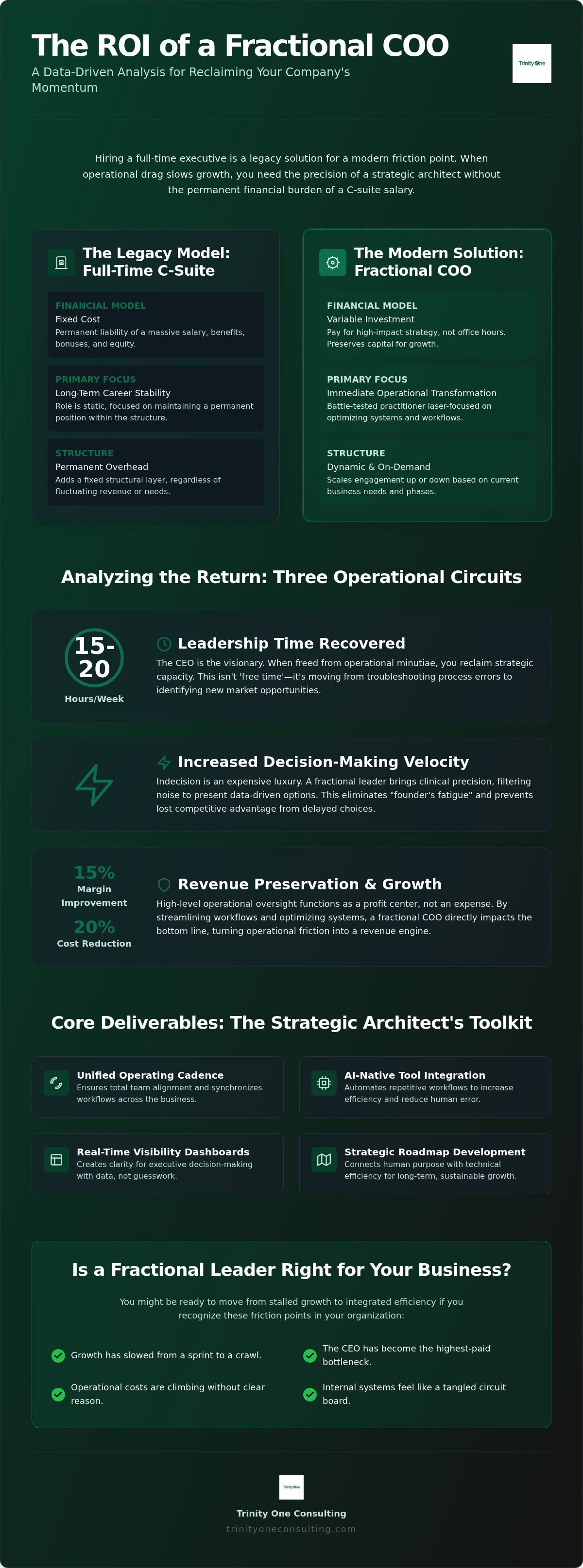
- Analyze real-world data where companies achieved 15% margin improvements and 20% operational cost reductions. High-level oversight functions as a profit center rather than a simple expense.
- Beyond the balance sheet, discover how fractional leadership fosters a culture of accountability and innovation. This integration creates a resilient system capable of navigating the complex market of 2026.
- Identify the specific friction points and growth plateaus that signal your business is ready for an Integrator. Move from stalled growth to integrated efficiency with a deliberate leadership shift.
What is a Fractional COO and Why Consider One?
A fractional COO is a strategic architect who integrates into your leadership team on a part-time basis. They provide the high-level oversight of a Chief Operating Officer without the permanent liability of a massive salary package. This model follows the rise of the Fractional executive, a role designed for organizations that have outgrown their current systems but aren't yet ready for a permanent C-suite expansion. It's the difference between buying a plane and booking a private flight. You get the destination without the maintenance costs.
Traditional roles are static. Fractional roles are dynamic. While a full-time executive focuses on long-term career stability, a fractional leader focuses on immediate operational transformation. They are battle-tested practitioners who have spent decades in the trenches. They understand that modern leadership requires a blend of clinical precision and human depth. You consider this path when your growth has stalled, your costs are climbing, and your internal systems feel like a tangled circuit board.
The Cost-Effective Advantage
Full-time executives are expensive. Beyond the base salary, you're looking at benefits, bonuses, and equity. These are fixed costs that don't fluctuate with your revenue. A fractional model converts these fixed costs into variable investments. You pay for high-impact strategy, not office hours. This flexibility is the cornerstone of the ROI of a fractional COO. You can scale the engagement up during a launch or down during a stabilization phase. It reduces financial risk. It preserves capital for growth-focused initiatives.
Operational Expertise on Demand
Operations are the engine of your business. If the engine is misaligned, you're burning fuel without moving forward. A fractional leader enters your environment to optimize these mechanics through specialized Fractional COO Services. Their focus is lean and intentional. They don't just manage people; they build systems. Typical deliverables include:
- Implementing a unified operating cadence to ensure team alignment.
- Integrating AI-native tools to automate repetitive workflows.
- Creating real-time visibility dashboards for executive decision-making.
- Developing a strategic roadmap that connects human purpose with technical efficiency.
They act as the strategic architect. They identify friction points, explain the underlying cause, and present a unified remedy. Every action is a step toward a more functional whole. This isn't theory. It's execution.
Breaking Down the ROI of a Fractional COO
Return on investment is often viewed through a narrow lens of immediate cash flow. This is a tactical error. To truly understand the ROI of a fractional COO, you must analyze three distinct operational circuits: time recovery, decision-making velocity, and revenue preservation. These aren't just abstract concepts. They are the gears that drive your enterprise value. When these gears are misaligned, your business loses energy. When they are synchronized, growth becomes a mathematical certainty. You aren't just buying a service; you're investing in an engine for sustainable expansion.
Time Recovered
The CEO is the visionary. If you're buried in the minutiae of daily operations, your vision is obstructed. You become the highest-paid bottleneck in your organization. A fractional leader functions as an Integrator, absorbing the operational friction that currently consumes your schedule. Some industry professionals report that founders recover 15 to 20 hours per week after bringing in fractional support. This isn't just "free time." It's strategic capacity. You move from troubleshooting process errors to identifying new market opportunities. The math is simple: your hourly value multiplied by the hours reclaimed equals an immediate, tangible return.
Strategic Decision-Making
Indecision is an expensive luxury. In the fast-paced environment of 2026, a delay of 48 hours can mean a lost competitive advantage. A fractional COO brings clinical precision to your decision-making process. They filter noise and present data-driven options. This eliminates the "founder's fatigue" that leads to erratic choices. By implementing a Visionary vs. Integrator Assessment, you can identify exactly where your leadership engine is leaking power. This alignment ensures every decision serves the larger systemic whole rather than just solving a temporary symptom.
Revenue preservation is the final, critical component. It's about stopping the leaks. Operational inefficiencies, employee turnover, and missed deadlines are silent killers of profit. A fractional COO identifies these failure points before they become catastrophic. They stabilize the foundation, ensuring every dollar you earn stays in the business. This stability is the bedrock of the ROI of a fractional COO. If you're ready to audit your current operations, you can schedule a consultation to identify where your efficiency is stalling.
Practical Examples of ROI in Action
Theory provides the blueprint. Execution builds the structure. To validate the ROI of a fractional COO, we must look at the mechanical outputs of real-world implementation. These aren't just success stories. They are case studies in operational recalibration. When a strategic architect enters a high-friction environment, the results are immediate and measurable. Efficiency isn't a vague goal; it's a mathematical output of the right leadership engine.
Mid-Sized Company Success
A mid-sized professional services firm faced a common growth plateau. Overhead was climbing. Real-time visibility was non-existent. The leadership team was making decisions based on intuition rather than integrated data. The friction was palpable. By bringing in a fractional leader to implement a unified operating cadence, the company achieved a 15% margin improvement within twelve months. The remedy was systemic. The fractional COO identified redundant manual processes and replaced them with streamlined workflows. This wasn't about cutting staff. It was about optimizing the human engine. The result was a leaner, more responsive organization that could finally scale without breaking its own foundation.
Startup Cost Reduction
Startups often mistake movement for progress. One high-growth tech startup was burning capital on specialized software and redundant roles that didn't talk to each other. Their operational circuits were overloaded. A fractional Integrator stepped in to conduct a total audit of their systems. By shifting to an AI-native operating system and consolidating their tech stack, the startup reduced operational costs by 20%. This intervention preserved their runway and allowed them to reinvest that capital into market expansion. You can read more about how a fractional Integrator impacts business growth to see how these efficiencies compound over time.
Sustainable scaling requires more than just capital. It requires alignment. Another organization struggled with team fragmentation, where departments operated as isolated silos. The fractional leader introduced a proprietary methodology that synchronized every team member with the company’s core vision. This cultural and technical integration eliminated the "friction tax" that usually slows down maturing companies. They didn't just grow. They grew efficiently. They transformed their business from a collection of parts into a functional whole. This is the ultimate proof of the ROI of a fractional COO. It's the difference between a business that survives and a business that dominates.
Strategic Benefits Beyond Cost Savings
Mathematics only tells half the story. While cost reduction is the entry point, the true ROI of a fractional COO manifests in strategic alignment. It's about building a resilient architecture. A business that only survives on cost-cutting is fragile. A business that thrives on alignment is unstoppable. This leadership shift moves your organization from a collection of reactive silos to a unified, proactive engine. You aren't just saving money; you're building enterprise value.
Enhancing Leadership Capabilities
Leadership isn't a solo endeavor. It's a circuit. The connection between a founder and an operator is the most critical link in the business. Strengthening the Visionary and Integrator Relationship creates a ripple effect. It filters down to every department. The fractional COO doesn't just manage; they mentor. They provide structured support that develops the next layer of leadership. This transition from "hero leadership" to "systemic leadership" is a massive multiplier. You move from a single point of failure to a distributed network of high-performance executives.
Fostering Innovation
Chaos kills creativity. When your team is stuck in a cycle of reactive firefighting, innovation stops. A fractional COO stabilizes the core engine. This creates the psychological safety and temporal space required for bold thinking. You can't ask your team to innovate when they're drowning in operational debt. By implementing programs like the Dream Manager Program, you align individual human purpose with the corporate mission. This creates a culture of extreme accountability. Innovation becomes a byproduct of alignment rather than a forced initiative. Your team stops managing tasks and starts owning outcomes.
Long-term growth is the natural result of a high-functioning system. Competitive advantage in 2026 isn't just about better products. It's about better operations. It's about having an engine that can pivot faster than the competition. A fractional leader ensures your strategic vision isn't just a document on a shelf. They turn that vision into a daily operating reality. This consistency is what builds market dominance. It's the ultimate return on your investment.
Is a Fractional COO Right for Your Business?
Not every organization is ready for an Integrator. It's a matter of timing and systemic scale. You must evaluate your internal metrics with clinical objectivity. If your vision is clear but your execution is fragmented, the friction is structural. This is where the ROI of a fractional COO becomes most apparent. It's the decision to install a precision regulator on an engine that's running too hot. You're choosing to trade chaotic effort for calculated results.
Indicators of Need
Growth stagnation is the primary signal. You've hit a ceiling that more sales can't break. This usually indicates an operational bottleneck where your systems are no longer capable of handling the load. High executive turnover or founder burnout are secondary indicators. The human circuit is failing because the technical system is flawed. You're reacting to symptoms instead of engineering a cure. Complex projects, such as large-scale AI implementation, also require specialized oversight that your current team likely lacks. Check our scaling guide to see if your organization meets the criteria for high-level fractional support.
Overcoming Barriers
Many leaders fear a lack of commitment from part-time executives. This is a misconception. Fractional leaders are driven by impact, not attendance. They focus on the high-leverage activities that move the needle. Continuity is maintained through structured systems and a unified operating cadence. Integration with your existing team is seamless when handled by a seasoned practitioner. They don't replace your culture; they provide the framework for it to flourish. By utilizing Fractional Dream Manager Coaching, you ensure that your team's personal growth is integrated into the company's operational success. This dual focus eliminates the friction between management and staff.
The ROI of a fractional COO is ultimately found in the transition from chaos to clarity. If you're spending more time managing people than pursuing your vision, the balance is off. A fractional leader restores that equilibrium. They plug into your business as a strategic architect, identifying the leaks and reinforcing the structure. The decision isn't just about hiring a person. It's about choosing to build a more efficient, systemic way of doing business in 2026. Stop managing the friction and start leading the growth.
Engineering Your Operational Future
Operational friction is a choice. You can continue to manage symptoms or you can choose to engineer a cure. We have analyzed how reclaiming leadership capacity and accelerating decision-making velocity creates a compounding return. The ROI of a fractional COO is found in the transition from a collection of fragmented parts to a functional, systemic whole. It's about moving from reactive firefighting to proactive, strategic growth.
Trinity One provides the fractional leadership expertise necessary to stabilize your core engine. We implement an AI-native operating system that synchronizes your human purpose with clinical technical excellence. This isn't just about efficiency; it's about building a business that can pivot and scale in the complex market of 2026. Your vision deserves a structure that actually supports it. Stop managing the drag and start leading the momentum.
Your organization is ready for its next evolution. Take the deliberate step toward integrated excellence today.
Frequently Asked Questions
What is the primary role of a fractional COO?
A fractional COO functions as an Integrator who translates the CEO's vision into a functional operating system. They align the team, manage daily mechanics, and bridge the gap between high-level strategy and tactical execution. This role is about stabilizing the business engine. They ensure every department works in a unified cadence. This eliminates operational friction and drives measurable results through clinical precision and human alignment.
How does a fractional COO improve ROI?
They improve the ROI of a fractional COO by identifying systemic leaks and optimizing resource allocation. This involves automating manual workflows with AI and reclaiming leadership time for the CEO. By reducing the "friction tax" of inefficiency, they turn operational overhead into a profit center. They ensure that your capital is invested in growth rather than wasted on redundant processes or misaligned efforts across your organization.
What are the cost benefits of hiring a fractional COO?
The primary benefit is the conversion of a high fixed executive salary into a flexible variable investment. This shift significantly boosts the ROI of a fractional COO by preserving capital. You gain access to C-suite expertise without the long-term liabilities of benefits or equity. This model allows mid-sized companies to access battle-tested leadership. It provides the strategic architecture needed to scale without permanent overhead.
Can a fractional COO help with strategic planning?
Yes, they act as the strategic architect who builds the roadmap for your company's future. They don't just plan; they ensure the plan is executable across all departments. By auditing your current operating circuits, they identify the precise path to your desired outcomes. This involves setting clear key performance indicators and creating real-time visibility. They turn a static vision into a dynamic, integrated reality for your team.
What industries benefit most from fractional COOs?
High-growth technology firms, professional services, and manufacturing companies see the most immediate impact. Any organization experiencing a growth plateau or operational complexity is a prime candidate. These industries often suffer from fragmented systems and siloed departments. A fractional leader enters these environments to synchronize the human and technical components. They create a unified operating cadence that works across any sector requiring rapid, sustainable scale.
How is a fractional COO different from a traditional COO?
A fractional COO provides the same level of authority but with a focus on specific outcomes rather than permanent tenure. Traditional roles are often anchored by administrative maintenance and long-term career stability. Fractional leaders are practitioners who focus on clinical transformation and rapid integration. They offer a higher level of flexibility. You can scale their involvement up or down based on your organization's current operational friction points.