
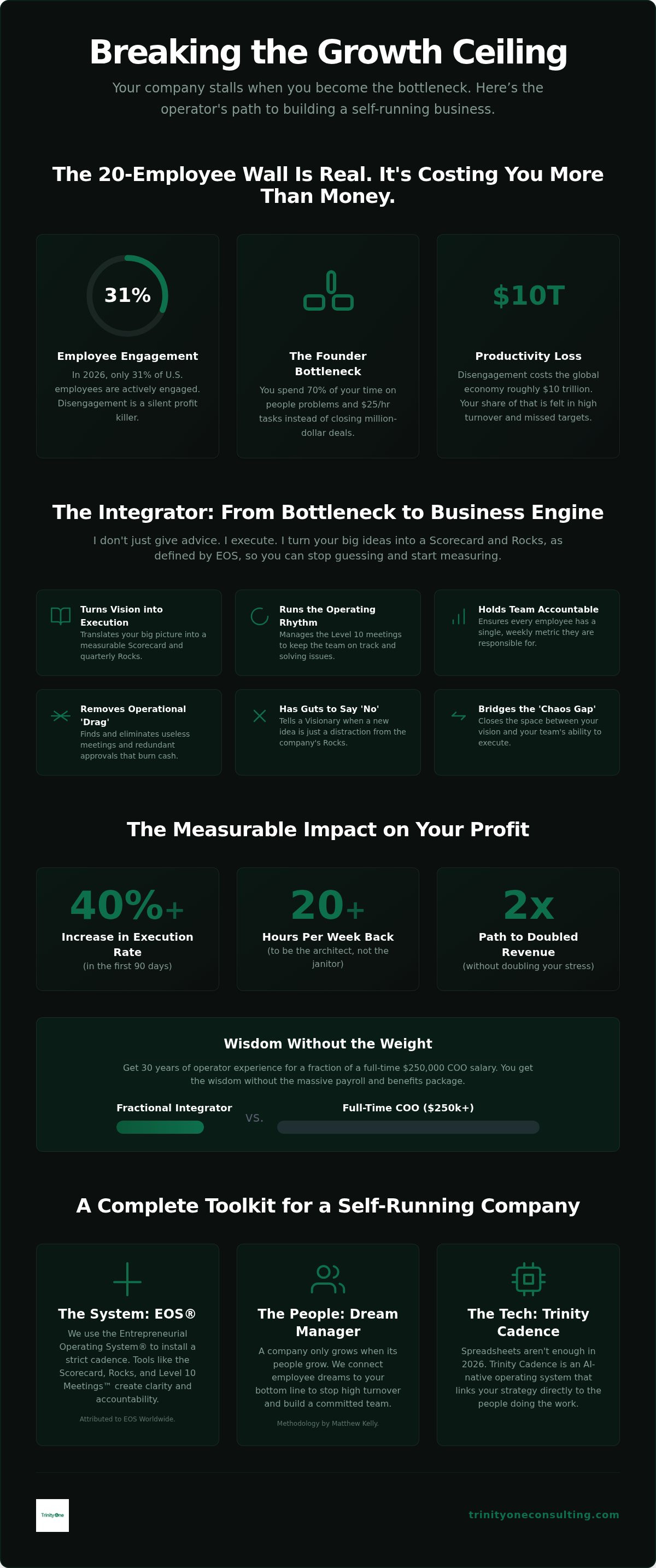
In 2026, only 31% of U.S. employees are actively engaged at work. This disengagement costs the global economy roughly $10 trillion in lost productivity. The impact of a fractional integrator on business growth starts with removing you from the center of every minor decision. You can't scale a company when you're the primary bottleneck for every choice.
I know you feel the weight of a team that stays busy but focuses on the wrong outcomes. It's frustrating to watch high turnover eat your profits because people don't feel a connection to the mission. You likely feel that if you stop pushing, the whole machine stops moving. I've spent 30 years as an operator and I've seen this friction destroy good companies from the inside out.
I'll show you how a fractional integrator fixes operational friction and links the dreams of your people to your bottom line using Matthew Kelly’s Dream Manager methodology. We'll look at how to get 20 hours a week back. You'll also see a clear path to doubling revenue without doubling your stress. This is the process for building a self-running business engine.
Key Takeaways
- Founders hit a wall at 20 employees when they can't manage every person directly. You'll learn how to stop being the bottleneck and build a business engine that runs without your constant input.
- The impact of a fractional integrator on business growth comes from turning vision into a Scorecard and Rocks as defined by EOS. This shift moves your company from chaos to measurable execution.
- An integrator must have the guts to tell a Visionary when an idea is just a distraction. You'll see why 'real talk' and a strict operating rhythm are the only ways to keep growth on track.
- Spreadsheets and hope aren't enough to manage a team in 2026. Discover how Trinity Cadence provides an AI-native operating system to link your strategy to the people doing the work.
- Companies only grow when their people grow. You'll learn how Matthew Kelly’s Dream Manager methodology connects employee dreams to your bottom line to stop high turnover.
Why does your growth stall when you hit 20 employees?
I've seen it happen dozens of times. You hit 20 employees and suddenly the wheels start to wobble. You can no longer talk to every person every single day. The personal connection that built the company is now a bottleneck.
Complexity grows faster than revenue. It creates friction in your business engine that wasn't there when you had five people. You likely spend 70 percent of your time fixing people problems instead of selling or innovating. A business without a clear operating cadence will eventually shake itself apart.
The high cost of a Visionary in the weeds
I see CEOs making $250 an hour doing $25 an hour administrative tasks. It's a waste of the company's most expensive asset. You're proofreading emails when you should be closing million-dollar deals. This drain on your time is the first sign of a failing system.
Decision fatigue leads to poor choices that cost the company thousands in lost time. When you are the only one who can say 'yes,' progress stops the moment you go to lunch. Your team stops taking initiative. They wait for your approval on basic client emails or stop solving operational problems because they know you'll just step in and fix it anyway.
The impact of a fractional integrator on business growth is most obvious when the owner stops being the only person who can solve a problem. They install the systems that allow your team to work without your constant supervision. You stop being the janitor and start being the architect again.
When the accountability chart fails
Roles become blurry as you scale. Tasks fall through the cracks between departments because nobody truly owns the handoff. I call this the 'chaos gap.' It's the space where your vision outpaces your team's ability to execute. Your business organizational structure needs a manager who lives in the details.
An Accountability Chart, as defined by EOS, only works if someone is watching the seats. Without an operator to own the execution, you'll keep hitting the same ceiling. You need a Fractional COO who can hold people to their numbers. This allows you to focus on the future while they handle the present day-to-day friction.
The impact of a fractional integrator on business growth is measured in the hours you get back to think about the next three years. They bridge the gap between your big ideas and the reality of your staff's daily output. Without this bridge, your growth will always be capped by your personal capacity.
What is the measurable impact of a fractional integrator on your profit?
A fractional integrator is a high level operator who runs your business engine for a few days a month. They don't just give advice. They execute. I focus on turning your big ideas into a Scorecard and Rocks as defined by EOS. This is how you stop guessing and start measuring.
I have seen companies increase their execution rate by 40 percent in the first 90 days. This happens because someone is finally holding the team accountable to their numbers. The impact of a fractional integrator on business growth is seen in the speed of your results. They fix the friction that is currently burning your cash and slowing your speed to market.
Moving from reactive fire fighting to proactive execution
The integrator runs the Level 10 meetings as defined by EOS to keep the team on track. These meetings are the heartbeat of the company. Without them, you're just reacting to the loudest problem in the room. I ensure every employee has a single metric they are responsible for every week. This creates a culture of ownership where nobody can hide behind vague updates.
I look for the 'drag' in your processes and remove it so the engine runs faster. Drag is the useless meeting that could be an email or the redundant approval step that slows down a sale. Removing these friction points directly impacts your bottom line. You can schedule a time to talk if you want to identify where your engine is losing power.
The ROI of fractional versus full time leadership
You get 30 years of experience for a fraction of the cost of a $250,000 COO. Most small businesses don't need a full-time executive in this role yet. They need the wisdom without the massive payroll tax and benefit package. I focus on the 20 percent of activities that drive 80 percent of your growth. This surgical approach prevents you from overpaying for management you don't use.
There's a tradeoff to this model. A fractional leader won't be in your office every day to handle minor personnel drama or order office supplies. They aren't there to be your best friend. They are there to drive the business forward. You can see the specific details of this role on my fractional-coo services page.
The real impact of a fractional integrator on business growth is the professionalization of your leadership team. Your managers start acting like executives because they are being led by one. This shift in culture is often worth more than the direct salary savings. It builds a foundation that can actually handle the weight of a $10 million or $50 million company.
What are the specific characteristics of a great integrator?
A great integrator is a master of the operating cadence and business rhythm. They aren't just managers who check boxes. They are the glue that holds your vision together while you're off dreaming about the next five years. Without this steady rhythm, your company is just a collection of people working on different projects.
They need the 'real talk' ability to tell a Visionary when an idea is a distraction. I've sat in rooms where a founder wanted to pivot the entire sales strategy because of one podcast episode. A battle-tested integrator stops that waste of time before it starts. The impact of a fractional integrator on business growth is often measured by the bad ideas they kill in the cradle.
I look for operators who value execution over theory and results over activity. Being 'busy' is a trap that disengaged employees use to hide. A real integrator sees through the noise. They must have the emotional intelligence to manage both machine logic and human motivation. You can't run a business on cold data alone, but you also can't run it on pure emotion.
The essential skills for 2026 operations
Proficiency in AI tools and data visualization is no longer optional. In 2026, you need to track real-time execution across your entire stack. A great integrator uses these tools to spot a dip in production before it becomes a quarterly loss. They turn raw data into a story that your team can actually understand and act upon.
The ability to facilitate difficult conversations without creating drama is another requirement. When a manager misses their Rocks for the third time, an integrator doesn't ignore it. They address it directly. This requires a deep understanding of the visionary integrator relationship. If that bond isn't solid, the rest of the team will sense the cracks and exploit them.
Why a football coach mentality wins in business
I use my coaching experience to build discipline and focus in your leadership team. In football, you don't win because you have the best playbook. You win because you execute the fundamentals better than the other guy. Great integrators don't just manage tasks. They develop people into better versions of themselves through consistent feedback and clear expectations.
They prioritize the 'huddle' to ensure everyone knows the play before they start the day. If your team doesn't know the score or the objective, they're just running around the field getting tired. An integrator makes sure the scoreboard is visible and the goals are clear. This level of clarity is where the true impact of a fractional integrator on business growth becomes permanent.
How do you build a business engine that handles AI and people?
In 2026 you cannot run a growth company on spreadsheets and hope. Spreadsheets are static. Your business is not. By the time you see a red cell in a manual spreadsheet, the damage is already done. You've lost a week of production or a month of sales momentum because you were waiting on a manual update.
The impact of a fractional integrator on business growth is tied to how they use technology to scale your execution. Trinity Cadence provides an AI-native operating system that links your people to your strategy in real time. It serves as the digital version of the war room. I believe technology should support human performance, not replace the human touch.
Using Trinity Cadence for a unified operating cadence
The platform provides real-time visibility into your Rocks and Scorecards as defined by EOS. AI coaching helps your team stay aligned with the company vision every day by flagging when a metric is trending the wrong way. I use these tools to ensure your business executes even when I am not in the room. This creates a self-running business engine that doesn't rely on your physical presence to function.
The impact of a fractional integrator on business growth is amplified when the operator uses AI coaching to identify friction points before they become fires. We look for patterns in the data that suggest a team member is struggling. We don't wait for the quarterly review to fix a problem. We fix it on a Tuesday afternoon because the system alerted us to a dip in output.
The tradeoff of AI integration
AI requires clean data and disciplined habits from your leadership team. If you put garbage in, you get garbage out. You can't be lazy with your inputs and expect the machine to save your profit margins. This is where most AI implementations fail. They lack the operational discipline to keep the data current and accurate.
AI is also bad at managing human emotions. It can't tell when a manager is burnt out or when a team is losing faith in a project. This is why the integrator role remains vital. I focus on using AI for the 'machine' tasks so your people can focus on 'human' growth. We use the machine to track the numbers and the human to lead the hearts of the team.
Success in 2026 requires this binary approach. You need the clinical precision of an AI-native operating system to handle the logic. You also need the empathetic depth of a battle-tested leader to handle the people. When these two forces are aligned, your business engine becomes unstoppable.
Can helping employees reach personal goals actually drive business ROI?
I believe a company only grows to the extent its people are becoming better versions of themselves. Most founders focus on the machine logic of the P&L while ignoring the human engine that drives it. This is a mistake that kills long-term scaling. The impact of a fractional integrator on business growth includes the ability to align individual desires with corporate objectives.
The Dream Manager concept by Matthew Kelly links personal dreams to professional performance. It isn't a fluffy HR initiative. It is a strategic tool for high-performance cultures. When you help an employee buy their first home, they don't just stay for the paycheck. They work harder for your mission because you've proven you care about theirs.
This is not soft talk. It is a strategic move to improve retention and engagement. In 2026, the battle for talent is won by the companies that provide the most value to the employee's whole life. If you treat people like replaceable parts, they will treat your company like a temporary stop.
Implementing the Dream Manager program
We use the twelve dream categories defined by Matthew Kelly to coach your staff. These categories cover everything from physical health to financial stability. It provides a structured way to talk about what actually matters to your people. Employees use the DreamCompass app to track their progress toward personal goals.
This system creates a level of transparency that most companies lack. I've seen it change the energy of a room in a single afternoon. You can learn more about the Dream Manager program and its impact on my site. It's the difference between a team that shows up and a team that is on fire for the mission.
How personal growth fuels business scaling
An employee who is winning at home is an employee who will win at the office. If a manager is drowning in debt or struggling with health, they won't have the capacity to hit their Rocks as defined by EOS. I have seen turnover drop significantly when people feel the company cares about their life. High turnover is a hidden tax that bleeds your cash and slows your speed to market.
This creates the loyalty needed to sustain rapid growth without losing your culture. The impact of a fractional integrator on business growth is maximized when the staff sees the integrator as a coach rather than a cop. We build a culture of accountability that is rooted in mutual success. My faith convinces me that treating people as whole human beings is the only way to build a business that lasts.
I've spent 30 years in the trenches of leadership. I've seen that the best operators aren't just good with spreadsheets. They are good with people. When you link their dreams to your bottom line, you build a business engine that can't be stopped.
Ready to align your team and scale your business? Book a discovery call with me today.
Stop being the bottleneck and start scaling
The impact of a fractional integrator on business growth is measured by the freedom you gain as a founder. You've seen how scaling past 20 employees requires a shift. You must move from personal oversight to systemic execution. I use 30 years of operational experience to install the rhythms that keep your team focused on the right outcomes.
We combine machine logic with human motivation. The AI-native Trinity Cadence OS provides the data while Certified Dream Manager facilitation based on Matthew Kelly’s methodology supports the person. This is the binary approach to scaling in 2026. It ensures your business engine runs on clean data while your people feel a genuine connection to the mission. Real results.
Your company only becomes the best version of itself when your people are becoming better versions of themselves. It's time to build a business that serves your life instead of consuming it. You have the vision. Now you just need the engine to carry it. I'm ready to help you build it.
Frequently Asked Questions
What is the difference between a Fractional COO and an Integrator?
An Integrator is a specific role within the EOS framework designed to harmonize the Visionary's ideas with the team's execution. A Fractional COO is a broader title for a part-time operations executive. In my practice, the impact of a fractional integrator on business growth is driven by this specific focus on the Visionary and Integrator relationship as defined by EOS. I act as the filter that turns your 100 ideas into the three that actually move the needle.
How many hours a week does a fractional integrator usually work?
A fractional integrator usually works between 5 and 15 hours a week depending on the size of your team and the complexity of your engine. This isn't a desk job where I sit in your office and wait for things to break. I focus on the core activities like running your Level 10 meetings and managing your Scorecard. You're paying for 30 years of experience, not 40 hours of activity. It's a surgical approach to leadership.
Do I need to be running EOS to hire a fractional integrator?
You don't need to be a "pure" EOS company, but you do need an operating system to scale. I use EOS terms like Rocks and the Accountability Chart because they provide a shared language for execution. If you don't have a system yet, I'll help you build one using Trinity Cadence. The goal is to move away from spreadsheets and hope toward a predictable business engine that runs without your constant input.
How does a fractional integrator help a visionary CEO?
I free you to stay in your "Unique Ability" as defined by EOS. Most visionaries are trapped in the weeds of personnel drama and project management. I take over the day-to-day operations so you can focus on big deals and the future of the market. The impact of a fractional integrator on business growth is most visible when the founder gets 20 hours a week back to focus on big ideas.
What is the typical cost of a fractional integrator for a small business?
Verified industry data from 2026 shows that fractional executives typically cost between $7,500 and $25,000 per month. That's 40% to 60% less than the total compensation for a full-time COO. You get the same level of strategic architecting without the massive payroll tax or equity requirements. It's an investment in your engine room that pays for itself through reclaimed time and higher profit margins.
How long does it take to see results after hiring a fractional integrator?
You should see a shift in your team's focus within the first 30 days. By day 90, your execution rate on Rocks should be at 80% or higher. This isn't magic. It's the result of installing a consistent operating cadence and holding people accountable to their metrics. If your team isn't ready for "real talk" about their performance, this process will feel uncomfortable at first.
What are the 12 dream categories in the Dream Manager program?
Matthew Kelly defines these twelve categories to help people identify what they truly want in life. They include Physical, Emotional, Intellectual, Spiritual, Psychological, Material, Professional, Financial, Creative, Adventure, Legacy, and Character. I use these categories within the Dream Manager program to link your employees' personal dreams to their professional output. When people win at home, they win at work.
Can a fractional integrator help with AI implementation?
Yes, I use Trinity Cadence to integrate AI directly into your operations. In 2026, you can't scale human performance without machine efficiency. I help you move from simple AI tools to autonomous agents that flag friction points before they become fires. We use AI to handle the data-heavy machine tasks so your leadership team can focus on human development and strategy.