
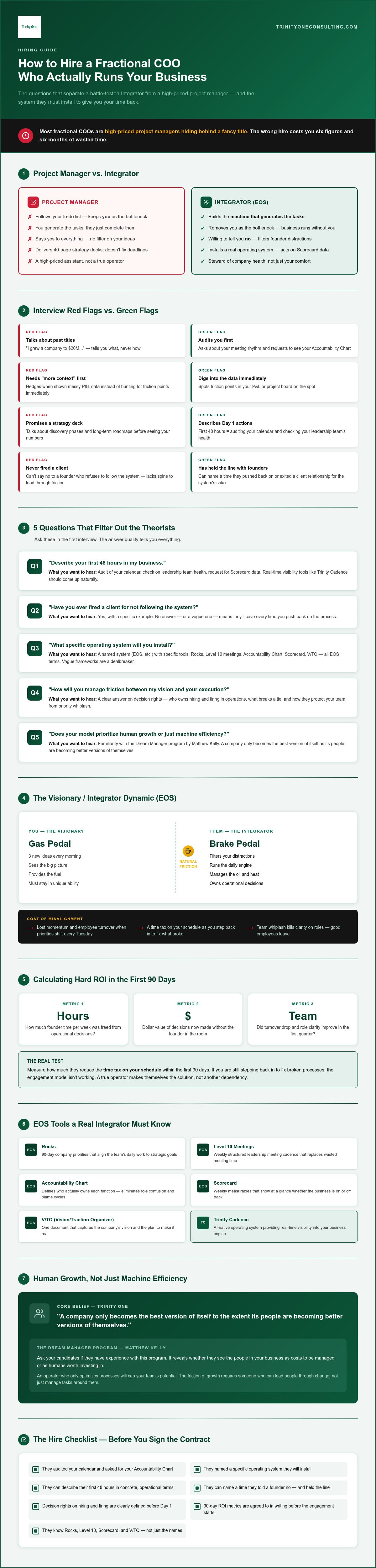
Most fractional COOs are just high-priced project managers hiding behind a fancy title. To find a true Integrator who can run your business engine, you must ask how they handle conflict and what specific operating system they install. A successful fractional COO engagement model requires more than checking boxes. You need someone who removes you as the bottleneck and builds a system that works when you aren't in the room.
I know the frustration of watching operations break while you're forced to make every single decision. Your meetings feel like a waste of time. You're losing good employees because they don't have clarity on their roles. It's exhausting to be the only person who sees the big picture while the daily grind eats your schedule.
I'm going to give you the exact questions you need to filter out the theorists and find a battle-tested operator. You'll learn how to spot a leader who can act as an Integrator, a term used in EOS, to build a self-sustaining business and give you your time back. We'll look at the technical requirements of the role and the human elements that keep a team together. No fluff. Just the tools you need to hire the right partner.
Key Takeaways
- Learn how to spot candidates who hide behind past titles instead of showing real execution habits so you don't hire a project manager in disguise.
- Discover the right way to test the relationship between a Visionary and an Integrator, an EOS concept, to ensure they can handle your shifting priorities.
- Understand why a fractional COO engagement model fails without a specific operating system like Trinity Cadence to provide real time visibility into your business engine.
- Calculate the hard ROI of your hire by measuring how much they reduce the time tax on your schedule within the first 90 days.
- Filter for leaders who prioritize human growth by asking about their experience with the Dream Manager program by Matthew Kelly.
Why your current interview process is missing the operational red flags
Most founders hire for the resume. You see a title like VP of Operations at a mid sized firm and assume that person can run your shop. This is a mistake that costs you six figures and six months of wasted time. You are likely focusing on past titles rather than current execution habits.
I have spent 30 years in the trenches of leadership. I have seen brilliant resumes fail because the person couldn't manage a Tuesday morning. Most candidates talk about what they did. They say they grew a company to 50 employees or 20 million dollars. They rarely tell you how they did it.
A successful fractional COO engagement model requires a candidate who audits you as much as you audit them. They should be asking about your current meeting rhythm. If they don't ask to see your accountability structure, a term used in EOS, they don't care about who actually owns the work. They are just looking for a seat at the table.
You need to see how they handle messy data. Ask them to look at your current P&L or your messy project management board. If they start making excuses about needing more context before they can give an opinion, they aren't an operator. An operator starts looking for the friction points immediately.
The difference between a project manager and an Integrator
Project managers follow tasks. They take your to do list and make sure it gets done. This keeps you in the center of the engine. You stay the bottleneck because you are still the one generating the tasks. You aren't buying freedom. You are just buying an assistant with a higher hourly rate.
An Integrator, builds systems. They create the machine that generates the tasks. They must be willing to tell you no. Ask them if they have ever fired a client for refusing to follow the system. If they haven't, they lack the spine to lead your team through the friction of growth. An Integrator is a steward of the company's health, not just your personal comfort.
Spotting the consultant who just wants a retainer
Beware of the person who promises a 40 page strategy deck. Strategy decks are where operations go to die. They look good in a board room but they don't fix the fact that your project managers are missing deadlines. Real operators don't want to write essays. They want to talk about your Scorecard data, which is an EOS tool.
Ask them to describe their first 48 hours in your business. A real operator will talk about auditing your calendar and checking the health of your leadership team. They might mention using a platform like Trinity Cadence to get real time visibility into your operations. If they talk about discovery phases and long term roadmaps before they've even seen your numbers, they are a consultant, not an operator. You don't need a roadmap. You need someone to drive the car.
How will you manage the friction between my vision and your execution?
The connection between a Visionary and an Integrator is the most important link in your company. If this link snaps, your growth stops. If it's too rigid, your innovation dies. A high performance fractional COO engagement model must account for the natural friction between big ideas and daily execution. You are the gas pedal and they are the brake. You need both to win the race without hitting a wall.
I have spent decades working with founders who feel like they are dragging their team uphill. You wake up with three new ideas every morning. Some are brilliant. Most are distractions that will derail your staff for a month. A true Integrator doesn't just say yes to you. They act as a filter so you can stay in your unique ability. They protect your time by handling the noise so you can focus on the big picture vision.
When you and your operator aren't aligned, the cost is measured in lost momentum and employee turnover. Your team gets whiplash when priorities change every Tuesday. This creates a time tax on your schedule because you have to keep stepping back in to fix what broke. A real operator knows how to manage a founder led business. They understand that your vision is the fuel, but the engine needs oil and maintenance to survive the heat.
Defining decision rights and escalation rules
You must decide who has the final say on hiring and firing in operations before the first conflict happens. If you disagree on a leadership hire, who breaks the tie? I tell my clients that the Integrator owns the operational team while the Visionary owns the culture. We need clear rules on how to communicate changes to the team. If you go around your Integrator to give orders to a manager, you undermine the system. We must agree on how to handle those moments of founder drift without causing a mutiny.
The physics of leadership: Visionary vs Integrator
The role of an Integrator for a visionary CEO is to turn heat into motion. This requires a same page meeting every week, which is a concept from EOS. This isn't a status update. It's an alignment check. We look at the vision and plan document, an EOS tool, and decide if your new idea fits the long term plan. If it doesn't, we put it on the long term Issues list, another EOS term. This keeps the engine running at top speed without blowing a gasket. If you want to see how this dynamic fits your specific business, let's look at your current organizational chart together.
What specific operating system will you install to run the company?
A fractional COO without a system is just an expensive temporary employee. They might fix a few fires, but when they leave, the chaos returns. You don't need a person who brings their own personal habits to your office. You need a person who installs a repeatable engine that lives in the company long after the contract ends. This is the backbone of a high performance fractional COO engagement model.
I have seen founders spend $15,000 a month on "strategic advisors" who never touch the front lines. If your operator doesn't have a specific methodology, they are just guessing with your money. I use a combination of EOS and Trinity Cadence to ensure every person in the building knows exactly what they own. We use quarterly priorities, weekly leadership meetings, and Scorecards, all terms attributed to EOS, to create absolute clarity. This eliminates the "I thought you were doing that" conversations that kill productivity.
The tradeoff of installing a real system is the initial friction. It takes roughly 90 days to get a team fully integrated into a new rhythm. Some of your legacy employees might resist the transparency. That's the price of a clean engine. A system that doesn't expose the truth is just a digital paperweight.
The importance of a unified operating cadence
Meetings are usually where your profit goes to die. A unified cadence fixes this by creating a predictable rhythm for every department. You need to understand the difference between a weekly vs monthly operating cadence to keep the team aligned without burning them out. If you are meeting just to give updates, you're failing. An ideal weekly leadership meeting starts on time and ends on time. It focuses on solving issues, not just talking about them. I ensure adoption by making these tools the only way to get work done.
AI-native operations and coaching
The 2026 business environment demands more than manual tracking. We use Trinity Cadence as an AI-native operating system to provide real time visibility into every corner of your business engine. It isn't just a dashboard. It acts as a digital coach for your managers. The system uses AI to analyze execution patterns and engagement levels. It can predict an operational bottleneck before it stops your production line. This saves your team at least 5 hours of manual reporting every week. You get the truth in real time, not a filtered report two weeks late.
How do we calculate the hard ROI of a part-time executive?
To calculate the hard ROI of a fractional COO engagement model, you must measure the reduction in your personal decision time and the increase in your team's execution velocity. A fractional hire costs significantly less than the $250,000 salary plus equity and benefits required for a full time executive. You are paying for the system and the result, not the hours spent sitting in a chair.
You can compare the fractional COO vs full time COO cost to see the immediate capital savings. Within the first 90 days, your time tax should drop. I track how many hours a CEO spends in operational meetings that they don't need to attend. If you are still answering basic staff questions after three months, the hire is failing. You should be back in your unique ability, not explaining how to use the CRM.
A real operator owns specific numbers on your Scorecard, an EOS tool. They might own the fulfillment cycle time or the error rate in production. If they won't put their name next to a hard metric, they are just a consultant. We look at execution lag. This is the time between a decision being made and the result being delivered. If your fulfillment process is dragging, that is lost cash flow.
Setting 90-day quarterly priorities and measurable goals
I set specific quarterly priorities, for every engagement. The first 30 days are spent auditing the engine. By day 60, we are installing the operating cadence. Successful engagement after six months looks like a business that runs weekly leadership meetings, an EOS concept, without the CEO present. If the team resists, we identify if they are the right person in the right seat, another EOS tool. Growth requires the right parts in the machine.
The hidden cost of execution lag
Slow decision making has a dollar cost. If a $10,000 project sits on a desk for two weeks, that's lost cash flow. I improve the velocity of your business engine by removing the friction in the approval process. We also look at employee retention and engagement. By using the Dream Manager program by Matthew Kelly, we ensure your people are becoming better versions of themselves while they work for you. This reduces turnover costs which can hit 150% of an employee's annual salary.
Does your model prioritize human growth or just machine efficiency?
A company only becomes the best version of itself to the extent its people are becoming better versions of themselves. If your operator treats your staff like line items on a spreadsheet, you'll face high employee turnover. A fractional COO engagement model that ignores the human engine is doomed to fail. You can have the best software in the world, but if your team is disengaged, your execution will lag.
I've seen 30 years of operations break because the leader forgot that people have lives outside of the office. You need to ask if they're familiar with the Dream Manager program by Matthew Kelly. This isn't about being soft. It's about aligning an employee's personal goals with their professional output. When people feel that the company is a vehicle for their own dreams, they show up differently.
Integrating the Dream Manager concept
I use the Matthew Kelly methodology to coach employees across the twelve dream categories, which include areas like physical, emotional, and intellectual growth. We use the DreamCompass app to keep these goals front and center so they don't get lost in the daily grind. Supporting personal dreams impacts the bottom line by creating a culture of loyalty and high performance. If you want to see real retention, you need certified Dream Manager coaching as part of your operational strategy. It turns a job into a mission and reduces the cost of hiring new staff every six months.
Building a culture of execution and engagement
Operational shifts are painful. Your team needs to feel heard during a transition or they'll quietly quit. I once worked with a disengaged manager who was ready to walk out. By identifying a personal dream of theirs and showing how their work funded that dream, we turned them into a top performer within 60 days. You must balance machine like precision with human level empathy. A system without a soul is just a set of rules that people will eventually ignore. My faith convinces me that every person has value. A good business honors that value through clear expectations and genuine support.
Build your business engine for long term growth
Hiring the right operator is the most important decision you'll make this year. You need a partner who understands that a fractional COO engagement model only works when it combines technical precision with human development. Fixing a few broken processes won't save you. You need to install a permanent business engine that runs without you.
I've spent 30 years in the trenches of leadership and operations. I've learned that a company only reaches its potential when its people are reaching theirs. That's why I combine operational focus with Certified Dream Manager facilitation, a program by Matthew Kelly. You deserve a business that provides you with both profit and freedom. Don't settle for a project manager who just checks boxes. Find an Integrator, a term used in EOS, who can challenge your vision and turn it into a tangible result.
You have the vision. Now you need the engine to carry it. It's time to stop being the bottleneck and start being the leader your company needs. Your team is waiting for the clarity and direction that only a true operating system can provide.
Frequently Asked Questions
What is the typical cost of a fractional COO engagement in 2026?
A fractional COO engagement model usually costs between $8,000 and $26,000 per month depending on the complexity of your business engine. This is significantly lower than the $250,000 base salary plus equity required for a full time executive. You're paying for the system they install rather than the hours they sit in a chair.
How many hours a week does a fractional COO actually work in my business?
Most fractional operators spend 5 to 10 hours a week focused on your specific leadership team and systems. I don't track hours because I'm not a freelancer. I'm an Integrator who ensures your company hits its quarterly priorities. If I can fix your engine in 2 hours, that's more valuable than me dragging it out for 40.
Can a fractional COO help with AI implementation and strategy?
Yes, a modern operator must include AI implementation to reduce your team's manual workload. I use Trinity Cadence to give you real time visibility into your business performance. We don't just talk about AI strategy. We install tools that automate your reporting and coach your managers on execution.
What is the difference between an Integrator and a Chief Operating Officer?
An Integrator is a specific role from EOS that functions as the glue for the leadership team and the filter for the Visionary CEO. While a Chief Operating Officer might just manage departments, an Integrator ensures the entire business engine stays aligned with the vision and plan document, an EOS tool. They're responsible for execution while the CEO focuses on the big picture vision.
How do I know if my company is ready for a fractional executive?
You're ready when you've reached roughly $2 million in revenue and your staff has grown past 10 people. If you're the bottleneck for every decision and your meetings feel like a waste of time, you need help. You can't scale past your own personal capacity without a system to manage the daily grind.
Will a fractional COO manage my entire leadership team?
A true Integrator manages the heads of your departments and runs your weekly leadership meetings, which is an EOS concept. They ensure everyone is hitting their Scorecard numbers and completing their quarterly priorities. This removes the time tax from your schedule so you can stop playing referee between your managers.
How does the Dream Manager program improve employee retention?
The Dream Manager program, created by Matthew Kelly, connects an employee's personal dreams to their daily work. When people see that their job helps them achieve goals in the twelve dream categories, they stay longer and work harder. I use the DreamCompass app to track this engagement. It's the difference between a hired hand and a committed partner.
What happens if the fractional COO and the CEO don't get along?
Friction is a natural part of the Visionary and Integrator relationship. We use same page meetings, an EOS tool, to resolve conflicts before they break the system. If the trust is gone, the engagement should end immediately. A fractional COO must be willing to tell you no, but they must always align with your ultimate vision.
One question worth asking early is what they charge and how they arrive at it. Ours is published on what a fractional COO costs.