
Hiring a full-time executive is often viewed as the ultimate milestone of scale. In 2026, it might actually be a symptom of operational waste. The fractional COO vs full time COO cost gap has widened. The math is no longer a simple salary comparison. Between 35% recruitment fees and health benefit costs rising nearly 7% this year, a traditional hire is a high-stakes gamble. You need an engine architect. You don't need a permanent seat at the table that drains capital before it delivers value.
You recognize the friction. Growth is stalling because you're stuck in the gears of daily execution. You want professionalized systems and the freedom to focus on strategy, but the budget for a $460,000 total compensation package isn't there. We understand the pressure of scaling without the bloat. This article provides a definitive breakdown of the financial and operational math between fractional and full-time leadership. We'll analyze the "fully loaded" cost of traditional hires, the agility of fractional integrators, and how to achieve full-time results at a 60% lower cost.
Key Takeaways
- Break down the fractional COO vs full time COO cost to reveal how strategic impact, not hours, drives 2026 profitability.
- Factor in the "fully loaded" reality of recruitment fees and rising benefit overhead that makes traditional hiring a high-stakes capital drain.
- Shorten the path to professionalized systems by replacing the six-month executive search with a fractional leader who integrates within 14 days.
- Apply the 80/20 rule of leadership physics to secure 80% of executive value at a fraction of the traditional overhead.
- Transition to an AI-native operating system like the Trinity Cadence to maintain real-time visibility while fostering human performance and alignment.
The Financial Blueprint: Fractional vs. Full-Time Math
Executive leadership is an engine. It requires fuel, maintenance, and precision timing to drive a company forward. For many CEOs, the decision to hire a Chief Operating Officer (COO) is the most significant financial commitment they'll make. In 2026, the fractional COO vs full time COO cost isn't just a line item; it's a strategic choice between ownership and access. A full-time executive demands a permanent seat. A fractional leader offers surgical intervention.
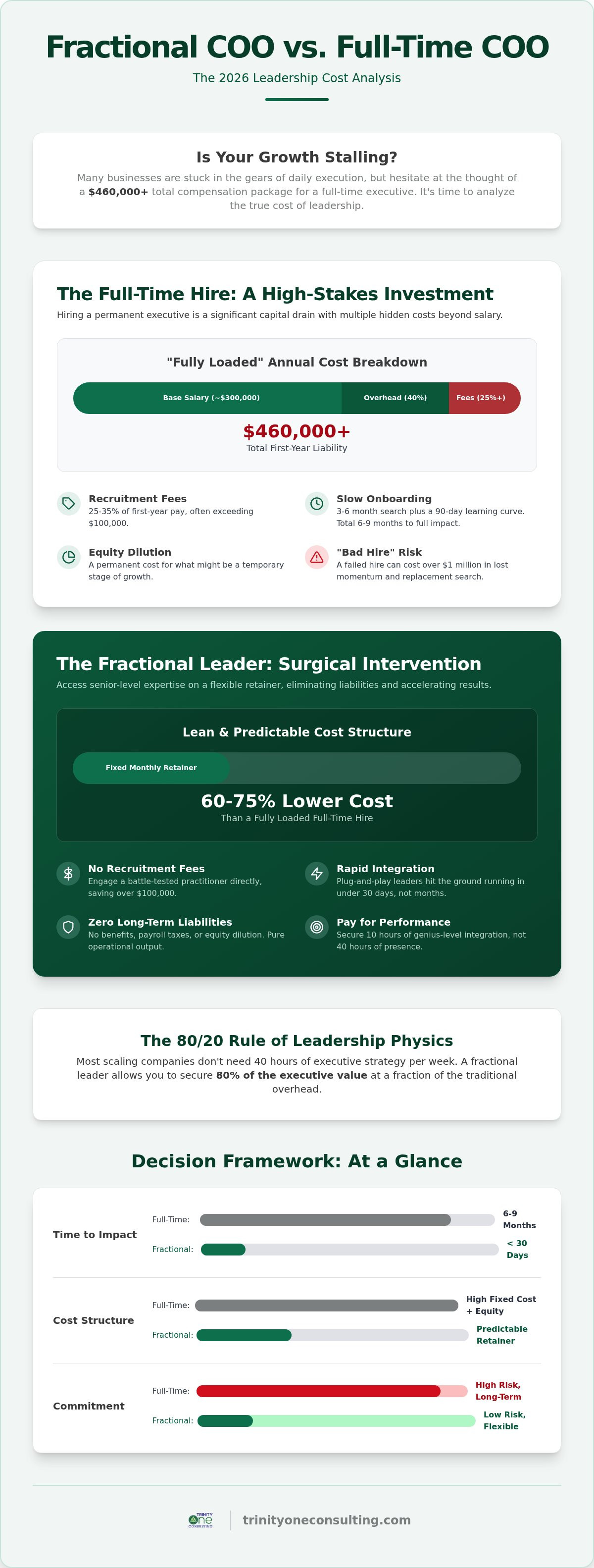
The math begins with the base salary. Current projections for 2026 place a full-time COO's base salary between $250,000 and $450,000 for mid-market firms. However, the base is only the tip of the iceberg. When you calculate the "fully loaded" cost, you must apply the 30% to 40% overhead rule. This includes payroll taxes, health benefits, which are rising at a steep 6.7% this year, and performance bonuses. A $300,000 base salary quickly transforms into a $420,000 annual liability. You aren't just paying for leadership; you're paying for the infrastructure required to sustain it.
This infrastructure often includes the critical technology and security systems that allow an executive to lead effectively. For businesses needing to stabilize their technical foundations, visit Trinity Networx, LLC to explore managed IT services that support sustainable growth.
The Full-Time Commitment: A High-Stakes Investment
Hiring for the long term carries heavy front-end friction. Retained executive search firms, such as Mark Loucas Ltd, typically charge 25% to 35% of the hired executive's first-year total compensation. For a high-level COO, this recruitment fee alone can exceed $100,000. Beyond the cash outlay, there's the cost of equity. Diluting your ownership to attract top-tier talent is a permanent price for a temporary stage of growth. The greatest risk, however, is the "bad hire." Industry data suggests the cost of a failed executive hire can reach $1 million when factoring in lost momentum, severance, and the search for a replacement. It's a high-stakes gamble with low liquidity.
The Fractional Model: Surgical Precision
The fractional model operates on a different logic. It's built for speed and predictable cash flow. Instead of a multi-year commitment, you engage a battle-tested practitioner via a fixed monthly retainer. There are no recruitment fees, no equity dilution, and no long-term benefits liabilities. You pay for the architect, not the office space. This model allows you to scale the "dial" of leadership. You can increase involvement during a launch sprint or decrease it once systems are stabilized. It's operational output without the structural weight.
The core of the fractional COO vs full time COO cost debate lies in the "Seniority Gap." Most scaling companies don't actually need 40 hours of high-level strategic judgment every week. They need 10 hours of genius-level integration and 30 hours of disciplined execution from their existing team. By choosing a fractional leader, you stop paying for "presence" and start paying for "performance." You secure the brain trust of a veteran executive at a 60% to 75% cost savings, allowing you to reallocate that capital into growth-driving assets like AI implementation or market expansion. This logic applies to other critical functions as well; for example, you can learn more about PCFO to see how fractional financial leadership provides similar strategic value.
Beyond the Salary: The Hidden Costs of Operational Leadership
The true fractional COO vs full time COO cost isn't found on a payroll report. It's hidden in the friction of slow execution and the weight of physical infrastructure. A full-time executive is a heavy asset. They require office space, high-end equipment, and dedicated administrative support. These overhead costs add a silent tax to every hour they work. Beyond the physical, there's the "Culture Drag." A permanent executive often feels compelled to build a department. They create layers. They introduce bureaucracy to justify their 40-hour week. This slows the very engine you're trying to accelerate.
Onboarding velocity is another critical differentiator. A traditional executive search takes three to six months. Once hired, they spend another 90 days "learning the culture." By contrast, a fractional leader is a plug-and-play component. They arrive with a proven methodology and hit the ground running in under 30 days. One of the primary benefits of a fractional COO is this immediate injection of seniority without the long-term structural bloat. You pay for the solution, not the learning curve.
The Cost of Turnover and Employee Disengagement
Replacing a mid-level manager costs between $15,000 and $50,000. When operations are messy, disengagement spikes. A fractional leader doesn't just fix processes; they stabilize the human element. By implementing systems like Dream Management facilitation, they align individual aspirations with corporate objectives. This isn't soft science. It's retention engineering. When employees see their personal goals reflected in their professional output, turnover drops. The ROI of a stable team far outweighs the cost of a specialized consultant.
Operational Friction: The "Tax" on Slow Execution
Every day a decision is delayed is a day of lost revenue. In a fast-moving market, indecision is a lethal friction point. The CEO is the Visionary. They're built to see the future. The COO is the Integrator. They're built to build the road. When the CEO is forced to manage daily stand-ups or troubleshoot software logic, they're performing "COO work" at a CEO's salary. This opportunity cost is staggering. A fractional integrator clears the path. They remove the operational static, allowing the CEO to return to high-level strategy. To see how this alignment works in practice, you might explore our fractional leadership models.
The ROI of Seniority vs. Quantity: The Integrator’s Physics
Business is a system of forces. In this environment, volume is a vanity metric. True value is the result of high-stakes judgment applied at critical junction points. This is the core of the Integrator’s physics. The Visionary CEO provides the spark and the direction. The Integrator is the transmission. They convert raw ambition into disciplined, mechanical movement. Without this conversion, the engine revs but the wheels don't turn. You don't need more hours; you need more torque.
The fractional COO vs full time COO cost equation shifts dramatically when you apply the 80/20 rule of leadership. Executive impact is rarely distributed evenly across a 40-hour week. Instead, 80% of a leader's value is generated in the 20% of their time spent on high-level strategy, system design, and bottleneck removal. For a battle-tested COO, those eight hours of "genius" work are far more valuable than 40 hours of mid-level management. You're paying for the decades of experience that allow them to solve in minutes what others might struggle with for weeks. It's a choice between buying a person's time or buying their results.
Professionalizing a team requires a Unified Operating Cadence. This is a rhythmic structure that eliminates the need for constant, reactive supervision. It replaces chaos with a predictable pulse. By engineering these systems, a fractional leader ensures that the business operates as an integrated circuit rather than a collection of loose wires. You stop supervising people and start managing the system.
The Visionary vs. Integrator Dynamic
Visionaries are architects of the future. However, they often fail when they attempt to build the engines meant to take them there. They get bogged down in the "how" and lose sight of the "why." A fractional integrator steps in as the Strategic Architect. They don't just manage; they build the infrastructure. They bridge the gap between the CEO’s vision and the team’s execution. This dynamic was recently evidenced in a case study where a founder-led tech firm professionalized its entire operation in 60 days by delegating the "how" to a fractional specialist. The founder returned to strategy, and the team finally had a clear roadmap.
Calibrating the Business Rhythm
Operational excellence is a matter of frequency. Precision meeting huddles and strategy tracking reduce "meeting fatigue" and eliminate the culture of constant status updates. When you establish a clear rhythm, you reclaim hours of lost productivity. This structured execution is the hallmark of The Fractional Integrator: Engineering Your Business Engine for 2026. By calibrating the business pulse, you ensure that every part of the organization is moving in harmony toward a singular objective. This isn't just management; it's calibration.
The 2026 Decision Framework: When to Pull the Trigger
Scaling a business is a series of threshold crossings. In 2026, the trigger for executive hiring is no longer just a revenue number. It's a calculation of complexity. While traditional advice suggests hiring a full-time leader once you hit $10 million, the fractional COO vs full time COO cost reality favors agility over headcount. For companies between $2 million and $15 million in annual revenue, a fractional model is often the superior financial choice. You need the systems of a $50 million company without the payroll of one.
Complexity indicators often signal the need for intervention before the budget allows for a full-time hire. Are you managing a distributed remote team across multiple time zones? Are you struggling to integrate AI into your core workflows? If your growth velocity is outstripping your current infrastructure, you're likely leaking profit. The "Ceiling Test" is the final metric. When the Visionary CEO becomes the primary bottleneck for every operational decision, the engine has reached its limit. You don't need a permanent manager; you need a strategic architect to redesign the circuitry.
Assessing Your Operational Maturity
Operational maturity begins with a "Chaos Audit." This is a clinical identification of where energy is being wasted. You must evaluate whether your friction points require general management or specialized AI implementation. Many leaders find that a "90-Day Sprint" with a fractional integrator provides the necessary proof of concept. This low-risk period allows you to professionalize your systems and stabilize the business rhythm before committing to a long-term executive contract. It's a data-driven approach to leadership.
The Hybrid Transition Strategy
The smartest path to a full-time hire is often a fractional start. A "Systems-First" approach ensures that you aren't hiring an executive to fix a broken engine; you're hiring them to run a high-performance one. A fractional COO can build the operating cadence, document the processes, and then help you recruit and train their full-time successor. This minimizes the risk of a bad hire and ensures the new executive inherits an integrated circuit rather than a pile of loose wires. The long-term ROI of this transition is unmatched.
If you're ready to stop managing chaos and start scaling with precision, you can book a fractional COO consultation to evaluate your operational readiness.
The Trinity One Advantage: AI-Native Fractional Leadership
Traditional fractional models are reaching their expiration date. Most fractional COOs still rely on manual status updates, human memory, and weekly check-ins. In 2026, these methods are too slow and too expensive. The fractional COO vs full time COO cost debate changes entirely when you introduce AI-native leadership. You no longer pay for a person to sit in meetings and ask for status reports. You pay for a strategic architect who installs an autonomous operating system. This is the transition from a manual engine to an integrated circuit. It's a move from reactive management to proactive integration.
At Trinity One, we utilize an AI-native approach to eliminate the "management tax" that plagues scaling businesses. By deploying the Trinity Cadence, we provide real-time visibility that traditional executives cannot match. This system aligns machine operations with human performance. We don't just optimize software; we utilize Dream Management facilitation to ensure your team's personal aspirations fuel the company's professional output. You achieve the clinical precision of technology alongside the empathetic depth of human development. It's a unified remedy for operational friction. When evaluating the fractional COO vs full time COO cost, the ability to scale without adding manual overhead is the ultimate competitive advantage.
Trinity Cadence: The Pulse of Execution
The Trinity Cadence is the heartbeat of a high-performance business engine. It automates the operating rhythm to eliminate the need for manual reporting and constant supervision. This AI-native OS provides:
- Real-time visibility into every department's performance and output.
- AI-driven operational coaching that provides staff with immediate feedback.
- A unified rhythm that persists even when the human COO is off-site.
- Automated strategy tracking to ensure daily tasks align with the CEO's vision.
The system doesn't sleep. It ensures that the engine is always aligned and the gears are always turning. This automation reduces the necessary hours of senior human intervention. You secure the brain trust of a veteran executive while the machine handles the mundane task of oversight.
Rapid Launch Sprints: Accelerating the ROI
Transformation shouldn't be a multi-year project. We utilize Launch Sprints to set the foundation for success in weeks, not months. These fixed-fee engagements are designed to map the AI ROI and ensure every tool in your stack drives measurable profit. We identify the friction points in your current business engine and install the necessary circuitry to bypass them. This closes the gap between your strategic vision and the daily execution of your staff. By professionalizing the systems first, you reclaim your freedom as a CEO. You stop managing chaos and start leading a high-performance engine designed for the 2026 economy.
Engineering the High-Performance Engine
Scaling a business is a matter of precision, not just persistence. You've seen the math. The fractional COO vs full time COO cost gap proves that in 2026, agility is the ultimate currency. A full-time hire is a heavy, static commitment. A fractional integrator is a surgical intervention. By prioritizing impact over hours, you eliminate the 40% overhead tax and secure the battle-tested seniority required to break through your current growth ceiling.
Trinity One brings over 30 years of operational experience to your leadership team. We utilize our AI-native Trinity Cadence OS to provide real-time visibility that manual systems can't match. As Certified Dream Management Facilitators, we don't just optimize processes; we align human purpose with mechanical efficiency. This is how you build a resilient, high-output organization without the structural bloat.
Stop managing the chaos of daily execution and return to your role as the Visionary. Schedule your Rapid Launch Sprint with Trinity One to install the systems your business deserves. Your engine is ready for its next gear.
Frequently Asked Questions
How much does a fractional COO cost per month in 2026?
Monthly retainers for a fractional COO typically range from $5,000 to $12,000 depending on the scope of work. High-complexity industries with significant regulatory oversight may see fees reach the $20,000 range. You pay for the architecture of the engine; you don't pay for the idle time of a permanent seat. This model ensures you only fund high-stakes judgment rather than administrative presence.
Is a fractional COO more cost-effective than a full-time hire for a $5M company?
A fractional leader is significantly more cost-effective for a company at the $5 million revenue mark. Most firms at this stage only require 15 to 25 hours of high-level operational leadership per week. The fractional COO vs full time COO cost comparison shows that you save roughly 60% to 75% by avoiding a full-time salary for a part-time need. You secure veteran expertise without the "management tax" of a permanent executive.
What are the hidden costs of hiring a full-time COO?
Recruitment fees are the most immediate hidden cost; they often reach 25% to 35% of the executive's total first-year compensation. Beyond the search, you must factor in employer health benefit costs, which rose nearly 7% in 2026. Add to this the cost of a three-to-six-month onboarding period and potential severance. A full-time executive is a high-maintenance asset that requires significant infrastructure to sustain.
How do you calculate the ROI of a fractional integrator?
ROI is calculated by measuring reclaimed CEO time and the financial impact of reduced operational friction. If a fractional integrator frees up 20 hours of your week for strategic growth, the ROI is the value of your new revenue minus the retainer. You also factor in the savings from stabilized employee retention. Systems like Dream Management help eliminate the $15,000 to $50,000 cost of replacing disengaged staff.
Does a fractional COO receive equity or benefits?
Fractional COOs do not receive health benefits, 401k matches, or equity as a standard requirement. They operate as specialized service providers rather than permanent employees. This eliminates the long-term dilution of your ownership and removes the structural liability of a traditional C-suite contract. You get pure operational output without the long-term financial debt of a traditional hire.
What happens if we outgrow our fractional COO?
Your fractional leader manages the transition to a full-time successor when the time is right. They spend their tenure building the systems and documentation required for a permanent executive to succeed. Often, the fractional COO leads the search and training for their replacement. This ensures your business rhythm remains steady and your engine continues to run during the handoff.
How does AI implementation impact the cost of senior leadership?
AI implementation reduces the total hours required for senior oversight by automating the "arithmetic" of management. By utilizing an AI-native OS like Trinity Cadence, a fractional leader gains real-time visibility into every department without manual check-ins. This lowers the fractional COO vs full time COO cost because the executive focuses entirely on high-stakes judgment. The machine handles the oversight; the human handles the strategy.
Can a fractional COO help with our business operating system?
A fractional COO acts as the natural Integrator for companies running a structured operating framework. They bridge the gap between the Visionary’s ideas and the team’s daily execution. They bring the discipline required to run weekly leadership meetings, track quarterly priorities, and clear bottlenecks. They ensure the system works as an integrated circuit rather than a series of disconnected events.
Trinity One publishes its own tiers rather than making you ask for them: the full schedule is on what a fractional COO costs.