
Growth can make a committed team look healthy until work starts slipping. Preventing employee burnout in a fast-growing company means spotting when work is outpacing people’s capacity, then changing the conditions causing the pressure. If the team keeps meeting deadlines by working late, delivery alone won’t tell you whether the workload is sustainable.
Growth brings new demands. The hard part is seeing when those demands have outgrown the way decisions and responsibilities are managed. A busy stretch can be part of building a company. Repeated overload needs a response.
I’ve spent more than 30 years in operations, and I’ve learned that growth depends on clear execution and people who can keep doing meaningful work. Leaders need to make ownership clear, weigh new requests against existing commitments, and follow through when employees raise concerns. The goal is work people can sustain while the company grows.
Key Takeaways
- Spot burnout risk when demand grows faster than staffing, decision-making, and clear ownership can keep pace.
- Use priority and workload reviews to find where pressure is building in the work system.
- Preventing employee burnout in a fast-growing company doesn’t require lowering standards. It requires making capacity and commitments visible.
- In a workload discussion, decide what can stop, move, or change hands, then assign an owner to each decision.
- Make capacity and follow-through part of leadership’s operating cadence. Use engagement visibility to guide conversation, not replace it.
Why does rapid company growth increase employee burnout risk?
Employee burnout is a response to chronic workplace stress that hasn’t been successfully managed, marked by exhaustion, growing mental distance from work, and reduced professional effectiveness. Preventing employee burnout in a fast-growing company means addressing sustained pressure in the work system. Risk rises when new demand arrives faster than staffing, decisions, and ownership can keep up.
A demanding stretch can be reasonable. A launch or customer deadline may call for extra focus for a defined period, followed by a return to a normal pace. The warning sign is when each “temporary” push rolls into the next, priorities keep changing, and employees have no real chance to recover or finish what they already own. That’s chronic pressure, not a short sprint.
Growth pace, role clarity, and employee capacity need to stay aligned. Otherwise, the people doing the work absorb the difference.
What changes for employees when a company scales quickly?
At a small company, a founder can settle a question in a hallway conversation. As more teams, customers, and dependencies enter the work, informal coordination starts to break down. Someone waits for approval while another person makes a different assumption, and the task comes back for correction. That’s time spent on rework instead of progress.
Priorities shift, too. An employee may block time to finish a product release, then be told to respond to a new customer request before the original deadline moves. The cost is lost focus and a schedule the employee no longer controls. In an AI-native company, producing a draft or prototype faster doesn’t remove the need for human review and decisions. It can increase the volume of work that needs them.
High performers often hide the strain at first. They fill gaps, answer messages after hours, or take on a task with no clear owner because they don’t want a customer or colleague left waiting. Leaders may see delivery and assume the workload is manageable. They may not see the personal cost until commitments start slipping or an employee says, “I can’t keep doing this.”
Which early work signals should leaders pay attention to?
Look for changes in the work, not reasons to label a person. Repeated after-hours activity, missed recovery time, and priorities that remain unfinished week after week are reasons to ask what has changed. They don’t prove that an employee is burned out.
Check the handoffs. Does work keep coming back because the decision-maker or definition of “done” wasn’t clear? Are employees waiting on approvals or carrying work nobody explicitly assigned? These patterns point to friction in how responsibilities and decisions move through the company.
I’d use those signals to open a specific conversation: “Which commitment is taking time from the work you’re responsible for?” That question can surface a capacity conflict without turning a workload discussion into a judgment about someone’s resilience. The WHO’s occupational framing, summarized in this overview of occupational burnout, also keeps attention on chronic workplace stress rather than personal weakness.
How does the operating system of a growing company create or reduce burnout?
Preventing employee burnout in a fast-growing company depends in part on how work moves from decision to delivery. Priorities set the pace. Staffing decisions determine who can carry the work. Meetings and manager behavior either expose pressure early or leave employees to absorb it quietly.
Unclear ownership creates hidden work. If a customer issue has no named owner, several people may investigate it, or one conscientious employee may take it on alongside existing responsibilities. Either way, unassigned work has landed on someone’s schedule without a matching decision about what should wait.
Urgent work has a cost beyond the task itself. Each interruption takes time away from planned responsibilities, and repeated interruptions can push focused work into time employees would otherwise use to recover. A team can respond quickly today and still lose capacity to deliver planned work tomorrow.
Recurring workload problems need a work-system response, not another request for people to try harder.
How do unclear priorities turn growth into constant urgency?
When leaders call several projects the top priority, employees have to decide which one to disappoint. A developer might pause a committed release to handle a new executive request, while a customer-facing employee keeps both deadlines and works later to cover the gap. The conflict is a leadership decision, even if no leader names it.
Task switching breaks concentration. Work may need to be reopened, checked, or repeated while deadlines remain unchanged. The team pays twice: first in time spent changing direction, then in commitments that slip because the original plan was never adjusted.
When a new priority enters, name what will pause. That decision may delay a project or leave a request unanswered for a time. The tradeoff is visible instead of being silently charged to employee capacity.
What role do managers and operating rhythms play?
A useful check-in gives people room to say what’s blocked, what’s at risk, and which commitment no longer fits. Managers can then make a decision while there’s still time to change the plan. Accountability should clarify ownership and remove a blocker, not produce a status report that changes nothing.
Meetings can add pressure, too. If employees prepare updates for several overlapping check-ins, reporting eats into the work those meetings are meant to support. Keep the discussion tied to decisions, capacity, and follow-through. Change or cancel a meeting when it repeatedly collects information without resolving the issue.
Understanding how employees experience the work can help you maintain clear expectations without dismissing the strain behind a missed commitment. I see empathy as an operating skill, grounded in the business case for empathy in leadership, not a reason to avoid accountability. Ask what’s making execution harder, then agree on the owner and next step.
Does preventing burnout mean lowering standards or accepting every request?
No. Preventing employee burnout in a fast-growing company means holding people to clear commitments without expecting them to meet every demand at once. The bar can stay high. The work has to fit the capacity and time available, or leaders need to make an explicit choice about what changes.
A missed deadline or frustrated response doesn’t prove an employee is burned out. Work frustration can have many causes, and leaders shouldn’t turn ordinary pressure into a medical diagnosis. Pay attention to recurring conditions instead: responsibilities keep expanding, priorities conflict, and the expectation remains that every commitment will still be met.
Is burnout mainly an employee resilience problem?
Resilience practices may help a person manage stress, but they can’t correct priorities or staffing decisions that remain unchanged. If the same team is repeatedly asked to deliver more work with the same time and support, advice to cope better leaves the operating conditions intact. Personal support can matter alongside leadership’s responsibility to examine how work is assigned.
Employees also need a responsible way to raise concerns before a commitment is missed. Psychological safety at work with accountability means people can flag a real blocker, explain its effect on delivery, and help agree on the next step. The manager still owns the decision. That balance is central to psychological safety at work with accountability.
Can a fast-growing company protect people and still hold a high bar?
Yes. Ambitious outcomes don’t require a permanent state of emergency. Set a clear owner and deadline, then make the tradeoff visible when a new request competes with existing work. Accountability is stronger when people know which result matters most and leaders review delivery against a realistic commitment.
Suppose a product team has committed to finishing a release while also being asked to respond to a new customer issue. Keeping both deadlines unchanged may look demanding, but it hides the decision about what gets delayed or who takes on the extra work. The cost may show up as rushed review, rework, or work pushed into personal time. Name the tradeoff before asking the team to absorb it.
Protecting every commitment when capacity hasn’t increased has a price. Something will give, even if leadership never names it. It may be quality, the date, or employees’ ability to recover between demanding stretches. Pretending none of those costs exist doesn’t preserve standards. It makes the real standard impossible to manage.
I believe people can grow alongside a company when expectations are direct and leaders respond honestly to capacity concerns. Keep the bar clear. Make the plan fit the work, then hold owners accountable for commitments they can actually meet.
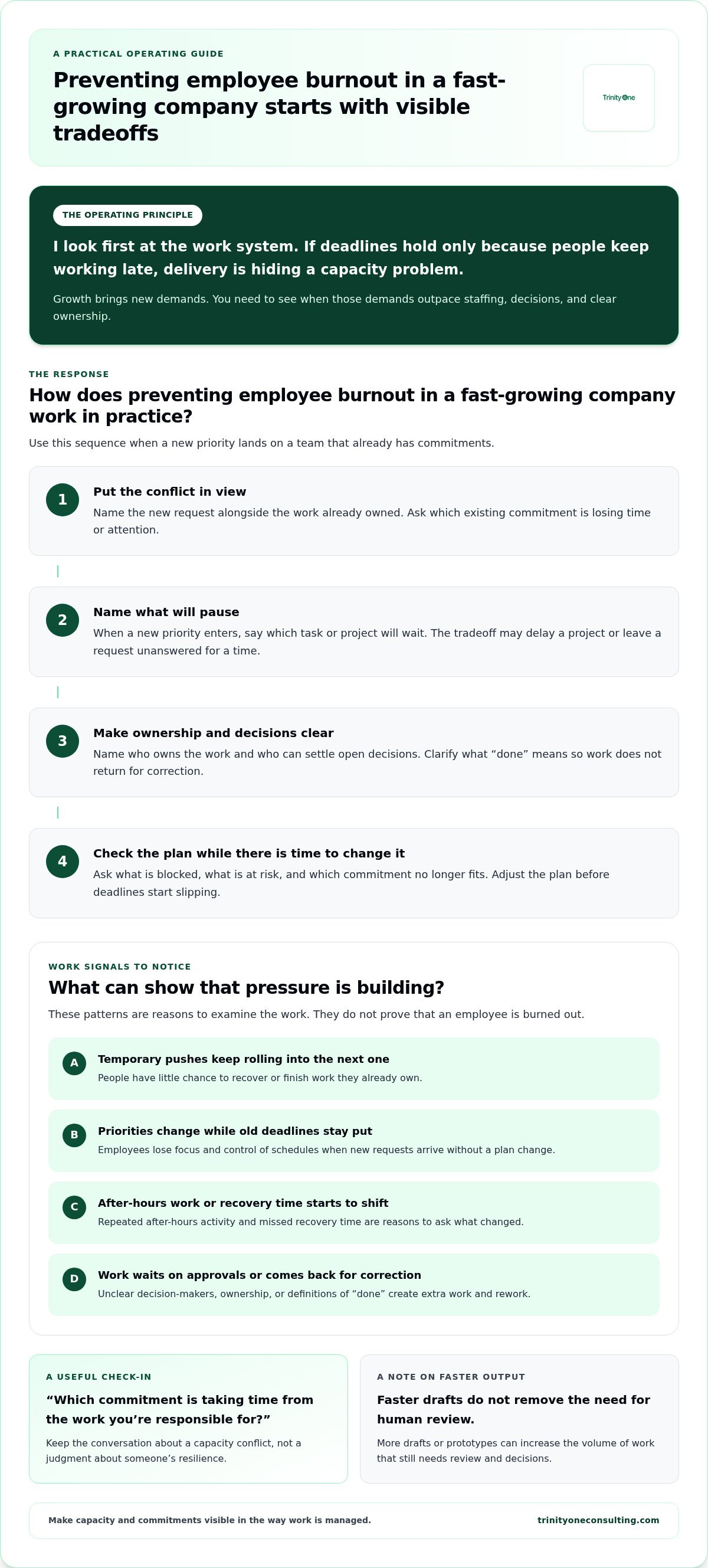
What can leaders change this week to reduce burnout pressure while preventing employee burnout in a fast-growing company?
Burnout pressure can ease when leaders change what happens after someone raises a capacity concern. This week, review the active workload, decide what can move, assign clear owners, and check whether the change reduced pressure. Don’t settle for a well-meaning conversation that leaves the same commitments with the same people.
How should a leader review workload and priorities?
Bring the team’s current commitments into one working session. For each item, record the owner, deadline, and any unresolved dependency. Compare that work with the capacity people actually have before adding another urgent request. The point is to see the conflict while there’s still time to decide what changes.
Then follow the sequence:
- Identify the pressure. Ask which commitment, dependency, or recurring request is making planned work hard to complete.
- Name the tradeoff. Decide what will stop, move to a later date, or change hands if a new priority must be addressed.
- Assign an owner. Name who will carry each decision and who needs to communicate the change to affected people.
- Review what changed. At the next workload check-in, see whether work moved as agreed or whether the pressure landed somewhere else.
Write the tradeoff beside the new request, not in meeting notes no one revisits. For example: “The customer escalation is assigned to Priya. The internal reporting update moves to next week.” That makes the decision visible and prevents employees from being held to two conflicting deadlines.
How can leaders make employee concerns safer to raise?
Ask for a specific example, then listen before explaining the business rationale. “Which part of the work is harder to finish than it was last month?” gives the employee room to describe the friction. Don’t treat the answer as a performance failure or a request for special treatment. It’s information you need to make a sound operating decision.
Managers shouldn’t promise a fix before they know what can change. A direct response works better: “I hear that the late changes are pushing your planned work into the evening. I can’t promise every request will stop, but I’ll review what’s changing and come back to you with a decision.” That respects the employee without making a commitment the manager may not control.
After an employee raises strain, name who will respond, when they’ll follow up, and what decision was made.
Follow-through matters even when the answer is no. Explain why the work must stay, what will be adjusted around it, and when the decision will be reviewed. If an employee’s concern points to a larger need for personal development, structured attention to aspirations through a Dream Manager program can support that conversation without replacing workload decisions.
How can leadership make burnout prevention part of the way the company runs?
Preventing employee burnout in a fast-growing company takes recurring leadership attention to capacity, priorities, and follow-through. Give a named leader responsibility for reviewing where work is accumulating, who can change commitments, and whether agreed changes help. If those decisions belong to everyone, they often belong to no one.
What should leaders review regularly as the company grows?
Review commitments alongside workload friction, unresolved blockers, and employee feedback. Looking at delivery alone can hide the cost of getting work done. A project may hit its deadline because employees repeatedly worked around late decisions, unclear handoffs, or shifting requests. The review needs to show what shipped and what the work demanded from the people responsible.
Track the result of each operating change. If a leader moves a task off one person’s plate, check whether it stopped or simply landed on another team. If a new approval step is meant to prevent rework, see whether it resolved the recurring issue or added another wait. Give every change a named owner and a next review point, so decisions don’t fade after the meeting.
Use the same discussion to identify who can make a tradeoff. A manager may own a team’s assignments but lack authority to defer a company priority. Make that boundary clear. When an issue needs an executive decision, name the decision-maker and the date it must be resolved. Otherwise, employees may keep carrying uncertainty while they wait for direction.
When could outside operating support help?
Outside operating support may help when leadership knows work is slipping but lacks clear ownership for coordinating priorities and execution. A fractional COO or Integrator can help clarify who owns decisions, how commitments are tracked, and where leaders need to resolve competing demands. That support still depends on leaders making the decisions. It can’t take the place of their willingness to set priorities or address tradeoffs.
Trinity Cadence brings an operating cadence, AI coaching, and visibility into execution and engagement. Those functions can give leaders useful information for regular conversations, but visibility alone doesn’t reduce pressure. A dashboard can show that commitments are slipping. Leaders still need to ask what’s getting in the way, decide what changes, and review whether the adjustment made a difference.
I believe a company can only become its best version as its people grow, too. Build the review into how you run the business, then follow through on what employees tell you about the work.
How can you build growth people can sustain?
Preventing employee burnout in a fast-growing company starts with the decisions leaders make before pressure becomes routine. Keep asking whether the way work is assigned still fits the people expected to deliver it. Growth should give employees more opportunity to develop, not leave them carrying an ever-expanding list of invisible commitments.
You don’t need every answer before you start. Choose one recurring source of pressure, make a clear decision about it, and follow through with the people affected. That gives your team evidence that speaking up can change how work gets done.
Build a company where strong execution and people’s growth move forward together.
Frequently Asked Questions
Is employee burnout the same as ordinary work stress?
No. Ordinary work stress often connects to a particular deadline or difficult task and may ease when that demand passes. Burnout is associated with workplace stress that persists without being effectively managed. A rough week alone doesn’t establish that someone is burned out, and managers shouldn’t diagnose employees. Look for ongoing changes in how work feels and gets done, then discuss the conditions behind them.
Can employees experience burnout even when they care about their work?
Yes. Caring about the work can lead someone to keep accepting tasks, cover gaps, or protect a deadline long after their workload has become difficult to sustain. Commitment doesn’t tell you how much capacity remains. If a dependable employee suddenly stops volunteering for work, ask what changed before assuming their motivation has disappeared.
How can a manager respond when an employee says their workload is unsustainable?
Take the statement seriously and ask for a recent example, such as a task that had to be postponed to meet another commitment. You might say, “Walk me through what’s competing for your time.” Listen before explaining the business need. Then clarify what you can change, who owns the decision, and when you’ll respond. Don’t make the employee responsible for fixing a staffing or priority problem alone.
Can time off alone prevent employee burnout in a fast-growing company?
Time off can provide a break, but it may not help if the employee returns to the same workload plus accumulated tasks. Preventing employee burnout in a fast-growing company also means deciding what happens to work while someone is away. Before the time off, name a temporary owner for essential tasks and defer work that can wait. Otherwise, the break can shift pressure into the return week.
What should leaders do when an employee keeps working after hours?
Ask what’s driving the pattern without praising it as a sign of exceptional commitment. Is the employee responding to late requests, trying to finish work that didn’t fit into the day, or choosing a schedule that suits them? The distinction matters. Review whether expectations are creating recurring after-hours work, and make clear which tasks can wait until the next work period.
Can a company grow quickly without creating chronic pressure for its employees?
Yes, if leaders accept that growth may require sequencing work rather than starting every promising initiative at once. For example, a team might focus on launching one customer feature before taking on another, giving employees a clearer target while the company expands. The tradeoff is that some opportunities wait. That’s a real cost, but starting more work than the team can finish creates costs, too.
How can leaders tell whether a workload change actually helped?
Check whether the specific problem improved, not just whether the employee met a deadline afterward. Ask if the postponed work stayed postponed, whether fewer tasks needed correction, and whether the employee can complete core responsibilities within the agreed schedule. Compare what the team expected to change with what happened, then ask where pressure moved. If it shifted to a colleague, the adjustment hasn’t solved the capacity issue.
Book a discovery call with Kevin to discuss how Trinity One can help clarify priorities, ownership, and execution in your company.