
Empathy earns its place in leadership when it changes what happens after the meeting. The business case for empathy in leadership is operational: understand why work is stuck, address the real constraint, and make the next decision executable.
That doesn’t mean listening forever or accepting missed commitments. I’ve seen leaders treat empathy as permission to soften the standard. It gives you better information before you hold the line, whether a deadline is unrealistic or a handoff is failing.
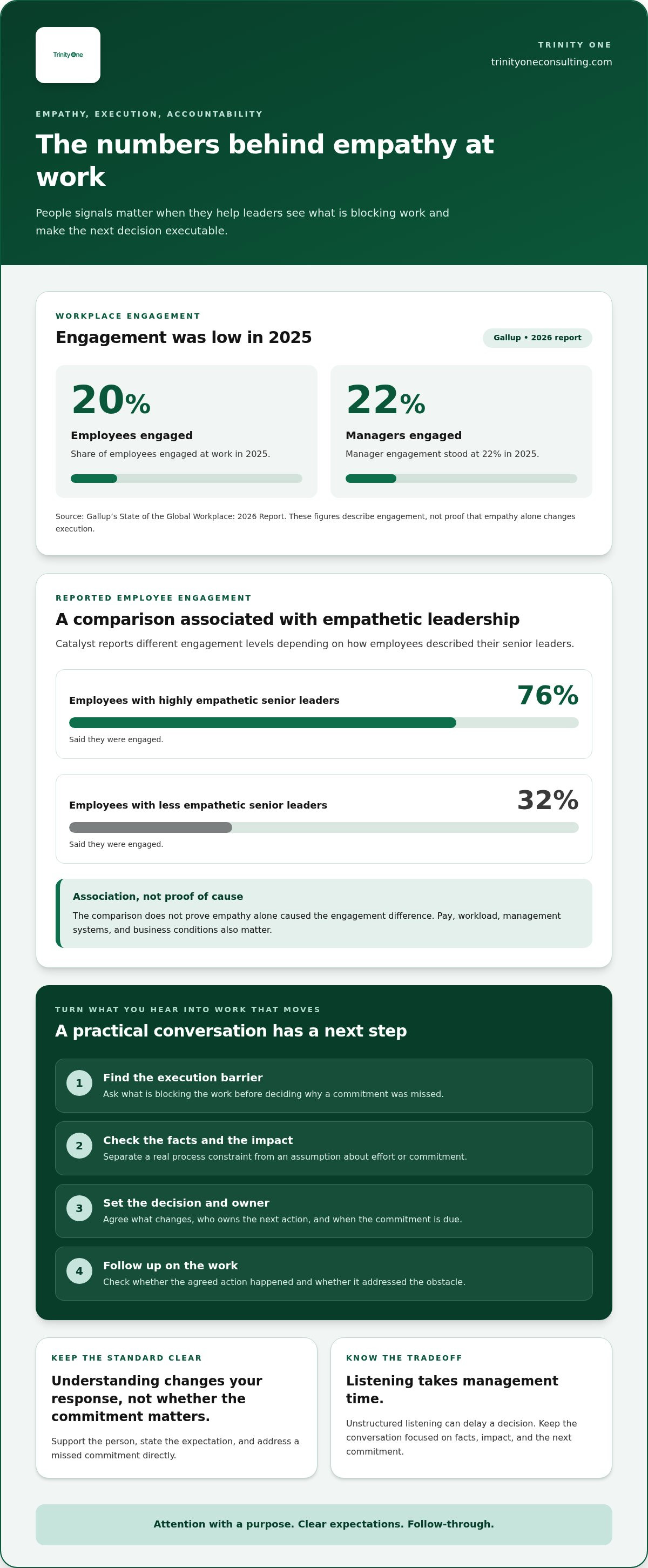
The pressure is real. Gallup’s State of the Global Workplace: 2026 Report says 20% of employees were engaged at work in 2025, while manager engagement stood at 22%. Those figures don’t prove empathy alone fixes execution, but they make it hard to ignore the conditions managers are working in.
You need a practical way to connect what employees tell you to what gets done. Listen for a specific execution barrier, then check whether the agreed next step happens. Listening takes time, and unstructured listening can delay a decision. The value comes from attention with a purpose, followed by clear expectations and follow-through.
Key Takeaways
- The business case for empathy in leadership is practical: understanding an employee’s perspective can reveal what’s blocking work and help you choose a clear next action.
- Ask curious, specific questions before treating missed commitments as a lack of commitment. The answer may point to a work constraint you can address.
- Keep standards, support, and consequences explicit. Empathy supports accountability, while avoidance and inconsistent enforcement leave expectations unclear.
- Start with one recurring conversation, such as a one-on-one. Agree on an action and follow up to see whether it changed the work.
- Give people concerns a regular place in your operating cadence, with clear ownership and follow-through tied to priorities.
What is the business case for empathy in leadership?
The business case for empathy in leadership is that understanding what employees are experiencing can help you make better decisions about work, support, and accountability. You get a clearer view of what is blocking execution before you decide how to respond. That can improve communication and help people meet expectations, but it doesn’t guarantee better performance.
Leadership empathy is the practice of understanding another person’s perspective while retaining responsibility for decisions and results.
Empathy is not agreement, sympathy, leniency, or conflict avoidance. You can recognize that a deadline collided with an employee’s unexpected workload and still hold them responsible for raising the risk earlier. The information changes how you address the problem, not whether the commitment matters.
How is empathy different from agreement or leniency?
Understanding an employee’s perspective doesn’t mean approving every request or removing every consequence. It means hearing the facts before drawing a conclusion. The idea of compassionate leadership is related, but empathy in a management conversation still requires a clear decision about the work.
Say an employee misses a report deadline. Don’t assume they’re careless, and don’t excuse the missed commitment without discussion. Ask what prevented delivery, clarify when the risk became visible, then agree on a correction and a check-in. “I understand the workload changed. I still need you to flag a missed deadline before it passes.” That’s an acknowledgment and an expectation in the same conversation.
The tradeoff is time. Asking before judging can add minutes to a difficult conversation, and empathy without a decision can leave the employee unsure what happens next. Keep the exchange focused on facts, impact, and the next commitment.
Which business outcomes can empathetic leadership affect?
Empathy can support clearer communication when employees feel able to raise a problem early. That information may help a manager adjust ownership or priorities before a delay affects other work. It can also support engagement and retention when people experience fair treatment and consistent follow-through. Those are possible pathways, not guaranteed outcomes. Pay, workload, management systems, and business conditions also matter.
Catalyst reports that 76% of employees with highly empathetic senior leaders said they were engaged, compared with 32% of those with less empathetic leaders. This is an association, not proof that empathy alone caused the difference. Still, it points to a useful leadership question: do people have a safe, direct way to raise the information your team needs to execute?
In my experience, empathy becomes operational when a leader turns what they hear into a specific action, owner, and follow-up. A supportive conversation that changes no decision or behavior can feel hollow. People development and execution have to connect.
How can empathy change the way a leadership team operates?
Empathy changes team operations when leaders use what they hear to identify a work constraint, understand its impact, and agree on a response. Accurate people signals help leaders make sound execution decisions by showing where work is actually getting stuck.
That’s a practical part of the business case for empathy in leadership. A missed handoff may look like low commitment from the outside. Curiosity gives you a chance to check the facts before you change someone’s workload or label the problem.
What changes when leaders listen before prescribing a fix?
Suppose a manager sees that a project coordinator is late sending weekly delivery updates. The quick fix might be to add a daily check-in or move the updates to another employee. Before changing the process, ask the coordinator to walk through how the information gets collected and where it stalls.
The answer might reveal that updates arrive from several teams in different formats, leaving the coordinator to reconcile conflicting details. That points to a process obstacle worth addressing. It doesn’t establish that every late update has the same cause, or remove the coordinator’s responsibility to flag delays.
Listening costs management time. A careful conversation can take longer than issuing an instruction, and the employee may still disagree with the final decision. The goal isn’t agreement at any price. It’s enough accurate context to make a sound call and explain it clearly.
How does empathy support clear decisions and follow-through?
After hearing the concern, reflect the issue in plain language: “The updates are arriving in different formats, so the report takes longer to assemble.” Then state the decision and what changes. For example, ask the contributing teams to use one agreed format while keeping the coordinator accountable for sending the report by its deadline.
Make the next step visible. Name who owns it and set a date for checking whether the agreed format is being used. Bring that check into a team meeting already on the calendar, rather than creating a new meeting for every concern. Listening becomes a management practice when people see that what they raise leads to a decision and a follow-up.
If the report is still late after the process change, return to the facts. The obstacle may not explain the whole performance issue. A leader can recognize the effort to fix the handoff and still address the missed commitment directly.
This is how empathy affects a leadership team’s operating habits. People get a fair hearing, decisions remain with the leader, and agreed actions have an owner and a place in the team’s regular review. Without that follow-through, listening can become another conversation that leaves the work unchanged.
Does empathy in leadership mean lowering performance standards?
No. The business case for empathy in leadership depends on keeping expectations firm while understanding what affected the work. Empathy can change how you respond, but the standard, owner, and consequence still need to be explicit.
Empathetic accountability means naming the work standard, hearing the employee’s perspective, and agreeing on a respectful, specific response.
Start with what you can observe. “The handoff was due Tuesday, and I received it Thursday” describes behavior. “You don’t care about the team” guesses at character. That guess can put someone on the defensive without helping you understand what happened or what must change.
How can a leader address a missed commitment with empathy?
Name the commitment and its effect, then ask what affected delivery. For example: “The client handoff was due Tuesday, and the next person couldn’t start until Thursday. What got in the way?” Listen for relevant context, but don’t let context erase the impact or the original agreement.
Agree on a corrective action with a named owner and a follow-up point. If the employee owns the next handoff, make that explicit and set when you’ll check progress. Repeated misses can force colleagues to absorb unfinished work and make planning less reliable. Responding without context carries a different cost: you may address the wrong cause and damage trust without fixing the work.
When can empathy become avoidance?
Empathy has become avoidance when you keep delaying feedback, make exceptions without explaining why, or leave ownership vague because a direct conversation feels uncomfortable. Short-term comfort can create unfairness. Teammates who meet the same standard may end up carrying extra work while one person’s missed commitments go unaddressed.
Consequences should relate to the work and be applied consistently. If the commitment is missed again, discuss the pattern and the impact, then state what happens next under your team’s expectations. Don’t turn a performance conversation into a judgment about someone’s character.
| Leadership response | What the employee hears |
|---|---|
| Empathetic accountability | “I’ll hear the context, and the expectation still stands.” |
| Avoidance | “We won’t discuss the miss, so nothing needs to change.” |
| Blame | “I’ve decided what your behavior says about you.” |
| Inconsistent enforcement | “The standard depends on who misses it.” |
Keep a brief record of the commitment, the agreed response, and the follow-up. That makes it easier to distinguish a one-time disruption from a recurring performance issue, and to apply the same expectations across the team. Clear notes take a little time, but they reduce the risk that accountability depends on memory or personal preference.
How can leaders put empathy into practice and assess its effects?
The business case for empathy in leadership becomes practical when you make it a repeatable management behavior, then look for changes in the work. Start with one recurring interaction, such as a one-on-one or a performance conversation. Don’t roll out a new process across the team before you know what you want to learn.
Use the same sequence when a concern surfaces:
- Notice a specific change in behavior or work, such as a missed handoff.
- Ask an open question before deciding what caused it.
- Reflect the employee’s concern in your own words and check that you understood.
- Agree on action with a clear owner and expected result.
- Follow up at an agreed point to see what changed.
The sequence keeps the conversation grounded. It also gives you a way to respond without treating empathy as an unstructured discussion with no decision attached.
What can leaders say and do in a difficult conversation?
Use a prompt tied to observable work: “I noticed the last two handoffs arrived after the agreed time. What’s affecting the timing?” Avoid questions that assume a cause, such as “Why aren’t you prioritizing this?” Before deciding, reflect what you heard: “You’re waiting on approvals, and that leaves little time to prepare the handoff.”
Then state your decision and set the next step: “Please flag approval delays as soon as they put the due date at risk. You own the next handoff, due Friday, and we’ll review it at our one-on-one the following week.” This gives the employee room to explain and leaves no doubt about the expectation.
How can a team assess whether the practice is working?
Start with a baseline from information you already have. Review existing employee feedback, recurring blockers, and which commitments were completed or missed. Choose a consistent period for comparing patterns, and keep the review focused on the interaction or issue you’re addressing.
Over time, look for signals such as whether the same blocker keeps returning, whether risks are raised earlier, and whether agreed commitments are followed through. Ask employees for direct feedback about whether conversations help clarify expectations and next steps. These indicators can show patterns. They can’t prove that empathy alone caused a change in execution, since priorities, workload, and other management decisions also affect results.
Frequent check-ins take time away from other work, so add follow-up to an existing one-on-one or team meeting where possible. Tracking concerns without acting on them has a cost too. It teaches people that speaking up changes nothing. Record the decision, owner, and follow-up point, then close the loop, even when the answer is that the plan will stay as it is.
How can empathy become part of the operating cadence?
The business case for empathy in leadership gets stronger when people concerns have a regular place in the way you run the company. Use existing meetings and follow-up routines to connect what employees are experiencing with priorities, ownership, and work in progress. A concern that stays outside the operating rhythm is easy to hear once and forget.
Give recurring leadership meetings a brief, consistent check on people-related barriers: what’s affecting execution, who owns the response, and when the team will review it. Keep personal details private. Bring forward only the work issue and the action needed. The tradeoff is that adding discussion takes meeting time, so keep the conversation tied to a decision or a clear next step.
How can leaders connect employee goals with company execution?
Ask employees what they want to develop, then discuss where those goals may fit with the company’s current work. You can support an individual goal without promising it will become a business priority. Be clear about what the company can support now, what may need to wait, and who will revisit the conversation.
Structured coaching frameworks include twelve dream categories and offer a reliable way to discuss individual goals. A dedicated company program can give those conversations a defined place alongside work priorities. The Dream Manager program connects attention to personal development with the broader work of helping people grow.
What does an integrated people and operations rhythm look like?
In a leadership meeting, connect an engagement observation to an operating priority. If a team is reporting difficulty with a handoff, clarify which work is affected, who owns the fix, and when progress will be reviewed. That keeps employee feedback connected to execution without turning an operations meeting into a private personnel discussion.
Trinity One provides an operating cadence, AI coaching, and real-time visibility into execution and engagement. Those elements can help leaders keep work status and people signals in view together. Visibility supports decisions, but it doesn’t replace a manager’s responsibility to hear context and set expectations.
When operating priorities lack clear ownership, an employee concern can be acknowledged without anyone being responsible for addressing its effect on the work. Fractional COO or Integrator work connects leadership decisions with operational ownership, so actions have a clear place in the company’s execution rhythm.
I believe a company can only become the best version of itself to the extent its people are becoming better versions of themselves. That requires a cadence where development conversations and business commitments both receive attention, with honest limits on what the company can take on.
Book a conversation with Kevin about your operating cadence
Make empathy part of the decisions people experience
The business case for empathy in leadership shows up in the everyday choices your employees can see: how you respond when priorities collide, how you explain a decision that affects someone’s work, and whether you honor commitments you’ve made to your team.
Pick one leadership interaction where trust or execution keeps getting strained. Decide what a better conversation would look like, then pay attention to how people respond and what happens to the work. Don’t expect one change to fix every obstacle. Keep adjusting based on what employees tell you and what your team can actually deliver.
That work takes patience. It also asks you to stay clear about priorities, even when you understand why someone wants a different outcome. The aim is a workplace where people can speak honestly and still know what the business needs from them.
Better leadership starts with a conversation people can trust, followed by action they can count on.
Frequently Asked Questions
Can empathy and accountability coexist in leadership?
Yes. Accountability sets the expected result, while empathy helps you understand what may affect an employee’s ability to deliver it. If a forecast is late because a data source changed, you can address the reporting process and keep the submission expectation clear. If the delay had another cause, respond to that evidence instead. The business case for empathy in leadership rests on better-informed decisions, not automatic exceptions.
Is empathy in leadership a skill that can be learned?
Yes. Leaders can practice noticing when they’re making assumptions, asking for the employee’s view, and checking whether they understood it accurately. After a conversation, write down what you observed separately from what you inferred. For example, “didn’t speak during the review” is observable. “Doesn’t care about the project” is an interpretation. That distinction helps you respond to evidence rather than habit. For founders and executives who want tailored support in strengthening these skills, discover Steven Stephania to explore integrative coaching for leaders.
How can a leader show empathy while delivering difficult news?
Be direct about the decision, then make room for the employee’s reaction. If a project has been paused, explain what has changed and what that means for the person’s current assignment. Don’t imply that a decision is open for negotiation if it isn’t. Ask what information they need to plan their next steps, and agree on who will communicate any changes to their responsibilities.
What should a leader do when an employee does not want to discuss a concern?
Respect the employee’s choice not to discuss personal details. Explain what information you do need to make a work decision, such as whether a deadline remains realistic or a handoff needs to change. Offer another time or a different format for the conversation. If they still decline, make the decision using the information available and state what work expectation remains in place.
Can empathy in leadership create bias in workplace decisions?
It can, especially if a leader gives more flexibility to employees they find relatable or who explain their needs confidently. Use the same job-related criteria when considering schedule changes, support, or performance concerns. Record the work facts and the reason for each decision. Then compare similar cases across the team. A consistent process makes it easier to notice when personal affinity is influencing your judgment.
How should leaders adapt empathetic communication for remote teams?
Don’t treat a short message, delayed reply, or quiet video call as proof of attitude. In remote work, you see fewer cues and can miss context. Ask which communication format works for a sensitive conversation, then speak privately rather than raising the issue in a group chat. Afterward, send a brief written note capturing the decision and any work change, so both people have the same record.
Does an empathetic leader need to agree with an employee’s perspective?
No. You can show that you’ve understood the employee’s reasoning while still making a different decision. Be precise: “I understand why you’re asking to move the deadline. I’m keeping Friday’s date because the next team depends on that handoff.” This separates acknowledgment from agreement. It also gives the employee a clear explanation instead of leaving them to guess whether their concern was heard.