
A team can meet its targets while people quietly sit on a warning that could derail the next one. Psychological safety grows when leaders respond to bad news with curiosity, make ownership clear, and keep the conversation focused on what needs to happen next. You can make candor part of the operating rhythm, not a slogan on a wall.
You already know silence has a cost. A missed handoff or unreported mistake gets harder to fix the longer it stays hidden. But openness without clear expectations can leave people unsure who owns the repair, and a defensive response can teach the room to stay quiet.
I’ve spent more than 30 years in operations, and I’ve seen how daily habits shape performance. Start with your response when someone challenges a decision or admits an error. Try, “What did we miss, and who owns the next step?” Then use meeting routines that make it normal to raise risks early, while keeping commitments visible and specific. The standard stays high. The conversation gets more honest.
Key Takeaways
- Psychological safety lets people raise work concerns without interpersonal punishment, while performance expectations stay clear.
- Learn how to foster psychological safety at work by naming uncertainty and inviting a specific alternative view.
- Separate blame from avoidance and direct accountability, so people know who owns the next step.
- Use meeting routines that invite risks and dissent before decisions are final, without putting quieter employees on the spot.
- Turn one team behavior into a repeatable habit by assigning an owner, practicing it, and reviewing what changes.
What does psychological safety at work look like in practice?
Psychological safety at work is the shared sense that people can raise work-related concerns, ask questions, or admit mistakes without being punished or humiliated for speaking up. The standard for the work remains. The risk of honest conversation gets lower.
That distinction matters if you’re figuring out how to foster psychological safety at work. Employees need room to point out a weak assumption, and they still need to meet clear expectations. A team can disagree respectfully, make a decision, and hold each person to the commitment that follows.
The term is commonly associated with organizational research on speaking up and interpersonal risk. For background on the concept, see What is psychological safety?
How is psychological safety different from being nice?
Being nice can mean keeping the conversation pleasant. Psychological safety means people can say what the work needs, even when it makes the room uncomfortable. Avoiding necessary feedback may spare a difficult moment, but it leaves an employee guessing about the gap between their work and the expected standard.
Consider a manager reviewing a project plan. An employee says, “I think this deadline assumes the vendor will deliver before we’ve confirmed the date.” The manager can respond, “Good catch. Show me the dependency,” then decide whether to change the plan. If the date stays, the manager names who owns the next check and when it’s due. The challenge was welcome. The decision and responsibility are still clear.
That response may take a few extra minutes and could reopen a decision the manager thought was settled. The tradeoff is useful when it surfaces a real risk. It’s less useful when every preference becomes a reason to restart the discussion, so the manager should distinguish new evidence from a simple difference in taste.
What does low psychological safety look like at work?
Watch ordinary meetings, not just formal surveys. A team reviews a project handoff. Everyone agrees to the date, but one employee knows a required file is incomplete and says nothing. Another has made the same error before but waits to see whether anyone notices. The meeting sounds aligned. The work may not be.
That silence doesn’t prove employees lack commitment. They may have learned that questions are treated as delays, mistakes trigger public blame, or disagreement is remembered during later decisions. The useful diagnostic is the leader’s response and the conditions around the conversation, not a quick label for the people in it.
Look for repeated signals: risks arrive only after a deadline slips, questions move to private messages after the meeting, or employees agree in the room and raise objections once the decision is harder to change. Each signal points to a gap between what the team says it welcomes and what people experience when they speak.
Start by examining one recent moment when someone raised a concern. What did you say next? That response is part of the working conditions your team uses to decide whether the next concern belongs in the room.
How to foster psychological safety at work through daily leadership behavior?
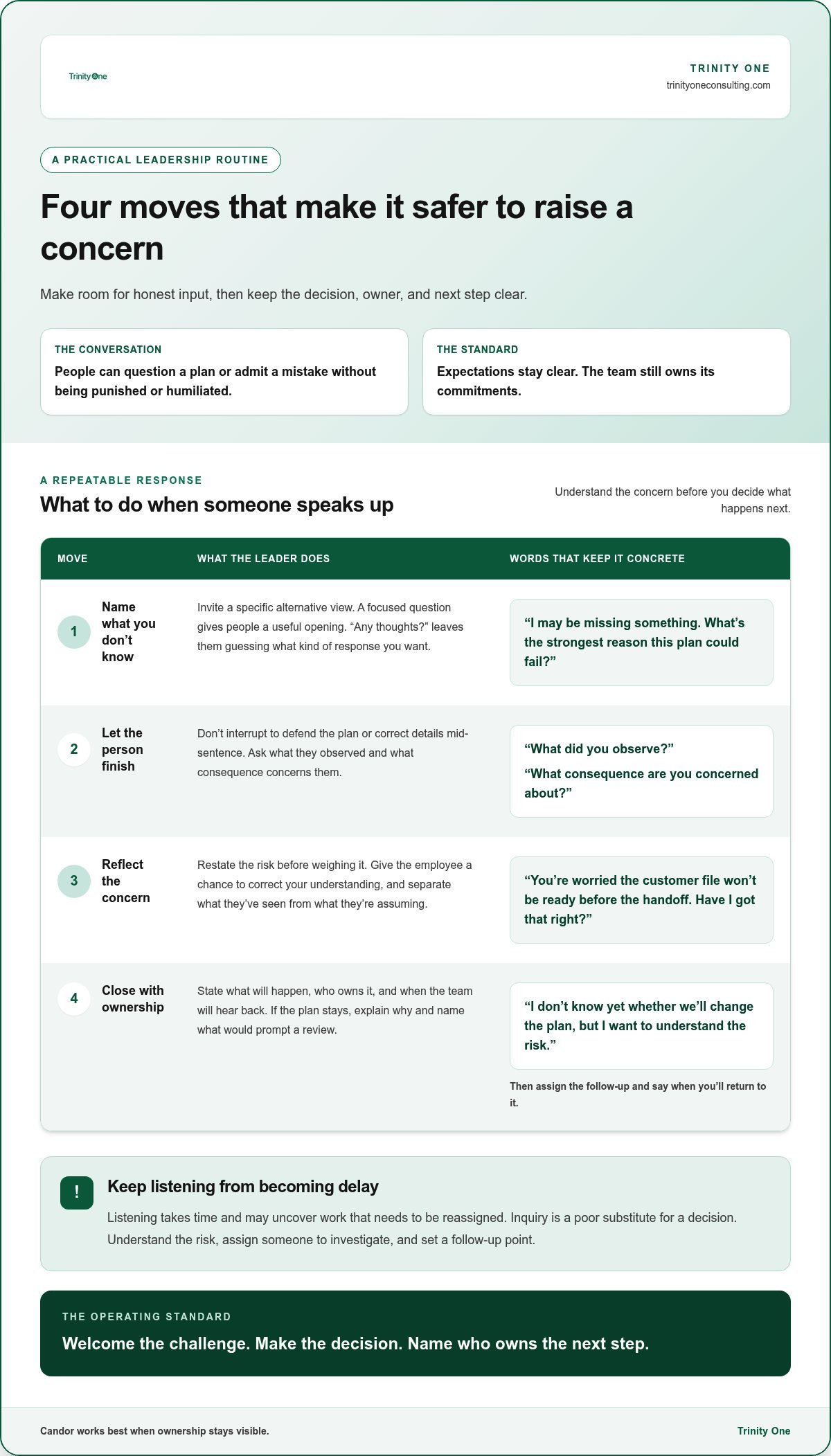
People watch what a leader does after someone raises a concern. In regular conversations, start by naming uncertainty or inviting a specific alternative, then listen without preparing your rebuttal. The point is to understand the issue before deciding what happens next.
- Name what you don’t know. Say, “I may be missing something. What’s the strongest reason this plan could fail?” A specific invitation gives people a useful opening. “Any thoughts?” often puts the burden on employees to guess what kind of response you want.
- Let the person finish. Don’t interrupt to explain the plan or correct details mid-sentence. Take a note if needed, then ask, “What did you observe?” and “What consequence are you concerned about?” Those questions separate direct evidence from assumptions without dismissing either.
- Reflect the concern before weighing it. Try, “You’re worried the customer file won’t be ready before the handoff. Have I got that right?” A clear reflection gives the employee a chance to correct your understanding. It also slows down the impulse to defend a decision before you know what is being challenged.
- Close with an owner and a next step. State what will happen, who owns it, and when the team will hear back. If you’re keeping the original plan, say why and name the condition that would prompt a review. Don’t leave an employee carrying an open concern with no path to resolution.
A leader’s response to one concern shapes whether people bring forward the next one.
What should a manager do when someone raises a concern?
Acknowledge the information without promising a result: “Thanks for raising this. I don’t know yet whether we’ll change the plan, but I want to understand the risk.” Then ask what the employee has seen and what outcome they’re trying to prevent. Close by naming who will investigate and when you’ll return to the issue. Listening takes time, and it can uncover work that needs to be reassigned. It’s a poor substitute for a decision, so don’t let inquiry become delay.
How can leaders respond when they do not know the answer?
Say it plainly: “I don’t know yet.” Bluffing may protect your authority for a moment, but it leaves the team acting on a guess. Separate what’s known from what still needs checking, then assign someone to find the answer and set a follow-up point. The person who raised the issue should know what happens next, even if the answer isn’t ready during the conversation.
A polished response can sound reassuring and still lead nowhere. Follow-through gives the team something firmer: a named owner, a clear next step, and an answer when promised. If the investigation takes longer, tell the employee before the agreed check-in passes.
Can psychological safety coexist with high standards and accountability?
Yes. Psychological safety makes it possible to raise a concern or admit a mistake. Accountability makes clear what was agreed, who owns the work, and what outcome is expected. You need both. Without candor, a problem can stay hidden. Without clear commitments, a discussion can end without anyone responsible for the next step.
That doesn’t mean psychological safety automatically improves performance. It gives people room to share information and challenge assumptions. Leaders still need to assess the work, make decisions, and address missed commitments. The practical test is whether you can question the result without attacking the person who produced it.
Use this comparison to check what your response communicates:
| Response | What the leader says or does | Likely effect on the conversation |
|---|---|---|
| Blame | “You clearly didn’t care enough to get this right.” | Turns a work gap into a judgment about motive. The employee may focus on defending themselves instead of explaining what happened. |
| Avoidance | “Let’s move on. We’re all doing our best.” | Protects the moment from discomfort, but leaves the expectation and the shortfall unclear. |
| Direct accountability with respect | “The report was due Tuesday, and it arrived Thursday without the final figures. What blocked delivery?” | Names the observable gap, asks for relevant context, and keeps attention on ownership and the next commitment. |
How do you hold someone accountable without shutting them down?
Describe the work and the agreed standard, not your theory about the person’s character. “We agreed the client file would be checked before it went out. The pricing page still had the old rate” is specific. “You’re careless” is an assumption, and it gives the employee little useful information to act on.
Then ask what blocked delivery. Listen for a process issue, a competing priority, or a mistake the employee needs to own. Agree on who will correct the file and how you’ll check that the next version meets the standard. The conversation may take longer than a reprimand. A reprimand is faster, but it’s poor at finding the cause of a repeated miss.
What should a team do when disagreement remains unresolved?
Don’t force agreement just to end the discussion. Name the decision owner and the deadline for the call. Record the strongest unresolved concern in the decision notes, so the team can act without treating dissent as disloyalty.
Set a review point tied to relevant results. For example, if a team chooses a new handoff process despite a concern about missing information, agree which handoff records will show whether the concern was valid. This keeps the decision moving while preserving a way to learn from the outcome.
Leaders asking how to foster psychological safety at work should keep this distinction in view: respect shapes how you address people, while accountability keeps the work and commitments visible. For more insights on intentional leadership and personal growth, check out David James Rhodes.
What team routines make it easier to speak up consistently?
Good intentions don’t carry a concern into the room. A repeatable meeting routine does. Before a decision becomes final, give each work owner a quiet moment to identify a risk or assumption, then make space to discuss what could change the plan.
How can a meeting invite honest input?
Try this sequence before you close a decision:
- Ask for a work-specific risk. Say, “What’s one assumption affecting your part of this plan?” A focused prompt is easier to answer than “Any concerns?” because it points people toward the work, not toward guessing what the leader wants to hear.
- Give people a moment to write. Ask everyone to note a concern before open discussion begins. This can give quieter participants time to form a clear point without requiring them to disclose personal feelings in front of the group. Written input takes meeting time and may not capture tone or context, so follow up where a note needs clarification.
- Record the concern and the decision. Note what was raised, what the team decided, and whether any action changed. If the decision stands, record that too. The notes make it possible to see whether input affected the plan, rather than leaving employees to wonder if anyone heard them.
Keep the loop short after the meeting: the person raising an issue can clarify it, an owner takes the next action, and that owner reports back at the agreed point. If the issue needs no change, close the loop by saying why. Without that return, asking for input can feel like collecting feedback for its own sake.
How can leaders tell whether people feel safe to speak?
Use the same direct prompts over time. Ask, “What concern did you hold back this week?” or “What happens here when someone brings bad news?” Don’t treat one answer as a verdict. Look for patterns and respond to what people describe.
Compare what employees raise privately with what appears in team discussions. If risks regularly surface one-on-one but not in the meeting, that gap is worth examining. It could reflect the meeting format, the decision at hand, or a past response that made speaking up feel costly. Participation patterns are signals to investigate, not proof of one cause.
A pulse survey can help track how people describe their experience, but a score alone can’t explain why someone stayed quiet or whether a specific leader response changed the room. Pair recurring questions with examples of what happened after concerns were raised. Keep responses confidential where appropriate, and don’t promise anonymity unless the process can protect it.
To put how to foster psychological safety at work into practice, pick one meeting where decisions carry real consequences, use the same prompt each time, and review whether concerns receive a clear response. The routine may add a few minutes. It won’t replace sound judgment, but it can expose assumptions before the team commits to them.
How can leaders turn psychological safety into a durable operating habit?
A team habit lasts when someone owns it, the team practices it, and leaders check whether it’s happening. To decide how to foster psychological safety at work, choose one visible behavior first. For example, a manager can pause before closing a decision and ask whose concern hasn’t been heard. Don’t launch several new practices at once. That can add meeting work without showing the team which behavior matters most.
- Choose one behavior. Make it specific enough that employees can recognize it, such as “I’ll ask for a dissenting view before I confirm a decision.”
- Assign an owner. A named leader is responsible for keeping the behavior on the agenda and noticing when it slips. Shared responsibility can sound fair, but it often leaves nobody accountable for the follow-through.
- Practice it in the regular meeting. Use the same prompt and give people time to answer. Repetition makes the action visible, though it can feel scripted at first. Adjust the wording if it stops producing useful discussion.
- Review what happened. At a recurring check-in, ask whether concerns received a response and what the team changed as a result. If the decision stayed the same, explain why. Silence after a concern can make the invitation feel performative.
How do you make the change visible to the team?
Tell the team what they should expect from you: “Before I close a decision, I’ll ask what assumption could be wrong.” Then return to that commitment at a regular team review. Use a brief record of the concern, the decision, and any action taken, so employees can see whether their input affected the work. If nothing changed, state the reason plainly.
Keep the review focused on leader behavior, not on whether employees appear confident or speak often. A quiet meeting doesn’t prove people feel unsafe, and a busy discussion doesn’t prove they do. Ask what happened after the last concern was raised, then make one practical adjustment if the response fell short.
Where does individual development fit into team safety?
People bring different goals, pressures, and responsibilities to work. Understanding what matters to an employee can help a manager ask more relevant questions and offer feedback that connects to that person’s growth, rather than treating every conversation as a task correction. Keep that discussion respectful and voluntary. Personal development takes attention and time, and it can’t replace clear work expectations.
Structured individual development programs offer a reliable approach to personal growth. A focus on employee aspirations helps managers support long-term success. In my view, employee development belongs alongside operating practices because a company’s performance can grow only as its people grow. Trinity One Dream Manager coaching provides a proven structure for conversations about individual goals and personal achievement.
Put the practice on the team’s operating calendar and review it alongside the work itself. If leaders make room for honest input but never examine whether employees are developing, the routine can become another meeting task. Keep both in view, the quality of the work and the growth of the people doing it.
How can you make candor part of the way your team works?
Pick one leadership behavior and make it visible in the next team conversation. Then keep practicing it. Knowing how to foster psychological safety at work matters less than what employees experience when they bring you a concern, question a decision, or admit a mistake.
Give the team a clear way to see whether the behavior is taking hold. When someone raises an issue, make sure the response is respectful and the next step is clear. When their input doesn’t change the decision, explain why. Trust grows through what leaders consistently do, not through a statement of intent. Over time, that lived culture also becomes a foundation for attracting and engaging talent, an area where employer brand specialists like GBS Worldwide help organizations align internal employee experience with their broader recruitment strategy.
I believe a company can only become its best version as its people grow. That takes attention to both how work gets done and how people are treated while doing it. Start with one conversation, and build from what your team learns.
Frequently Asked Questions
Is psychological safety the same as trust at work?
No. Trust usually describes confidence in a person’s reliability or intentions, while psychological safety describes whether people expect they can take interpersonal risks within a team. You might trust a colleague to finish a task but still hesitate to tell them their plan has a flaw. Both matter. A useful check is whether team members can disagree with one another without turning the disagreement into a judgment of character.
Can psychological safety improve in a remote or hybrid team?
Yes. Remote and hybrid teams can make speaking up easier by offering more than one way to contribute. For example, share the decision question before a video meeting and let people add comments in a shared document. Set clear expectations for responding to those comments. Written channels can give people time to think, but they can also miss tone, so discuss ambiguous points directly rather than guessing what someone meant.
What should a leader do after dismissing an employee concern?
Revisit it directly. A leader might say, “I cut you off earlier, and I want to understand the point I missed.” Then give the employee space to explain without making them prove the concern was worth raising. If the concern changes the decision, explain what changed. If it doesn’t, explain the reasoning. A repair matters, but the leader also needs to notice what triggered the dismissive response and handle that moment differently next time.
How can an employee raise a concern when their manager is part of the problem?
If speaking directly to the manager feels unsafe or unproductive, an employee can look for another appropriate person in the organization, such as a senior leader they trust. Keep a factual record of work-related events, including dates, decisions, and their impact, without adding guesses about motive. The safest route depends on the situation and the organization. A concern about immediate harm may call for a different response than a disagreement about how a project is run.
Does psychological safety mean employees should never feel uncomfortable?
No. A candid performance conversation can feel uncomfortable and still be respectful. The useful distinction is whether discomfort comes from facing clear feedback or from being shamed, threatened, or mocked. For example, an employee may feel challenged when a manager asks them to explain a missed deadline and agree on a recovery plan. That’s different from being criticized in front of colleagues without a chance to explain what happened.
How long does it take to build psychological safety at work?
There isn’t a reliable fixed timeline. People judge the environment through repeated interactions, especially what happens after someone questions a decision or reports a mistake. If you’re working out how to foster psychological safety at work, choose a behavior you can repeat and watch for signs that concerns surface earlier or receive clearer follow-up. A single good meeting won’t settle the question. Consistency over time matters, particularly when pressure rises.