
You're likely paying a hidden "bottleneck tax" every time a decision stalls on your desk for three days. Measuring the ROI of a fractional COO starts with identifying this quiet drain on your capital. It's the cost of growth initiatives that never leave the whiteboard because you're too busy putting out fires.
I know the feeling of being trapped in your own engine. You built this company to create freedom, but now you're the only one who can find the keys. It's exhausting. Every employee needs to talk to you before they can do their job.
I believe we're called to lead people, not manage chaos. You'll learn how to calculate the exact financial impact of a fractional integrator through recovered time and execution speed. We'll also look at how these changes affect employee performance. This calculation relies on hard numbers instead of vague metrics.
We'll look at how getting 15 hours back per week changes your bottom line. I'll show you the math behind execution speed and why your profit increases when you finally stop attending every single meeting.
Key Takeaways
- Calculate the hard math of measuring the ROI of a fractional COO by comparing a $300,000 full-time executive salary to a more efficient fractional retainer.
- Assign a specific dollar value to the 15 hours you get back each week to see the impact of moving from administrative tasks to high-level strategy.
- Protect your bottom line using the Dream Manager methodology by Matthew Kelly to reduce the expensive cycle of hiring and training new staff.
- Increase execution speed through an AI-native operating cadence that provides real-time visibility into every corner of your business.
- Follow a 90-day integration roadmap that starts with a systems audit and ends with an expert running your daily huddles.
How do you start measuring the ROI of a fractional COO?
Measuring the ROI of a fractional COO starts with a spreadsheet, but it ends with your sanity. You have to look at the cold, hard numbers before you look at the strategy. Most founders wait until their hair is on fire to hire help. They look at the Chief Operating Officer role and assume they need a full-time body in a chair.
That is often a $300,000 mistake. You aren't just paying a salary. You're buying a person's entire professional life, which comes with a heavy price tag. If your systems are still broken, a high-priced hire will just manage the mess at a higher cost.
The direct cost comparison of executive leadership
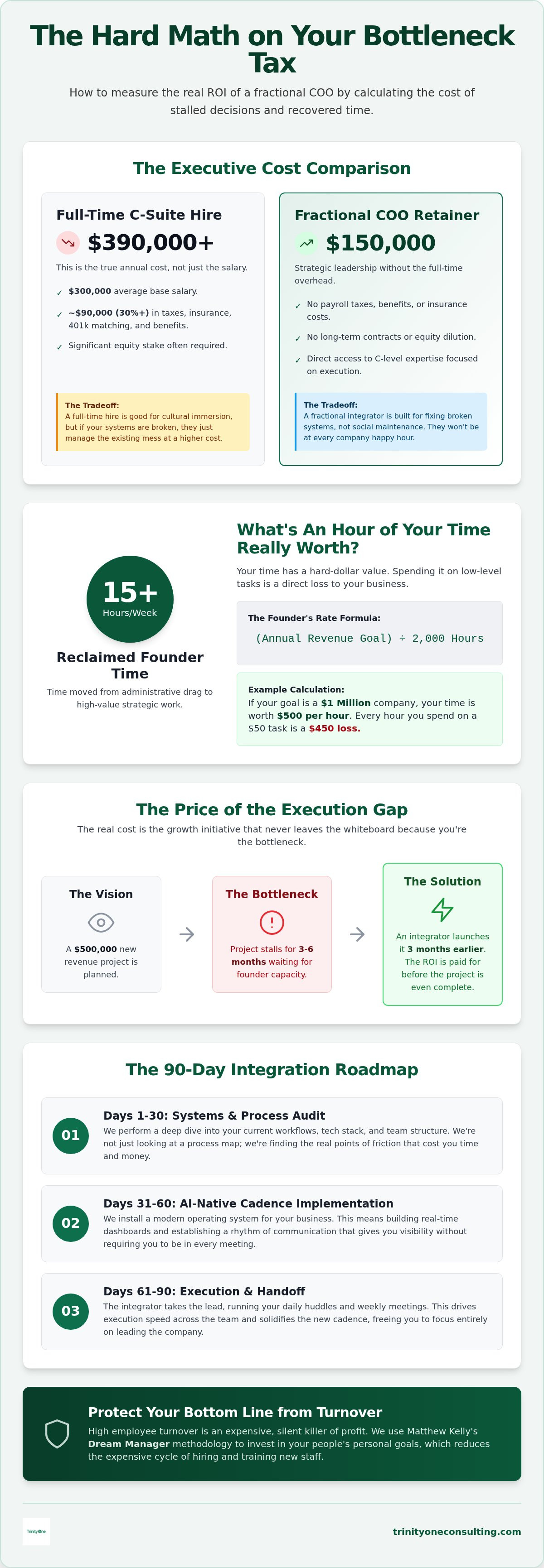
A full-time C-level executive is an expensive engine to maintain. You aren't just paying a $300,000 salary. You're paying for payroll taxes, health insurance, 401k matching, and often a significant equity stake. These hidden costs can bloat the true expense of a full-time hire by 30 percent or more.
Compare that to a fractional COO retainer that might total $150,000 for the year. You get the same level of strategic architecture without the permanent overhead. There is a clear tradeoff here. A fractional integrator is bad at long-term cultural immersion. They won't be at every happy hour or birthday lunch. They are built for fixing broken circuits and aligning execution, not for social maintenance.
Calculating the price of an execution gap
The real cost of a missing integrator isn't on the balance sheet. It's the $500,000 revenue initiative that has been sitting on your desk for six months. You're the bottleneck in your own business. If you're stuck in 25 hours of meetings every week, your company is suffering from operational drag.
This drag acts like a heavy brake on your growth engine. Think about the projects you haven't started because you don't have the capacity to manage them. An integrator closes the gap between your vision and the team's output. They turn the "what if" into a "how to" and then drive the team to finish the job.
If that $500,000 project launches three months earlier, the ROI is already paid for. You aren't just buying time. You're buying the speed of execution. I believe we're all meant to run toward a purpose, not just away from a crisis. That is the difference between a business that survives and a business that scales.
Is measuring the ROI of a fractional COO possible for founder time?
Measuring the ROI of a fractional COO is about more than just the money you save on a salary. You have to look at the value of your own calendar. Most founders I work with are exhausted because they are the only ones making decisions. If you're spending your day answering questions about software logins or project deadlines, you're losing money every single hour.
I've seen leaders get trapped in 25 hours of meetings every week. This is a massive drain on the company's potential. When you hire an integrator, you aren't just buying their time. You're buying your own freedom to focus on the vision that started the business in the first place.
Determining your effective hourly rate as a founder
Start with a simple math exercise. Take your annual revenue goal and divide it by 2,000 working hours to find your target value. If you want to build a $1 million company, your time is worth $500 an hour. Every minute you spend on a $50-an-hour task like basic scheduling or status updates is a $450 loss for your business.
This is why understanding the fractional COO role is vital for your growth. You're hiring someone to take those $50 tasks off your plate so you can stay in the $500 zone. I recommend tracking your time for one week before the hire to see exactly where your money is leaking out. You'll likely find 10 to 15 hours that could be handled by someone else.
The ROI of decision speed and clarity
How many projects are waiting for your "okay" right now? In most businesses, the CEO is the ultimate bottleneck. Decisions get stuck because you're in a meeting or on a plane. This delay has a real price tag. An integrator removes you from the "how" of the business so you can stay in the "why."
They own the execution while you own the direction. There is a specific tradeoff here that you must accept. You have to give up some control. You won't know every single detail of every single workflow anymore. If you're a micromanager, this will be a difficult transition. You're trading the comfort of knowing everything for the power of moving fast.
One hour spent closing a major partnership could bring in six figures. One hour spent in a status meeting just keeps the lights on. When you stop firefighting, your business finally starts to scale. If you're ready to see how your calendar could look without the clutter, schedule a time to talk through your current operations.
What is the financial impact of a Dream Manager program?
Measuring the ROI of a fractional COO requires looking at the people who turn the gears of your business. A machine is only as good as its parts. If your team is burned out or looking for the exit, your operating system will fail regardless of your software. I use the Dream Manager methodology created by Matthew Kelly to solve this human friction.
Kelly identifies twelve dream categories that cover everything from physical health to financial stability and character development. When an integrator focuses on these, they aren't just being nice. They are protecting your most expensive asset. This approach moves the needle on performance because it addresses the person behind the desk.
Reducing the cost of employee turnover
Replacing a mid-level manager often costs 1.5 times their annual salary. If a manager making $100,000 leaves, you just burned $150,000 in recruiting fees, training time, and lost productivity. A dream manager program stops this talent drain by proving you care about the person, not just the payroll entry.
Loyalty isn't bought with a bigger bonus or a ping-pong table. It's earned by helping people reach their own finish lines. When you invest in their personal growth, they invest in your company's execution. This is a direct financial gain that shows up in your retention rates and hiring costs.
Aligning personal goals with company execution
Generic engagement surveys are a waste of your time and money. They provide data without connection. True performance jumps when an employee realizes their daily work is the vehicle to buy their first home or pay for their child's college. I've seen productivity spike simply because a technician finally had a clear plan to pay off their credit card debt.
The coaching process follows a human rhythm. We sit down. We talk about what matters at home. We connect those home wins to the work wins. It is simple, but it is effective. You don't need a complex psychological profile to see that happy, focused people do better work.
I believe we are called to serve the people who help us build our businesses. Work is a tool for personal fulfillment, not the other way around. A company only becomes the best version of itself to the extent its people are becoming better versions of themselves. This is the honest conviction that drives every meeting I lead.
How does an AI-native operating cadence increase execution speed?
Measuring the ROI of a fractional COO requires looking at the speed of your information. Most businesses operate on a 30-day lag. They wait for end-of-month reports to see what went wrong. I use the Trinity Cadence system to eliminate this delay by turning your operations into a real-time engine.
This is a machine for execution. It doesn't sleep and it doesn't forget. When you integrate AI into your daily rhythm, you stop guessing about project health. You start knowing. You can read more about how to measure the actual ROI of AI implementation in your business to see the specific data points we track.
Replacing manual status reports with real-time data
Manual status reports are a tax on your most talented people. Think about the hours your team spends typing updates into a spreadsheet for a weekly huddle. In a typical 20-person agency, this can eat up 40 hours of collective time every month. Trinity Cadence captures this data automatically from your existing tools.
It creates a unified rhythm for the entire organization. Every person knows exactly what they need to do by 9:00 AM. There is no confusion. There is no "I thought you were handling that" because the system shows the gaps in real time. This shift from guessing to knowing is where your profit margin hides.
The ROI of AI-driven operational coaching
AI tools can now coach your staff on meeting protocols and execution without needing a human manager to hover over them. This allows you to scale your operations without adding expensive middle management layers. You get the discipline of a corporate environment without the overhead of a corporate headcount. It's about building a business that runs on logic instead of just effort.
I will be blunt about the limitations. AI is bad at empathy. It cannot understand the psychological weight of a personal crisis or a creative block. However, it is great at enforcing a cadence. It provides a steady, reliable path forward by ensuring every meeting follows the same logic and every task has a clear owner.
What does a successful 90-day integrator onboarding look like?
A successful 90-day onboarding for a fractional integrator is a three-phase transition that moves you from bottleneck to visionary. Measuring the ROI of a fractional COO starts with identifying waste in the first 30 days and ends with a self-sustaining operating cadence. You'll see the full profit impact as task completion rates climb and your calendar clears. The results are visible if you know where to look.
I focus on a specific timeline to ensure the investment pays off quickly. We move from discovery to execution with a steady, controlled urgency. You'll see the friction points disappear as we replace chaos with a predictable cadence. This is a tested process, not a collection of theories.
The first 30 days: Identifying friction points
I start with a system audit that looks at your software stack and your meeting schedule. We don't look for abstract improvements. We look for specific waste. This includes things like duplicate software seats or hours spent on re-work because of bad project briefs.
I use a rapid launch sprint to find immediate wins. These wins put five to ten hours back on your calendar by the end of the first month. This is specific work. We fix the broken circuits that are draining your energy. We identify the two or three meetings that should have been emails and cut them immediately.
Days 61 to 90: Establishing the rhythm
By the 60-day mark, the integrator takes the wheel of your daily huddles. You are still in the room, but you aren't leading the charge. This transition is where many founders struggle. You have to let someone else run the play you called.
It requires a high level of trust and a commitment to the new system. You'll see task completion rates climb by 20 percent or more during this phase. Accountability becomes a part of the machine.
You aren't just reading about the fractional integrator engineering your business engine for 2026. You are seeing the results in your bank account because projects are finishing on time. The execution gap narrows as the team learns to trust the cadence.
By day 90, the investment starts paying for itself. You have 15 hours back each week. Your team has a clear cadence. The execution gap is closing because the machine is finally aligned. I believe every leader is a steward of the lives in their care, and a healthy business is the best way to honor that responsibility.
Your path to a self-sustaining business engine
Measuring the ROI of a fractional COO requires looking at the clock and the balance sheet simultaneously. You've seen how recovering 15 hours a week allows you to move from tactical fires to strategic growth. This transition isn't an accident. It's the result of a precise cadence and a commitment to your people.
I combine the mechanical precision of our Trinity Cadence AI-native operating system with the human depth of Certified Dream Manager facilitation. One ensures your team knows what to do. The other ensures they actually want to do it. This dual approach eliminates the execution gap that keeps most founders stuck in the weeds.
You don't have to be the only one holding the keys to the engine. A business that runs without you is a business that's finally ready to scale. I believe your company's potential is only limited by the systems you're willing to build. It's time to stop managing chaos and start leading with clarity.
Your best season of leadership is still ahead of you. Let's get to work.
Frequently Asked Questions
Is measuring the ROI of a fractional COO possible for a company with under 20 employees?
Yes, it is very possible. Measuring the ROI of a fractional COO in a small shop is often easier because the bottlenecks are more obvious. If you have 12 employees and you are the only one who can sign off on a project, you are losing money every hour. I've seen founders recover 15 hours a week almost immediately by simply installing a better cadence.
How much does a fractional COO typically cost compared to a full-time hire in 2026?
A full-time COO can cost over $400,000 a year when you add up the salary, taxes, and benefits. A fractional engagement typically totals between $100,000 and $180,000 annually. You are getting the same level of leadership for about 60 percent less than a full-time hire. This allows you to deploy that saved capital into marketing or product development while still fixing your internal systems.
What is the most immediate sign that a fractional integrator is providing ROI?
The most immediate sign is the "founder's exhale." You'll notice decisions stop stalling on your desk and projects actually reach the finish line. When you stop attending every status meeting and firefighting every minor crisis, you have found your initial return. This recovered time is the primary lead indicator for the profit increases that follow. It means the systems are finally working without your constant manual input.
Can a fractional COO help me integrate AI tools like Trinity Cadence?
Yes, this is a core part of my methodology. Measuring the ROI of a fractional COO involves looking at how fast your team can execute. I use Trinity Cadence to provide real-time visibility into your operations. This AI-native operating system replaces manual status reports with live data so you can lead with vision and stop guessing about your profit.
How many hours a week does a fractional COO actually work in my business?
Most fractional engagements average about 14 hours per week. This isn't about sitting in a chair for 40 hours. We focus on the big levers that move the business forward rather than administrative busywork. You are paying for results and execution, not for someone to clock a full shift. It is a surgical approach to leadership that respects your budget and your time.
What happens if the ROI isn't visible after the first 90 days?
If you don't see a shift in execution by day 90, we have to look at the alignment. Sometimes the founder isn't ready to let go of the tactical huddles. I use this milestone to audit our progress and adjust the engine. ROI should be measurable through increased task completion and recovered founder time. We don't hide from the numbers when the systems fail to perform.
Does a fractional COO replace my current operations manager?
Usually, no. A fractional COO is a strategic leader who builds the systems, while an operations manager focuses on the day-to-day tasks. I often mentor existing operations managers to help them grow into better versions of themselves. They keep the trains running while I build the tracks and the engine. It is a partnership that creates a stronger leadership layer for your business.
How does the Dream Manager program impact the bottom line of a business?
Employee turnover is a massive expense that can cost 1.5 times a manager's salary to fix. The Dream Manager program, based on the methodology by Matthew Kelly, drives retention by investing in personal goals. When people see their job as the vehicle for their own dreams, they work with more focus. This stability reduces your hiring costs and turns your company into a place where people actually want to stay.