
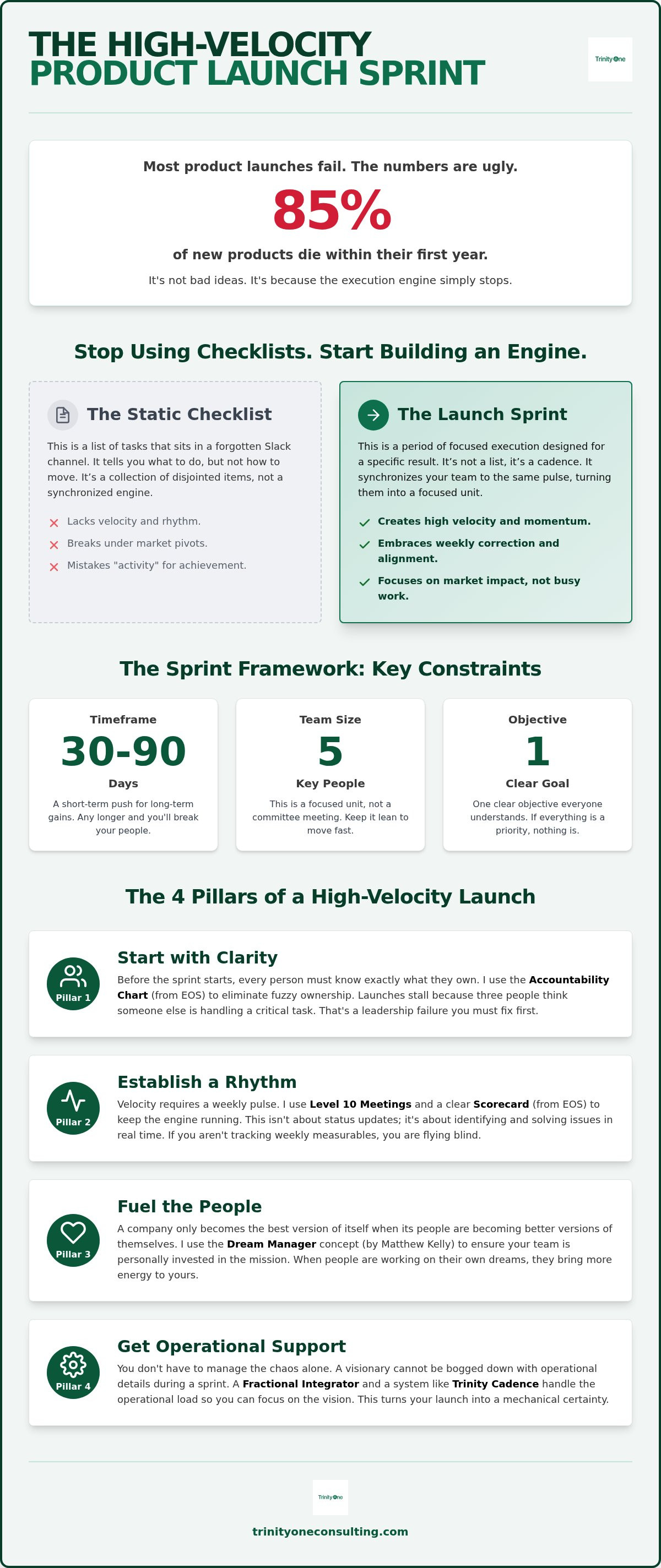
Eighty five percent of new products fail within their first year. Most of these deaths occur because the execution engine simply stops. You've likely watched projects drag on for months with no finish line in sight. Your team feels disconnected while AI tools you bought are never used. You need a product launch sprint plan that functions like an integrated circuit rather than a messy checklist.
I understand the frustration of seeing human capital wasted on tasks that don't move the needle. I'll show you how to build a high velocity launch plan that aligns AI operations with human performance to hit your 2026 targets. This is a 30 or 90 day roadmap that yields a higher ROI. We'll build a system where your team owns the results instead of just doing tasks. It's time to turn your launch into a mechanical certainty.
Key Takeaways
- I define a product launch sprint plan as a 30 to 90 day window of high velocity movement. It focuses on how your team moves instead of just ticking boxes on a static list.
- You must start with a clear accountability structure that shows who owns what. If your people don't know exactly what they own, the sprint will stall before it starts.
- I use a weekly leadership meeting to surface and resolve issues. This structure keeps the engine running without the friction of unnecessary status updates.
- A company only grows as much as its people grow. I use the Dream Manager concept by Matthew Kelly to ensure your team stays personally invested in the mission.
- You don't have to manage the chaos alone. A fractional integrator and the Trinity Cadence system can handle the operational load while you focus on the vision.
What makes a business launch sprint different from a standard checklist?
I define a launch sprint as a 30 to 90 day period of focused execution. A standard checklist is a static list of to-dos that usually sits in a drawer or a forgotten Slack channel. It tells you what to do but it doesn't tell you how to move. Most plans fail because they lack a unified operating cadence. They're a collection of disjointed tasks rather than a synchronized engine.
You need to stop thinking about tasks and start thinking about velocity. A product launch sprint plan is designed to create a specific result within a tight timeframe. It requires a level of intensity that your business cannot maintain indefinitely. This is the tradeoff. You trade long term comfort for short term market gains. If you try to sprint for six months, you'll break your people and your systems.
I've seen companies spend $50,000 on software to track tasks while their actual launch date keeps slipping. The software isn't the problem. The lack of a rhythm is the problem. A sprint provides that rhythm by forcing every team member into the same pulse of execution. It turns a group of individuals into a focused unit.
The difference between activity and achievement
Busy teams often produce zero market results. I see founders mistake a long meeting or a filled calendar for progress. It's a trap. Achievement is measured by market impact, not by how many hours you sat in a chair. A sprint plan must have one clear objective that everyone understands. If you're building a marketing plan, don't measure the number of posts you created. Measure the revenue those posts generated.
This approach is bad at making people feel "safe" in their daily routines. It exposes who is actually producing and who is just hiding behind email. That's a cost some leaders aren't willing to pay. But if you want to hit your 2026 targets, you have to prioritize achievement over simple activity. You have to be willing to cut the fluff that doesn't get results.
Why traditional project management fails visionaries
Gantt charts are often where dreams go to die. They're built for administrators who love boxes and lines. Visionaries don't think in boxes. They think in outcomes. Visionaries need speed and flexibility to respond to the market. Integrators need order and predictability to keep the business functional.
Your product launch sprint plan acts as the bridge between these two needs. It provides enough structure to keep the integrator happy but enough speed to satisfy the visionary. Traditional management tools are bad at handling the pivots that happen during a real launch. A sprint embraces those pivots because it's built on a weekly cycle of correction and alignment. It keeps the mission alive while the details change.
How do you prepare your operational engine for a launch sprint?
Preparing for a high velocity sprint is like prepping a race car. You don't wait until the light turns green to check the oil. You must start with a clear accountability structure. Every person in the sprint needs to know exactly what they own. If ownership is fuzzy, execution will be slow.
I've seen launches stall because three different people thought someone else was handling the CRM integration. That's a leadership failure, not a technical one. I require a clear weekly scorecard to track the numbers that matter. If you aren't tracking weekly measurables, you're flying blind. You need to know if you're hitting your 2026 targets in real time.
If the key roles aren't filled with capable owners, you will fail. It's that simple. You can't ask a visionary to do integrator work during a high velocity product launch sprint plan. You need operators who can handle the pressure of daily deadlines. If your engine feels sluggish, you might need a fractional integrator to tune it up before you launch.
Aligning your quarterly priorities for the next 90 days
Quarterly priorities are the handful of outcomes that matter most in the next 90 days. A launch sprint should be your top priority for the quarter. I recommend limiting the sprint team to five key people. Any more than that and you're just hosting a committee meeting. Sprint planning is the mechanical process of deciding what gets done, but the quarterly priority provides the strategic weight. If everything is a priority, nothing is.
Evaluating your AI readiness before the first huddle
Do not buy new software in the middle of a sprint. It's a diversion that kills momentum and drains your budget. Audit your current tools to see if they talk to each other. I use Trinity Cadence to provide real-time visibility into execution. It serves as the central nervous system for your data. If your tools don't sync, your team will waste hours on manual entry. That's a cost you can't afford when you're moving at this speed.
Check your data feeds before you start. If your AI tools are pulling from messy spreadsheets, you'll get messy results. Clean your data now so your product launch sprint plan doesn't turn into a cleanup project. You want your team focused on the market, not on fixing broken software integrations.
What are the mechanics of a high-velocity launch sprint plan?
A high velocity product launch sprint plan requires a specific mechanical sequence to maintain momentum. The process begins with a one-day alignment session. This is an eight-hour block of intense focus. It's expensive in terms of payroll. You're pulling five key people off their daily tasks for a full day. But this session prevents the $20,000 errors that occur when your team guesses at their priorities.
I use a weekly leadership meeting to solve issues that threaten the timeline. These meetings are pure problem solving. We don't do status updates. We work the friction points to resolution. Daily huddles of fifteen minutes keep the team synchronized without wasting time on long emails. If a huddle goes to sixteen minutes, you've failed the rhythm.
The plan must include a hard stop date with no exceptions. If you allow the deadline to slide, you lose the psychological edge of the sprint. It turns into just another project that never ends. You need the pressure of the clock to force decisions. Speed is your primary defense against market indifference. It forces you to stop overthinking and start shipping.
The 30-day rapid launch methodology
Week one is dedicated to workflow setup and brand systems. You can't build a house on a swamp. You need the technical foundation ready before you push the product. Week two focuses on the AI ROI mapping for the product. We look at how the technology saves time or increases revenue for the end user. We don't guess at value. We map it to concrete dollars and cents.
Weeks three and four are for aggressive market testing. This is the stage where you get punched in the face by reality. It's messy. It's often discouraging. But it's necessary to find the actual demand. You're looking for proof of concept, not perfection. Perfection is a luxury you can't afford in a thirty day window. You want data that shows people are willing to open their wallets.
Maintaining the rhythm of business
Rhythm is more important than raw effort. A team that works ten hours a day in a chaotic environment will produce less than a team that works six hours in a synchronized flow. I track engagement scores alongside execution stats to ensure the engine isn't overheating. If your execution stats are high but engagement is low, your team will quit the day after the launch. You've traded your future for a single win.
You need to balance the clinical precision of your software with the emotional state of your people. This is where the fractional integrator comes in to manage the tension. They act as the governor on the engine. They ensure you hit the targets without burning out your best talent. It's about sustainable velocity, not a one-time explosion. You want a team that is ready for the next sprint, not one that is looking for the exit.
Why do most product launch plans fail at the human level?
Execution requires more than software logic. Your product launch sprint plan will fail if your team is burnt out. A company only becomes the best version of itself to the extent its people are becoming better versions of themselves. I believe we are called to help people grow, not just use them for their labor.
I use the Dream Manager concept by Matthew Kelly to keep teams engaged during high pressure sprints. Burnout occurs when personal goals are buried under business targets. You can't expect a developer or a marketer to care about your 2026 revenue targets if they can't see their own future in the work. You must link the success of the launch to the specific dreams of your team members.
Using the twelve dream categories for retention
Matthew Kelly defines twelve dream categories. These range from physical health to financial stability. I ask my team which category this specific launch helps them achieve. If the sprint is successful, it should move them closer to a personal finish line. You should Learn more about the Dream Manager Program to understand how to close this gap between business needs and human desires.
The cost of ignoring employee buy-in
Disengaged employees are the silent killers of momentum. They won't tell you they've quit. They'll just stop producing at the required velocity. I have seen $100,000 launches fail because a key manager felt ignored by leadership. They didn't miss the deadline because of a technical bug. They missed it because they lost their connection to the mission.
Real talk. You cannot scale a high growth company with people who are only there to trade hours for a check. If your staff doesn't own the result, you're just managing a group of expensive task-doers. That's a recipe for operational chaos. You need partners in the trenches who see the launch as a vehicle for their own growth.
How can you implement a launch sprint plan without creating operational chaos?
Implement a product launch sprint plan by hiring a fractional integrator and using an AI-native operating system like Trinity Cadence. This approach separates visionary strategy from mechanical execution. It ensures your team maintains a synchronized rhythm instead of drowning in a list of disjointed tasks. You must stop managing tasks and start managing the cadence of the business.
Chaos happens when you add pressure to a system that lacks a governor. If your team is already at 100 percent capacity, a new launch will break them. You need a system that integrates machine operations and people management. This is about creating a predictable pulse that everyone can follow without the friction of constant status updates.
The role of the Fractional COO in a launch
I act as the integrator so the visionary can stay in the clouds. This keeps the big ideas moving while I handle the mechanical details of the execution. A fractional integrator is often cheaper than a failed launch that wastes $100,000 in lost market opportunity. It provides a battle-tested perspective that your internal team might lack during high-pressure windows.
This approach is bad at providing a long-term administrative presence. It's a high-impact engagement designed for speed and precision. If you need someone to manage your facility or handle basic payroll, this isn't the right fit. Check out the When to Hire a Fractional Executive: 2026 Scaling Guide for more details on this role.
Using Trinity Cadence for real-time visibility
Trinity Cadence is our AI-native operating system. It shows me who is winning and who is struggling in real time. Most project management tools are just digital graveyards for forgotten tasks. Trinity Cadence provides AI coaching to keep the team on track by identifying where the engine is losing power before it results in a missed deadline.
I use this data to coach the team before the sprint stalls. It allows us to move from reactive management to proactive leadership. You can see the stats that matter without digging through messy spreadsheets. This creates a level of visibility that forces accountability across the entire team. It ensures the machine and the people work in total alignment to hit your goals.
Build an engine that actually executes
A successful launch isn't a matter of luck. It's the result of a disciplined operational engine. Your product launch sprint plan is the bridge between a visionary idea and a market reality. I've spent 30 years as an operator and Integrator seeing where these plans fail. They usually fail because they lack a unified rhythm or ignore the humans doing the work.
You need a system that balances machine precision with human motivation. I use the Trinity Cadence operating system to track the data and the Dream Manager process by Matthew Kelly to keep your people invested. This combination ensures you hit your 2026 targets without breaking your culture. You can't just manage tasks. You have to manage the pulse of the entire organization.
I'll help you put a clear owner on every critical role. We'll set the quarterly priorities and build the weekly scorecard needed for high velocity movement. It's time to stop guessing and start moving with clinical precision. I've seen $100,000 launches fail because a manager felt unheard, and I won't let that happen to you.
I'm ready to help you build an engine that actually executes. Let's get to work.
Frequently Asked Questions
What is the ideal length for a product launch sprint plan?
The ideal length for a product launch sprint plan is between 30 and 90 days. I find that a 90 day window provides the best balance of urgency and execution for most companies. Anything shorter doesn't allow for enough market testing. Anything longer causes burnout and makes the team lose focus on the finish line.
How many people should be on a launch sprint team?
I recommend limiting your sprint team to five key people. This usually includes the visionary, an integrator, and three specialists. Adding more people increases the cost of communication and slows down the decision engine. You want a small group of operators who can move with speed and total alignment.
Do I need an integrator to run a successful sprint?
You absolutely need an integrator to run a successful sprint if you are a visionary founder. Visionaries are great at the 30,000 foot view but bad at the mechanical details of a launch. An integrator ensures everyone knows who owns what and that every task hits its deadline. Without one, your launch will likely drift into operational chaos.
Can we run a launch sprint while maintaining normal operations?
You can run a sprint while maintaining normal operations, but you must accept the tradeoff of reduced capacity elsewhere. A product launch sprint plan requires a high velocity that will pull focus from your standard routines. I suggest designating specific blocks of time for the sprint so your core business doesn't suffer. If you try to do both at 100 percent, you'll break your team.
How do I know if my team is ready for a high-velocity sprint?
Your team is ready when you have a clear accountability structure and a weekly scorecard that everyone understands. If people are already missing their weekly measurables, they aren't ready for the pressure of a sprint. You need a foundation of discipline before you add the speed of a high velocity launch. I look for teams that already own their results instead of just doing tasks.
What are the most common mistakes in sprint planning?
The most common mistakes are allowing the deadline to slide and failing to define clear ownership. I also see founders buy new software in the middle of a launch which pulls focus from the work. A sprint fails when there is no hard stop date or when the team doesn't know who owns the final result. You have to eliminate ambiguity to maintain momentum.
How does the Dream Manager concept fit into a product launch?
The Dream Manager concept by Matthew Kelly fits into a launch by linking the success of the project to the personal growth of your team. I ask each person which of the twelve dream categories this launch helps them achieve. When a team member sees the launch as a vehicle for their own dreams, their engagement levels skyrocket. It turns a job into a mission.
What software tools are essential for a launch sprint plan?
You need a system like Trinity Cadence for real time visibility into your stats. I avoid complex project management tools that just become digital graveyards for tasks. You need a simple way to track your weekly scorecard and your weekly leadership meetings. The best tools are the ones that provide clarity without adding unnecessary complexity to your daily workflow.