
Boards fund operational accountability and clear risk boundaries, not open-ended science projects. Knowing how to present an AI strategy to the board means ditching vague productivity promises and proving who owns the bottom-line outcome. You must show how each initiative protects margins. Your plan must also match the actual capacity of your frontline team.
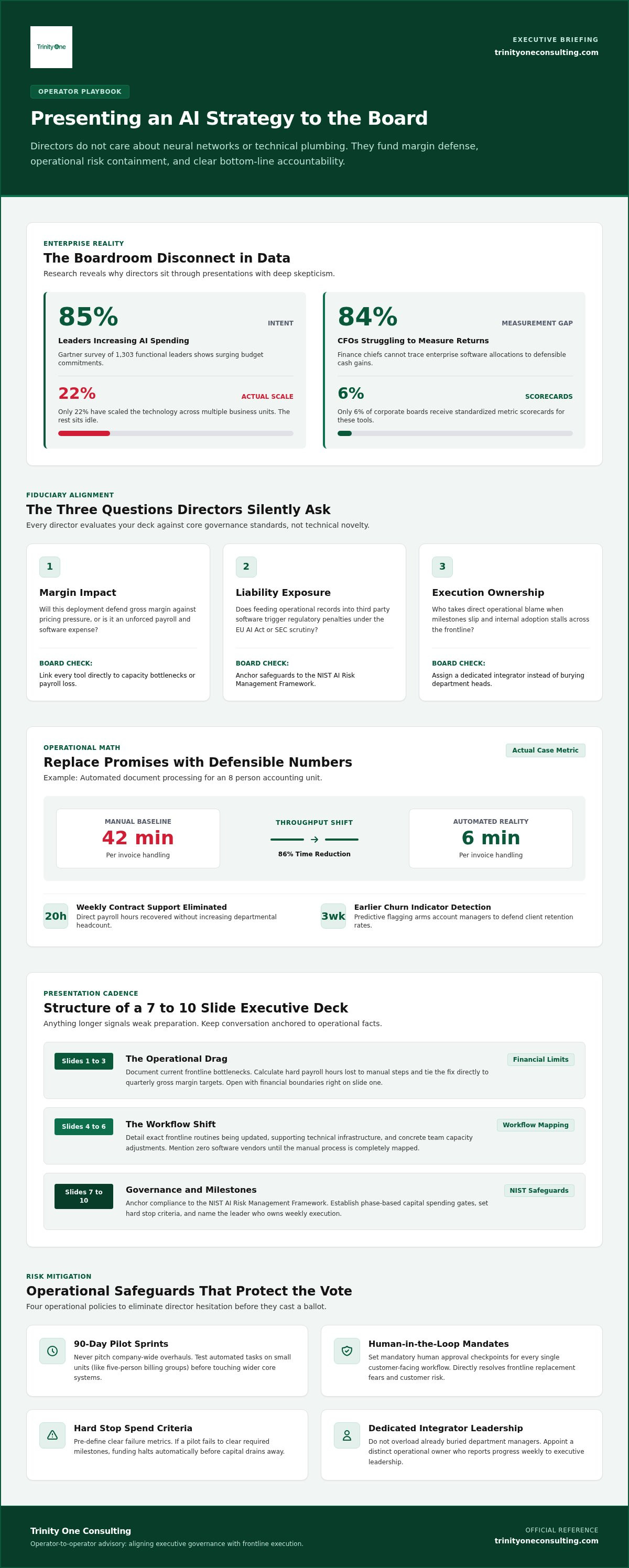
You already sense the skepticism waiting across that boardroom table. Gartner found that 84% of chief financial officers struggle to measure enterprise AI returns, while only 6% of boards receive standard metric scorecards. Directors don't want another software wish list. They want defensible math.
You'll get the exact slide structure and operational payback models needed to secure board approval. You'll also get direct answers for tough governance questions. No fluff. Just operator-level proof.
We will break down the executive deck structure alongside the operational cadence required to deliver real results without grinding your people down.
Key Takeaways
- Board members don't care about neural networks or technical plumbing. They care about margin defense, risk containment, and protecting the bottom line.
- Learn how to present an AI strategy to the board using a focused 7 to 10 slide deck that opens with clear financial boundaries.
- Separate software license expenses from frontline labor time to build defensible payback schedules based on real hours recovered.
- Address team replacement fears directly while setting mandatory human-in-the-loop policies for all customer-facing workflows.
- Protect your operational cadence after the vote by assigning dedicated integrator leadership instead of overloading already buried department managers.
What do board directors really want to hear about AI?
Board members do not care about neural network architectures or technical plumbing. When you walk into the room with 40 slides on model parameters and API layers, their eyes glaze over. They sit there wondering how much cash you plan to waste on software shelfware.
Directors care about margin defense, operational risk containment, and protecting the business from aggressive competitors. According to a September 2026 Gartner survey of 1,303 functional leaders, 85% plan to increase AI spending, yet only 22% have successfully scaled the technology across multiple units. The rest bought expensive software that sits idle. Your directors know these odds. They've lived through past enterprise software disasters where massive consulting retainers generated thick reports, zero cultural adoption, and bloated overhead.
Frame every line item as a direct remedy for an existing capacity bottleneck. If a process does not bleed payroll dollars or limit daily throughput, leave it off the docket. That is the foundation of how to present an AI strategy to the board without losing the room in five minutes.
The three questions every board member silently asks
A good presentation anticipates what directors won't say out loud. As established by classical corporate governance principles, directors hold a fiduciary duty to balance ambitious upside against long-term enterprise solvency. Every member evaluates your proposal against three specific checks:
- Margin impact: Will this deployment defend our gross margin against pricing pressure, or is it an unforced expense?
- Liability exposure: Does feeding operational data into these tools trigger regulatory penalties under the EU AI Act or SEC scrutiny?
- Execution ownership: Who takes direct operational blame when milestones slip and adoption stalls?
Notice what isn't on that list. Nobody is asking for a tutorial on machine learning algorithms. Both corporate boards and private investment offices expect leaders to demonstrate clear commercial discipline and risk management; find out more about evaluating strategic technology investments and sector-specific guidance.
Shifting your language from technical features to operational reality
Cut the developer jargon entirely. Swap out vendor slides for frontline operational facts. Instead of promising improved throughput, show how an automated document processor cuts invoice handling from 42 minutes down to 6 minutes for an accounting team of eight. That reclaimed time eliminates 20 hours of weekly contract support.
Connect your tooling directly to the priorities the board signed off on last quarter. If the strategic focus was customer retention, show how predictive flagging helps your account managers spot churn indicators three weeks earlier. When you master how to present an AI strategy to the board in clear operational terms, you stop sounding like an enthusiastic tech vendor. You start talking like an operator.
How do you present an AI strategy to the board step by step?
Keep the core presentation deck between seven and ten slides. Anything longer signals weak preparation. When you work out how to present an AI strategy to the board, open with strategic intent and strict financial limits right on slide one. Do not mention a single software vendor until you have mapped the exact operational process needing repair. Reserve the end of the deck for milestones, ownership, and a weekly reporting rhythm.
The anatomy of a ten-slide executive board deck
Structure the deck like a disciplined operational review. Directors want to see cause, cost, and control in a straight line:
- Slides 1 to 3 (The Operational Drag): Document current labor bottlenecks, calculate payroll hours lost to manual steps, and link the project to quarterly margin targets.
- Slides 4 to 6 (The Workflow Shift): Detail the exact frontline routines being updated, the technical infrastructure, and the direct impact on team capacity.
- Slides 7 to 10 (Governance and Milestones): Anchor your compliance safeguards to the NIST AI Risk Management Framework, set phase-based capital spending gates, and name the leader who owns weekly execution.
This structure prevents directors from derailing the meeting with abstract tech debates. It keeps the conversation anchored to operational facts.
Presenting realistic pilot projects instead of enterprise overhauls
Never pitch a company-wide transformation. Pitch a ninety-day sprint aimed at a single, painful friction point. For example, test automated invoice processing for your five-person billing group before touching payroll or procurement.
Establish hard stop criteria before asking for the vote. Tell the board that if the pilot fails to eliminate fifteen manual hours per worker every week by day sixty, you will pull the plug. Name the tradeoffs honestly. Acknowledge that the new software will not clean up corrupted legacy data or replace frontline decision-making.
Take time to review our framework for measuring ROI of AI implementation so your financial figures hold up under fire. If you want an objective operator to pressure-test your deck before the meeting, consider scheduling an operational review to verify your numbers.
What financial models and operational trade-offs win over the board?
Directors spot theoretical math immediately. If you present a spreadsheet claiming every worker saves four hours a week, a sharp board member will ask which positions you plan to eliminate. If your answer is none, your financial model collapses. Phantom labor savings do not fund capital projects.
A winning financial model separates software expenses from internal labor commitments. The Harvard Law School Forum on Corporate Governance notes in its review of board oversight of AI transformation that directors scrutinize capital allocation through the lens of workforce capacity, operational discipline, and enterprise solvency. Winning models treat AI tools like industrial machinery. They track hard payback schedules based on billable output, eliminated external contractor fees, and reduced transaction rework.
Building the phased capital request table
Never ask for an open-ended annual budget. National Association of Corporate Directors data reveals that only 8.9% of boards have approved a dedicated, stand-alone capital expenditure line for AI. Directors fund stages, not abstractions.
Split your request into three funded gates:
- Gate 1 (Discovery): Funds process mapping and data hygiene for a single bottleneck. Zero software licenses purchased.
- Gate 2 (Pilot Validation): Capital releases only after the pilot team proves a measurable 15% reduction in cycle time.
- Gate 3 (Operational Rollout): Full deployment funding unlocks only when department leaders certify team adoption.
This phased structure protects cash. It also proves you respect their governance role.
Naming the trade-offs and hidden implementation costs
Every operational push carries an operational cost. Tell the board what initiatives you will pause to pull this off. If two senior operational leaders spend ten hours a week supervising data validation, other internal projects will slow down. Say that plainly.
Account for the human toll of change. Gartner reports that organizations seeing real financial gains spend 30% more of their budget on staff development, governance policies, and data architecture than on basic software licenses. Software doesn't adopt itself. People must learn new routines while running their day jobs.
Address vendor lock-in directly. Show what happens if the vendor raises per-seat pricing by 40% next year or discontinues a core capability. When you know how to present an AI strategy to the board, you highlight the risks, costs, and tradeoffs with the same clarity you bring to the financial upside.
How do you address board concerns about employee adoption and governance?
Directors expect workforce pushback. When employees fear software will replace them, they quietly resist adoption and find reasons why the system cannot work. Addressing this friction early is essential when mastering how to present an AI strategy to the board. Show the room that you have anticipated cultural resistance and built operational safeguards to counter it.
Establishing clear operational and data governance boundaries
Governance starts with hard boundaries, not loose policies. Put a mandatory human-in-the-loop requirement on every customer-facing output and critical financial record. Automated drafts must require verified human sign-off before reaching a client or entering an accounting ledger.
Set clear data perimeters so proprietary operational records never train public models. Under EU AI Act transparency rules and SEC oversight, unmonitored shadow tools create direct corporate liability. Build audit logging directly into workflow steps. Require department heads to conduct weekly compliance reviews so your governance controls remain defensible under external scrutiny.
Protecting team capacity and culture during technological rollouts
New tools fail when teams are already exhausted. If your frontline managers work sixty-hour weeks just to survive their backlog, adding software training breaks them. They drop the initiative the moment fire drills start. Technology never solves an underlying culture problem.
A company only becomes the best version of itself to the extent its people are becoming better versions of themselves. That conviction guides my operating work, rooted in my faith that every person on your payroll carries dignity beyond their daily output. We counter burnout by tying workflow automation directly to employee growth through the Dream Manager methodology created by Matthew Kelly. We track operational usage alongside personal goals across Kelly's twelve dream categories, showing workers that automation eliminates grunt work so they can advance their careers.
Bringing in a fractional Dream Manager signals to both workers and directors that leadership invests in culture through technological disruption. Directors respect leaders who protect workforce retention right alongside the balance sheet.
Who will actually lead the operational execution once directors vote yes?
A successful vote in the boardroom creates an immediate operational vacuum. Directors know that visionary leaders rarely possess the patience for execution detail. Your department heads are already drowning under daily firefighting, and dumping new software rollouts onto their plates invites disaster.
Securing approval requires an operational owner named right in the deck. Showing who runs execution day to day completes the formula of how to present an AI strategy to the board with total credibility. You must prove who holds the baton. If nobody owns the process, the initiative dies.
The leadership gap between strategy and operational delivery
Loading digital initiatives onto existing executives burns out your top performers. When a finance director must run core reporting and manage system integration at the same time, both suffer. Sourcing a full-time operations executive often takes six months and demands heavy corporate overhead. That lag stalls momentum before your first pilot launches.
Flexible leadership bridges this gap by inserting veteran leadership without permanent payroll liabilities. Review our fractional COO retainer guide to understand how mid-market firms structure these arrangements. An interim integrator steps into the operational trenches immediately, removing guesswork from workflow redesign.
Installing an operating system to maintain accountability
Strategy falls apart without a relentless operational rhythm. We run execution on ninety-day operational sprints backed by weekly scorecards. Milestones need clear owners. If an integration deadline slips by three days, the issue surfaces at Monday morning standup, not at the next quarterly board review.
Engaging a seasoned fractional COO gives your business an objective operator who aligns frontline routines with technical systems. This operator protects your existing business lines while holding every team member accountable to weekly commitments. When you stand before your directors, show them both the playbook and the referee. That operational clarity turns board skepticism into decisive approval.
How do you take your AI strategy into the boardroom with confidence?
Winning over your board requires proving that operational discipline protects company capital. Directors don't fund vague software promises. They back plans with hard boundaries, clear ownership, and measurable payback schedules. When you master how to present an AI strategy to the board, you replace software hype with phased funding, frontline capacity safeguards, and direct accountability.
Over thirty years of corporate operational leadership taught me that major initiatives collapse when nobody manages the weekly routine. We built the Trinity Cadence operating system to fix that breakdown. Pairing disciplined execution gates with Certified Dream Management under Matthew Kelly protects your frontline team from exhaustion while your systems deliver real margin defense.
Walk into that boardroom prepared to stand behind both your math and your people. When your operating plan defends the bottom line while respecting the team doing the work, directors give you the green light.
Schedule a 30-minute cadence call with Kevin Patrick to pressure-test your deck and build your operational plan.
Frequently Asked Questions
How long should an AI strategy presentation to the board take?
Keep your formal presentation under twenty minutes, leaving twenty to thirty minutes for discussion. Directors tune out during long monologues. Deliver your seven to ten slides briskly. State the business problem, the proposed workflow change, the budget guardrails, and the operational owner. When planning how to present an AI strategy to the board, remember that boardroom buy-in happens during the discussion, not while you click through slides. Give them room to challenge your operational assumptions.
What is the biggest mistake leaders make when presenting AI to the board?
The biggest mistake is pitching technology capability instead of operational outcomes. Presenters get excited about model features and vendor claims while ignoring unit economics. Directors don't want an education on algorithmic advances. They want to know what breaks, what costs change, and who takes operational responsibility when things stall. If your deck focuses on software specs rather than reclaimed payroll hours or risk boundaries, directors will table your proposal before slide four.
How should I answer when directors ask about intellectual property and data security?
Give a direct operational answer without hiding behind technical jargon. Explain that company data remains locked in dedicated enterprise tenants with zero public model training. Detail which vendor agreements include explicit indemnification clauses and show how data logging records every automated transaction. Show them a clear human review step for confidential client materials. When directors see you treat intellectual property protection as a strict operational boundary rather than an afterthought, their security concerns drop quickly.
How do you calculate payback periods on AI investments for a skeptical board?
Base your payback math purely on hard operational costs, not soft productivity gains. Focus on eliminated contractor invoices, reduced customer churn, or direct payroll hours redirected from repetitive processing to revenue work. Knowing how to present an AI strategy to the board means avoiding hypothetical time savings multipliers. If a pilot recovers 20 hours of manual data entry weekly and cuts $3,000 in monthly contract support, use that exact dollar offset to define your break-even date.
Should we hire an internal AI leader before getting board approval?
No. Adding expensive executive payroll before validating operational use cases burns capital and spooks the board. Bring in an experienced fractional integrator or COO who has managed technology rollouts and corporate workflows before. An interim operator helps you validate processes, run ninety-day pilot sprints, and set accountability systems. Once your operational workflows prove real ROI and team adoption holds steady, you can decide whether the business actually justifies a full-time, permanent hire.
What governance policies does the board expect to see in the initial pitch?
Boards look for three non-negotiable governance policies right away. First, an explicit ban on unapproved public tools to prevent shadow software adoption. Second, a mandatory human-in-the-loop requirement for any external communication or regulatory filing. Third, clear audit trails that identify which operator signed off on an automated output. Presenting these rules upfront shows directors that your execution plan protects company reputation, complies with regulatory standards, and guards the business against unmonitored legal risk.