
You are paying for a leader. Not a project manager. If your inbox is still a collection of daily fire drills and your team remains stuck in second gear, your investment is failing. Learning how to measure the success of a fractional integrator requires looking past the calendar of meetings they run.
Real success is found in the silence of your phone and the steady rhythm of a business engine that produces results without your constant intervention. I've seen high retainers wasted while founders stay trapped in the weeds. You hired an integrator to reclaim your time and build a system that functions without you.
I will give you the metrics and behavioral shifts. We will break down the structured performance tracking and accountability metrics you need to hold them accountable. Track the shift from founder-led chaos to a streamlined AI-native business engine, a transformation Trinity One specializes in. Finally, we'll explore proven strategies to foster team alignment and motivation, ensuring everyone hits their targets.
Key Takeaways
- Success is measured by the silence in your inbox and a business engine that hits targets without you.
- You will learn how to measure the success of a fractional integrator by tracking a completion rate of at least 80% for quarterly Rocks, an EOS term.
- Your daily fire drills should drop to zero so you can spend 80% of your time on high-level strategy.
- Real ROI is proven when your leadership team reports 100% of their Scorecard metrics from EOS on time without you nagging them.
- We measure people success by team retention and the personal growth of employees using the Dream Manager program by Matthew Kelly.
What does fractional integrator success look like in 2026?
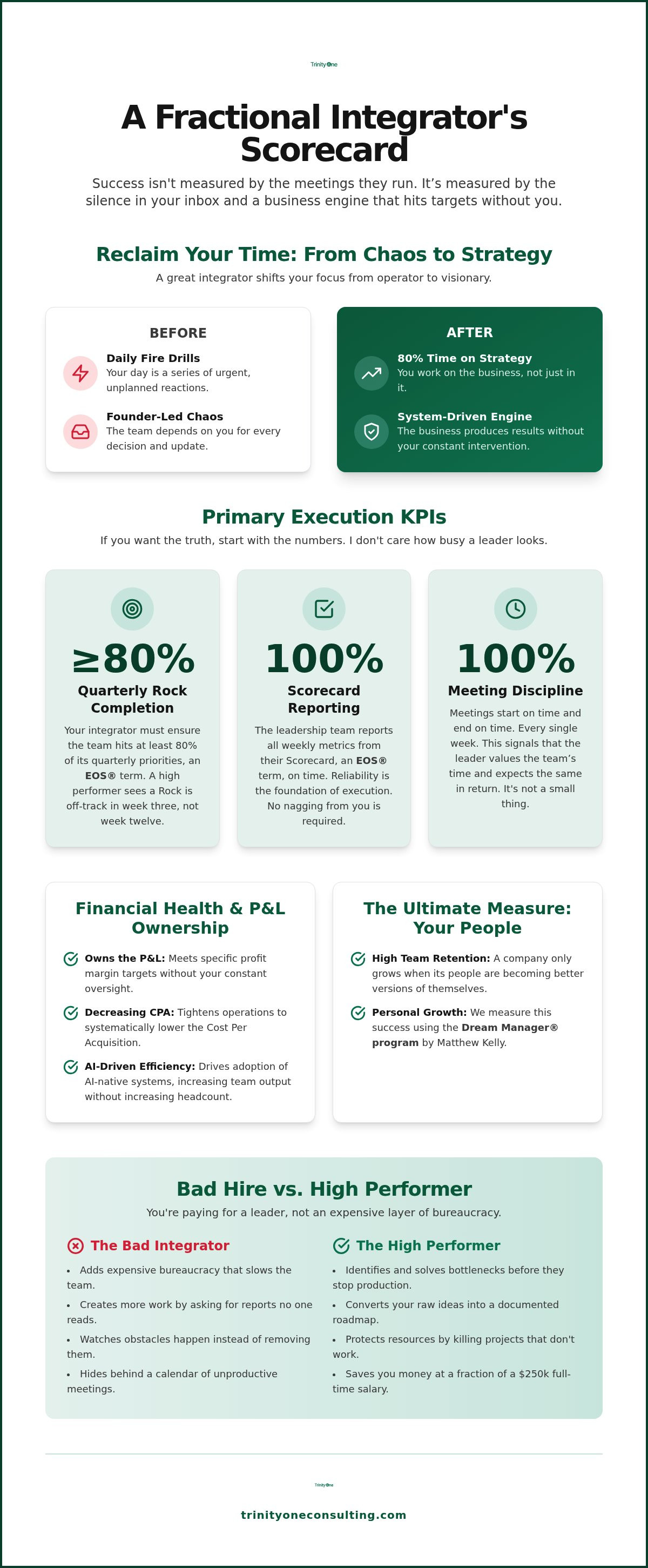
Success means your business engine runs at a high tempo without your constant intervention. You measure it by the silence in your inbox and the noise of your team hitting targets. If your integrator's just running meetings, they're failing. A high performer turns your vision into a documented plan with clear deadlines and measurable ROI.
I've spent 30 years in the trenches of operations. I know that a fractional leader is an architect, not a babysitter. When founders ask me how to measure the success of a fractional integrator, I tell them to look at the friction between their technology and their people. A successful hire removes that friction by building a system like Trinity Cadence that provides real-time visibility into every moving part of the company.
This evolution mirrors the traditional Chief Operating Officer role but with a focus on speed and technology. You're looking for two primary pillars. Execution must be visible. Financial health must be stable. Once the machine is running, you can focus on rising team engagement.
You hired this person to reclaim your time. If you're still the one chasing people for updates or clarifying the plan, you're wasting money. A high performer takes your raw ideas and converts them into a documented roadmap that the team can follow without you. This is the difference between a business that relies on a founder and an engine that runs on a system.
Moving beyond the Level 10 meeting agenda
Running a Level 10 meeting, a term from EOS, is the bare minimum requirement for this role. I've seen too many integrators hide behind a calendar of meetings while the business stalls. Success is actually measured by the quality and speed of the issues solved during those sessions. You want to see the leadership team identifying bottlenecks and clearing them without you having to step in and play referee.
The cost of a bad hire versus a high performer
A bad integrator adds a layer of expensive bureaucracy that slows down the team and confuses the mission. They create more work by asking for reports that nobody reads. A great fractional COO identifies those bottlenecks before they stop production entirely. They save you money by providing executive leadership at a fraction of a 250,000 dollar full-time salary. We also measure people success through the Dream Manager program by Matthew Kelly. A company only grows when its people are becoming better versions of themselves.
What are the primary KPIs for an integrator role?
I have spent 30 years learning how to measure the success of a fractional integrator by watching the behavior of the team. If you want the truth, start with the numbers. I don't care how busy a leader looks or how many emails they send. I care about the Scorecard. This is an EOS term for the weekly data tracking that keeps a business honest. A successful integrator ensures that 100 percent of weekly metrics are reported on time by the leadership team.
Reliability is the foundation of execution. If your team is guessing at their performance because the data is late, your integrator is failing. You are paying for discipline. That discipline extends to the operating cadence. Meetings must start and end on time every single week. It sounds small. It isn't. It signals that the leader values the team's time and expects the same in return. When meetings run over, it usually means the issues aren't being solved.
Next, look at the Rock completion rate. Rocks are the quarterly priorities defined in the EOS framework. Your integrator should ensure the team hits at least 80 percent of these goals every 90 days. If the rate is lower, they aren't managing the obstacles. They are just watching them happen. A high performer identifies why a Rock is off track in week three, not week twelve. They protect your resources by killing projects that don't move the needle.
Financial health and P&L ownership metrics
The integrator must own the P&L. You need to see specific profit margins met without you constantly checking the bank balance. Success is watching your cost per acquisition decrease as your operations tighten up. This level of executive oversight is why the fractional COO vs full time COO cost makes sense for growing companies. You get the expertise without the quarter-million dollar price tag. If the integrator doesn't understand your margins, they can't lead your people.
AI adoption and machine efficiency
In 2026, efficiency is tied to your tech stack. I track how many manual, repetitive workflows have been replaced by AI-native systems. Your integrator should be driving this shift. You want to see an increase in team output without a corresponding increase in headcount. This is how you scale without breaking the culture. Trinity Cadence provides real-time visibility into these metrics so you don't have to wait for a monthly report to see if the engine is running hot. If you want to see how this visibility changes your daily operations, you can book a call to discuss your current bottlenecks.
How do you measure the impact on the Visionary?
Success is measured by the silence in your inbox. If you are still the primary firefighter in your business, you haven't hired a leader. You've hired a spectator. A high performing fractional integrator creates a barrier between you and the chaos of daily execution.
I want to see your daily fire drills drop to zero. You should spend 80 percent of your time on future strategy and high level relationships. This isn't just about feeling less busy. It's about ROI. When you are doing 50 dollar an hour tasks, you are losing money every single day.
The ultimate test of how to measure the success of a fractional integrator is the vacation test. You should be able to take a one week vacation without checking your email once. If the business engine stalls the moment you stop watching it, the integrator hasn't built a system. They've just built a reliance on themselves.
The freedom to think and the end of fire drills
We track the reduction in Slack messages and urgent interruptions for the CEO. Your team should stop coming to you for permission. A great integrator ensures your ideas are vetted and scheduled before they ever hit the production floor. This is part of the fractional integrator pillar of a modern business engine.
Your time should be spent on the big moves. I look for the speed at which a Visionary's idea moves from a whiteboard to a documented project plan. If your ideas sit on a shelf because nobody knows how to execute them, your integrator is failing. They are the bridge between your creativity and the team's output.
Transitioning from operator to strategic architect
The integrator takes the weight of the Accountability Chart, an EOS tool, off your shoulders. You shouldn't be managing six different department heads. You should be managing one person. Success means you only interact with the integrator for operational updates. This allows you to stop being an operator and start being the strategic architect your company needs to grow.
I have seen founders struggle with this handoff. It's hard to let go of the controls. But your company only becomes the best version of itself when you are in your unique ability. If you are still checking the Scorecard, an EOS term, every hour to see if the team is working, the trust hasn't been built. A successful integrator earns that trust through consistent, visible results.
How to set 90-day benchmarks for your integrator?
You cannot wait six months to see if a high level hire is working. You need a timeline. I use a 90 day sprint to define how to measure the success of a fractional integrator. By the end of the first quarter, the fog should be gone. Your team should know exactly what they are doing and why they are doing it. If they are still confused, the integrator is failing.
I have seen founders lose 50,000 dollars in retainers because they didn't set clear expectations from day one. You are not hiring a consultant to give you a slide deck. You are hiring an operator to drive results. This requires a structured onboarding process that moves from observation to full ownership. Anything less is just expensive babysitting.
The first 30 days: Alignment and audit
The first 30 days are for alignment and audit. It isn't enough to just show up and run a meeting. The integrator must interview every direct report on your Accountability Chart, which is an EOS tool. They are hunting for the hidden operational gaps that keep you from scaling. I expect a written report on the health of your business engine by day thirty. This report should name the friction points that are costing you money. If you are still looking for the right fit, review these questions to ask a potential fractional COO before you sign a contract.
Days 60 to 90: Driving the operating cadence
Month two is about ownership. The integrator takes over the Level 10 meetings, a term from EOS. They own the Scorecard, another EOS tool. You shouldn't be the one asking why a metric is in the red. They should have the answer and a solution ready before the meeting starts. This is where you begin to reclaim your time as a Visionary. If you are still playing referee in every discussion, the handoff hasn't happened.
The final month is where the operating cadence hits its stride. The integrator ensures the team delivers on their first full set of quarterly Rocks, which are priorities in the EOS framework. Every priority must have clear ownership and a deadline. We measure success by the percentage of tasks completed before each weekly session. I want to see that number above 90 percent. This accountability is the hallmark of a professional fractional COO service.
At day 90, the engine should be humming. You are no longer the bottleneck. The team is focused on their targets. The integrator is driving the tempo. This is the ROI you were looking for when you made the hire. You can finally stop looking at the ground and start looking at the horizon.
Why is team retention a success metric for an integrator?
A business is just a collection of people. If your team turns over every six months, your operating system is broken. I believe a company only becomes the best version of itself to the extent its people are becoming better versions of themselves. When you consider how to measure the success of a fractional integrator, you must look at team retention in your key seats.
A high performer doesn't just hit the numbers on a Scorecard, an EOS term. They ensure the humans running those numbers actually want to be there. This is where most fractional leaders fail. They focus on the machine and ignore the operator. If your integrator creates a culture of fear or burnout, your ROI will vanish the moment your best talent walks out the door.
Success is measured by the progress your employees make on their own lives. When business goals align with personal aspirations, execution becomes a natural byproduct. It's the difference between a team that works for a paycheck and a team that works for a purpose. My conviction is that we are called to lead people well. That responsibility includes their growth outside of the office.
Integrating personal growth into the business engine
I use the Dream Manager program, a methodology created by Matthew Kelly, to bridge this gap. We track how many employees are actively pursuing their personal goals across the twelve dream categories defined by Kelly. We use DreamCompass as an invitation only tool to give them a path for this process. If your integrator isn't interested in what your team dreams about, they aren't building a sustainable business engine.
Why the human engine drives the technical ROI
A team that feels heard will always out-execute a team that feels ignored. High tempo operations require high levels of trust. When your integrator builds a healthy operating cadence, people feel challenged to grow every single day. They stay because the environment makes them better. This is the ultimate proof of how to measure the success of a fractional integrator.
Low turnover in your leadership team is a leading indicator of long term financial health. It can cost you twice a person's annual salary to replace them when you factor in recruiting and lost production. If your integrator saves just two key players a year, they have already paid for their retainer. Stop looking for someone who just runs meetings and start looking for a leader who builds people.
If you are ready to build a business engine that grows your people and your profits, let's talk. Schedule your discovery call here.
Reclaim your seat as a strategic architect
Your business engine should produce results without your constant intervention. Real ROI is found in hard data like 100 percent Scorecard accuracy and the speed of AI adoption within the Trinity Cadence system. I've spent 30 years refining these processes to ensure founders can finally stop playing referee and start looking at the horizon. You didn't start this company to be an administrator. You started it to be a Visionary.
A high performing leader also protects your most valuable asset: your people. We measure this through the Dream Manager program by Matthew Kelly. When your team is becoming better versions of themselves, they stay longer and execute harder. Learning how to measure the success of a fractional integrator ensures you aren't just paying for meetings but investing in a sustainable future. This is the difference between a business that relies on your grit and an engine that runs on its own power.
Success is the silence of your phone on a Saturday. It's the confidence that your team has the tools and the leadership they need to hit every Rock. You deserve an operator who cares as much about your people as you do.
You built this company to create freedom. Now it's time to build the engine that delivers it.
Frequently Asked Questions
How long does it take to see results from a fractional integrator?
You should see a measurable shift within the first 90 days. I use the first month for an audit and the second for taking ownership of the operating cadence. By day 90, the team must be hitting at least 80 percent of their quarterly Rocks. This is a term from EOS.
Should my fractional integrator own the P&L immediately?
I don't recommend handing over the P&L on the first day. The leader needs 30 to 60 days to understand your margins and cost per acquisition. Once they have that data, they should own the budget to protect your profit targets. This is how to measure the success of a fractional integrator in a financial sense.
What is the difference between a fractional COO and an integrator?
An integrator is a specific role within the EOS framework. A fractional COO is a broader title, but in a small business, the responsibilities are almost identical. Both roles focus on execution and building a business engine that runs without the founder.
How do I know if my fractional integrator is failing?
You know they are failing if your inbox is still full of daily fire drills. If the Scorecard, an EOS tool, is constantly late or inaccurate, the discipline is missing. A failing integrator adds a layer of expensive bureaucracy instead of removing the bottlenecks that slow down your team.
Can a fractional integrator help with AI implementation?
A modern integrator must be an architect of your tech stack. I use Trinity Cadence to help teams move from manual tasks to AI native workflows. Success is seeing your team output increase without adding more people to the payroll.
What is the best way to track integrator performance weekly?
The Scorecard from EOS is the only way to track performance every week. I look for 100 percent on time reporting from every department head. If the integrator isn't holding the team accountable to these numbers, they aren't doing their job.
Is a fractional integrator responsible for employee engagement?
They are responsible for the health of your people. I use the Dream Manager program by Matthew Kelly to ensure the team is growing personally while they hit business targets. A company only becomes the best version of itself to the extent its people are becoming better versions of themselves.
What happens if the Visionary and Integrator do not align?
The business will stall if there is friction between the Visionary and the Integrator. This relationship is the most important circuit in your company engine. If you can't agree on the priorities, you will waste money on a leader who cannot lead.