
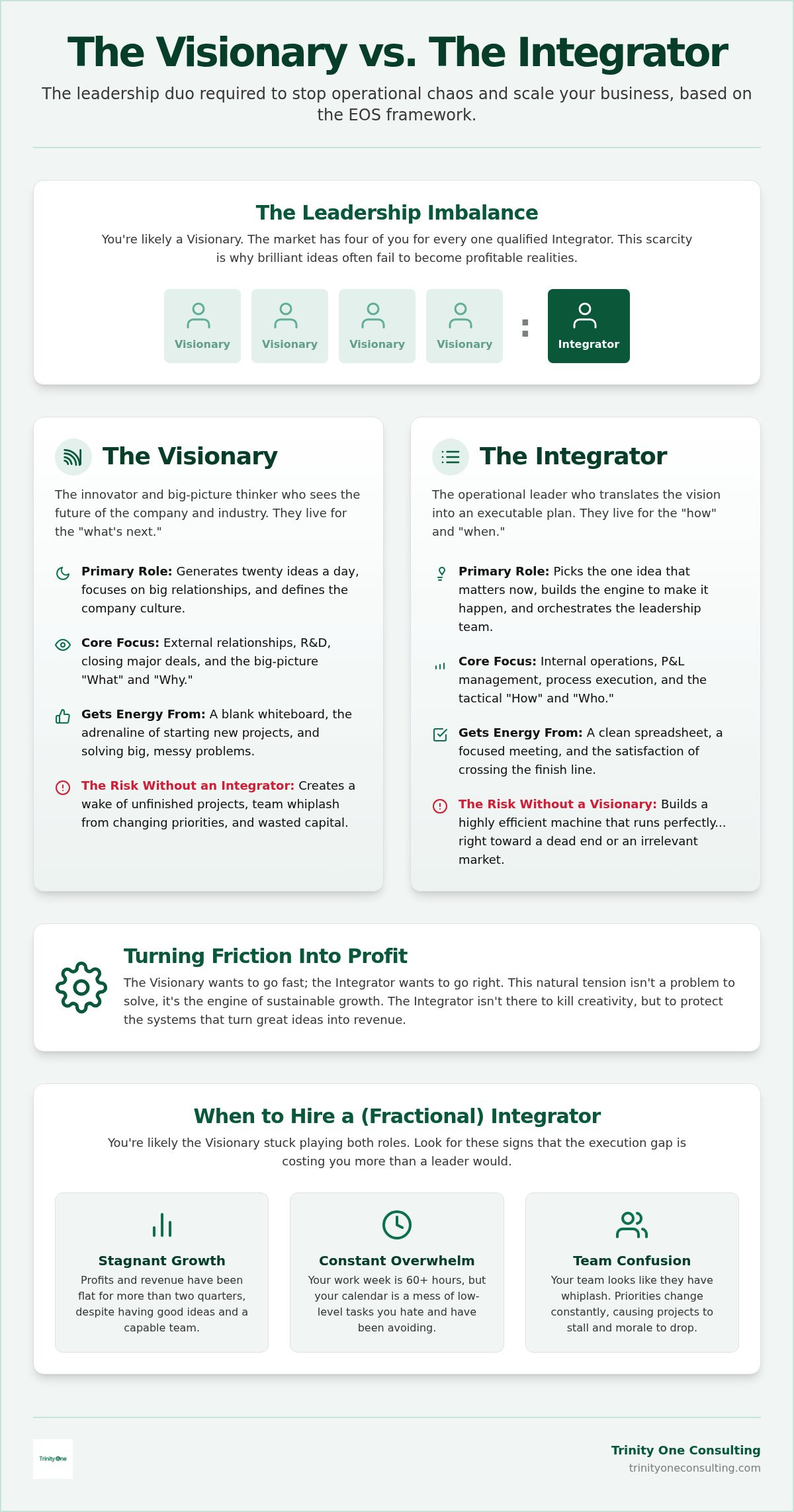
You are likely a Visionary because there are four of you for every one qualified Integrator in the market today. This scarcity explains why your business often feels like a collection of brilliant ideas that never quite reach the finish line. Learning how visionary and integrator work together according to EOS is the only way to stop the operational chaos that keeps you buried in low-level management tasks.
It's exhausting to watch your team get confused by changing priorities while your personal stress levels climb. You want the freedom to focus on big-picture strategy without the constant fear that the engine will fall apart. I've spent 30 years in the trenches and I know that growth stops when one person tries to play both positions.
I'll help you identify your specific leadership archetype and explain how this partnership creates a repeatable system for execution. We are going to look at the specific traits of each role and how they solve the problem of stalled projects. You'll see exactly how to align your team and get back to the work you actually enjoy.
Key Takeaways
- Identify your archetype by where you spend your energy. Visionaries create twenty ideas a day while Integrators build the engine to make one of them actually happen.
- Master how visionary and integrator work together to stop the team confusion caused by shifting priorities. This partnership is the core of the EOS framework and is what drives real growth.
- Learn why these roles clash and how to turn that friction into profit. The Integrator isn't there to kill your creativity but to protect the systems that keep you in business.
- Create a functional operating cadence where the Integrator owns the meeting agenda and the Visionary provides the "why" behind the goals.
- Recognize the hiring triggers, like flat profits or a 60-hour work week filled with tasks you hate. A fractional leader can fix the execution gap without the cost of a full-time executive.
What is the difference between a visionary and an integrator?
The Entrepreneurial Operating System, or EOS, defines two distinct roles that must exist for a company to scale. A Visionary is the person who sees the future and generates twenty ideas a day. An Integrator is the person who picks the one good idea and builds the engine to make it happen. Understanding how visionary and integrator work together is about recognizing that one cannot function effectively without the other. This dynamic fits into broader leadership theories and styles by separating the "what" from the "how."
I have spent 30 years in the trenches, and I have seen that most founders start as both roles, but they eventually hit a ceiling. You likely feel like you are dragging your team along by their hair while your Integrator feels like they are constantly cleaning up messes. It is a natural friction point. The Visionary wants to go fast and the Integrator wants to go right.
What are the traits of a true visionary?
Visionaries focus almost entirely on external relationships and big-picture strategy. They are the ones closing $500,000 deals and defining the company culture from the stage. These leaders are brilliant at the start but often struggle with the middle. They find repetitive tasks and detailed project management soul-crushing. If you find yourself bored by a spreadsheet after ten minutes, you are likely the Visionary.
What are the traits of a true integrator?
An Integrator loves the clarity of an Accountability Chart and a Scorecard, both of which are core EOS tools. They provide the steady beat for the company operating cadence. While the Visionary is out in the world, the Integrator is inside the building acting as the glue for the leadership team. They take the chaos of twenty ideas and filter them down to the three that matter for this quarter. Many companies find that hiring a fractional COO or Integrator is the fastest way to install this discipline without the overhead of a full-time executive.
The cost of not having this balance is high. Without an Integrator, the Visionary creates a wake of unfinished projects that confuses the staff and wastes capital. Without a Visionary, the Integrator builds a very efficient machine that is heading toward a dead end. You need the tension between these two archetypes to keep the business moving in a straight line. Mastering how visionary and integrator work together is the only way to turn a collection of ideas into a functional engine.
You either feel energized by a blank whiteboard or a finished spreadsheet. There is rarely a middle ground. If you live for the whiteboard, you are probably a Visionary. If you get a hit of dopamine from a clean, balanced spreadsheet, you are an Integrator. Understanding your archetype is the first step in learning how visionary and integrator work together to build a company that actually grows.
Look at your team. If they look like they have whiplash every Tuesday morning, you are likely a Visionary who changes priorities too often. If they are bored by the routine but the numbers are always green, you are likely an Integrator. This dreamer-doer relationship requires you to be honest about where you add value. You cannot lead a $10 million company if you are spending forty hours a week doing the work you hate.
Audit your calendar from the last month. Count the hours you spent on "what" we are doing versus "how" we are doing it. Visionaries live in the "what." They see the 2026 revenue goals and the new product lines. Integrators live in the "how." They manage the Rocks and the Level 10 meetings, which are core EOS terms. Mastering how visionary and integrator work together requires psychological alignment rather than just a change in job titles. If your calendar is a mess of low-level tasks you have been avoiding for six months, you are likely a Visionary stuck in an Integrator seat.
Questions to identify a visionary leader
Do you find yourself starting three new projects before you have finished the one you started last month? Is your desk covered in napkins with ideas that never made it to a formal meeting agenda? I have found that Visionaries prefer the adrenaline of the start line while Integrators take pride in crossing the finish line.
Questions to identify an integrator leader
Do you feel a physical need to organize a meeting when it loses focus? Are you the person who constantly asks for the specific deadline and the budget? If you are a founder who lacks these traits, Trinity One fractional COO services can bridge that gap. You need someone who is built to manage the friction of execution so you can get back to the big picture.
If you aren't sure which role you play, it is worth having a conversation to look at your current operation. You can schedule a discovery call to see where the friction is coming from.
Why do visionaries and integrators clash during growth?
Growth creates friction. If you don't have conflict between your leadership types, you probably aren't moving fast enough. Visionaries often feel like their Integrators are "no" people who exist only to kill creativity. Meanwhile, the Integrator feels like they are managing a "chaos" person who breaks every system they build. This tension is exactly how visionary and integrator work together to keep the company on the rails.
I have seen partnerships fail because of high ego and a lack of trust. If you can't trust your partner to own their seat, the business will plateau. You have to be willing to be wrong. Friction is a healthy signal that both roles are protecting their territory. The goal isn't to eliminate the clash but to manage it so it doesn't destroy the engine.
The cost of the visionary bottleneck
When a Visionary refuses to let go, they become a bottleneck for every decision. I have worked with founders who still insist on approving every $200 marketing spend or entry-level hire. This behavior leads to team burnout and a total lack of accountability. Your staff will stop thinking for themselves because they know you will just override them anyway.
The real cost isn't just the frustration of the team. It is the cost of lost opportunities. If you are stuck in the weeds fixing a minor operational glitch, you aren't out closing the next $100,000 contract. You are paying yourself a founder's salary to do a manager's job. That is a bad trade every single time.
Managing the friction with an operating cadence
You need a regular rhythm to voice disagreements behind closed doors. This is where you hash out the "how" versus the "what." I recommend using the Level 10 meeting format from EOS to stay aligned. It provides a structured environment to identify, discuss, and solve issues without letting them fester into personal resentment.
Unity in front of the team is a non-negotiable requirement for success. You can scream at each other in the conference room, but you must walk out with a single voice. If the team sees a crack in the leadership partnership, they will start picking sides. That is how politics start, and politics are the death of a productive culture. Keeping the friction private ensures that how visionary and integrator work together remains a source of strength rather than a point of failure.
How do these two roles build a functional operating cadence?
A functional operating cadence is the heartbeat of your business. The Integrator owns this rhythm and ensures every meeting has a strict agenda and a clear objective. While the Integrator manages the mechanical details, the Visionary provides the necessary context and the "why" behind every goal. This is how visionary and integrator work together to keep the leadership team aligned without wasting hours in circular debates.
Together, you must set the Rocks for the quarter as defined by EOS. These are the three to seven most important things that must get done in the next 90 days. I have seen too many companies fail because they try to do fifteen things at once. By focusing on a few Rocks and using a Scorecard to track data, you remove the emotion from the decision-making process. Numbers don't lie, even when your gut feeling does.
Using Trinity Cadence to synchronize execution
In 2026, manual spreadsheets are no longer enough to keep up with the speed of business. Trinity Cadence is an AI-native operating system that provides real-time visibility into your operations. It helps the Integrator track execution across the entire company without the need to micromanage the staff. This system allows the Visionary to see the health of the business engine at a glance, providing peace of mind that the vision is actually being built.
Aligning people through Dream Management
A company only becomes the best version of itself to the extent its people are becoming better versions of themselves. I use the Dream Manager process, a methodology created by Matthew Kelly, to align personal goals with company execution. When your employees see that their work helps them achieve their own dreams, their engagement levels skyrocket. You can explore Dream Manager coaching to see how this human-centric approach drives a higher return on investment than any software alone.
This alignment is the secret to high team retention and lower personal stress. It turns a job into a vehicle for personal growth. If you are tired of team members who just punch the clock, you need a system that connects their dreams to your quarterly Rocks. This is the ultimate proof of how visionary and integrator work together to create a thriving culture.
When is it time to hire a fractional integrator?
You should look for help when your revenue is growing but your profit stays flat. This usually means your operational engine is leaking cash through inefficient processes. I have seen founders working sixty hours a week on tasks they absolutely hate. They are stuck managing payroll or fixing software glitches instead of looking at the horizon. A fractional integrator provides the system you need without the $200,000 plus price tag of a full time executive.
This role allows you to return to the visionary work that built the company. You need to be out in the world closing deals and building the culture. You don't belong in a spreadsheet. Understanding how visionary and integrator work together is about recognizing that your time has a specific dollar value. If you are doing $25 an hour work, you are stealing from your own growth.
The benefits of a fractional approach
You get 30 years of operational experience for a fraction of the cost of a traditional hire. This isn't about a long term commitment before you are ready. It allows for a rapid launch sprint to fix the most broken parts of your business engine immediately. You can see the specific details of this impact in my article on How a Fractional Integrator Impacts Business Growth in 2026.
A fractional leader is bad at one thing: being a permanent fixture. They are built to install the system and train your team to run it. They provide the clinical precision of an expert without the internal politics of a full time staff member. This creates a steady path forward for your leadership team to finally stop the operational chaos.
Taking the first step toward alignment
Start with an assessment to see where the friction is highest in your current structure. You can find this through the Visionary vs. Integrator Assessment: Engineering Your Leadership Engine for 2026. You have to be honest about your willingness to let someone else run the day to day operations. If you can't let go, no system will save you.
True alignment happens when you stop trying to be everything to everyone. You have to trust the process and the person in the Integrator seat. Learning how visionary and integrator work together is the only way to ensure your people are becoming better versions of themselves while the company hits its revenue targets. It is time to stop the grind and start leading again.
Engineering your leadership engine for scale
You now understand that identifying your archetype isn't just about a title. It's about recognizing whether you belong at the whiteboard or in the engine room. Mastering how visionary and integrator work together is the difference between a business that stalls and one that scales. You have to be willing to trust the system and the person running it.
I've spent 30 years in the trenches of leadership and I know that letting go is the hardest part of growth. You've built something valuable, but you can't be the one fixing every operational glitch if you want to reach your next revenue target. If you find yourself buried in sixty hours of work you hate, the engine is broken. A fractional integrator provides the clinical precision of an expert without the full-time cost.
Your business only becomes the best version of itself when you are in the right seat. Trust the process and stay focused on the big picture. You have the vision, now it's time to build the machine that can actually carry it.
Frequently Asked Questions
How do I know if I am a visionary or an integrator?
You know your archetype by what energizes you. Visionaries love the 30,000 foot view and external relationships. Integrators love the internal engine and the Scorecard, which is an EOS term. If you hate the details and find spreadsheets soul crushing, you aren't an Integrator.
Can one person be both the visionary and the integrator?
You can play both roles for a while, but you'll eventually break. Most founders start this way out of necessity. It works until you hit about $2 million in revenue or 10 employees. Then the "how" starts to kill the "what" and your growth will plateau.
What happens if a company has two visionaries and no integrator?
Two Visionaries without an Integrator create a chaotic workplace. I call this "the idea of the week" syndrome. You'll spend thousands on new software and marketing campaigns that never get fully implemented. The team will eventually stop listening because they know the priorities will change by next Tuesday.
How much does a fractional integrator cost compared to a full-time COO?
A fractional Integrator provides high level execution without the full time executive cost. You aren't paying for 40 hours of someone sitting in an office or a six figure benefits package. You're paying for a battle tested system that fixes your engine in a fraction of the time it takes to hire a full time replacement.
What is the first thing an integrator does when they join a company?
The first step is usually fixing the Accountability Chart as defined by EOS. I need to know who owns which seat. If two people are responsible for the same number, nobody is responsible. We clear the deck and define the decision making rules so we can start building.
How does the Dream Manager program help with business execution?
The Dream Manager program, created by Matthew Kelly, turns employees into partners. It uses twelve dream categories to help staff achieve personal goals. When people feel the company cares about their life, they stay longer and work harder. This lowers your hiring costs and raises your execution speed.
Is an integrator the same thing as a project manager?
An Integrator is not a project manager. A project manager tracks a timeline for a specific deliverable. An Integrator manages the entire leadership team and ensures the business stays on its operating cadence. It is a high level leadership role, not a clerical one.
How do visionaries and integrators handle disagreements?
Disagreements are handled in private. This is a core part of how visionary and integrator work together. We use data from the Scorecard to make decisions instead of relying on gut feelings. If we can't agree, the Visionary has the tie breaking vote on the "what," but the Integrator owns the "how."