Most leaders treat their calendars like a junk drawer where they toss every problem that requires more than two minutes of thought. You're likely spending twenty hours a week sitting in rooms where the only thing being produced is more work for you. Forget the better snacks or the tighter agenda. Learning how to improve meeting productivity requires a system that values your time as much as your bottom line.
I know the feeling of looking at a Tuesday morning schedule and wanting to walk back to your car. You feel like a babysitter instead of a leader because you're chasing people for updates they should've sent days ago. The burnout is real. Your team feels it too.
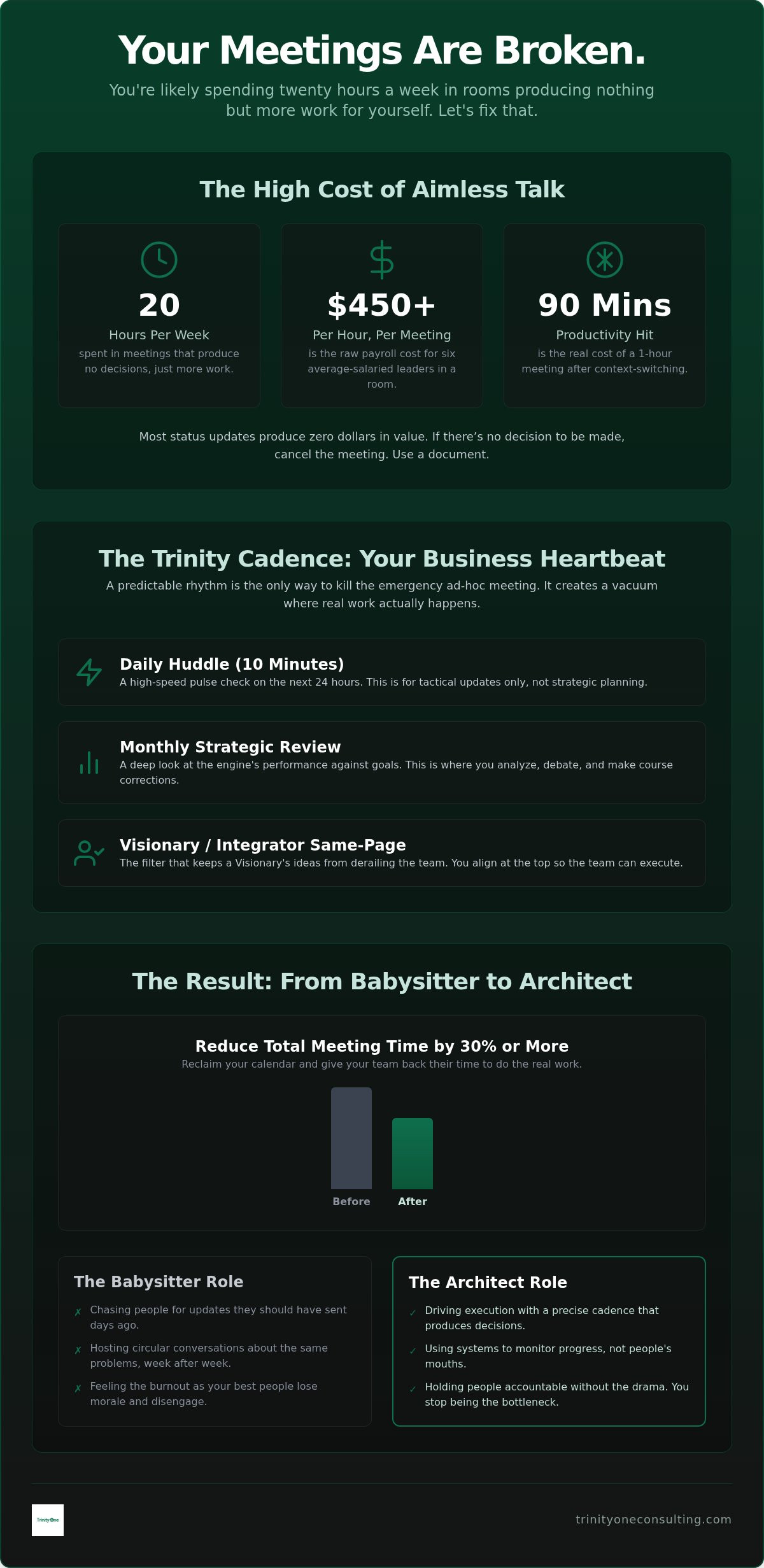
You will replace aimless talk with a precise operating cadence that drives execution. The Trinity Cadence can cut your total meeting time by 30 percent or more while making your strategic goals actually happen. You stop being the bottleneck and start being the architect.
This approach requires a shift from talking about work to demonstrating progress through a unified system. We will look at the exact structure of a high-performance meeting and how to hold people accountable without the drama.
Key Takeaways
- Conduct a hard audit of your calendar to identify and kill every recurring meeting that doesn't result in a specific decision.
- Establish a precise operating cadence to serve as the mechanical heartbeat of your business and reduce the need for disruptive ad-hoc sessions.
- Learn how to improve meeting productivity and reduce your total meeting time by 30 percent by replacing manual status updates with the Trinity Cadence.
- Apply the Dream Manager methodology by Matthew Kelly to align individual personal growth with your company's strategic goals.
- Shift your role from a babysitter to an architect by using AI-native systems to monitor progress and maintain high accountability.
Why does your team hate your meetings?
Your team doesn't hate collaborating. They hate the feeling of their life force leaking out of their ears while you talk about things that could've been an email. Most unproductive meetings are a direct failure of your operational architecture. If you don't have a system, you have chaos.
I've sat in those rooms. People are staring at their laptops, nodding along, and counting the minutes until they can get back to their real work. Research in Meeting science shows that bad meetings don't just waste time. They actively damage employee engagement and morale. When a meeting lacks a clear output, it feels like a chore rather than a contribution.
The root cause is often a lack of a clear Integrator role. Without someone to act as the architect of the session, conversations become circular. You talk about the same problems week after week without ever reaching a resolution. This is how you burn out your best people.
The high cost of aimless talk
Let's look at the math. If you put six people in a room with an average salary of 150,000 dollars, that meeting costs your business about 450 dollars per hour in raw payroll. That doesn't include taxes, benefits, or the opportunity cost of the work they aren't doing. Most status updates produce zero dollars in value.
The hidden tax is context switching. It takes a focused manager nearly twenty minutes to get back into a deep work state after an interruption. A one hour meeting actually costs you ninety minutes of productivity per person. You're paying a premium for a distraction.
If the goal is just sharing information, cancel the meeting. Use a document. Use a screen recording. Meetings should be for making decisions that require the collective brainpower of the group. If there's no decision to be made, there's no reason to meet.
The Visionary and Integrator friction
I've seen it a thousand times in my coaching. A Visionary CEO walks into a tactical meeting and drops a new idea grenade. Suddenly, the team stops working on the quarterly goals to chase a shiny object. The meeting gets hijacked, and the original agenda dies on the table.
This is why you need a Fractional COO or a strong Integrator to keep the rails on the conversation. Their job is to protect the team's focus and ensure that "new ideas" go through a proper vetting process rather than derailing the current sprint. You need to understand how to improve your visionary and integrator relationship to stop this cycle.
Without that discipline, you'll never learn how to improve meeting productivity. The tradeoff for a creative, high-energy leader is that they need a system to ground their ideas. If you don't have that balance, your meetings will always feel like a waste of time.
How can you build a precise operating cadence?
An operating cadence is the mechanical heartbeat of your business. Without it, your company is an engine with mistimed pistons. You're burning high-octane fuel, but the car isn't moving forward. If you want to know how to improve meeting productivity, you must stop looking at meetings as isolated events.
A predictable rhythm is the only way to kill the emergency ad-hoc meeting. When your team knows they have a specific time to bring up issues, they stop knocking on your door every ten minutes. It creates a vacuum where real work actually happens. I believe we are called to steward our time and our people with excellence.
I often see businesses where the fractional integrator acts as the cadence manager. They ensure the gears mesh perfectly. This role prevents the friction that usually grinds a growing company to a halt.
Establishing your business rhythm
A daily huddle is a ten minute pulse check on the next 24 hours. A monthly strategic review is a deep look at the engine performance. They serve different purposes and you should never mix them. Mixing tactical updates with strategic planning is a recipe for a three hour meeting that solves nothing.
Same day and same time are non-negotiable requirements for meeting productivity. If you move the meeting, you tell your team that the system is optional. Consistency builds trust, but it requires a level of discipline that most founders find painful at first.
A same-page meeting between the CEO and COO prevents top-down chaos. It's the filter that keeps the Visionary's latest brainstorm from becoming the team's latest nightmare. You align at the top so the bottom can execute without second-guessing.
The role of the fractional COO in meetings
A fractional COO manages this cadence without the six figure overhead of a full-time executive. They are the Integrator in the room. They police the agenda and stop the tangents that eat your afternoon. The tradeoff for this level of precision is rigidness, which can feel restrictive to a creative founder.
Their primary job in the room is to be the bad guy for the sake of the clock. They cut off the long stories and the what ifs. They force the group back to the data and the current rocks. If your current meetings feel like a circle with no exit, you can book a cadence check-in to see where your engine is skipping a beat.
They also turn aimless talk into actual project tasks. If a decision is made, it gets assigned a name and a due date before anyone leaves the room. Talk is cheap, but execution requires clear ownership and a deadline.
What are the steps to fix a broken meeting?
Open your calendar right now and look at every recurring invite. If a meeting has been on the books for three months and you can't name the last three major decisions it produced, delete it. You can always add it back later if the wheels fall off. This audit is the most aggressive way to learn how to improve meeting productivity.
I've found that most meetings are just expensive support groups for people who are afraid to make a call. If the goal isn't a specific decision, don't have the meeting. You're paying for results, not for people to sit in a circle and agree with each other. Talk is cheap, but a decision has a price and a deadline.
Limit the room to the deciders and the primary data sources. If someone is there just to stay in the loop, they're costing you money while doing nothing. Spectators belong in the stands, not on the field. You're running a business, not a theater.
Use a physical timer on the table. When people see the seconds ticking down, they stop telling long stories and get to the point. It creates a sense of controlled urgency that keeps the engine running hot. If the timer hits zero, the conversation ends.
The 24-hour agenda rule
I enforce a "no agenda, no attendance" policy in my own work. Every meeting owner must post their agenda at least one day in advance. If it's not there, the meeting is automatically cancelled. No exceptions and no excuses.
This rule forces the organizer to actually think before they steal an hour from five other people. It protects your team's focus from being shattered by a whim. The tradeoff is that some sessions might get delayed because of a lack of prep, but that's a price worth paying for a disciplined culture.
Managing the office bore and the tangent
Every meeting needs a "parking lot" list for ideas that don't fit the current agenda. When a great idea comes up that isn't on the map for today, write it down and move on. Don't let a shiny object derail the current sprint. A big part of how to improve meeting productivity is simply refusing to let one person hold the room hostage.
Stick to a two-minute rule for individual updates. If a person can't explain their progress in 120 seconds, they don't understand their own work well enough yet. I've had to cut people off mid-sentence to keep us on the clock. It feels harsh at first, but it's an act of kindness to the rest of the group.
You're protecting their time from being stolen by someone else's lack of brevity. A company only becomes the best version of itself when its people are becoming better versions of themselves. That starts with respecting their time and their focus. If you can't lead a meeting, you can't lead a team.
Why does personal growth drive meeting engagement?
You can't fix a meeting with a better icebreaker or free donuts. Real engagement happens when an employee sees a direct line between your company's success and their personal life. I use the Dream Manager methodology, created by Matthew Kelly, to bridge this gap.
A company only becomes the best version of itself to the extent its people are becoming better versions of themselves. If your team feels like they're just cogs in your machine, they'll check out mentally before the first slide. This is a primary factor in how to improve meeting productivity over the long term.
When we look at the twelve dream categories, we see everything from physical health to financial stability. These aren't just nice to haves. They're the engine of human motivation. A person with a clear personal goal is a person who shows up to a meeting ready to execute.
Through dream manager coaching, we build a culture where high performance is the byproduct of personal growth. It's a fundamental shift in how you view your staff. You move from being a boss to being a partner in their success.
Connecting dreams to the daily huddle
Imagine knowing that your lead developer is working late because they want to buy their first home. That changes the entire dynamic of your daily huddle. You aren't just asking for a status update on a piece of code. You're checking in on the progress of their dream.
This is the shift from doing a job to funding a dream. When work becomes the vehicle for a personal win, the friction of accountability disappears. People stop making excuses because they aren't just letting you down. They're letting themselves down.
This level of alignment is exactly how to improve meeting productivity without using a stopwatch. The team polices itself because they all have skin in the game. They want the meeting to be fast and effective so they can get back to the work that matters.
Implementing the Dream Manager program
I am a certified Dream Manager, and I've seen this program change the trajectory of struggling firms. It isn't a surface-level HR initiative. It's a deep commitment to the individual humans on your payroll.
The 1-on-1 coaching happens outside of your standard operational meetings. This keeps your tactical sessions focused on the business while ensuring the human element isn't ignored. It's a separate track that feeds back into your company's performance.
The tradeoff is time and vulnerability. You have to be willing to listen to things that aren't about business. If you aren't ready to care about your team's lives, this program will fail. My faith reminds me that every person has inherent value beyond their output.
How does an AI-native system change the way you meet?
Manual prep is the silent killer of your Tuesday mornings. You spend hours digging through spreadsheets and Slack threads just to prepare for a thirty minute update. When you use an AI-native business operating system like Trinity Cadence, that friction disappears. You learn how to improve meeting productivity by letting the machine handle the data collection.
I've seen leaders waste half their week just trying to get a clear picture of what's actually happening in their own company. AI coaching provides real-time visibility into execution without you having to ask a single question. It connects the technical performance of your systems with the human performance of your team. You stop guessing and start knowing.
Automating the operating cadence
Trinity Cadence tracks your high-level strategy and your daily huddles in one integrated circuit. This creates a digital single source of truth for every decision your team makes. You don't have to argue about the numbers because the numbers are right there on the screen. It removes the emotional weight of status updates.
AI also identifies engagement gaps before they turn into resignation letters. If a team member's output or participation patterns shift, the system flags it as a potential burnout risk. You can address the human need before it becomes an operational failure. This is how a company becomes the best version of itself.
The future of the meeting huddle
The worst question you can ask in a meeting is "what are you working on?" If you have to ask that, your system has already failed. In a high-performance huddle, everyone already knows the status of every project. You only discuss the blocks that are stopping the engine from moving forward.
This shifts your management style from reactive to proactive. You aren't putting out fires that started three days ago. You're clearing the path for work that needs to happen three days from now. It's a faster, leaner way to run a business that respects everyone's time.
The tradeoff is that you have to trust the data over your gut. Some leaders find it hard to stop the interrogation style of management. But the result is a 30 percent reduction in meeting time and a team that actually enjoys the process of execution. I believe we are called to be wise stewards of the tools available to us.
Stop talking and start executing
You have the tools to reclaim thirty percent of your week. Meeting productivity isn't a soft skill. It's a technical discipline that requires a mechanical cadence and deep human alignment.
When you master how to improve meeting productivity, you stop being the bottleneck in your own business. You replace aimless talk with the AI-native Trinity Cadence platform. This gives you the visibility you need to drive execution without the constant check-ins.
I also use Certified Dream Manager facilitation to ensure your people are personally invested in the outcome. A company only becomes the best version of itself to the extent its people are becoming better versions of themselves. My faith tells me that every person in your room has a purpose beyond their job description.
You don't have to keep grinding through a calendar that exhausts you. Build the engine that lets your team thrive and your business grow. I'm ready when you are.
Frequently Asked Questions
How do I reduce meeting fatigue without missing important updates?
You can reduce meeting fatigue by shifting status updates to an asynchronous system. Use a tool like Trinity Cadence to provide a dashboard of progress so you don't need a live meeting just to hear what happened yesterday. This reserves your face-to-face time for solving complex problems. It's a technical fix for a human energy problem that keeps your team focused on their work.
What is the ideal length for a weekly leadership meeting?
Ninety minutes is the hard ceiling for a productive leadership session. If you can't solve your top three issues in an hour and a half, you aren't being decisive enough. I recommend a 60-minute block for most teams. Shortening the duration forces people to stop the small talk and get to the data that actually moves the needle for the company.
Should I cancel a meeting if the agenda is not ready?
I always cancel the meeting if the agenda isn't ready 24 hours in advance. A meeting without an agenda is just a group of people wasting company money on aimless talk. Enforcing this rule teaches your team that their time is valuable and prep work is mandatory. It feels uncomfortable at first, but it stops the cycle of unproductive calendar bloat.
How can I tell if a meeting should have been an email?
If the primary goal is one-way information sharing, it should be an email or a document. Meetings are for debate, decision-making, and alignment. If you don't need a back-and-forth conversation to reach a conclusion, don't book the room. Learning how to improve meeting productivity starts with recognizing that most updates are better handled in writing or through a digital dashboard.
What is an operating cadence in business?
An operating cadence is the mechanical rhythm of your business cycles. It's the predictable schedule of daily huddles, weekly tactical meetings, and monthly strategic reviews. This heartbeat ensures that every part of the engine is firing at the right time. Without a cadence, you're constantly reacting to emergencies instead of executing a clear plan. It provides the structure your team needs to perform.
How does the Dream Manager program help with meeting productivity?
The Dream Manager program, which I attribute to Matthew Kelly, aligns personal dreams with professional performance. When an employee sees that hitting company goals helps them buy their first house or finish a degree, they show up to meetings with a different level of intensity. They want the meeting to be effective so they can get back to doing the work that funds their life. It drives real engagement.
What are the benefits of an AI-native operating system for meetings?
An AI-native system like Trinity Cadence provides real-time visibility into project execution. It removes the need for manual status reports because the data is already integrated into the platform. You walk into the room knowing exactly where everyone stands. This is a primary strategy for how to improve meeting productivity by cutting out the fluff and focusing on blocks that stop progress.
How do I handle a team member who talks too much in meetings?
You must be the referee and cut them off politely but firmly when they go off on a tangent. Use a timer to give every person exactly two minutes for their update. If they go over, tell them to put the rest of their thought in the parking lot for later. Protecting the group's time is an act of leadership that everyone appreciates.