
Your calendar is full, but your business is drifting. You've spent 40 hours this week in meetings, yet you're still firefighting problems that should've been solved months ago. Learning how to establish a rhythm of business means more than adding appointments to your digital planner. You're building a mechanical engine that synchronizes human performance with operational execution.
I know the frustration of watching a vision stall because the team lacks a clear cadence. You want a predictable weekly and monthly schedule where everyone knows their role. It's exhausting to feel like the only one pushing the boulder uphill. I've been there as an operator and a coach for 30 years.
I'll show you how to build a predictable operational engine that aligns your team and technology without the usual corporate friction. This system requires absolute discipline and will expose underperformers quickly. It is bad at accommodating cultures that avoid accountability, but it creates real-time visibility into what's actually happening on the ground.
We'll break down the specific meetings and data flows required to keep your people focused. I'll explain how the right rhythm increases employee retention by connecting their personal growth to company performance. A company only becomes the best version of itself when its people are becoming better versions of themselves. Let's get to work.
Key Takeaways
- A rhythm of business is the mechanical heartbeat of your organization. It synchronizes your team better than a pile of calendar invites.
- Learn how to establish a rhythm of business by connecting annual strategy to daily execution through specific operational gears.
- Match your meeting frequency to the actual speed of your industry to avoid the high cost of corporate rigidity.
- Identify why the CEO is usually the worst person to manage the operational engine and how an Integrator fixes that friction.
- Apply the Dream Manager methodology to bridge the gap between company output and employee personal growth.
What is a rhythm of business?
A rhythm of business is the mechanical heartbeat of your organization. It is the sequence of meetings and reports that move strategy into execution. I define it as the engine that turns your vision into a predictable result. Without it, your company is just a collection of people reacting to emails and shouting into the void.
Most leaders treat their operations like a series of isolated events. They hope that if they hire good people and work hard, the results will follow. Hope is not a strategy. Understanding how to establish a rhythm of business starts with realizing that execution is a mechanical process, not a creative one.
I believe we are called to be good stewards of the business and the people in our care. This requires a system that ensures work is done correctly and people are treated with respect. A functional rhythm provides that system by creating a predictable environment where everyone can succeed.
The difference between a schedule and a rhythm
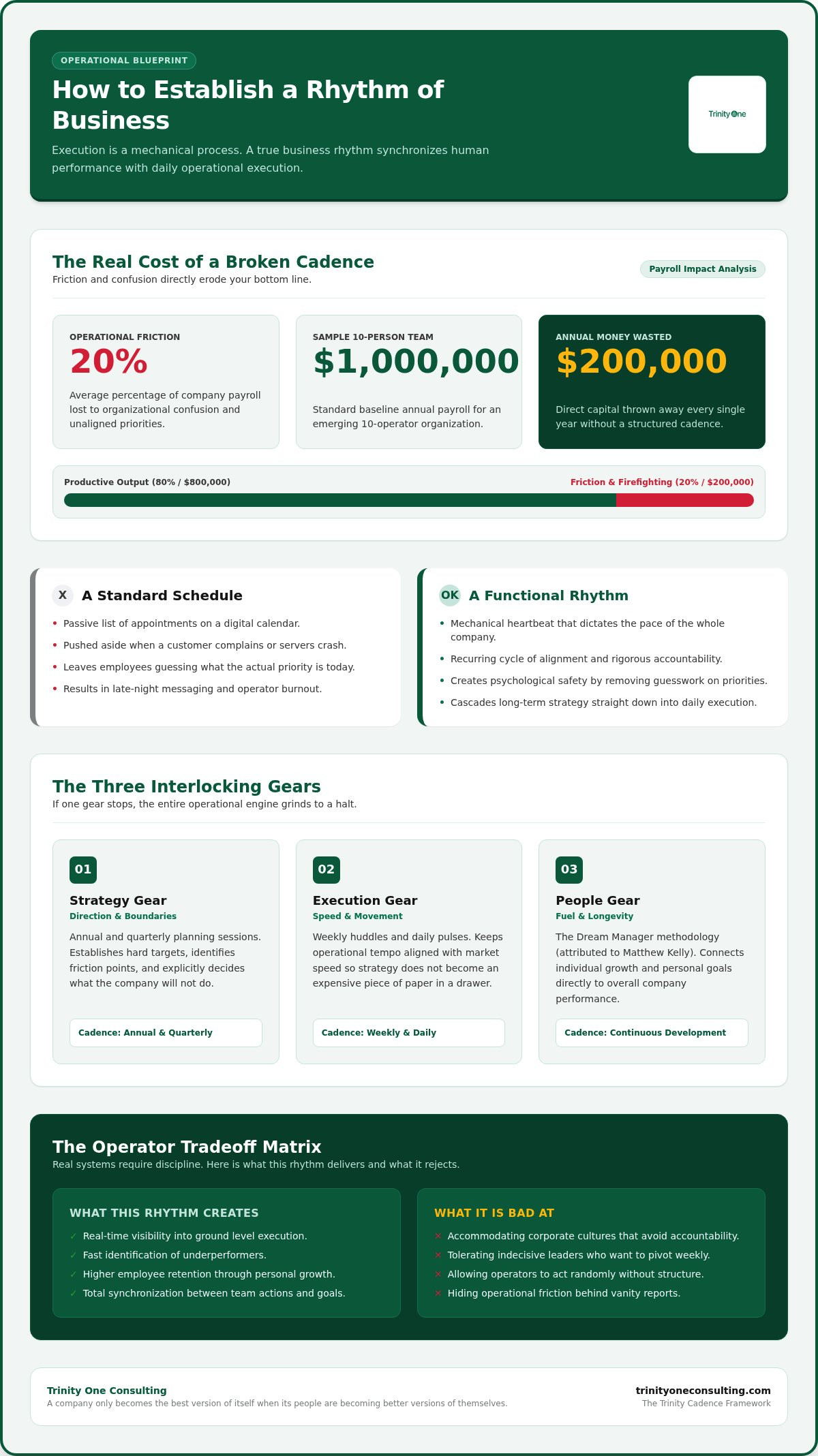
A schedule is a list of things you might do. It is passive. It lives on a calendar and gets pushed aside the moment a customer complains or a server goes down. A rhythm is a commitment to how the business breathes. It is a recurring cycle of alignment and accountability that dictates the pace of the entire company.
This structure acts as the core of your organizational operating model. When you commit to a rhythm, you create a sense of safety for your team. They stop wondering what the priority is today because the rhythm provides the answer. It eliminates the guessing game that kills productivity in small teams.
A functional rhythm is a sequence. It starts with high level vision and cascades down into daily actions. It ensures that every person in the building knows exactly how their work connects to the quarterly goals. This is not micromanagement. It is synchronization.
The cost of a broken business cadence
Broken rhythms lead to expensive firefighting sessions that drain your energy and your bank account. You lose about 20 percent of your payroll to friction and confusion. If you have a 10-person team with a million dollar payroll, you are throwing 200,000 dollars away every year. That is the price of chaos.
I have seen CEOs pay for this with their health and their families. They stay up until 2 AM answering Slack messages because the team doesn't have a structured time to get answers. The friction creates a gap between the vision in your head and the output of the team. That gap is where burnout lives.
This engine is bad at handling indecisive leaders who want to pivot every week. It requires a level of discipline that many corporate environments simply can't sustain. The tradeoff for a predictable result is the loss of your ability to be random. I follow a specific process to build this engine for my clients using the Trinity Cadence to ensure nothing falls through the cracks.
What are the core parts of a functional business rhythm?
A functional rhythm consists of three main gears that must interlock perfectly. When you look at how to establish a rhythm of business, you have to address each one with equal discipline. If one gear stops, the entire engine grinds to a halt. Strategy sets the direction. Execution provides the movement. People provide the fuel that keeps the engine running over the long haul.
Strategy happens in annual and quarterly planning sessions. We don't just talk about growth in a vacuum. We set hard targets and identify the obstacles. This is where we decide what we are not going to do. Making those trade-offs is the only way to keep the team focused on what actually moves the needle.
The daily work lives in the weekly huddles and daily pulses. These meetings are short and focused on high-speed alignment. They ensure that the cadence of the work matches the speed of the market. If your execution gear is slipping, your strategy is just an expensive piece of paper sitting in a drawer.
Understanding how to establish a rhythm of business means recognizing that people performance happens through the Dream Manager program. We don't treat employees like line items on a spreadsheet. We treat them like humans with aspirations. I believe we have a responsibility to help our people grow beyond their job descriptions.
The Trinity Cadence AI operating system
We use an AI-native platform to track these gears in real time. It is called Trinity Cadence. This tech provides a unified view of your team’s engagement without you having to chase people for status updates. It eliminates the manual friction of traditional reporting.
AI coaching identifies where execution is stalling before it becomes a crisis. It acts as an early warning system for the CEO. You can see how to create a business operating system that survives the noise of a growing team. This visibility allows you to lead with data rather than just gut feeling.
Integrating the Dream Manager methodology
A true rhythm includes 1-on-1 coaching for personal dreams. We use Matthew Kelly’s concept of the Dream Manager to bridge the gap between company goals and human motivation. People work harder for you when they know you are helping them achieve their 12 categories of dreams. This is how you build a culture of loyalty.
These categories include physical health, emotional well-being, financial stability, and spiritual growth. When an employee sees that their work helps them buy their first home or run a marathon, their commitment shifts. You can learn more about our Dream Manager program to see how it integrates with your operational schedule.
If you're tired of guessing why your team is disengaged, it's time to fix the people gear. A company only becomes the best version of itself when its people are becoming better versions of themselves. You can book a quick call to see how these gears fit your specific headcount.
How do you choose the right meeting frequency for your team?
Frequency isn't a guess. It depends entirely on how fast your industry moves. A tech startup needs a tighter loop than a commercial construction firm. When you are learning how to establish a rhythm of business, you must calibrate the frequency to your specific operational speed.
Too many meetings create fatigue. This is the cost of rigidity. If your team spends six hours a day in "sync" calls, they aren't actually doing the work. You are paying for them to talk about work instead of executing it. It is an expensive way to accomplish nothing.
Too few meetings create drift and misalignment. Without a regular pulse, the team loses sight of the vision. Misalignment leads to rework and wasted resources. I've seen it cost companies thousands in lost billable hours because two departments were working on opposing goals for a month.
I recommend a 15 minute daily huddle and a 90 minute weekly meeting. This is the baseline for most teams between 10 and 50 people. It provides enough structure to catch errors without suffocating the team. I believe every person has a God-given potential that deserves a structured environment to flourish.
The Daily Huddle vs The Weekly Level 10
The daily huddle is about synchronization. It is not for problem solving. You state what you did yesterday, what you are doing today, and where you are stuck. This keeps the McKinsey's analysis of organizational operating rhythms in mind by ensuring high-performance accountability through a tight loop.
Weekly meetings are for identifying and solving the biggest roadblocks. We call this the Level 10 meeting. I have seen teams save 10 hours a week by moving to this structure. It stops the constant "quick questions" that interrupt deep work. You save the issues for the weekly meeting and solve them once.
Monthly and Quarterly resets
Monthly meetings focus on the financial health and Dream Management progress. We look at the P&L and the 12 categories of dreams from Matthew Kelly. This ensures the people are growing alongside the profit. It is a time to breathe and check the vitals of the organization.
Quarterly sessions are for checking the compass and adjusting the 90 day plan. These sessions prevent the team from getting lost in the weeds. You spend a full day off-site to reset the engine. It is the only way to ensure your vision remains the priority. If you don't step back, you'll just keep running in the wrong direction.
How do you establish a rhythm of business that actually sticks?
Establishing a rhythm of business isn't a suggestion. It is a mechanical overhaul that requires a clear start date and zero exceptions. If you let one meeting slide because of a "client emergency," the entire engine stalls. You must be willing to trade your personal flexibility for organizational speed.
I follow a specific process to build this engine for my clients. It starts with the CEO surrendering the need to run every meeting. You cannot be the architect and the foreman at the same time. If you are leading the sync, you aren't watching the gears.
Learning how to establish a rhythm of business means naming the tradeoffs upfront. You will have less room for random pivots, but you will gain the ability to move faster than your competitors. This discipline is what separates a hobby from a high-performance organization.
Step by step implementation
Step 1 is a calendar audit. Look at your current schedule and delete 50 percent of the junk that doesn't drive execution. Most "check-ins" are just placeholders for poor communication and lack of a system.
Step 2 is the "Same Day, Same Time" rule. Your weekly leadership meeting happens at the same time every week, no matter what. If someone is missing, the meeting continues. This creates a gravity that pulls the rest of the business into alignment.
Step 3 is defining the metrics you will track in your Trinity Cadence dashboard. You need to see the red and green lights without asking for a manual report. This data provides the clinical precision needed to make fast decisions.
Step 4 is launching your Dream Manager program to get the people gear turning. This connects the personal aspirations of your team to the output of the company. It ensures that as the business wins, the individuals win too.
Managing the change with your team
Be honest with your team about why the old way failed. Tell them that the firefighting and the 60-hour weeks are symptoms of a broken system. They know it's not working, and they're waiting for you to provide a steady path forward.
Show them how this rhythm gives them their time back. A structured cadence eliminates the need for 20 "quick sync" calls throughout the week. I believe your team wants to win. They just need the rules of the game to be clear and consistent.
You can read more about how a Fractional Integrator engineers this engine for growth. It takes the burden of management off the CEO's shoulders so they can focus on the vision. This is how you bridge the gap between the vision in your head and the reality of your results.
Should you hire someone to manage your business rhythm?
The CEO is usually the worst person to run the rhythm. You are the Visionary. Your job is to live in the future and spot the next big opportunity. When you try to manage the daily pulse, you get stuck in the weeds and the business loses its direction.
You need an Integrator. This person is the architect of the engine. They ensure the gears are turning and the team is aligned. While you focus on where the company is going, the Integrator focuses on how it gets there. It is a binary structure that creates balance.
Understanding how to establish a rhythm of business requires recognizing your own limitations. I've seen brilliant leaders fail because they refused to give up the clipboard. They wanted to be the quarterback and the coach at the same time. It doesn't work in football, and it doesn't work in business.
I believe we are called to lead with clarity and purpose. This means putting the right people in the right seats. A Fractional COO can build this system for you in a 90 day sprint. It is a fast-paced implementation that sets the foundation for years of growth.
The role of the Fractional Integrator
The Integrator manages the cadence and removes the friction. They hold the team accountable so you don't have to be the "bad guy" in every meeting. This preserves your relationship with your leadership team and keeps the culture healthy.
I provide fractional COO services to help leaders get out of the trenches. My goal is to build an engine that runs without your constant intervention. We set the rules, build the dashboard, and train the team to execute without you.
This role allows the Visionary to stay in the future. You can focus on big deals and long-term strategy while the Integrator ensures the daily work is done. It is the only way to scale a business beyond your own personal capacity.
When to use an AI-native operating system
Manual tracking is a trap for busy leaders. If you have to spend your Sunday night updating a spreadsheet, the system is broken. You need real-time visibility that doesn't require manual labor. Manual systems always fail when things get busy.
Trinity Cadence acts as a digital Integrator for your team. It keeps the rhythm alive even when you are on vacation or focusing on a new product launch. It provides the clinical precision of technology to support the depth of human development. This is how to establish a rhythm of business that actually survives the noise of a growing company.
Establishing this system is about building something that outlasts your own energy. It is the only way to ensure the company becomes the best version of itself. Let's build an engine that drives execution every single day.
Build your business engine for the long haul
Stop treating your operations like a series of accidents. You now have the mechanical structure for how to establish a rhythm of business that holds the line when things get messy. I've spent 30 years in the trenches as an operator and a football coach.
Winning teams aren't lucky. They're disciplined. You have to decide if you want to keep firefighting or build an engine that runs without you.
Your company's growth is tied to your people's growth. As a Certified Dream Manager, I've seen how aligning personal dreams with corporate goals changes everything. I believe we're called to be good stewards of the businesses we lead.
It's time to get out of the weeds and start leading.
Frequently Asked Questions
What is the first step to establish a rhythm of business?
The first step to establish a rhythm of business is a brutal audit of your current calendar. You must identify and delete at least 50 percent of the meetings that aren't driving real results. This clears the space for a functional engine to actually turn.
Most leaders are afraid to cut the fluff because they confuse activity with progress. You have to stop the noise before you can start the music.
How long does it take to see results from a new business cadence?
You'll start to see the first signs of alignment within 30 days, but a full engine reset takes about 90 days. The first month is usually painful as the team adjusts to the new discipline. By the second month, the friction begins to drop and the clarity increases.
Building the engine is a sprint. Maintaining it is the daily work of leadership.
Can a rhythm of business be too rigid for a creative team?
A rhythm protects your creative team. It provides the boundary that keeps their deep work safe from interruptions. When you learn how to establish a rhythm of business, you give your designers and writers 10 to 15 hours of their week back.
Structure provides the safety they need to take risks. Without a rhythm, your creatives spend all their energy reacting to the chaos instead of producing.
Is a rhythm of business the same thing as a meeting schedule?
A rhythm of business is different from a simple meeting schedule. A schedule is a passive list of events that people often ignore or reschedule. A rhythm is a commitment to a recurring cycle of alignment and accountability.
It's the mechanical heartbeat of the organization. While a schedule tells you when to show up, the rhythm dictates how the business actually executes its strategy.
What happens if we miss a weekly meeting in our cadence?
If you miss a weekly meeting, the engine stalls and drift sets in immediately. Consistency is the gravity that holds your team together. I've never seen a winning team that treated practice as optional. When meetings become secondary, accountability disappears.
I tell my clients that the "Same Day, Same Time" rule is absolute. If you allow exceptions, you're telling your team that the system doesn't actually matter.
Do small teams with under five people need a rhythm of business?
Small teams of three to five people actually need a rhythm more than large corporations. In a small group, one person drifting off course can derail the entire company in a matter of days. Establishing a cadence early prevents the bad habits that make scaling impossible later on.
It builds the operational muscle you'll need when you hit 20 or 50 employees. Start the discipline before you have the complexity.
How does AI help maintain a business rhythm?
AI helps maintain the pulse by providing real-time visibility into execution without manual reporting. Trinity Cadence acts as an early warning system that identifies where work is stalling before it becomes a crisis. It removes the burden of chasing people for status updates.
This technology ensures the rhythm stays alive even when you're focused on long-term vision. It provides the clinical precision that human intuition often misses.
Who is responsible for enforcing the rhythm of business?
The Integrator is the person responsible for enforcing the rhythm. The CEO is usually the worst person for this role because they're wired for vision. You need a dedicated architect who cares about the engine's performance every single day.
Knowing how to establish a rhythm of business means putting a dedicated owner in charge of the cadence. This allows the leader to stay in the future while the business executes in the present.