
Your team doesn't have a productivity problem. They have a cadence problem. Establishing a rhythm of business requires a predictable schedule that connects your team's daily output to your long-term vision. Using a rhythm of business template is the only way to stop the vision in your head from dying on a Tuesday afternoon.
I'll show you how to build a predictable operational engine. This system aligns your team and technology without the usual corporate friction. It's about execution. In 2026, AI tools can handle the administrative heavy lifting, but they can't replace a human rhythm.
We're going to map out a weekly and monthly schedule that provides visibility into every project. I'll explain how to use the Dream Manager methodology by Matthew Kelly to ensure your people are growing as the business scales. I believe our highest calling is helping people grow while we manage the spreadsheets. You'll see exactly how to close the gap between your strategy and your team's output.
Key Takeaways
- A rhythm of business functions as a mechanical engine that synchronizes your strategy with daily execution.
- Meeting frequencies must match the actual speed of your industry or you will face the high cost of rigidity.
- A rhythm of business template provides the structure needed to turn a chaotic calendar into a predictable execution engine.
- The CEO is often the wrong person to manage the rhythm and should hire an Integrator to architect the system.
- A well-defined rhythm of business can foster an environment where individual aspirations contribute directly to organizational achievements.
What is a rhythm of business?
A rhythm of business is the mechanical heartbeat of your organization. It's the specific sequence of meetings and reports that moves your strategic planning into daily execution. I define it as the engine that turns your vision into a predictable result. Without it, your company is just a collection of people reacting to emails and Slack notifications.
Your team needs a reliable cadence to function. When you use a rhythm of business template, you stop guessing what needs to happen next. You start operating with the precision of an integrated circuit. It's the difference between a group of people working in the same building and a synchronized unit moving toward a single goal.
This engine doesn't just happen. It requires an architect to design the gears and a dedicated operator to keep them turning. In my work as a fractional COO, I see too many leaders try to wing it. They think they can lead by "feeling" the room, but feelings don't scale. Systems do.
The difference between a schedule and a rhythm
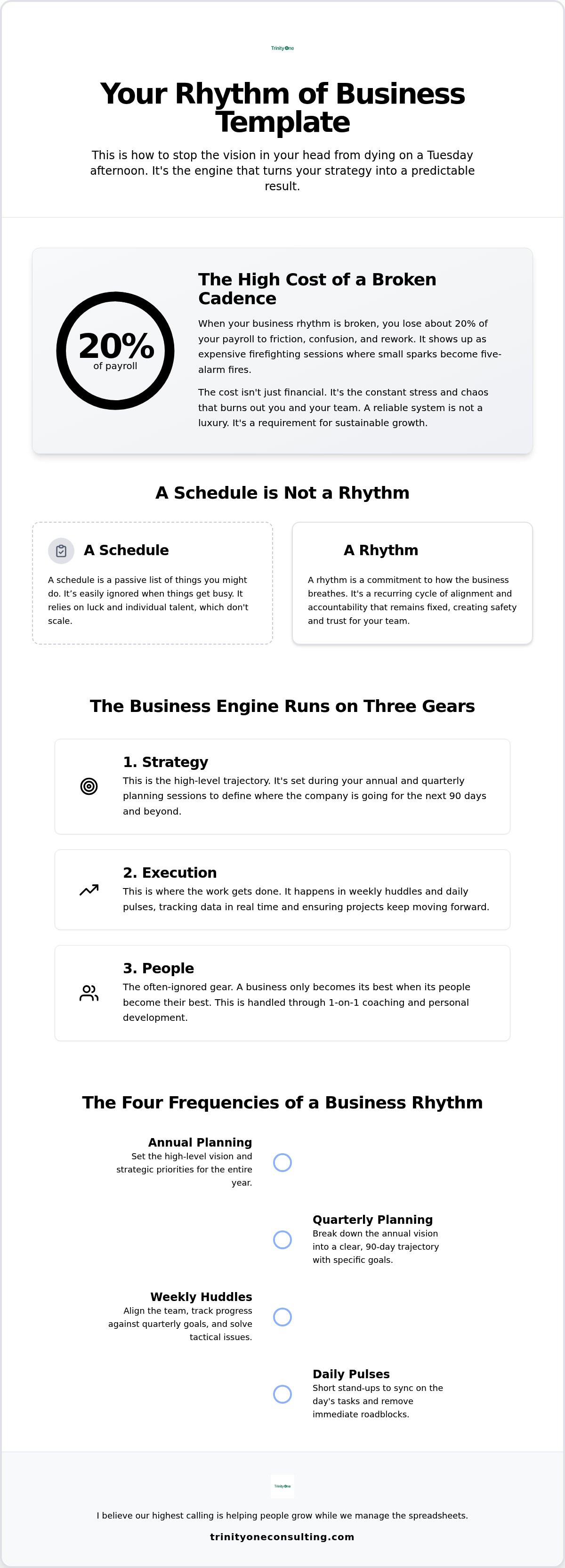
A schedule is a list of things you might do if you have time. It's passive and easily ignored when things get busy. A rhythm is a commitment to how the business breathes. It's a recurring cycle of alignment and accountability that remains fixed regardless of the daily noise.
Rhythms create a sense of safety for your team. When people know exactly when they will be heard, they stop interrupting your day with "quick questions." They trust the system to catch the details. This reliability allows for deep work and higher engagement across the board.
Think of it as the difference between a pickup game and a choreographed play. One relies on luck and individual talent. The other relies on a system that works every time. A true rhythm of business template ensures that every person knows their position and the timing of the next move.
The cost of a broken business cadence
Broken rhythms lead to expensive firefighting sessions. When communication is sporadic, small sparks turn into five-alarm fires before you even notice them. You end up losing about 20 percent of your payroll to friction, confusion, and rework. That's money that could've gone to profit or expansion.
I've seen CEOs pay for this with more than just money. They pay with their health and their families. Constant stress from a chaotic operation isn't a badge of honor. It's a sign that your engine is misfiring and destroying its own components.
Faith tells me we're called to steward our resources well. Your time and your people are those resources. Leaving them to drown in a sea of unorganized tasks is a failure of leadership. It's time to build the engine properly.
What are the core parts of a rhythm of business template?
A functional business rhythm operates through three main gears: strategy, execution, and people. If one gear stops, the entire engine grinds to a halt. You can't just create a rhythm of business model and expect it to run without maintenance. Your rhythm of business template must account for the specific friction points in your industry.
Strategy happens in your annual and quarterly planning sessions. These are the high-level sessions where you set the trajectory for the next 90 days. Execution happens in the weekly huddles and daily pulses. This is where the work gets done and the data gets tracked in real time.
People performance is the often-ignored third gear. It happens through 1-on-1 coaching and specialized development. A business only becomes the best version of itself to the extent its people are becoming better versions of themselves. I've seen teams with 50 employees fail because they ignored the human element while chasing a spreadsheet goal.
The Trinity Cadence AI operating system
We use an AI-native platform called Trinity Cadence to track these gears. This isn't a simple dashboard for your KPIs. AI coaching identifies where execution is stalling before it becomes a crisis. It flags a project that hasn't moved in 48 hours so you can intervene early.
This technology provides a unified view of your team's engagement and output. You can see who is hitting their targets and who is burning out from meeting overload. If you want to see how this fits into a larger business operating system, you have to look at the data daily. Execution is a game of inches.
Integrating the Dream Manager methodology
I follow Matthew Kelly's concept of the Dream Manager. A true rhythm of business template must include 1-on-1 coaching for personal dreams. It sounds soft to some corporate types, but it's the hardest operational truth I know. People work harder for you when you help them achieve their 12 categories of dreams.
These categories, defined by Matthew Kelly, include physical, emotional, intellectual, and spiritual goals. When an employee sees that their job is the vehicle to their own success, their loyalty changes. They stop looking for the exit and start looking for ways to win. If you're struggling to find this balance, let's look at your current cadence together.
Faith is my foundation, but I know that faith without works is dead. You have to put the systems in place to support the people you lead. That's why I use the Dream Manager program to bridge the gap between corporate output and human fulfillment. It's a mechanical solution to a human problem.
How do you choose the right meeting frequency for your rhythm of business template?
Frequency depends on the speed of your industry. A high-growth software company needs a different pulse than a legacy manufacturing plant. You have to match the frequency of your meetings to the rate of change in your market. Using a rhythm of business template allows you to visualize this pulse before you commit it to the digital calendar.
Too many meetings create fatigue. This is the cost of rigidity. When your team spends six hours a day on Zoom, they aren't executing. They're performing for the camera. Fatigue is a silent killer in high-growth companies. When meetings feel like a waste of energy, your best people start looking for the exit.
Too few meetings create drift and misalignment. Without a consistent pulse, your team will start making assumptions. Assumptions are the friction that kills your profit margins. It's the slow, quiet gap that opens between what you think is happening and what the team is actually producing. A consistent rhythm closes that gap before it costs you a contract.
I recommend a 15 minute daily huddle and a 90 minute weekly meeting. This combination provides enough gravity to keep everyone in orbit without weighing them down. It's the baseline for any fractional COO looking to stabilize an erratic operation. I believe we're called to lead with excellence because our work is a reflection of our character.
The Daily Huddle vs The Weekly Level 10
The daily huddle is about synchronization. It's a stand-up meeting where each person shares their top priority and any "stucks." It is not a place for problem solving. If a discussion takes more than two minutes, it moves to a separate breakout or the weekly meeting. The goal is a quick pulse check, not a deep dive.
Weekly meetings are for identifying and solving the biggest roadblocks. This is where you look at your KPIs and tackle the issues that are stalling your progress. I've seen teams save 10 hours a week by moving to this structure. They stop the endless "quick calls" because they know the big issues will be handled on Tuesday morning.
Monthly and Quarterly resets
Monthly meetings focus on financial health and progress in the Dream Manager program. We review the P&L and ensure our people are moving toward their personal goals. If your people aren't growing, your business won't either. We use the methodology created by Matthew Kelly to keep this human element at the center of our operations.
Quarterly sessions are for checking the compass and adjusting the 90 day plan. You need to establish your rhythm of business so these sessions are non-negotiable. These resets prevent the team from getting lost in the weeds of daily tasks. They keep the vision clear and the execution sharp for the next sprint.
How do you establish a rhythm of business that actually sticks?
Implementation requires a clear start date and zero exceptions. You can't drift into a new operating system. You have to install it. If you treat your rhythm of business template as a suggestion, your team will ignore it by the second week.
I follow a specific process to build this engine for my clients. It starts with the CEO surrendering the need to run every meeting. You are the visionary, not the administrator. When you stop managing the clock, you can start leading the people.
You must name the tradeoffs early. You will have less flexibility to change your mind on a whim. In exchange, your team will gain massive speed. This is a binary choice between the comfort of chaos and the discipline of growth.
Step by step implementation
Step 1 is a calendar audit. Look at every recurring meeting on your books right now. Delete 50 percent of the junk. If a meeting doesn't have a clear owner and a specific output, it's costing you money and killing morale.
Step 2 is the Same Day, Same Time rule. Your weekly leadership meeting happens at the same time every week without fail. You don't reschedule it because of a busy week. Consistency is the only way to build trust in the system.
Step 3 is defining your metrics in the Trinity Cadence dashboard. Stop relying on how things feel. We track real-time visibility into execution so we can spot stalls before they become crises. Data is the fuel for your rhythm of business template.
Step 4 is launching the Dream Manager program. This gets the people gear turning. When you help your team achieve their 12 categories of dreams, as defined by Matthew Kelly, they stop being cogs and start being partners. Loyalty is earned through investment in their lives.
Managing the change with your team
Be honest about why the old way failed. Tell them that the constant firefighting and meeting overload is over. Show them exactly how this new rhythm gives them five to ten hours of their week back for deep work.
I believe your team wants to win. They just need to know the rules of the game. When you provide a clear structure, you remove the anxiety of the unknown. A fractional integrator can help you engineer this engine while you focus on the big picture.
I'm convinced that we are called to lead with a spirit of service and order.
Should you hire someone to manage your business rhythm?
The CEO is usually the worst person to run the daily and weekly cadence. You're wired to see what is coming next. You aren't wired to track if the marketing manager updated their KPI spreadsheet by 9:00 AM on Monday. When you try to do both, you fail at both.
You need an Integrator. This person is the architect of your operational engine. They take your high-level strategy and build the rhythm of business template that makes it real. This role allows the Visionary to stay in the future where they belong.
A fractional COO can build this system in a 90 day sprint. We don't spend months theorizing. We install the gears and start the engine. It's a mechanical process that produces a predictable result.
The role of the Fractional Integrator
The Integrator manages the cadence and removes the friction that slows your team down. They are the ones who hold the team accountable. This means you don't have to be the bad guy in every meeting. You get to keep the relationship while someone else manages the execution.
I provide this service to help leaders get out of the trenches. I've spent 30 years in the operational trenches. I know how to spot a misfiring system from a mile away. My job is to protect your time so you can focus on the big moves that actually grow the company.
Accountability isn't about punishment. It's about clarity. People want to know if they are winning or losing. The Integrator provides that scoreboard every single week so there are no surprises during quarterly reviews.
When to use an AI-native operating system
This focus on clarity and relationship-building is essential for long-term retention. To further support a positive culture, teams can engage in shared experiences like actividades grupales en Costa Rica, which help bridge the gap between professional accountability and personal connection.
Manual tracking is a trap for busy leaders. If your rhythm relies on you remembering to check a dozen different apps, it will fail. Trinity Cadence acts as a digital Integrator for your team. It never forgets to ask for an update.
This system provides real-time visibility into execution. It uses AI coaching to identify where projects are stalling. The tech keeps the rhythm alive even when you are on vacation. It doesn't get tired or distracted by emails. It just works.
I believe we are called to build businesses that serve people. A chaotic business serves no one. By using a digital operating system, you ensure that the Dream Manager program and your operational goals stay aligned. Order creates the space for growth and human development.
Build your operational engine for 2026
Execution is a choice between the comfort of chaos and the discipline of order. Systems win. Implementing a rhythm of business template provides the mechanical structure your company needs to scale without breaking the people who build it. You can't lead a team to their best version if you're stuck in the trenches of daily firefighting.
I've spent 30 years as an operator and a football coach. I know that talent loses to a better system every single time. As a Certified Dream Manager, I also know that your team will only give you their best if you invest in their 12 categories of dreams. Matthew Kelly's methodology proves that personal growth drives professional results.
You don't have to be the one managing every gear in the engine. Your job is to stay in the future while an Integrator handles the cadence. It's time to stop reacting and start executing with precision. I'm convinced that order is a form of stewardship.
I'm ready to help you install the system that finally matches the vision in your head.
Frequently Asked Questions
What is the first step to establish a rhythm of business?
The first step is a ruthless audit of your current calendar. You must delete at least 50 percent of your existing recurring meetings to make room for a functional rhythm. I've seen teams reclaim 10 hours a week just by cutting the fat from their schedules. Once the calendar is clear, you can start installing the new gears. You can't build a new engine on a cluttered workbench.
How long does it take to see results from a new business cadence?
You'll see the first signs of clarity in 30 days, but a full operational cycle takes 90 days. This is why I run 90-day sprints for my clients. It takes three months for the new habits to become truly mechanical for the whole team. By the end of the first quarter, the firefighting stops and the strategic work begins to move forward with real momentum.
Can a rhythm of business be too rigid for a creative team?
Order actually creates the space for creativity to exist. Without a rhythm, your creative team spends all their mental energy on Slack or in "quick" sync calls. A predictable cadence gives them blocks of four to six hours for deep work. Rigid schedules protect the time needed for imagination. It's the difference between a controlled burn and a wildfire that destroys everything in its path.
Is a rhythm of business the same thing as a meeting schedule?
A rhythm of business template is much more than a list of calendar invites. It's a mechanical engine that synchronizes your strategy, execution, and people gears. A schedule is passive. A rhythm is active and includes real-time data tracking and personal growth goals. It's the integrated circuit that keeps the whole company breathing in sync. I believe this order is how we steward our talents well.
What happens if we miss a weekly meeting in our cadence?
Missing a meeting is a signal that the rhythm isn't a priority. It breaks the "Same Day, Same Time" rule and creates immediate drift. If you miss one session, you lose the pulse for the entire week. Friction returns and decisions get delayed. You have to treat these sessions as non-negotiable if you want the engine to keep turning without your constant intervention.
Do small teams with under five people need a rhythm of business?
Small teams need this more than anyone because every single minute counts. When you only have four people, one person being misaligned means 25 percent of your workforce is heading the wrong way. Building these habits now makes scaling to 50 people much easier. It's better to install the pipes correctly before you turn on the high-pressure water of rapid growth.
How does AI help maintain a business rhythm?
AI handles the administrative burden that usually kills a business rhythm. Trinity Cadence uses AI coaching to flag projects that have stalled for 48 hours or more. It provides real-time visibility into execution without requiring the CEO to manually check every dashboard. This tech ensures the rhythm stays alive even when you're focused on high-level strategy. It acts as the digital nervous system for your firm.
Who is responsible for enforcing the rhythm of business?
The Integrator is the architect and the enforcer of the rhythm. The CEO is often the visionary who wants to break the rules to chase a new idea. You need an Integrator to hold the line and keep the team accountable to the schedule. This setup allows you to lead with vision while someone else manages the mechanical details. It keeps you out of the trenches.