
A fractional executive earns a place in your plan when the cost of operational friction exceeds the cost of the engagement. That’s the central idea behind how to build a business case for a fractional executive.
You may feel the friction when routine decisions keep landing on your desk or a growth initiative stalls because nobody owns execution. The pressure is real, but a board needs more than a founder’s exhaustion. Start with your calendar and operating records. How much time goes to decisions that could sit elsewhere? How long does work wait for approval?
Use those records to quantify delays, compare their business impact with the fractional leader’s defined scope, and state what results would justify the investment. Make your assumptions visible so directors can challenge the numbers and understand how you’ll assess success.
A strong case also accounts for the people doing the work. The right leader should clarify ownership and give you room to lead without carrying every decision. That matters because a company can only become its best version as its people grow into their best versions.
Key Takeaways
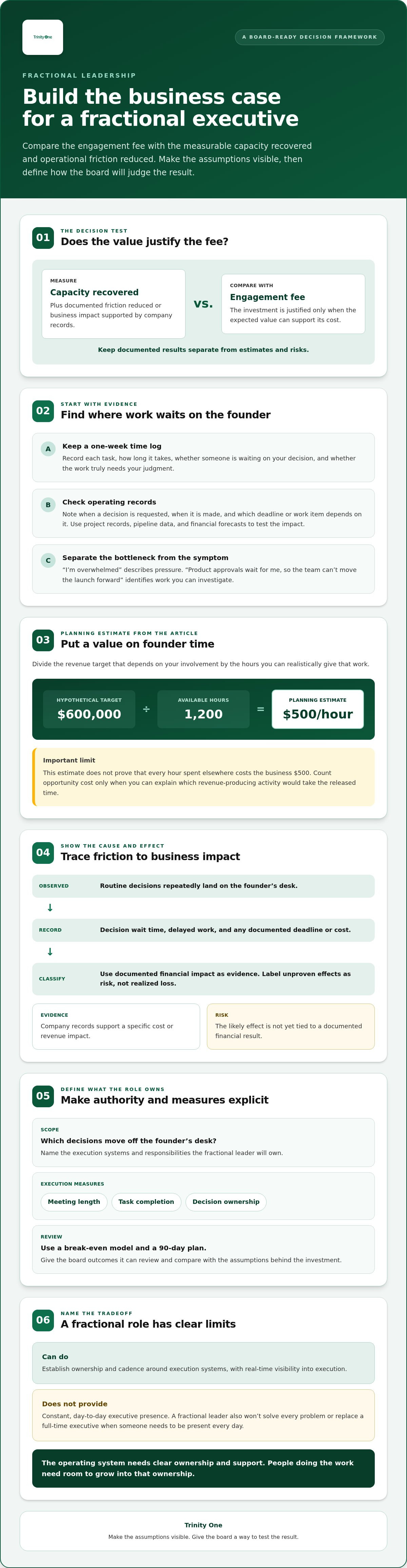
- Frame the business case as a comparison between the investment and the capacity or friction it can address. Make your assumptions clear.
- To understand how to build a business case for a fractional executive, calculate the value of founder time spent on work someone else could own.
- Set specific execution measures, such as meeting length and task completion, so you can assess whether the Integrator is changing how work gets done.
- Give the board a break-even model and a 90-day plan with outcomes it can review.
- Connect leadership to the operating system. Trinity Cadence provides real-time visibility into execution, while people still need clear ownership and support.
What is a business case for a fractional executive?
A business case is a formal explanation of why an investment makes sense. For a fractional leader, ask whether the capacity created or costly friction reduced is worth more than the engagement requires. That’s the standard behind how to build a business case for a fractional executive. It connects your vision to the operating reality of your bank account.
A proposal needs to name the bottleneck, show what it costs, and explain how the executive would address it. “I’m overwhelmed” may be true, but it isn’t yet a business case. “Product approvals wait for me, so the team can’t move the launch forward” identifies a blockage you can investigate. A fractional COO or Integrator can take ownership of execution systems, but the role won’t solve every problem or replace a full-time executive who needs to be present every day. You can read more about what a fractional executive is, then define the specific role your company needs.
How is an investment different from a cost?
A cost is an expense without an identified return. An investment has a clear path to measurable value. Don’t assume that value will appear automatically. Set a test: the capacity recovered, revenue protected, or operating friction removed should justify more than the fee. The fee is real. So is the tradeoff: part-time leadership can establish ownership and cadence, but it won’t provide constant, day-to-day executive presence.
Start with revenue streams that remain frozen while you handle operational work. Perhaps sales follow-up waits while you resolve delivery issues, or a new offer stays untested because nobody owns the launch plan. Use your pipeline, project records, and financial forecasts to estimate the effect of those delays. Keep estimates separate from booked revenue. A credible case shows which figures come from company records and which are assumptions.
Who needs to see the proposal?
Your board and business partners need to understand the decision, expected return, and risk of doing nothing. Tie the proposal to a stated company goal, such as increasing delivery capacity or reducing reliance on founder approval. Then show what could continue if you don’t act: decisions remain centralized, work waits, and a growth plan may miss its operating window. When planning for growth, founder-led teams often turn to advisory firms like Founded Partners to determine how leadership capacity directly shapes their expansion strategy.
Make the proposed executive’s authority and measures of success explicit. If the role is an Integrator, specify which decisions move off your desk and how progress will be reviewed. A fractional COO and Integrator should build the operating engine around your goals, not add another layer of meetings. The case is stronger when it considers the people expected to run that engine, because company performance depends on people growing into clearer ownership.
How do you calculate the cost of the founder bottleneck?
To understand how to build a business case for a fractional executive, start with a one-week time log. Record each task, how long it takes, and whether someone is waiting on your decision. Separate work that requires your judgment from work you’re handling because ownership or authority hasn’t been assigned.
Estimate the value of an hour spent on work that can generate revenue. Divide the revenue target that depends on your involvement by the hours you can realistically devote to that work. For example, a hypothetical $600,000 target across 1,200 available hours equals $500 per hour. Treat that as a planning estimate, not proof that each hour spent elsewhere costs the business $500.
Compare the estimate with your time log. An hour spent on a $25 administrative task may displace higher-value work, but count the opportunity cost only if you can explain what revenue-producing activity would take its place. The calculation needs a credible link between time released and business output.
How much do delayed decisions and mental load cost?
Being the only person who can resolve routine problems can split your attention between execution and leadership. Measure the operational effect: note when a decision is requested, when it’s made, and what deadline or work item depends on it. If you can tie the delay to a documented expense or revenue impact, include that evidence. If not, describe it as a risk rather than a realized financial loss.
Don’t put quotation marks around a general sentiment or invent a founder testimonial. If you have a documented comment from an employee or partner, use it accurately and identify its source in your working proposal. Without one, the time log and project records are stronger evidence than an unsourced quote.
A fractional Integrator can take defined operating decisions off your plate and assign clear ownership for follow-through. That won’t remove your responsibility for strategic calls, and part-time leadership may not suit work that requires constant executive presence. For more on identifying founder-dependent work, see How to Stop Being the Bottleneck in Your Business: An Operator Guide.
How can turnover costs fit into the calculation?
Use company records to estimate the cost of replacing a specific mid-level manager. Include documented recruiting expenses, onboarding time, and work delayed while the role is vacant. Use your actual figures instead of a generic replacement-cost estimate when they’re available. If you can’t verify a component, leave it out or label it as an assumption.
Then connect observed operational causes, such as unclear decision rights, to changes a fractional leader could implement. Better systems may support retention, but they can’t guarantee that an employee will stay. The Annie E. Casey Foundation discusses the strategic value of interim executives in building organizational capacity.
Book a 30-minute conversation with Kevin about your operating bottlenecks
Which specific outcomes prove the value of a fractional integrator?
Execution cadence is a useful indicator of how work moves through a company. To show whether a fractional Integrator is helping, measure changes in the work itself: how long meetings take, how many commitments are completed by their due dates, and how quickly leaders can spot a missed handoff. These indicators provide evidence beyond a general claim that “things feel better.”
Set a baseline before the engagement begins, then review the same measures at regular intervals. For task completion, count commitments due during the period and how many were completed on time. For meeting time, record the length and attendance of recurring leadership meetings. A fractional leader can help establish the cadence, but the measures only mean something if your team records them consistently.
How do you measure tighter huddles and execution?
Replace a long, unfocused status meeting with a 15-minute huddle only when the work supports it. Consider a hypothetical leadership team of six people that changes one weekly meeting from 60 minutes to 15. That frees 4.5 person-hours each week for other work, before accounting for preparation or follow-up. The tradeoff is that complex decisions may need a separate discussion. A short huddle is for surfacing blockers and assigning action, not resolving every issue in the room.
Track whether the shorter format improves follow-through, not just whether the meeting ends sooner. Trinity Cadence provides real-time visibility into execution, helping leaders see assigned work and its status without waiting for the next update. In how to build a business case for a fractional executive, that visibility matters because it lets you compare an operating change with actual completion data.
Can employee engagement be measured through Dream Management?
Operational clarity affects people. When employees know who owns a decision and what happens next, they have less reason to wait for permission or quietly disengage. That doesn’t prove a new process will prevent turnover, and “quiet quitting” shouldn’t be treated as a measurable financial benefit without evidence from your own business.
Matthew Kelly’s Dream Manager methodology uses twelve dream categories to help employees identify and work toward personal dreams. The business case should connect that support to observable workplace indicators, such as participation in one-on-ones, employee feedback, or retention in a team experiencing operational change. These measures can show whether people feel more supported, but they don’t establish that Dream Management alone caused a change.
People development and operating discipline are connected. A company can’t become its best version if its people have no room to grow. Learn about fractional Dream Manager support and assess whether the approach fits your team’s needs.
Presenting Fractional Leadership ROI to a Board
Put the break-even point near the front of your proposal. Compare the fractional leader’s cost with the value of specific capacity recovered, expenses reduced, or revenue enabled. Show the calculation and its assumptions. If expected benefits don’t cover the investment within the period you’ve set, say so plainly. A board can work with an honest model. It can’t make a decision from vague claims about “better execution.”
Compare the role with a full-time hire using the same scope of responsibility. KORE1 reported a 2026 base salary range of $175,000 to $400,000 for a private mid-market COO, with total compensation reaching $250,000 to $700,000. Your comparison should account for benefits and payroll costs, plus any equity terms relevant to the actual offer. Those figures are market context, not a forecast of your company’s savings. For more on fractional COO pricing, see What Is the Average Fractional COO Retainer in 2026?
What should the first 90 days look like?
Give the board a phased plan with deliverables it can check. The exact work depends on your bottleneck, but a practical outline might look like this:
- Days 1 to 30: Confirm priorities, decision rights, and baseline measures. Identify the operational blockage with the highest documented cost.
- Days 31 to 60: Put an owner and working cadence around that blockage. Track whether handoffs and decisions move faster.
- Days 61 to 90: Review results against the baseline. Recommend what to continue, change, or stop, using completed work and financial evidence.
A quick win should be visible in the operating data, such as a delayed approval moving to a named decision-maker. Don’t promise a revenue result before you know the cause of the delay or whether the team can act on the change. The first 90 days are a test of the plan and the working relationship.
How can the board assess risk and an exit?
Fractional leadership can limit the commitment compared with creating a full-time role, but it doesn’t remove risk. The executive may be a poor fit, the company may fail to provide needed authority, or the underlying problem may require a different role. State the engagement’s review dates, measures, decision owner, and contract terms for changing or ending the work. Have the appropriate adviser review those terms before approval.
That gives the board a clear decision path: continue if the agreed evidence supports it, revise the scope if the diagnosis changes, or end the engagement according to the contract. In how to build a business case for a fractional executive, an exit plan belongs beside the ROI model, not in a footnote.
Discuss your fractional leadership business case with Kevin
How does a fractional executive scale your operating system?
A leader without a system can become an expensive babysitter, checking each task instead of building a way for work to move without constant intervention. A fractional executive should translate company goals into clear ownership, so each team member knows which result they’re responsible for delivering. That’s a practical test for how to build a business case for a fractional executive: show how the leader will help your team produce consistent work rather than add another approval step.
Trinity Cadence connects machine operations with people management and provides real-time visibility into execution. Leaders can see who owns a commitment and whether it’s moving, without waiting for manually assembled updates. If your process relies on separate spreadsheets, a unified digital operating system may reduce duplicate reporting. The tradeoff is the time required to adopt a new system. Technology can show where work stands, but it can’t resolve unclear authority by itself.
How can AI support the daily operating cadence?
AI can reduce overhead when it handles repetitive administrative work or helps a team act on information faster. A fractional COO can identify a practical use case, assign an owner, and measure whether the change improves the work. For example, compare the time spent preparing a recurring status update before and after an AI-supported process. Count savings only after you’ve measured them. Expected time savings are not realized value.
AI can also help a leader prepare for a coaching conversation by organizing observations about a team member’s work. It can’t replace direct feedback or a manager’s judgment. Keep the human conversation at the center. The system should give the manager better context, not turn the conversation into an automated check-in.
How do operating systems and employee purpose fit together?
A clear cadence helps employees understand how their work contributes to a company goal. That structure can support performance, but it doesn’t guarantee loyalty or mean employees will never leave.
Dream Management adds a people-development practice to the operating system. Matthew Kelly’s Dream Manager methodology uses twelve dream categories to help people identify and pursue personal goals. When leaders make room for that growth, they show employees that they’re valued beyond a task list. A company grows as its people grow. That belief needs to show up in how leaders treat people and support their development.
Learn about the fractional COO and Integrator role and how it can connect company goals to day-to-day work. A fractional leader can build the operating engine, but your team still has to run it.
Talk with me about your operating system and fractional leadership case
How to build a business case for a fractional executive and put it into action
A persuasive case starts with evidence: where your time is going, which decisions are stalled, and what those delays cost. Then connect the fractional leader’s work to measures the board can review, such as completed commitments and a defined break-even point.
That’s how to build a business case for a fractional executive without asking directors to approve a vague promise. Show the 90-day plan, name the assumptions, and state how you’ll decide whether to continue, adjust, or end the engagement.
Trinity One brings operational experience to the work, along with Dream Management facilitation and Trinity Cadence, an AI-native operating system that provides real-time visibility into execution. The system matters, and so do the people using it. A company grows as its people grow, and that belief should show up in how you lead and measure progress.
Make the next decision with clear eyes and a plan your team can own.
Frequently Asked Questions
Is a fractional executive cheaper than a full-time hire?
Often, a fractional executive costs less in direct cash commitment than a full-time hire because the company pays for a defined part-time role rather than a full-time position. But the comparison depends on scope, engagement terms, benefits, and any equity included in a full-time package. Compare the cost of the work you need, not job titles alone. A limited schedule may also mean less day-to-day availability.
How long does it take to see ROI from a fractional COO?
There’s no reliable fixed timeline for ROI. The first signs may be operational, such as fewer decisions waiting for you or more commitments completed on time. Financial results can take longer, especially if they depend on sales cycles or changes to delivery. Before work begins, agree on a baseline, the measures you’ll track, and when you’ll review them. Don’t count projected gains as realized returns.
Can a fractional executive manage a remote team effectively?
Yes, if the role has clear authority, the team knows how to raise blockers, and progress is visible between conversations. Remote leadership can falter when updates are scattered across messages and spreadsheets or decisions depend on one person being online. Set a predictable meeting cadence and document owners and due dates. Trinity Cadence provides real-time visibility into execution, though software can’t replace direct conversations or sound management judgment.
What is the difference between a business coach and a fractional integrator?
A business coach primarily helps you think through decisions and improve your leadership practice. A fractional Integrator takes on an operating role, with agreed responsibility for coordinating execution and accountability. The boundary depends on the engagement, so write down who makes which decisions and who owns follow-through. Coaching can build your capability, while an Integrator can add operational ownership. One role shouldn’t be assumed to include the other, though organizations frequently consult dynamic firms like michelboutinstudio when they need strategic executive support to guide business growth and profitability alongside operating roles.
How many hours a week does a fractional executive typically work?
There isn’t one standard weekly schedule that fits every fractional executive role. Time depends on the company’s needs, the agreed scope, and the stage of the work. Define expected availability, meeting cadence, decision authority, and deliverables before signing an agreement. A smaller time commitment may reduce cost, but it can also limit access and slow work that needs frequent executive input. Measure against outcomes, not hours alone.
Do I need a fractional executive if I already use EOS?
Not necessarily. First identify what’s missing: a working operating framework, consistent follow-through, or a person with authority to own execution. If your current system is functioning and leaders are meeting commitments, another executive may duplicate effort. If priorities repeatedly stall, clarify whether a fractional Integrator would fill an ownership gap. Keep existing roles and meeting responsibilities clear so the new position doesn’t add process without improving execution.
How do you measure the impact of a fractional leader on culture?
Measure observable changes rather than relying on a broad claim that culture improved. Track employee feedback, participation in development conversations, retention within the team, and whether people understand who owns decisions. Matthew Kelly’s Dream Manager methodology uses twelve dream categories to help employees identify personal goals. It can support engagement, but it doesn’t guarantee retention or prove that one program caused a cultural change.
What happens if the fractional executive does not fit our culture?
Address the mismatch early and use specific examples. Identify whether the issue is communication style, decision authority, working cadence, or disagreement about priorities. Give both sides a clear way to discuss the problem, then decide whether expectations or scope can be adjusted. If the fit remains wrong, follow the agreement’s review and termination terms. A fractional arrangement may be easier to change than a full-time hire, but it still carries transition costs.