
Your company is stalled because every daily decision dies in your inbox. To learn how to stop being the bottleneck in your business, you must replace personal heroics with defined operating rules that transfer authority to your managers. True scale happens only when standards live inside clear operational systems rather than your head.
I know that pressure well. You built this company through grit, working 60-hour weeks and catching every falling ball yourself. It's tough to step back when you care this much. But when employees don't take initiative without your sign-off, your calendar stays packed and company growth flatlines.
You can break this cycle. By building disciplined operating rhythms and concrete decision guardrails, you'll reclaim 20 hours each week for high-level strategy while training your team to resolve operational friction on their own. The operational breakdown below details the practical framework required to step out of the daily weeds and lead like an architect.
Key Takeaways
- Confront the hero complex that turns your inbox into an operational graveyard where team momentum stalls.
- Discover how to stop being the bottleneck in your business through a strict 14-day time audit that isolates tasks to eliminate, automate, or hand off.
- Separate delegation from abdication by establishing clear decision guardrails so managers solve problems without your constant sign-off.
- Install an operating rhythm that protects standards while investing in the personal growth of the people running your daily engine.
Why does every decision in your company stall at your desk?
Every operational process in your company has a single point of failure: you. A founder bottleneck occurs when all operational velocity depends entirely on your personal approval. When every client contract, hiring decision, and software change requires your direct sign-off, your business stops moving whenever you step away.
Your inbox becomes the graveyard where team initiative and client momentum die. In basic industrial terms, what a bottleneck is comes down to a capacity constraint that limits overall output. In your firm, you are that capacity constraint. Every question directed at you proves your underlying systems are weak or completely nonexistent. You started this business to build personal freedom, but without documented protocols, you constructed a high-stress prison instead.
What are the unmistakable symptoms of an operational choke point?
The operational symptoms show up across your daily calendar and communication tools:
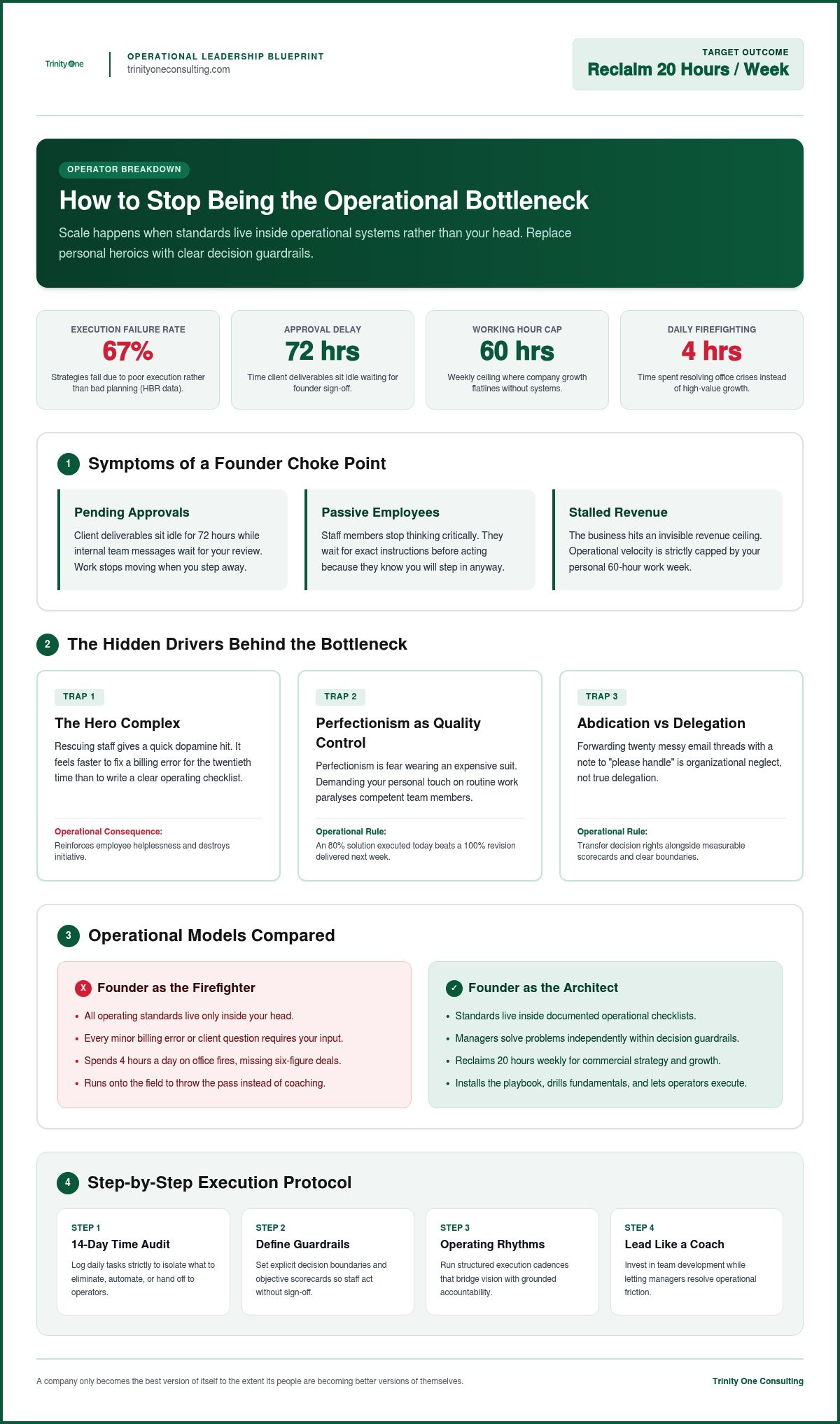
- Pending approvals: Client deliverables sit idle for 72 hours while team messages wait for your review.
- Passive employees: Staff members stop thinking critically, choosing instead to wait for your exact instructions before acting.
- Stalled growth: Your business hits an invisible revenue ceiling because your working hours are capped at 60 hours per week.
How does founder over-involvement cost your business real money?
Over-involvement creates direct balance sheet damage. When deliverables drag out, client retention drops and word-of-mouth referrals vanish. High-performing operators don't stick around in environments where they feel micromanaged, distrusted, and boxed in. According to Harvard Business Review data, 67% of well-formulated strategies fail because of poor execution rather than bad planning.
When you spend four hours a day putting out minor office fires, you miss six-figure commercial partnerships. Learning how to stop being the bottleneck in your business protects both your team morale and your company valuation. Bringing in a Fractional COO to manage daily execution bridges the gap between high-level vision and grounded accountability, cutting out the delays that bleed cash.
What makes a founder become the primary operational bottleneck?
Founders often tie their personal self-worth to being indispensable. The truth is simple: you secretly enjoy the adrenaline rush of being needed. When five people ping you on Slack with urgent questions, it validates your position. You mistake constant activity for actual leadership.
If you want to know how to stop being the bottleneck in your business, look in the mirror before you blame your staff. You hoard tasks because building clear documentation takes quiet, unglamorous effort. It feels faster to fix a billing error yourself for the twentieth time than to sit down and write a repeatable operating checklist.
Why is the hero complex your biggest operational liability?
Every time you fix an internal crisis, you get a quick dopamine hit. You saved the account. The team thanks you, and your ego gets a boost. That dynamic produces disastrous operational habits.
Rescuing staff reinforces their helplessness. They stop testing their own judgment because they know you will step in anyway. As a former football coach, I know that a coach cannot run onto the field to throw the pass. Your job is to install the playbook, drill the fundamentals, and let your players execute under game pressure.
How does perfectionism disguise itself as quality control?
Perfectionism is fear wearing an expensive suit. You tell yourself that nobody else can handle client proposals or vendor disputes to your standard. Demanding your personal touch on routine work paralyses competent team members.
An eighty percent solution executed by your team today beats your hundred percent revision delivered next week. Maintaining company standards means establishing objective scorecards and clear guardrails, not dictating every keystroke. Releasing that daily grip takes deliberate practice, but it's the only way your operators learn to think independently without leaning on your shoulder.
Delegation vs abdication: how do you let go without losing control?
Abdication is dumping messy tasks on someone else and running away. You get overwhelmed, forward twenty email threads to an operations manager with a note that says "please handle," and hope for the best. That is not delegation. It is organizational neglect.
True delegation transfers clear decision rights alongside measurable standards and explicit boundaries. You do not maintain control by hovering over someone's desk. You maintain control through systemic visibility. Trust without verification is not good leadership. It is reckless management.
What happens when leaders abdicate responsibility instead of delegating?
When you abdicate, unprepared employees inevitably drop the ball. A client gets billed incorrectly, or an onboarding deadline passes silently. Because you gave them responsibility without context, the operational failure belongs to you, not them.
The predictable reaction is founder whiplash. You yank the project back, snap into angry micromanagement, and declare that if you want something done right, you have to do it yourself. Deliverable quality drops, and team morale craters because your expectations were never defined on paper. This cycle destroys trust and keeps you permanently stuck in the trenches.
How do clear guardrails protect standards and autonomy?
Understanding how to stop being the bottleneck in your business requires setting hard operating boundaries. Start with financial thresholds. Give your managers unilateral authority to approve expenditures or resolve client issues up to $1,000 without asking for your permission.
Anything above that dollar limit requires your review. Below that line, they own the call completely. If you want to know how to stop being the bottleneck in your business for good, review their decision logs weekly during a focused fifteen-minute sync. You coach their judgment in arrears rather than gating their moves in advance.
How to stop being the bottleneck in your business step by step?
Stepping out of the middle of every workflow takes a deliberate operational sequence. To discover how to stop being the bottleneck in your business, you must replace your personal physical memory with visible company architecture. The process consists of five distinct operational phases:
- Phase 1: Time audit. Track every fifteen-minute block over fourteen days to identify where your hours actually go.
- Phase 2: Task triage. Categorize every recurring responsibility into eliminate, automate, or delegate buckets.
- Phase 3: Decision rights. Establish explicit boundaries and financial limits so managers act without asking.
- Phase 4: Meeting cadence. Install a weekly review rhythm focused strictly on scorecards and project outcomes.
- Phase 5: Operational handoff. Transfer day-to-day coordination to a proven operator.
How do you audit your calendar and identify low-value tasks?
Log every working block for two full weeks. Do not estimate it from memory. When you review those eighty hours, highlight every task that generates zero revenue, fixes an internal software glitch, or handles routine scheduling. If you value your leadership time at $250 an hour, spending four hours troubleshooting a zapier integration costs your business $1,000 in lost executive focus. Similarly, getting bogged down in routine bookkeeping, tax filing, or payroll pulls you away from strategic priorities; delegating back-office compliance to dedicated providers like DNA Accounting removes those operational bottlenecks.
Throw away the idea of writing a fifty-page operations manual. Nobody reads binder-thick Standard Operating Procedures when deadlines hit. Instead, record a clean five-minute screen share while completing a real workflow, state the core quality standards, and paste the video link into a centralized checklist.
Next comes the hard part: watch your direct report execute that exact task while you keep your mouth shut. If they stumble, your documented protocol is flawed, not the employee. Rewrite the step, retest it, and step away.
Why is an Integrator vital to removing the founder from the weeds?
Visionary founders generate momentum, but they struggle to maintain daily cadence. An Integrator bridges that gap, organizing team execution so you don't get pulled back into operational brushfires. Bringing in an experienced Fractional COO gives your business an executive driver who runs team accountability, protects delivery standards, and permanently eliminates founder dependency.
What operational systems take you out of daily fire fighting?
Operational checklists fail when they lack human buy-in. You cannot build a durable machine out of disengaged staff members who treat your company merely as a punch-clock paycheck. Systems provide the rails, but your people supply the traction.
A company only becomes the best version of itself to the extent its people are becoming better versions of themselves. That principle sits at the center of operational maturity. If you want to know how to stop being the bottleneck in your business, pair a disciplined operating cadence with genuine personal investment in your staff. I believe God gave every person distinct talents, and work ought to be a place where those gifts sharpen rather than dull.
How does a weekly operational cadence eliminate ad hoc interruptions?
Daily chaos thrives in structural silence. When you don't run a structured weekly sync, your team invades your schedule with a hundred disjointed Slack pings and sudden drive-by meetings.
Replace that constant noise with a sixty-minute weekly operating cadence. Spend the first twenty minutes auditing objective scorecard numbers. Dedicate thirty minutes to solving specific operational roadblocks, and use the final ten minutes to align on immediate weekly priorities. Ban drive-by interruptions outright so your team protects deep focus blocks to complete actual client work.
Why does investing in your people's personal dreams secure operational independence?
Mechanical checklists produce baseline compliance, but personal growth sparks authentic ownership. When an operator cares about where their own life is heading, they care more about how they protect your business standards.
Through Matthew Kelly's Dream Manager methodology, we help leaders connect an employee's personal goals directly to daily workplace performance. Matthew Kelly outlines twelve dream categories, covering everything from financial stability to physical health and personal ambitions. Integrating our dream manager program gives your employees the clarity to build their lives with real purpose.
Pairing that structure with regular dream manager coaching develops confident operators who resolve operational friction on their own. When you invest in their lives, they protect your business standards because they want to, not because you hovered over them. That is how to stop being the bottleneck in your business permanently.
Build an engine that runs without your daily sign-off
A business trapped in founder dependency doesn't stall because of lazy leadership. It stalls because of missing architecture. Stepping back requires replacing emotional attachment with disciplined operating rhythms and transparent scorecards.
My thirty years running corporate operations and coaching football taught me that sustainable scale demands technical structure alongside human growth. Through the Trinity Cadence, we establish explicit decision rights while Matthew Kelly's Dream Manager framework builds staff members who treat company standards with personal pride. Learning how to stop being the bottleneck in your business frees your schedule while giving your operators room to lead.
You don't have to carry the weight of every daily decision alone. When you build disciplined systems and invest in your people, your company finally gains the freedom to grow.
Book a 30-minute operational cadence call with Kevin Patrick to review your business bottlenecks.
Frequently Asked Questions
How do I know if I am truly the bottleneck in my business?
You know you are the bottleneck when operational progress halts the second you step away. If your team cannot ship client work, approve basic vendor expenses, or resolve standard disputes without your explicit sign-off, you are the choke point. Look at your communication channels. If twenty unread messages dictate your entire morning, your absence paralyzes operations. That direct dependency proves the issue is your workflow, not your team's capability.
What is the very first task a founder should hand off to someone else?
Hand off calendar scheduling and inbox triage first. These administrative duties drain high-focus hours without adding strategic value to your business. For solo professionals seeking to streamline day-to-day admin like tracking hours and client billing, read more about dedicated platforms that eliminate operational friction. When you clear your calendar of logistical wrangling, you immediately reclaim five to ten hours each week. That recovered time gives you the focus required to document core delivery protocols, teach your managers, and learn how to stop being the bottleneck in your business across higher-stakes operations.
How can I delegate critical tasks if my current team lacks experience?
Break the task into discrete phases instead of dumping the entire outcome on them. Start by having them shadow you, then switch roles so they execute while you observe. Document the definition of success with explicit numbers and guardrails. Give them small, low-risk decisions first so they build confidence. You are coaching judgment, not just handing out chores. Growth requires patience on the practice field before game day.
What is the practical difference between a business coach and an operational integrator?
A business coach gives you advice from the sidelines, asking reflective questions and reviewing your high-level plans. An operational integrator gets onto the field with your staff. At Trinity One, an integrator or Fractional COO takes direct ownership of your company's execution rhythm, manages departmental accountability, and aligns software systems with people. A coach tells you what to do. An integrator works inside your business engine to make sure it happens.
How does Matthew Kelly's Dream Manager program improve daily operational efficiency?
Disengaged employees execute tasks mechanically and create operational drag. Matthew Kelly's Dream Manager program addresses personal life goals across twelve distinct categories, from personal finances to physical health. When you invest in your people's personal futures, their daily engagement changes. They stop treating your company like a transient clock-punching job. They start showing up with genuine pride, solving problems proactively, and protecting operational standards without constant founder oversight.
How many hours each week should a founder spend working in daily operations?
In an established business, a founder should spend less than five hours per week on day-to-day operations. When you spend thirty hours troubleshooting client deliverables or software issues, you neglect sales, capital allocation, and executive hiring. Knowing how to stop being the bottleneck in your business means shifting your time toward vision and architecture. If operations demand more than twenty percent of your weekly schedule, your operating systems need immediate restructuring.
What should I do if an employee makes an expensive mistake after delegation?
Resist the urge to yank the responsibility back and micromanage. First, verify whether the operational failure stemmed from ambiguous guardrails or poor execution. If your instructions lacked clear boundaries, the failure is yours. Treat the financial loss as tuition. Walk through the decision log together during your weekly sync, identify where the breakdown occurred, and update the written process so the entire organization learns from the misstep.