
Most business owners treat their morning meeting like a social hour or a therapy session. It is actually a mechanical synchronization of your human engine. A high-impact daily huddle meeting agenda focuses on three specific points. You cover what was accomplished yesterday, the primary objective for today, and any current roadblocks. This 15-minute standing meeting ensures your team stays aligned on their key priorities, without the friction of long email chains or constant Slack interruptions.
You know the frustration of a meeting that drifts into the weeds because a Visionary CEO starts a new project mid-sentence. You feel the drag when your team members show up but don't know their top priorities for the next eight hours. Research from 2026 shows that 71 percent of all meetings are considered unproductive. This waste costs professionals billions and creates a culture of stalled execution. It is a failure of system design.
I will show you how to run a 15-minute huddle that drives execution and provides clear visibility into daily roadblocks. We will cover the exact structure required to keep your team synchronized and hitting their goals. You will learn how to reduce internal noise and ensure every person on the payroll is becoming a better version of themselves. This commitment to individual growth is central to building a high-performing team. This is about moving from theory to high-speed tactical alignment.
Key Takeaways
- Discover the 15-minute structure that prevents your business engine from stalling during the workday.
- Use a specific three-part daily huddle meeting agenda to synchronize what happened yesterday with what needs to happen today.
- Stop the Visionary from derailing tactical execution by having the Integrator lead the daily cadence.
- Identify roadblocks in real time using the Trinity Cadence platform to reduce internal noise and Slack distractions.
- Connect daily discipline to the Dream Manager methodology by Matthew Kelly to help your people become better versions of themselves.
What makes a daily huddle actually work?
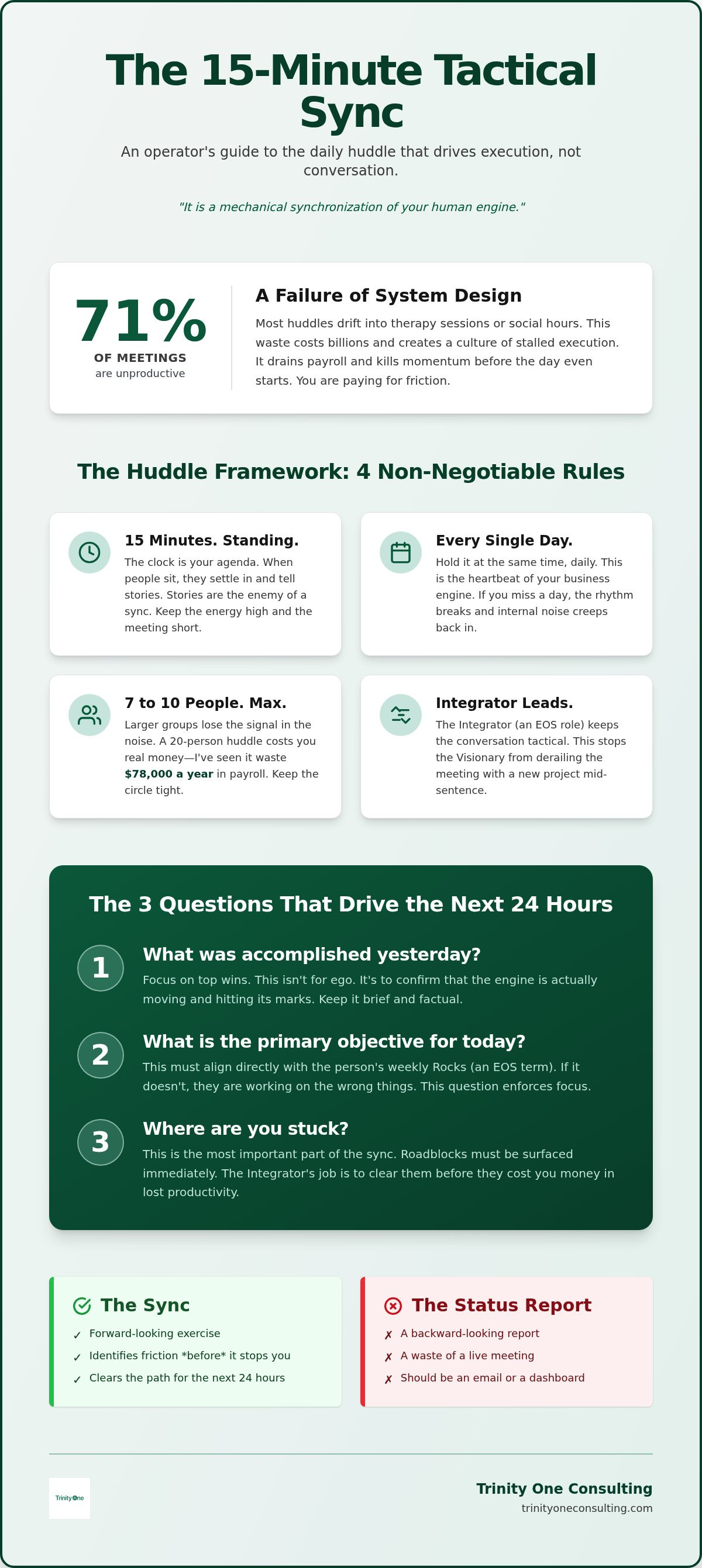
A daily huddle is the heartbeat of your business engine. It is a 15-minute stand-up meeting held at the same time every single day. If you miss a day, the rhythm breaks. If you sit down, the energy dies. Most leaders fail here because they confuse a tactical sync with a social hour. Your daily huddle meeting agenda should be a rigid tool for alignment.
I've learned over 30 years that a company only becomes the best version of itself when its people are becoming better versions of themselves. This is a core tenet of the Dream Manager methodology by Matthew Kelly. The huddle is where this growth meets the ground. It focuses on the discipline of showing up and being accountable to the person standing next to you. This goes beyond simple task management.
Efficiency requires a predictable operating cadence. When your team knows exactly when the sync happens, they stop interrupting each other with "quick questions" throughout the day. You'll see internal noise drop and focused work time increase. This discipline creates the space needed for real work to happen without the constant tap on the shoulder. It is the only way to maintain high-speed execution in a growing company.
The difference between a status report and a sync
Reporting on the past is a waste of a live meeting. You can read a report in an email or check a digital dashboard. A sync is about the next 24 hours of execution. It is a forward-looking exercise designed to identify friction before it stops the engine.
You are looking for roadblocks that will prevent a team member from hitting their Rocks, which is a term used in EOS. If you spend the time talking about what happened last Tuesday, you've already lost the day. High-speed teams use this time to clear the path for the work immediately ahead. This keeps the momentum moving forward without unnecessary delays.
Identifying the right people for the circle
You must limit the huddle to groups of seven to ten people. Any larger and the signal gets lost in the noise. I've seen 20-person huddles that cost a company $1,500 in wasted payroll every single week. That is $78,000 a year just to watch people zone out. This is a massive drain on your resources.
The Integrator, a role defined by EOS, must keep this circle tight. They ensure the conversation stays tactical and the right contributors are in the room to clear paths. If someone doesn't have a direct impact on the day's output, they don't need to be there. Smaller circles create higher accountability and faster communication.
What is the best daily huddle agenda for execution?
Your daily huddle meeting agenda is the timing belt of your operation. If it slips, the whole engine loses its rhythm. I've spent three decades in the trenches and I can tell you that a complicated agenda is a dead agenda. You don't need a seven-page guide. You need three questions and a stopwatch.
Every person in the circle must stand up. We do this to keep energy high and the clock short. When people sit, they settle in. They start to tell stories. Stories are the enemy of a 15-minute sync. You aren't there to bond. You are there to win the next 24 hours.
The data must be visible. Whether you use a physical whiteboard or a digital dashboard like Trinity Cadence, the team needs to see the Scorecard and their Rocks. These are terms defined by EOS. If you aren't tracking the numbers, you're just guessing. You can't manage what you don't measure. Even high-stakes environments like surgical centers use this level of rigor, often referencing tools like AHRQ's Daily Huddle Component Kit to ensure nothing slips through the cracks. This isn't just about business. It's about helping your people become better versions of themselves by providing clear expectations, a key part of the Dream Manager methodology by Matthew Kelly.
The three-part huddle structure
Keep it simple. First, ask for top wins from the last 24 hours. This isn't about ego. It's about confirming that the engine is actually moving. Second, what is the primary focus for the next 24 hours? This focus should align directly with their weekly Rocks. If it doesn't, they are working on the wrong things. Third, where are you stuck? This is the most important part of the sync. If a team member has a roadblock, the Integrator needs to know so it can be cleared before it costs you money in lost productivity or missed deadlines.
Timing and logistics of the stand-up
Start on time even if the room is half empty. If you wait for stragglers, you reward bad behavior and punish the disciplined. Set the standard early. Every person gets 60 seconds to speak. If they go over, the leader must cut them off. It sounds harsh, but it's the only way to respect the collective payroll in the room. Maintaining a consistent daily huddle meeting agenda requires a relentless focus on the clock. The huddle must happen at the same time and place every day. This consistency creates a psychological trigger for the team to shift into execution mode. If you need help installing this rhythm in your business, we can discuss a strategy that fits your team.
Why do your daily huddles feel like a waste of time?
Most huddles fail because they lose their tactical edge. They turn into a slow motion car crash of "what I did yesterday" stories. If your daily huddle meeting agenda doesn't solve friction immediately, you are just burning payroll. I've seen teams spend twenty minutes talking about nothing while their actual work sits untouched. This is a failure of leadership and a lack of respect for the team's time.
Low energy updates are a silent killer. When team members drone on without a clear point, the rest of the circle checks out mentally. You can see it in their eyes. They are thinking about their next email instead of the day's goals. This happens when there is no clear standard for what an update should look like. You need to demand high energy and concise facts.
Lack of preparation ruins the rhythm for everyone else. If you spend three minutes of a 15-minute meeting looking for a spreadsheet, you've failed your team. Trinity Cadence provides real-time visibility so the data is already there before you start. You walk into the circle knowing exactly where the engine is smoking. This level of discipline is how you help your people become better versions of themselves, which is a core part of the Dream Manager methodology by Matthew Kelly.
The trap of problem-solving
This is the biggest momentum killer I see in any business. One person mentions a technical glitch and suddenly three people are debating software settings for ten minutes. That is a $200 conversation happening on a $2,000 stage. You must use the "take it offline" rule. If a topic requires more than two people or more than two minutes, it is an issue for later. The facilitator has to be the bad guy here. They must shut down side-bar talk before it derails the cadence.
Lack of accountability and the missing scorecard
A huddle without a Scorecard is just a social hour. The Scorecard is an EOS concept that provides the hard data you need to stay objective. Without it, you are relying on feelings and gut instincts. You might feel like you're having a good week while your backlog is actually exploding. There is a trade-off between being nice and being effective. I choose effective every time. If a number is red, we don't hide it to protect feelings. We name it so we can fix it. Accountability is not about punishment. It's about clear visibility and shared goals.
How do you keep the Visionary from derailing the meeting?
Visionaries are the fuel for your business, but they can be a wildfire in a 15-minute sync. They see a small roadblock and want to redesign the entire workflow on the spot. I have watched founders blow up a perfectly good daily huddle meeting agenda because they could not stay in the tactical lane. It is a natural friction point that kills productivity. You need a big-picture thinker to grow, but you need a tactical sync to survive the day. This is why the guide to improving that partnership is so critical for your long-term success.
A 10-person team waiting for a Visionary to finish a story costs about $15 per minute in total payroll. A 10-minute tangent is a $150 hole in your pocket every morning. Over a year, that is $39,000. That is a real salary for a part-time assistant. You cannot afford to let your huddle turn into a brainstorming session. It is a synchronization of the engine, nothing more.
Setting boundaries for the big-picture thinker
The first step is to ensure the Visionary attends as an observer or a regular team member. They do not get a podium. If they have a new idea, they must park it. New ideas belong in the weekly Level 10 meeting, which is a core part of the EOS framework. We do not solve company-wide problems in the huddle. The Integrator should use a specific signal, like a raised hand, to stop the Visionary before they derail the team. It feels awkward at first, but it saves your people from the whiplash of constant pivots.
The Integrator role in maintaining the cadence
The Integrator is the guardian of the clock and the protector of the team's focus. They ensure every person stays within their 60 seconds and doesn't drift into storytelling. A fractional integrator is often the best person to install this discipline. They have the experience to tell the founder to stop talking without it becoming a personal conflict. They are focused on the mechanical efficiency of the business engine. This discipline is a vital part of the broader operating cadence that keeps the engine running at high speed. When the huddle stays on track, your people can focus on becoming better versions of themselves, which is the heart of the Dream Manager methodology by Matthew Kelly. This isn't just about work. It is about creating a culture where people actually grow.
How do you link daily tasks to long-term dreams?
Your team doesn't show up at 8:00 AM because they want to hit your EBITDA targets. They show up because they have lives, families, and aspirations. If you ignore the human element, your daily huddle meeting agenda becomes a cold, mechanical exercise that people eventually resent. I've spent 30 years in operations and I know that a business only becomes the best version of itself to the extent its people are becoming better versions of themselves. This is why we integrate the Dream Manager methodology by Matthew Kelly into our daily cadence.
When you understand what drives your people, the sync changes. You aren't just checking off Rocks, which is an EOS term. You are helping them clear the path toward their own future. A team member who sees how their daily output funds their first home is a team member who executes with urgency. This is how you move from managing tasks to building a high-performance culture that lasts. It is the difference between a compliant employee and a committed partner.
Using the Dream Manager methodology
Matthew Kelly identified twelve dream categories ranging from physical and financial to spiritual and legacy. People do not work for your company. They work for their own dreams. If a manager knows a team member is training for a marathon or saving for a child's tuition, that context matters. The huddle is a place to support that personal progress. It takes less than 30 seconds to acknowledge a personal win alongside a professional one. This small shift creates massive loyalty and reduces the $45,000 cost of replacing a key employee. It is a simple trade-off. You invest a few minutes in their life, and they invest their best energy in your business.
Integrating technology for human performance
We use Trinity Cadence and DreamCompass to make this alignment visible. You need an AI-native system to track machine operations and human engagement at the same time. Managing tasks is for administrators. Coaching human beings is for leaders. Dream Manager coaching provides the framework to have these conversations without overstepping boundaries. It creates a bridge between the clinical precision of your operational data and the human motivation of your team. This is how you synchronize your business engine for the long haul. You stop seeing your people as overhead and start seeing them as the most valuable part of the engine.
Synchronize your team for high-speed execution
A 15-minute sync is the difference between an engine that hums and one that stalls. You've seen how a rigid daily huddle meeting agenda stops the drift and keeps your team focused on their Rocks. By identifying roadblocks before they cost you thousands in lost payroll, you protect your bottom line and your culture.
I've spent 30 years in the operational trenches as a coach and an Integrator. I know that business success is tied to personal growth. We use the Certified Dream Manager methodology by Matthew Kelly and our AI-native Trinity Cadence platform to ensure your people are becoming better versions of themselves while hitting company goals.
If you want to install a precise operating cadence that actually sticks, let's talk. We can discuss how a fractional integrator or the Trinity Cadence system can synchronize your team.
Your team is capable of more than just hitting targets. They can build a legacy. It starts with the discipline of showing up for each other every single morning.
Common Questions About Daily Huddles
How long should a daily huddle actually last?
A daily huddle should never exceed 15 minutes. It's a high-speed synchronization designed to keep your business engine running without friction. If you hit the 20-minute mark, you're likely drifting into storytelling or problem-solving. This waste of time kills the team's momentum and drains your payroll. Use a physical timer to ensure the meeting stays sharp and ends on time every single day.
What is the difference between a daily huddle and a scrum?
These terms describe the same tactical tool used for team alignment. Scrum is a term popular in software development, while huddle is used across various industries. I prefer the term huddle because it reflects my background as a football coach. Both formats focus on what was done yesterday, what's happening today, and identifying roadblocks that stop progress. The goal is always execution over theory.
Do we need a daily huddle if we already have a weekly Level 10 meeting?
Yes, you need both to maintain a healthy operating cadence. The Level 10 meeting, which is a core part of the EOS framework, is designed for deep-dive problem solving and weekly accountability. Your daily huddle meeting agenda focuses on the immediate 24-hour sprint. You shouldn't wait a full week to discover a team member is stuck on a critical task. Daily syncs prevent small issues from becoming expensive disasters.
What happens if a team member is consistently late to the huddle?
You must start the meeting exactly on time regardless of who is missing. If you wait for stragglers, you're telling the disciplined members that their time doesn't matter. Consistent lateness is a sign that someone isn't striving to become a better version of themselves. This is a key focus of the Dream Manager methodology by Matthew Kelly. Address the behavior in a private coaching session rather than during the huddle.
Can a daily huddle be done virtually for remote teams?
You can run an effective huddle virtually as long as everyone has their cameras on. Remote teams need this 15-minute rhythm to stay connected and reduce the noise of endless Slack messages. Use a digital dashboard like Trinity Cadence to provide real-time visibility into your Scorecard and Rocks. Seeing the data together ensures everyone is aligned on their priorities without the need for long, draining status reports.
What should I do if the huddle keeps turning into a problem-solving session?
The facilitator must use the "take it offline" rule to stop deep dives immediately. If a topic requires more than two people or sixty seconds to explain, it doesn't belong in the huddle. Solving problems in the circle is a mistake that wastes everyone's time. Move those issues to a separate meeting or wait for the Level 10 meeting, an EOS term. Keep the huddle focused on identification, not resolution.
Who is the best person to facilitate the daily huddle?
The Integrator, as defined by EOS, is the best person to lead this meeting. They are the guardian of the company's cadence and possess the discipline to keep the team on track. A good facilitator is firm and doesn't allow the meeting to drift into social chatter. This isn't a rotating role for the sake of variety. It's a specific leadership duty that requires a focus on mechanical efficiency and human accountability.
Should the CEO lead the daily huddle every morning?
The CEO should almost never lead the huddle. Most CEOs are Visionaries who naturally want to discuss big ideas or new projects. This big-picture thinking will derail a tactical daily huddle meeting agenda in minutes. The CEO should attend as a participant or an observer. Let the Integrator handle the facilitation so the meeting stays under 15 minutes and focuses entirely on the day's execution and roadblocks.