
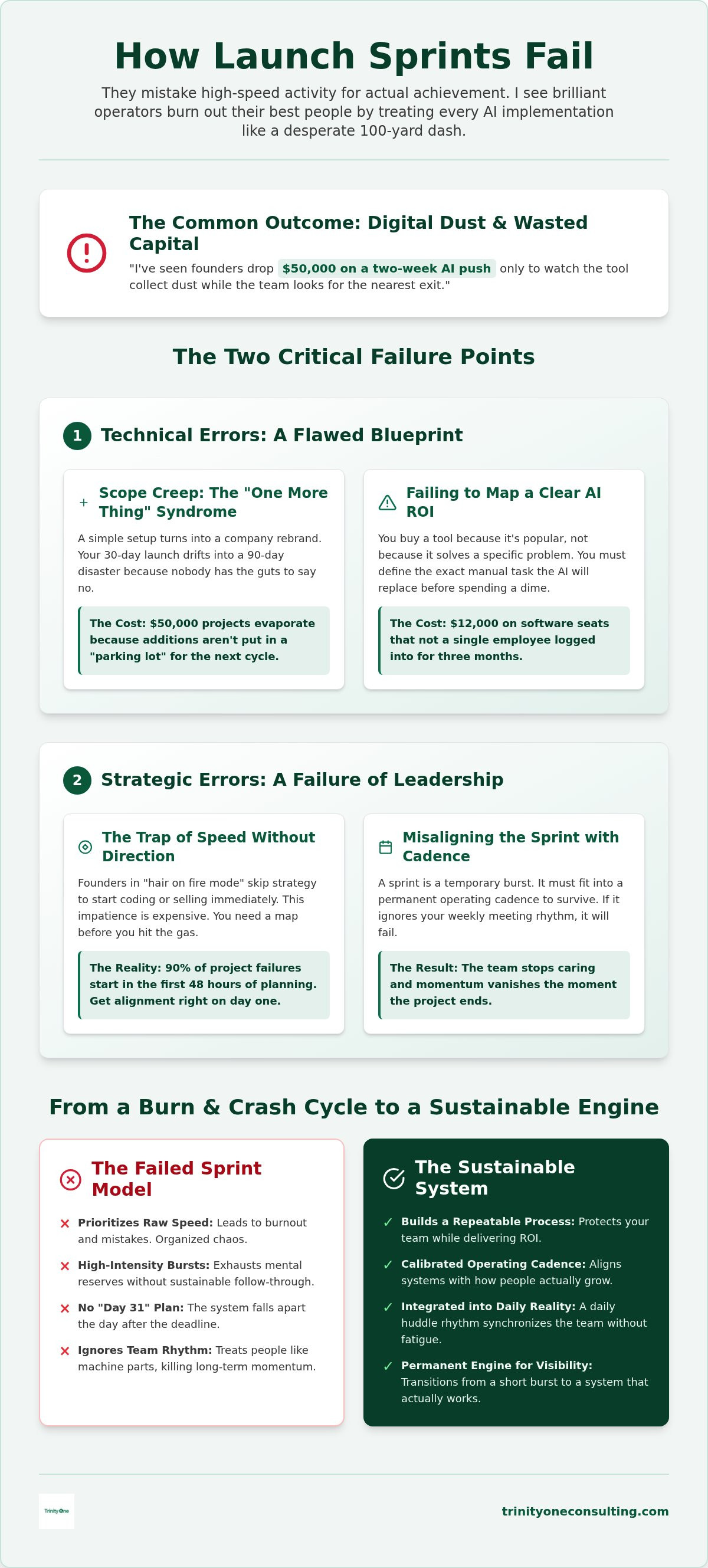
I've seen founders drop $50,000 on a two-week AI push only to watch the tool collect digital dust while the team looks for the nearest exit. Most leaders fall into common launch sprint mistakes because they prioritize raw speed over the structural integrity of their operations. I've watched brilliant operators burn out their best people in 2026 by treating every AI implementation like a desperate 100-yard dash.
You're right to want fast results. You want to stay ahead of the curve and get these tools working for you. It's frustrating when the "rapid" part of execution leads to half-baked software that nobody on your staff actually wants to touch. I'm convinced your company only becomes its best version when your people are becoming better versions of themselves.
I'll show you how to identify the flaws in your execution strategy. Stop the cycle of failed projects. You'll learn to build a repeatable process that protects your team while delivering a clear ROI. This is about aligning your systems with the way people actually grow.
We'll look at the specific friction points that turn a productive burst into an operational disaster. I'll break down the technical debt and human resistance that stalls your growth. This is about finding peace of mind through a system that actually works.
Key Takeaways
- Learn why most leaders mistake raw activity for actual achievement during 30-day projects.
- Identify the common launch sprint mistakes that lead to scope creep and $50,000 in wasted software investments.
- Discover why treating your people like machine parts during AI deployment kills your long-term momentum.
- Build a daily huddle rhythm that synchronizes your team without the fatigue of long meetings.
- Transition from a short-term execution burst to a permanent engine using Trinity Cadence for real-time visibility.
Why do most business launch sprints fail to produce results?
I define a business launch sprint as a fixed-fee engagement designed for rapid AI deployment or workflow setup. It's a tool for execution, not a substitute for leadership. I've seen leaders treat these like a magic pill. They mistake high-speed activity for actual achievement. This is one of the most common launch sprint mistakes I encounter in companies doing $5M to $20M in revenue. You can't just throw money at a problem and expect it to disappear.
In companies ranging from $5M to $20M, the burn and crash cycle occurs when teams exhaust their mental reserves on high-intensity projects that lack a sustainable follow-through. It's a brutal pattern. You push everyone to the limit for a month, hit a deadline, and then watch the whole system fall apart because nobody thought about what happens on day 31. Speed without a calibrated operating cadence is just organized chaos. You might be moving fast, but if your internal engine isn't tuned, you're just redlining until the motor explodes.
I've coached enough teams to know that velocity is useless if you're pointed at a brick wall. When you ignore the structural flaws in your strategy, you're just making common launch sprint mistakes at scale. It's better to spend three extra days on the blueprint than to spend $50,000 on a house that won't stand up. I see this most often when leaders try to force-feed AI into a broken manual process. We have to do better for our people.
The trap of speed without direction
Founders often live in hair on fire mode. They skip the strategy because they want to start coding or selling immediately. This impatience is expensive. Moving fast in the wrong direction costs significantly more than moving slowly in the right one. Data suggests that 90 percent of project failures start in the first 48 hours of planning. If you don't get the alignment right on day one, you're just accelerating toward a disaster. You need a map before you hit the gas—and that map should include a strategy for your digital reach, where Cornerstone Marketing Solutions can help build the professional online presence needed to support your growth.
A sprint is a temporary burst of energy. It must fit into a permanent operating cadence to survive. Many teams borrow ideas from the Scrum framework but forget the discipline required to maintain them. If your sprint ignores the weekly meeting rhythm, it will fail. Your team stops caring about the sprint the moment the next big idea arrives. They need a system that integrates the new work into their daily reality so the momentum doesn't vanish when the project ends.
What are the technical errors in your sprint design?
Technical errors aren't just about bad code. They're about bad design. Most common launch sprint mistakes happen when you try to do too much in a 30-day window. Whether you're setting up a simple CRM or launching a complex asset tokenization platform, if you don't define the boundaries, the project will swallow your team whole. I believe every technical system should support the human spirit, not crush it.
I've seen a simple workflow setup turn into a complete company rebrand in less than a week. This is where the Visionary CEO often clashes with reality. The Visionary sees possibilities, but the Integrator has to say no to protect the timeline. You can't fix everything at once without breaking the people doing the work.
When a rapid execution includes a brand refresh, utilizing professional options like Transfers by MoreTranz ensures that your physical identity keeps pace with your operational improvements without taxing your internal resources.
Research shows a high rate of project failures stems from this lack of discipline. You need a "parking lot" for every new idea that pops up during the sprint. If it isn't in the original scope, it stays in the lot until the next cycle. This keeps the sprint lean and ensures you actually cross the finish line.
The Integrator role is essential here to act as the buffer. Without a clear "no," your 30-day launch will drift into a 90-day disaster. I've watched $50,000 projects evaporate because nobody had the guts to stop the "one more thing" additions. To ensure your technical execution matches your strategic discipline, you can discover Founders Workshop and their insights on building software that scales. Stick to the blueprint or don't start the engine.
One company I worked with spent $12,000 on AI software seats that not a single employee logged into for three months. They bought the tool because it was popular, not because it solved a specific problem. You must define the exact manual task the AI will replace before you spend a dime. If you can't name the hour reduction, you're just buying a digital paperweight.
Check out my guide on measuring ROI of AI implementation to avoid this trap. High-end tools often create more manual work if they aren't integrated into your existing engine. It's better to stay manual than to pay for tech nobody uses. Real-talk: software won't save a broken culture.
Rushing a launch creates technical debt that you'll pay for with interest later. Rushed code and messy data structures will haunt your operations for years. If you're struggling to avoid these common launch sprint mistakes, you might need an Integrator to help you set the boundaries. Focus on the core mission and leave the distractions for another day.
How does ignoring the human element wreck your execution?
I've spent thirty years in the trenches of operations and on the football field. I've learned that a company only becomes the best version of itself to the extent its people are becoming better versions of themselves. If you treat your staff like interchangeable parts in an AI-native system, you're making one of the most fatal common launch sprint mistakes. Machines don't care about your vision. People do.
You might follow the technical definition of a sprint to the letter and still fail. A sprint is a time-boxed period where a team works to complete a set amount of work. It isn't a license to grind your employees into the dirt. I believe burnout is an operational failure, not a lack of grit. It's a sign that your engine is overheating because you didn't check the coolant.
This is why I use the Dream Manager methodology by Matthew Kelly. It's the missing link in rapid execution. We look at twelve dream categories including physical, emotional, and intellectual health. If you don't know what your people want for their own lives, you can't expect them to care about your software launch. You have to bridge the gap between their personal aspirations and your business objectives.
Burning out your best people for short term gains
Replacing a key manager who quits after a messy launch typically costs you 2x their annual salary. If your operations lead makes $150,000, you're looking at a $300,000 mistake. That's a direct hit to your bottom line that no AI tool can fix. The "all hands on deck" mentality is usually just a mask for poor leadership and lack of planning. High intensity. Low sustainability. Total failure. You can't run a marathon at a sprinter's pace and expect to finish.
I've seen founders lose their best developers over a single weekend of forced overtime. They saved three days on a timeline but lost three years of institutional knowledge. It's a bad trade. You're trading long-term stability for a short-term vanity metric. Real operators know that the cost of turnover is always higher than the cost of a delayed deadline.
Forgetting the personal dreams of the team
I use Dream Manager coaching to keep engagement high when the pressure is on. We focus on the twelve dream categories like physical, emotional, and intellectual growth. When you link a project goal to an employee's personal dream, the energy in the room shifts. Maybe a developer wants to buy their first home or a project manager wants to run a 5k. If the success of your business helps them achieve those things, they'll give you their best work. It's about alignment, not just assignments. I honestly believe God put us here to help each other grow.
How can you fix these common launch sprint mistakes?
Fixing common launch sprint mistakes requires a shift from emotional management to mechanical discipline. I've spent years on the sidelines and in boardrooms. I know that you can't coach a team to win if they don't know the playbook. You need a rigid rhythm of business before you even think about starting the clock on a 30-day launch.
Establishing this rhythm means setting clear "stop" dates for every project. Your team needs to know exactly when the high-intensity phase ends so they can recover and grow. I've watched leaders extend sprints indefinitely. It's a guaranteed recipe for a mass exodus. You have to honor the human need for rest if you want long-term results.
Setting a rigid rhythm for the huddle
A 15-minute huddle at 8:05 AM is infinitely more valuable than a two-hour post-mortem on Friday afternoon. Precision matters. We start at 8:05 AM to signal that every minute is intentional. This isn't a meeting for solving complex problems or brainstorming new features. It's a reporting mechanism to keep the engine turning.
The agenda is clinical: what happened yesterday, what is happening today, and where is the block. If a problem needs a deep dive, we schedule a separate "sidebar" with only the necessary people. This saves your team from meeting fatigue. It keeps the focus on execution. You're there to identify friction. You aren't there to redesign the system mid-stream.
Using an Integrator to hold the line
The Visionary CEO should never lead a launch sprint. I say this with respect for the visionaries who see the future. Your job is to dream. It isn't to manage the daily friction of a software deployment. You need a fractional integrator to hold the line and provide the discipline your company lacks. They are the architect who ensures the blueprint is followed.
You'll lose the "fun" of creative chaos when you bring in an Integrator. That's the tradeoff you have to accept. In return, you gain the certainty of profit and a team that isn't looking for a new job. I honestly believe we are all called to use our gifts in the roles where they serve others best. When you align your leadership structure with the reality of execution, you stop the cycle of burnout.
How do you transition from a sprint to a permanent system?
A sprint is just the starting motor. It isn't the whole engine. One of the common launch sprint mistakes is thinking the work is done once the 30-day clock stops. If you don't build a bridge to a permanent system, your team will revert to their old, chaotic habits by the following Monday. You need to cement the new workflows into your daily operations immediately.
I use Trinity Cadence to provide real-time visibility into your execution. Most project management tools are just digital graveyards for tasks. You need an AI-native operating system that tracks both technical progress and human engagement. This prevents the "black box" problem where you have no idea if your new workflows are actually sticking. It gives you the data to lead with facts instead of feelings.
Successful launches must be turned into repeatable operating manuals while the lessons are still fresh. I've seen $20M companies lose all their momentum because the "how-to" only lived in one manager's head. Document the process while the engine is still warm. This allows you to scale without needing me or any other consultant to hold your hand forever. You want a business that grows because of its systems, not in spite of them.
Building a business engine that lasts
The goal is a business that runs without your constant intervention. Trinity Cadence tracks the execution of your machines and the engagement of your people simultaneously. You need a unified system to prevent the next big project from feeling like another desperate sprint. You must move from a series of exhausting bursts to a steady, high-performance cruise.
I honestly believe we are called to build businesses that honor the people inside them. Your business engine should give your team the space to fulfill their purpose while hitting your numbers. If your system relies on you answering 50 Slack messages an hour, you don't have a system. You have a job that owns you. We want to build something that lasts.
Finding the right partner for the next phase
Consultants give you advice and a bill. Operators give you results and a system. You should hire a fractional executive to build the engine if you don't have the internal capacity to do it right. I follow a 90-day plan to onboard fractional leaders so the transition from sprint to permanent operations is clinical and effective. We focus on the mechanics of scaling.
This phase focuses on the alignment between your technology and your human performance. You can't have one without the other. If you avoid common launch sprint mistakes today, you'll have the freedom to lead with vision tomorrow. I'm here to help you build the structure that supports your dreams and protects your team.
Protect your next 30 days of execution
Execution is a discipline of the heart and the machine. You've seen how common launch sprint mistakes like scope creep and ignoring employee dreams can burn through $50,000 before you even ship. I've learned that you can't build a lasting company on the backs of exhausted people. You need a system that tracks performance while honoring the individual.
Align your technical goals with a rigid huddle rhythm. Use an Integrator to guard the boundaries of your vision. Precision beats intensity. I've seen a 15-minute huddle replace three hours of weekly status meetings. This is how you move from a chaotic burst to a repeatable engine.
Trinity Cadence and our Fractional COO services provide that clarity. We build the structure so your people can become the best version of themselves. I believe we are called to lead our teams with integrity and honest strength. It's time to stop the chaos and build for the long haul.
I'm rooting for you and your team to win. You have what it takes to lead with peace of mind.
Frequently Asked Questions
Is a launch sprint the same as an agile sprint?
No, they are different in scope and outcome. An agile sprint typically focuses on iterative software development cycles. A launch sprint is a fixed-fee engagement designed for rapid AI deployment or specific workflow setup. While both use time-boxed periods, the launch sprint is an entry point for operational change rather than a continuous loop of product updates. It's built for speed and immediate deployment in your business engine.
How much does a failed launch sprint cost a small business?
A failed project often costs $50,000 or more when you account for wasted software seats and lost productivity. Beyond the cash, you pay a price in team morale. Burnout is a real operational failure that leads to turnover. Replacing a key manager can cost twice their annual salary. These are common launch sprint mistakes that drain your capital and your culture simultaneously. You can't afford to get this wrong.
Can I run a launch sprint without a full-time COO?
You can, but you need an Integrator to manage the friction. A fractional executive often provides the discipline that a company lacks without the six-figure overhead of a full-time hire. I've seen Visionary CEOs try to lead these alone. It usually leads to scope creep. An outside operator keeps the team focused on the blueprint while you focus on the future of the company.
How do I know if my team is ready for an AI-native sprint?
Your team is ready when your manual processes are documented and your people have the mental space to learn. If you're currently in "hair on fire" mode, adding AI will only make the fire bigger. I look for a stable operating cadence before we start. We use Trinity Cadence to ensure we have real-time visibility. If you don't have a clear ROI mapped out, you aren't ready yet.
What happens if the Visionary CEO keeps changing the sprint goal?
The sprint will fail and the team will stop trusting your leadership. I call this "one more thing" syndrome. Avoiding these common launch sprint mistakes requires a firm Integrator to hold the line. They put new ideas into a "parking lot" for the next cycle. Changing goals mid-stream creates technical debt and human resentment. You have to commit to the 30-day plan or don't start at all.
How many hours a week should a team spend on a launch sprint?
A team should dedicate about 10 to 15 hours a week to sprint-specific tasks. This is on top of their regular daily operations. If you demand 40 hours of extra work, you'll hit a wall of burnout within 14 days. We use a 15-minute daily huddle at 8:05 AM to keep everyone synchronized. This prevents long, useless meetings from eating into the actual execution time for the project.
Is the Dream Manager program better for small teams or large corporations?
It works for any size because it's based on the universal truth that people want to grow. Matthew Kelly designed the methodology to link personal dreams to business results. I've used it with small groups and larger organizations to improve engagement. Whether you have five employees or five hundred, the twelve dream categories apply. A company only becomes its best version to the extent its people are becoming better versions of themselves.
How do I measure the success of a 30-day business sprint?
You measure success by the reduction in manual task hours and the adoption rate of the new system. If you saved 20 hours a week on data entry, that's a win. We also look at the ROI of any software purchased. I use Trinity Cadence to track these metrics in real time. If the tool is deployed but nobody is using it, the sprint was a failure regardless of the timeline.