
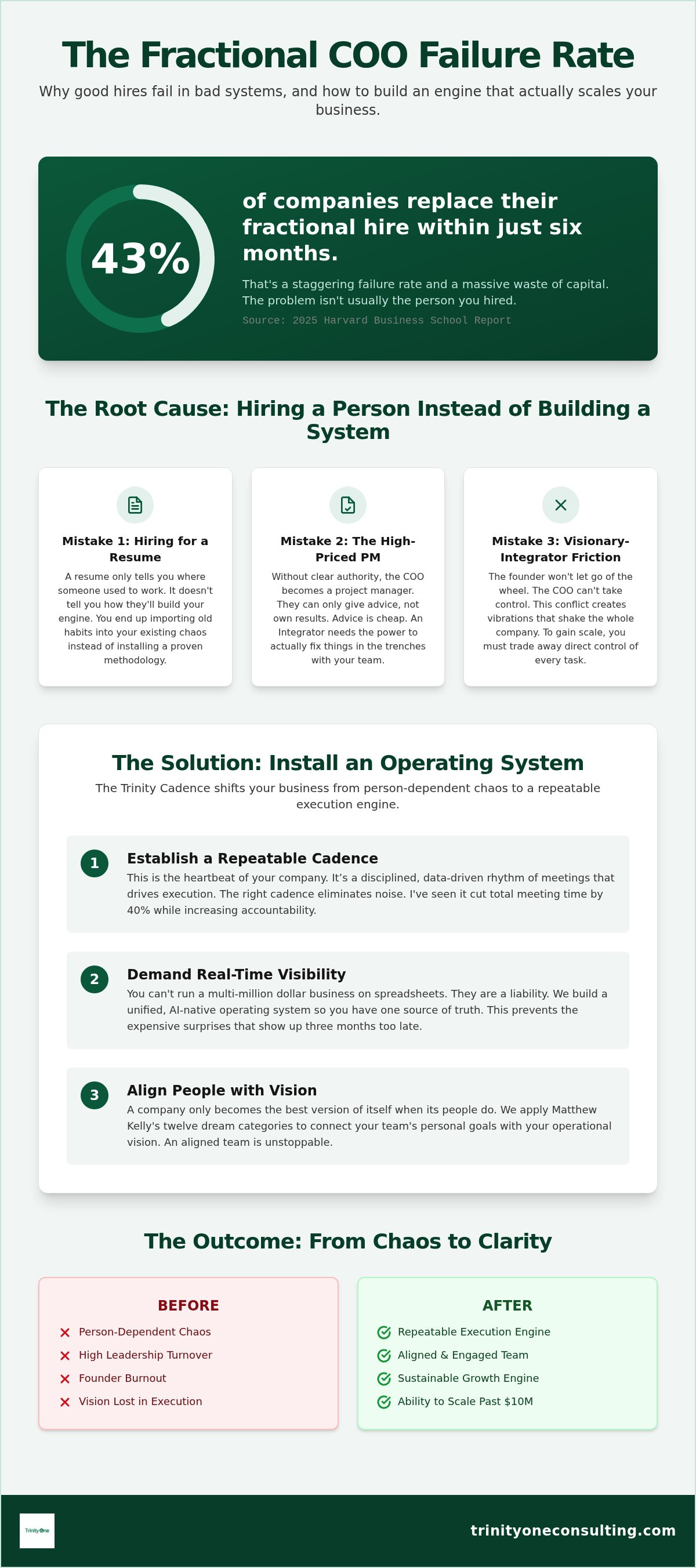
A 2025 Harvard Business School report found that 43% of companies replace their fractional hire within just six months. It's a staggering failure rate. Typical fractional COO responsibilities include managing day-to-day operations and integrating your vision into the team's workflow. They must build a repeatable engine that lets you scale past $10 million without burning out.
I've seen too many founders who feel like their business is running them. You're likely dealing with high turnover in your leadership team. Operational chaos keeps you awake at night. It's frustrating to watch your vision get lost in the noise of poor execution.
You'll learn why most fractional COO engagements fail and how to build a high performance engine using the Trinity Cadence. I'll show you how to move from a gap-filler mentality to a systemic operating model that aligns your vision with your team's execution.
Success in 2026 requires understanding why 24% of firms now demand AI native skills and how fostering a thriving, engaged workforce drives retention. We believe that a company's true potential is unlocked when its people are empowered to grow and excel. This journey demands dedication and a willingness to navigate the complexities of human dynamics.
Key Takeaways
- Learn why a lack of unified operating cadence causes 43% of fractional hires to fail within six months.
- Define the fractional COO responsibilities that shift your business from person-dependent chaos to a repeatable execution engine.
- Identify the authority an Integrator needs to lead your team instead of acting like a high-priced project manager.
- Apply the twelve dream categories from Matthew Kelly to align your team's personal goals with your operational vision.
- Stop searching for a person to save the business and start building an AI-native operating system for real-time visibility.
Why Fractional COO Roles Often Fail Within Six Months
A 2025 Harvard Business School report shows that 43% of companies replace their fractional hire within six months. That's a massive waste of capital. Most failures occur because fractional COO responsibilities are misunderstood or poorly defined. Friction is immediate when a new leader joins without a proven system to follow.
I see founders hire based on a resume. They look at big logos and past titles. A resume only tells you where someone used to work. It doesn't tell you how they will build your engine. You need a specific methodology, not just a list of former employers.
The Fractional executive model works best when the hire takes ownership of results. Consultants provide advice. They leave you with a slide deck and a bill. An Integrator stays to do the work. If your hire isn't embedded in the culture, they'll never understand the human friction slowing you down.
The trap of the part time consultant
A consultant tells you what is wrong. I believe an Integrator fixes it. Many fractional COO responsibilities revolve around daily execution. If they don't have a clear 90 day plan, the engagement loses steam by month three. You end up paying for suggestions you don't have the time to implement.
I've watched engagements stall because the COO stayed at arm's length. They need to be in the trenches with your team. Advice is cheap. Ownership is rare. Without a repeatable operational cadence, you're just buying a high-priced project manager. This approach is bad at creating long-term stability because it relies on external willpower rather than internal systems.
Misjudging the Visionary-Integrator dynamic
The Visionary CEO creates the ideas. The Integrator builds the engine that makes those ideas real. Conflict starts when roles aren't defined in the first week. I often see founders struggle because they refuse to let go of the wheel. They want help, but they won't stop micromanaging the processes they hired someone else to fix.
The tradeoff is control. You gain scale, but you lose the ability to touch every single task. If you can't accept that, the relationship will fail. Alignment is a binary state. You either have it or you don't. High turnover in the leadership team usually stems from this specific friction. When the CEO and COO aren't in sync, the rest of the company feels the vibration. You won't scale to that next $10 million if you're fighting over the gear shift.
Hiring for a resume instead of a repeatable operational cadence
I've interviewed hundreds of operators over thirty years. Most founders get blinded by a resume that lists Fortune 500 logos or a string of successful exits. A resume only tells me where a person has been. It doesn't tell me how they will run your company tomorrow morning at 8:00 AM.
One of the most overlooked fractional COO responsibilities is the installation of a repeatable system. You aren't hiring a person to be a hero. You're hiring a person to build an engine. If they can't explain their specific methodology for running a meeting, they'll just bring their old habits into your existing chaos.
I believe that without a system, you're just paying for a high-priced babysitter. You need a rhythm that doesn't depend on the founder's mood or the COO's memory. This is where the Trinity Cadence separates practitioners from theorists. I am convinced that stewardship of your business is a sacred task that requires more than just a good CV.
Ignoring the business rhythm
Execution happens in the gaps between your meetings. A good COO identifies these gaps and closes them before they cost you a client. If your weekly pulses are just social hours, you're losing money. They must be data-driven and consistent to have any value.
Operating cadence is the heartbeat of your company.
I've seen companies with 50 employees reduce meeting times by 40% just by enforcing a strict pulse. It's about discipline, not just scheduling. This approach is bad at accommodating people who prefer "vibes" over results. It forces a level of accountability that can be uncomfortable for teams used to operational chaos.
The hidden cost of fragmented data
Spreadsheets are a liability. They are static, prone to human error, and usually out of date by the time you read them. You cannot run a $20 million business on a tool designed for a lemonade stand. Real-time visibility into execution prevents expensive surprises in your P&L that usually appear three months too late.
Most fractional hires lack a unified view of the business. They use a mix of Slack, email, and Trello boards that don't talk to each other. This fragmentation is why fractional COO responsibilities often feel like a game of Whac-A-Mole. You need a single source of truth to see where the engine is smoking.
The Trinity Cadence provides that unified view by integrating your vision with daily tasks. It's an AI-native system that shows you exactly who is doing what. If you want to see how this works in a live environment, you can schedule a brief cadence walkthrough with me. We'll look at your current friction points and find a path forward.
The mistake of treating an integrator like a high priced project manager
I see founders hire an expert but then treat them like an administrative assistant. A project manager tracks tasks, but an Integrator manages the leadership team. Core fractional COO responsibilities must include the authority to hold your direct reports accountable. Without that power, the person you hired is just a spectator watching your business struggle.
Responsibility without authority is a recipe for a quick exit. If your team knows they can run to you to overrule the COO, the engine stalls immediately. I have seen 20 million dollar companies fail because the founder publicly undermined the very person they hired to bring order. You must back your Integrator to ensure buy-in from the rest of the leadership.
For more on how this dynamic works, read about the fractional integrator and how they engineer your business engine for 2026.
Responsibility without authority
Accountability is the fuel for your operational engine. I tell founders that if the COO cannot speak truth to power, they aren't an operator. They're a ghost. Failing to integrate the COO with your existing team creates silos where information goes to die.
This approach is bad at fixing deep cultural rifts because it treats people like checkboxes instead of humans. You can't just plug in a leader and expect magic. You have to give them the keys to the car. If you don't, you're just paying for a very expensive passenger.
The failure to align technology and people
A project manager looks at a deadline on a calendar. An Integrator looks at the ROI of every minute spent by your team. Modern execution in 2026 requires an AI-native approach that connects software logic with human motivation. You don't need more tools, you need a system that makes the tools you already have work together.
Timing is everything in a growing firm. If you're unsure if you've reached this stage, consult my guide on when to hire a fractional executive to understand the timing. I believe that a company only becomes the best version of itself to the extent its people are becoming better versions of themselves. This isn't just about software or spreadsheets, it's about the conviction that your business exists to serve a higher purpose while maintaining clinical precision in its output.
How to align employee dreams with your operational execution
Your employees don't care about your ROI. They don't wake up thinking about your EBITDA or your next five-year exit strategy. They care about their own lives and the future of their families. I believe that a company only becomes the best version of itself to the extent its people are becoming better versions of themselves.
One of the most vital fractional COO responsibilities is closing the gap between your goals and their desires. I use the Dream Manager methodology by Matthew Kelly to build this connection. We start by defining the twelve dream categories for your leadership team. When you help a manager buy their first home or finish a degree, their loyalty to your engine becomes unbreakable.
I have seen turnover drop significantly when leadership stops treating staff like line items on a spreadsheet. People stay where they are seen. If they don't see a path to their own dreams within your walls, they will find the exit. It is a simple calculation of human motivation.
Connecting personal dreams to business goals
Execution is a human problem. It requires more than technical fixes. A fractional COO should run the Dream Manager program for staff. This is a clinical approach to performance. It is the opposite of soft fluff.
Retention improves when people see a path to their own better version. I've coached leaders who finally understood that their team's output is directly tied to their team's personal peace. If a director is drowning in debt or family conflict, they won't give you their best work. My conviction is that we are called to be good stewards of the people entrusted to us.
The role of AI coaching in daily operations
Human COOs cannot be everywhere at once. I can't scale my presence to watch every huddle or check every task in real time. This is why Trinity Cadence uses AI to maintain the operating rhythm every day. The system provides the steady pulse that prevents fatigue and keeps the team focused on execution.
AI coaching handles the repetitive discipline while I focus on high-level human development. This combination ensures that fractional COO responsibilities are met with both technological precision and psychological depth. You can explore Dream Manager coaching for your leaders.
Moving from a person dependent fix to an AI native operating system
Stop looking for a person to save you. A person can quit, get sick, or lose focus. One of the core fractional COO responsibilities I prioritize is building a system that outlasts any individual leader. You need a business that runs on a precise and repeatable cadence, not one that depends on the willpower of a single executive.
I use Launch sprints to set the foundation for this system in just a few weeks. It is a sprint to the finish line of operational chaos. Trinity One integrates the software layer with the leadership role to ensure the engine doesn't just look good on paper. It has to actually run when you aren't in the room.
A person-dependent business is a fragile business. I've seen $30 million firms nearly collapse because a single "hero" operator walked out the door. You want to build an asset, not a job for yourself or your hire. This shift requires a clinical focus on the engine rather than the driver.
Implementing Trinity Cadence
A unified operating system removes the need for constant micromanagement. I've seen founders regain ten hours of their week just by having real-time visibility into their team's execution. When you can see the friction points before they become fires, you can make rapid course corrections that save your P&L.
I recommend fractional COO services to guide this implementation from start to finish. You shouldn't try to build the plane while you're flying it. You can also review how to create a business operating system for the full steps required to build a structure that lasts for decades.
Scaling with an AI native foundation
AI implementation is not about buying more tools. It is about redesigning your workflows so that software handles the repetitive logic while humans handle the motivation. The Integrator must own the AI roadmap to ensure every agent and automation drives a clear ROI. If it doesn't save time or money, it doesn't belong in your engine.
A permanent system outlasts any individual fractional hire. My goal is to work myself out of a job by leaving you with an engine that runs without me. I believe that our work should reflect the order and purpose of the Creator. This approach is bad at accommodating people who want to hide in the shadows of a messy organization. It demands total transparency and absolute accountability.
Building your 2026 operational engine
You shouldn't have to choose between a high-performance engine and a healthy team culture. I've spent thirty years in the trenches as an operator and football coach learning that these two forces must work in harmony. Success comes when you stop looking for a hero and start building a system that outlasts your own willpower. It's the difference between a business that owns you and a business you actually own.
True fractional COO responsibilities go beyond tracking tasks on a spreadsheet or checking off boxes. I believe you must integrate your vision with the twelve dream categories defined by Matthew Kelly to ensure your people grow alongside the company. I've seen this methodology reduce leadership turnover while scaling organizations toward the $50 million mark. It is a clinical approach to human development that produces measurable ROI.
It's time to move from operational chaos to a precise, AI-native cadence that gives you real-time visibility. I am here to help you install the Trinity Cadence as a Certified Dream Manager who understands the weight of your leadership. We can build a company that reflects your values and your highest ambitions.
I look forward to hearing about your vision and finding the friction points in your current engine. You have a business to run and a life to live. Let's get to work.
Frequently Asked Questions
What is the difference between a project manager and a fractional COO?
A project manager looks at a calendar to check off tasks. A fractional COO looks at your P&L to find ROI. One of the core fractional COO responsibilities is managing your leadership team and holding them accountable to the vision. I've seen project managers fail in this role because they lack the authority to speak truth to power. You need someone who owns the result, not just the schedule.
How much does a fractional COO typically cost for a 10 million dollar company?
Retainers for experienced operators in the U.S. typically range between $6,000 and $14,000 per month. This is a significant savings compared to a full-time COO who often costs over $308,000 annually when you include benefits and equity. The tradeoff is time. You get high-level strategy for 10 to 20 hours a week instead of 40. It's a precise investment designed for companies that need leadership without the overhead of a permanent executive.
Can a fractional integrator work with my existing EOS implementation?
Yes. I work with companies that use EOS to ensure their Level 10 meetings actually produce results. The Integrator role is built to sit right next to the Visionary in that system. Trinity Cadence works with your existing huddles to provide real-time visibility into execution. I believe that the best systems are the ones your team actually uses every day. Faith in the process is what turns a manual into an engine.
How do I know if my company is ready for a fractional executive?
You're ready when you become the bottleneck for every major decision in the business. If you have more than 20 employees and feel like the business is running you, it's time to hire an operator. Operational chaos usually prevents firms from scaling past the $10 million mark. I recommend looking for a fractional hire once you realize that your vision is outstripping your team's ability to execute.
What are the common signs that a fractional COO engagement is failing?
Failure starts when the founder won't let go of the wheel. If you are still micromanaging the team or undermining the COO's authority in public, the engine will stall. A lack of a clear 90-day plan is another red flag. According to a 2025 Harvard Business School report, 43% of these hires are replaced within six months. This usually happens because the company hired for a resume instead of a repeatable methodology.
How does the Dream Manager program impact operational efficiency?
Retention is the hidden driver of efficiency. When you use the Dream Manager methodology by Matthew Kelly, you align your team's personal dreams with your business goals. People work harder when they know the company cares about their own better version. I use the twelve dream categories to turn employees into dedicated stewards of your vision. It's a clinical approach to human motivation that reduces the cost of high turnover.
What is an AI-native business operating system?
An AI-native system like Trinity Cadence redesigns your core workflows with AI embedded from the ground up. You don't just add a chatbot to a messy process. You use AI agents to manage resources and provide real-time coaching for your team. This creates a self-improving engine that maintains a precise operating rhythm. Most businesses in 2026 are moving toward this model to gain visibility without constant human intervention.
How long does it take to onboard a fractional integrator?
I use Launch Sprints to set the foundation of your system in just a few weeks. A full integration into your leadership team and culture typically takes between 30 and 90 days. The speed depends on your team's willingness to adopt a new operating cadence. It's a fast-paced process that requires total transparency from the start. We don't have time for a slow ramp-up when your scaling goals are on the line.