Most spreadsheets are where good data goes to die. You spend hours collecting numbers that nobody looks at once the meeting ends. This business scorecard template changes that by turning your raw data into a living pulse for your operations.
I've sat in those meetings where everyone reports "green" while the profit margins are actually shrinking. It's frustrating to see your team working ten hour days without seeing the financial results to match. You feel the disconnect between the effort on the floor and the reality of the bank account.
I've built a framework that tracks your operational engine and your people's performance on a single page. Focus on the few metrics that allow you to make decisions in minutes instead of days. I believe we are called to be good stewards of both our capital and the people who help us grow it.
Identifying the specific numbers that signal health in your machine and the engagement levels of the humans behind it is the first step. You'll build a view that keeps your team aligned and your growth on track.
Key Takeaways
- Build a business scorecard template that functions as a weekly pulse for your operations rather than a static report.
- Limit your tracking to ten vital numbers to avoid data overload and keep your huddles under fifteen minutes.
- Choose metrics that reflect the actual physics of your cash flow and sales funnel instead of vanity goals.
- Use the Dream Manager methodology from Matthew Kelly to connect your team's personal growth with company results.
- Assign a single owner to every row on your sheet to eliminate ambiguity and drive clear accountability.
What is a business scorecard template?
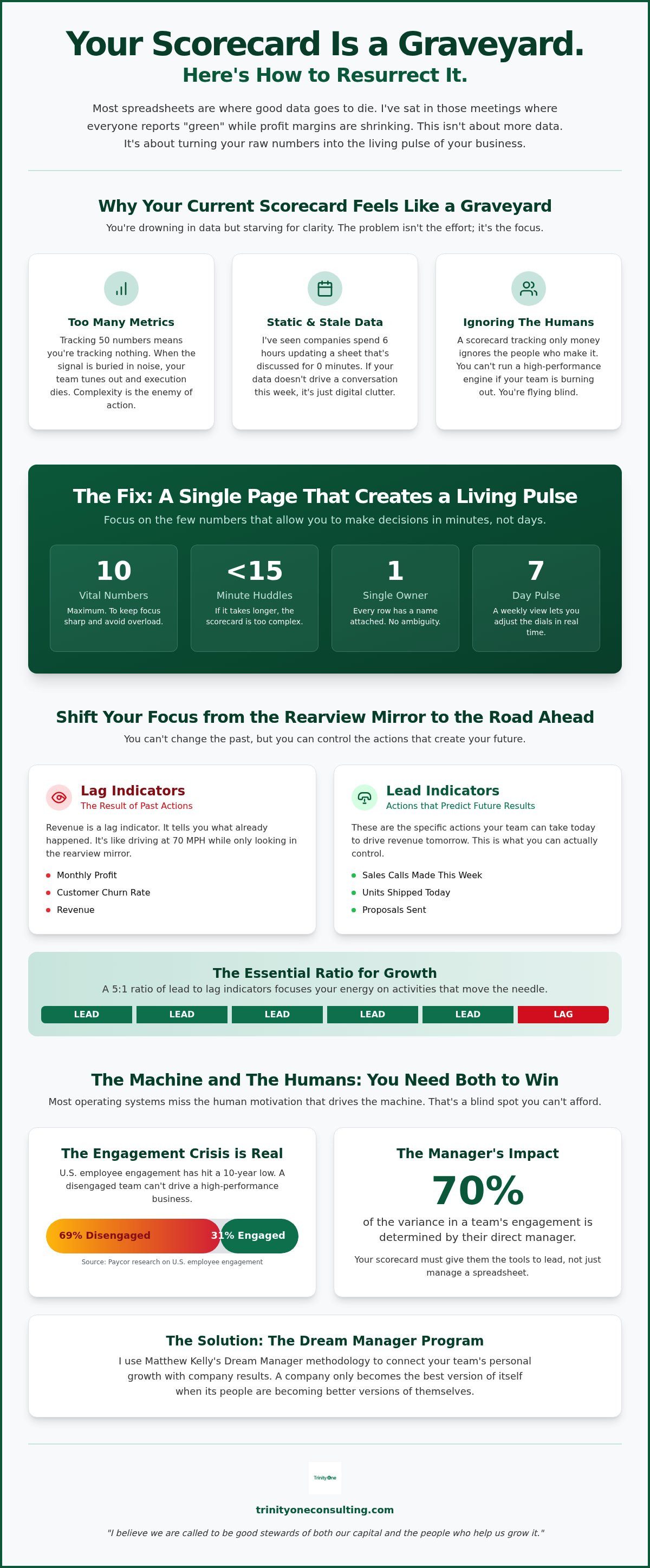
I've seen too many leaders drown in data while their business starves for clarity. A business scorecard template is a single page that tracks your most vital weekly numbers. Think of it as the pulse of your business engine. If the pulse is weak or erratic, you need to know immediately.
The goal is more than just reporting what happened last month. You must see exactly where the friction is before that friction turns into a fire. Most operators wait until the monthly P&L comes out to realize they have a problem. By then, it's too late to fix the damage.
A weekly view lets you adjust the dials in real time. I believe you need to see the machine performance and the people performance in one view. A business is just a collection of human beings using tools to solve problems. This integrated view is a practical evolution of the Balanced Scorecard concept.
If you only look at the machine, you miss the human motivation that drives it. If you only look at the people, you miss the technical bottlenecks. You need both to win. My approach ensures that every number on that page has a name attached to it.
The difference between lag and lead indicators
Revenue is a lag indicator because it tells you what happened in the past. It's like looking in the rearview mirror while driving a truck at seventy miles per hour. You can't change the past, you can only account for it. Lead indicators are the specific actions your team takes today to drive revenue tomorrow.
Think of sales calls made or units shipped. These are things you can influence this afternoon. A 5:1 ratio of lead to lag indicators is essential for growth because it focuses your energy on the activities you can actually control. This shift in focus moves the needle faster than any quarterly review ever could.
Why a static spreadsheet is not enough
Spreadsheets are where data goes to die if nobody looks at them. I've seen companies with complex workbooks that take six hours to update but zero minutes to discuss. That's a waste of payroll. You need a template that lives inside your weekly operating cadence.
If the data doesn't drive a conversation, it's just digital clutter. Technology like Trinity Cadence makes these numbers visible in real time. This visibility allows a Fractional COO to step in and help you interpret the data. You spend less time entering numbers and more time solving the issues they reveal.
Why does your current scorecard feel like a graveyard?
Most scorecards fail because they are too complex for a fifteen minute huddle. If you track fifty numbers, you are tracking nothing. You end up with a graveyard of data that provides no direction for your team.
A good business scorecard template forces you to pick the five to fifteen numbers that actually move the needle. I have seen leaders spend three hours a week updating a sheet that nobody reads. They treat data entry like a ritual instead of a tool for execution.
This creates a massive tradeoff where you lose the time you should spend coaching your people. You are paying for spreadsheets instead of performance. If your data doesn't trigger an immediate action, it doesn't belong on the page. Every hour spent on a dead report is an hour stolen from growing your team.
The cost of overcomplicating your data
Complexity kills execution and creates fatigue in your leadership team. More data usually means less clarity for the visionary. You lose the ability to spot trends when the signal is buried in noise. A visionary needs a dashboard that provides instant situational awareness.
If you want to see How Is a Balanced Scorecard Implemented? without the bloat, you must start by cutting the fat. Every extra column on your sheet increases the chance that your team will tune out. Focus is a finite resource that you can't afford to waste on vanity metrics that don't impact the bank account.
When you overcomplicate the sheet, your managers spend the meeting defending their numbers instead of solving problems. You want a culture of ownership, not a culture of excuses. A lean template makes the truth impossible to hide. If your current system is too heavy, a Fractional COO can help you strip it back to the essentials.
The danger of ignoring human engagement
A scorecard that only tracks money ignores the people who make the money. You cannot run a high performance engine if the people are burning out. U.S. employee engagement hit a 10-year low of 31% in 2026 according to research from Paycor.
This is where most traditional business operating systems fall short. They treat humans like interchangeable parts in a machine. Managers are responsible for 70% of the variance in their team's engagement levels. If your business scorecard template doesn't reflect human health, you are flying blind.
You might hit your financial targets this month while destroying your culture for next year. I believe a company only becomes its best version when its people are becoming their best versions. We can audit your current metrics to ensure they align with your long term vision.
Which numbers should you put on your weekly scorecard?
Your scorecard must reflect the physics of your specific business. I don't care what a textbook says about general management. You need to pick the numbers that represent your sales funnel, your delivery speed, and your cash flow right now.
Every single number on your business scorecard template must have a clear owner. This person is responsible for the result, but they aren't on an island. No ambiguity. No excuses. If a number is off track, it becomes an issue for the team to solve together during the huddle.
This creates a culture where the data serves the team instead of the team serving the data. We use the numbers to find the friction points in the engine. Once the friction is identified, we fix it and move on to the next task.
Operational metrics for the machine
I focus on lead indicators that drive future results. You should track things like sales calls made, proposals sent, or specific project milestones hit this week. These are the gears that keep the machine turning. If these gears stop, the revenue stops shortly after.
In a modern office, you also need to account for your technological efficiency. You can track the time saved on repetitive tasks to see the actual impact of your tools. I've written a guide on how to measure the actual ROI of AI implementation to help you get these numbers right.
If you aren't measuring the time your team gets back from automation, you are missing a huge part of your operational pulse. Don't guess. Use hard minutes and hours to prove the tool is working. This is how you justify the cost of your tech stack.
People metrics for the soul of the company
Engagement is not a vague feeling. It is a metric you can track just like your bank balance. I use a simple 1 to 10 rating for team morale or a pulse score on personal goals to keep a finger on the heartbeat of the organization.
This prevents the quiet quitting that destroys retention in growing companies. When you see a morale score drop from an 8 to a 5, you have an early warning signal. You can address the human issue before the person walks out the door. It saves you the $50,000 cost of a bad hire and a messy exit.
I believe a company only grows as fast as its people. If your business scorecard template ignores the soul of the company, your technical success will be short lived. Stewardship requires looking at the person and the profit simultaneously.
How do you link personal dreams to business numbers?
A standard business scorecard template usually stops at the balance sheet. That's a massive oversight for any leader who wants a sustainable operation. I believe a company only becomes its best version to the extent its people are becoming better versions of themselves.
I use the Dream Manager concept, which was created by Matthew Kelly, to bridge the gap between technical output and human fulfillment. We don't just track widgets or billable hours. We also track how many personal dreams our employees are achieving each quarter.
When you help a person buy their first home or finally run a marathon, they show up to the office differently. They have stopped trading time for a paycheck. They now contribute to an engine that actively supports their life goals.
The twelve dream categories
Matthew Kelly identifies twelve specific categories of dreams. These include physical, emotional, intellectual, spiritual, psychological, material, professional, financial, creative, adventure, legacy, and character dreams. This framework ensures you are looking at the whole human being instead of just a worker.
Implementing the Dream Manager program is the most effective tool for retention I've found in thirty years. This is more than a nice gesture. It is a strategic move for your operational health.
Tracking these personal wins serves as a lead indicator for professional performance. If a team member is hitting their personal goals, their professional energy and focus usually follow. This prevents the burnout that happens when work feels like a dead end.
Turning engagement into a scorecard metric
You need to add a 'Dream Progress' column to your leadership scorecard. This keeps the human being at the center of your technical operation. It forces you to discuss human growth during your weekly huddle.
When you integrate these human wins into your business scorecard template, you change the nature of your meetings. This approach builds a level of loyalty that money cannot buy. You aren't just a boss who pays the bills. You are a strategic architect for their future.
It creates a culture of stewardship. You are responsible for the capital and the people. When the people win, the company wins by default. This is how you build a legacy.
How can you start using a scorecard this week?
You can start using a business scorecard template by listing ten vital numbers on a whiteboard today. Assign an owner to every row and set a clear goal for each metric so you know what success looks like. Review these numbers at the same time every week to build a consistent operational pulse.
Don't wait for the perfect software to begin. I've seen companies waste three months debating software features while their operations remained a mess. Pick up a marker and write your numbers on the wall if you have to.
Every row needs a name next to it. If "Sales Calls" belongs to everyone, it belongs to no one. Clear ownership eliminates the finger-pointing that happens when a goal is missed. This accountability is the foundation of a healthy business engine.
You also need a target for every metric. Without a goal, a number is just a lonely digit on a page. You need to know if a 7 is a win or a failure before the meeting starts. This creates a binary environment where the truth is visible to everyone.
The weekly huddle rhythm
The huddle should last no more than fifteen to thirty minutes. You aren't there to debate strategy or tell long stories about why a lead didn't close. Spend the time looking for trends rather than explaining why a number is what it is.
If a number is red for two weeks, it's a trend. If it's red for three weeks, it's a fire. You can learn more about how to create a business operating system to master this cadence. Consistency is the only way to turn data into a pulse.
When to bring in a fractional integrator
If you are the visionary and you hate spreadsheets, do not try to build this yourself. You will start with good intentions and then quit by week three. I've seen visionaries burn out trying to be operators when their real value is in the big ideas.
A fractional COO can engineer the engine while you focus on the vision. The tradeoff is simple. Paying for an integrator saves you the massive cost of operational chaos and missed targets. It allows you to lead from your strengths instead of your weaknesses.
I believe we are called to be good stewards of the talents and people we've been given. If building a business scorecard template feels like pulling teeth, delegate the architecture. Focus on the work that only you can do.
Build a pulse that drives your mission
You don't need another report gathering dust in a folder. You need a pulse that tells you exactly how your machine is running and how your people are feeling. By tracking lead indicators instead of just past revenue, you take control of your future.
This business scorecard template is the first step toward settling the operational chaos. It forces you to look at the truth every week. I believe we are called to be good stewards of our resources and our teams.
I've spent thirty years in the trenches building these engines. We can use the AI-native Trinity Cadence platform to see your data in real time and Certified Dream Manager coaching to keep your team engaged so that every person in the organization is moving toward the same goal. You don't have to build the architecture alone.
It's time to stop guessing and start leading with clarity. I'm here to help you build a company that wins for everyone involved.
Frequently Asked Questions
What is the difference between a dashboard and a business scorecard?
A dashboard is a real-time view of your current speed, like a speedometer in a truck. A business scorecard template tracks weekly trends and historical performance. You use a dashboard for quick technical adjustments and a scorecard for the weekly huddle. I've found that dashboards show you what is happening now. Scorecards tell you if you are actually winning the race over time.
How many metrics should be on a business scorecard template?
You should aim for five to fifteen metrics on your business scorecard template. If you track fifty numbers, you are tracking nothing but noise. I've seen leadership teams spend forty minutes just reading a sheet instead of solving problems. Focus on the vital few lead indicators that predict your revenue. This keeps your meeting lean and your team focused on what actually moves the needle.
Who should own the business scorecard in a small company?
The Integrator or COO must own the scorecard to ensure the data is accurate before the meeting starts. In a small company without those roles, the owner often gets stuck with it. This is usually a mistake because visionaries often hate spreadsheets. I recommend using a fractional COO to manage the engine so you can stay focused on the big picture and high-level growth strategies.
Can AI help me update my business scorecard automatically?
AI handles the heavy lifting of data collection and trend analysis. My Trinity Cadence platform is AI-native. It provides real-time visibility into your execution without the manual data entry grind. You save hours of clerical work every week by automating the connection between your tools and your sheet. This allows your team to focus on the human conversations that actually drive performance.
How often should I change the metrics on my scorecard?
You should review your metrics every quarter but keep the core pulse consistent for at least thirteen weeks. Changing numbers every week destroys your ability to see meaningful trends. I only suggest a change when the physics of your business shift, such as launching a new product line. Consistency allows you to spot friction in the machine before it becomes a fire that destroys your margins.
What happens if my team misses their scorecard targets?
A missed target is an early warning signal. It is a tool for identification, not a reason for a sermon. When a number is red, it becomes an issue for the team to solve together in the huddle. I've seen managers hide numbers because they fear the consequences. You want a culture where the truth is welcome. Use the data to find where the engine is snagging.
Is the Balanced Scorecard still relevant in 2026?
The Balanced Scorecard is still relevant in 2026. It requires a modern update to account for digital speed. Traditional models from twenty years ago often ignore AI efficiency and individual employee aspirations. I integrate the Dream Manager methodology to ensure the growth quadrant actually means something to your people. A scorecard must evolve to track both the technical machine and the human soul behind it.
How do I get my team to buy into using a scorecard?
You get buy-in by showing the team how the company's success fuels their personal dreams. I use the Dream Manager program to connect professional output to personal wins like buying a home or finishing a degree. When people see that hitting a scorecard target helps them achieve their own goals, they stop viewing the sheet as a chore. They start viewing it as the engine that powers their future.