
Your sales team is hitting their numbers while your operations team is drowning in backlogs. This is a structural failure that costs you money every single hour. Aligning departments for company goals requires more than a shared spreadsheet or a monthly all-hands meeting. It demands a specific operating cadence that bridges the gap between your vision and their execution.
I've spent 30 years in the trenches of leadership and coaching. I know that departmental silos create friction that kills momentum and drives up employee turnover. You want a unified team hitting KPIs without the usual operational chaos. It's possible.
You can stop the drift and hit your 2026 targets by implementing the Trinity Cadence. This system provides real-time visibility while the Dream Manager program, created by Matthew Kelly, turns employee growth into company ROI. I believe God put us here to grow, and your business is the engine for that growth.
Key Takeaways
- Stop treating your departments like isolated engines and start viewing them as an integrated circuit. Aligning departments for company goals fails when marketing and sales use different languages to describe the same customer.
- Establish a rigid operating cadence to serve as the heartbeat of your business engine. A digital tracking rhythm prevents the drift that usually occurs between quarterly planning sessions.
- Connect employee growth to your bottom line using the Dream Manager methodology by Matthew Kelly. Your company only becomes its best version when your people are actively pursuing their own dreams.
- Deploy AI-native coaching to catch operational friction before a human manager notices the lag. This logic identifies execution gaps in real time to keep your 2026 targets on track.
- Bring in an Integrator to act as the architect of your business engine. This role bridges the gap between the Visionary's ideas and the team's daily execution.
Why do departments drift away from company goals?
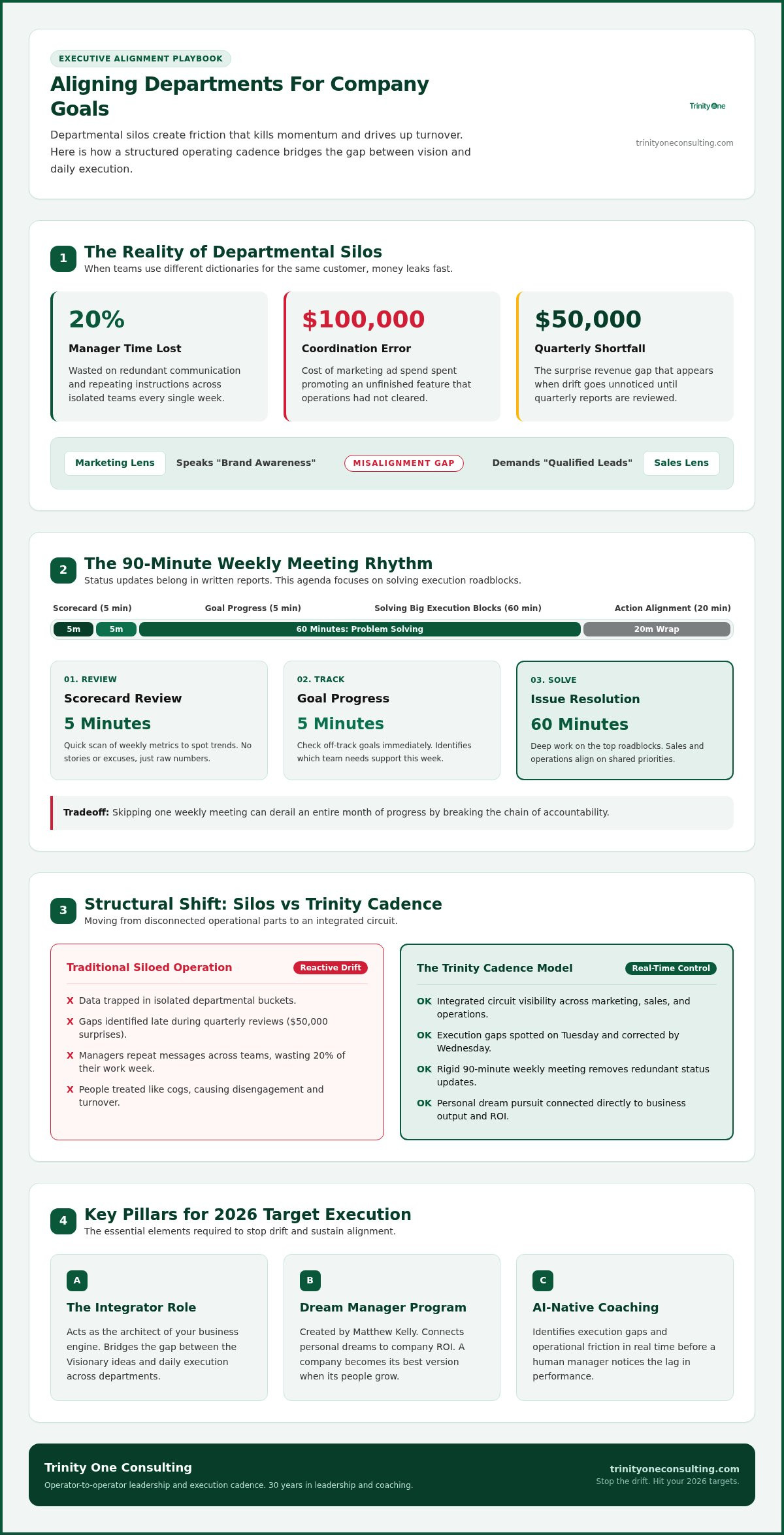
Alignment fails when departments operate as isolated engines instead of an integrated circuit. This mechanical breakdown is why you see a $100,000 mistake in product launch coordination. Marketing spends the budget on a campaign for a feature that operations hasn't even finished testing yet. The result is a wasted ad spend and a frustrated customer base. You can't afford that kind of drift.
In a company of 50 people, you'd think communication would be easy. It isn't. Marketing talks about 'brand awareness' while Sales is screaming for 'qualified leads'. They're both looking at the same customer but using different dictionaries. This is the silo effect in action. It creates friction that slows down every decision you make. I've coached teams where the offense and defense were playing two different games. It never ends well.
The high cost of departmental silos
Silos waste 20 percent of a manager's time on redundant communication. You spend your day repeating the same instructions to three different teams because they don't talk to each other. Silos are a leadership failure. They are not a staff problem. I've been in those meetings where the left hand has no idea what the right hand is doing. It's painful to watch and even more expensive to fix.
When your data is stuck in departmental buckets, your executive decisions are based on half-truths. You can't steer the ship if the engine room and the bridge aren't on the same radio frequency. This lack of visibility leads to missed opportunities and expensive pivots. You need an integrator who can see the whole board and fix the alignment before the engine blows. Real-time visibility is the only way to stop the bleeding.
When technical efficiency kills human connection
I've seen leaders try to automate their way out of a culture problem. Precision in machine operations is easy. People management is messy. There is a specific moment a team loses interest in company goals: it's when they feel like a cog in a machine rather than a contributor to a mission. They stop caring about the 'why' and just focus on the clock. It's a slow death for any organization.
Software alone cannot fix a broken culture. If you focus only on technical efficiency, you kill the human connection that fuels actual execution. Aligning departments for company goals requires a methodology that values the person as much as the process. You can't expect a team to care about your ROI if you don't care about their growth. It's a two-way street that requires honest conversation and shared purpose. My faith tells me that every person has value beyond their output. If you forget that, you lose the heart of your company.
How to build a unified operating cadence for alignment?
An operating cadence is the heartbeat of your business engine. Without it, your departments are just a collection of expensive parts sitting in a garage. Aligning departments for company goals requires a rhythmic repetition that keeps every team in sync. It's the difference between a high-performance machine and a pile of scrap metal.
There is a significant tradeoff here. A rigid cadence requires a level of personal discipline that many founders simply lack. They love the spark of a new idea but recoil at the grind of a weekly check-in. If you can't commit to the rhythm, your team will eventually stop listening. You're choosing between your personal comfort and your company's ability to execute.
Establishing a weekly rhythm that works
You need a 90 minute weekly meeting that focuses entirely on execution. This isn't a time for status updates. Status updates belong in a report that everyone reads before the doors close. This time is for identifying friction points and clearing the path for your people. I've found that when you stop talking about what happened and start talking about how to win, the energy in the room shifts.
The agenda must be surgical. Spend five minutes on the scorecard, five on goal progress, and sixty minutes on solving the biggest issues blocking your path. This huddle is where marketing and sales finally speak the same language. If marketing is bringing in leads that sales can't close, you find out here. Skipping one meeting can derail a month of progress because it breaks the chain of accountability.
The Trinity Cadence approach to execution
The Trinity Cadence moves your focus from machine operations to human performance. We use a digital tool to track this rhythm so everyone has real-time visibility into the numbers. This prevents the dreaded end of quarter surprise where you realize you're $50,000 short of your target. You see the gap on Tuesday and fix it by Wednesday. It's about staying ahead of the curve.
Our system uses AI coaching to maintain this rhythm by identifying logic gaps in your operational plans. It spots when a department's goals don't actually support the primary mission. This technology acts as a strategic architect, ensuring every integrated circuit in your business is firing correctly. You can read more about how to create a business operating system that stands up to the pressures of 2026. If you want to see how your current rhythm stacks up, let's talk during a 30 minute cadence call.
How do you link personal dreams to departmental output?
Aligning departments for company goals requires more than a shared dashboard. It requires a shared purpose that connects the company's mission to the individual's aspirations. I've found that people don't burn out because of hard work. They burn out because they don't see how that work serves their own life.
This is why I use the Dream Manager methodology, a program created by Matthew Kelly. The core belief is simple: a company only becomes the best version of itself to the extent its people are becoming better versions of themselves. We look at twelve dream categories, ranging from physical health to intellectual growth. You can explore the full scope of this approach on our Dream Manager program page.
Implementing the Dream Manager methodology
Imagine a 1 on 1 session where you don't just talk about the sales pipeline. You ask your team member about their personal goals. Maybe they want to buy their first home or run a marathon. When you help an employee achieve a personal milestone, their commitment to the company shifts from a transaction to a partnership.
Helping an employee buy that house or improve their health directly improves their work performance. They show up with more energy and less stress. The cost of ignoring these dreams is high. I've seen companies with a 30 percent turnover rate simply because the staff felt like interchangeable parts. People leave when they feel their life is on hold.
Mapping personal growth to company ROI
Aligning departments for company goals becomes much easier when the team knows that hitting their targets brings them closer to their own dreams. When a person becomes a better version of themselves, they naturally produce better work. This isn't theory. I've seen a sales rep hit a difficult quarterly quota specifically because they wanted to fund a dream trip to Italy with their spouse.
There is a significant tradeoff to this approach. You must genuinely care about the person, or the system fails immediately. If you try to use someone's dreams as a tool for manipulation, they will smell the insincerity from a mile away. It requires a level of emotional investment that many managers find uncomfortable.
I believe we are called to serve the people we lead. My faith reminds me that every individual has a purpose far greater than a spreadsheet. If you treat your people like an integrated circuit instead of human beings, the system will eventually short out. You can't have a high-performance engine without taking care of the parts.
How can AI coaching fix execution gaps in real time?
AI-native systems act as an early warning system for your business engine. They identify friction in your integrated circuit before a human manager even notices the lag. Aligning departments for company goals requires this level of real-time precision to stop departmental drift and hit your 2026 targets.
I've seen the Trinity Cadence AI coaching feature catch a logic gap in a marketing plan that would have stalled sales for three weeks. The system flags when a department's tactical plan doesn't actually support the primary mission. It's like having a strategic architect watching every gear in the machine. You get the correction before the mistake costs you money.
I once saw a client save $200,000 in wasted labor across a single quarter because the AI flagged a misalignment between the engineering roadmap and the sales team's promises. The system identified that the engineers were building a feature the sales team had stopped pitching. We caught it on a Tuesday morning. Without this logic, that friction would have persisted until the next quarterly review.
Real time visibility into team engagement
The execution dashboard shows you which departments are leaning in and which are checked out. You see execution and engagement side by side. Waiting for a monthly report is too late in a fast business. By the time you read a PDF, the damage to your culture is already done.
If the execution score is high but the engagement score is plummeting, you have a retention crisis on the horizon. You can't ignore the human element of the engine. Real-time visibility allows you to intervene before a key player decides to walk out the door. It turns data into a leadership tool.
Using AI to coach managers instead of micromanaging
AI prompts help managers have better 1 on 1 conversations by suggesting questions based on recent performance and personal dreams. We are moving away from clinical software that only tracks numbers. This is AI that understands human motivation. It might remind a manager to ask how an employee is doing with their health if it detects a dip in daily output.
I've coached enough teams to know that micromanaging is a death sentence for culture. AI coaching removes the need for a manager to breathe down a neck. The system provides the correction so the manager can provide the support. It changes the dynamic from a clinical interrogation to a helpful consultation.
The tradeoff is simple: the AI is only as good as the data your team actually enters. If your people don't use the system, the logic fails. It requires a culture of honesty and regular input. I believe that truth is the foundation of any good team, and this technology just makes that truth visible.
How does a fractional integrator solve the alignment puzzle?
An Integrator is the architect who builds your business engine. Aligning departments for company goals requires a person who can translate high-level ideas into a functional reality. While you focus on the future, the Integrator focuses on the gears. I believe God gave you a vision, and my job is to build the engine that carries it.
A Visionary without an Integrator creates operational chaos. You likely have a new idea every Tuesday that moves the finish line for your 50 person staff. This creates friction. Your team gets whiplash. They stop trusting the plan because it never stays the same for more than a week.
The Integrator provides a steady, reliable path to growth. I act as the filter for your newest inspirations. I decide which ideas fit the engine and which ones are just noise that will stall your progress. This creates a buffer between your creativity and the team's execution.
The tradeoff is real: you must give up some control. You can't tinker with the gears once the architect starts building the system. This approach is bad for leaders who feel the need to micromanage every small detail. If you can't step back, the engine will never reach full speed.
The difference between a Visionary and an Integrator
Visionaries are great at seeing the mountain peak. They aren't always great at packing the bags or checking the weather. Friction happens when a CEO changes the goal every week without considering the capacity of the operations team. This is how you lose your best people. They want to win, but they can't win if the rules change every morning.
A Fractional Integrator brings the discipline you might lack. I don't care about the newest shiny object unless it directly hits a KPI on the scorecard. I keep the team focused on the 2026 targets we set during the planning session. It's about protecting the team from the chaos of unrefined ideas.
Why your business engine needs an architect
During the first 90 days of onboarding, I strip the engine down. I find the leaks in your communication and the redundant meetings that waste 10 hours a week. I align every department to a single scorecard. Marketing and sales finally look at the same data points to judge success.
This architect role ensures that every integrated circuit in your company is firing in the right sequence. You can read more about the fractional integrator role to see how this engineering works. If you are ready to scale without the whiplash, check out my fractional COO service page. I build the systems so your vision can actually move forward.
Build a business engine that executes for 2026
Aligning departments for company goals is a mechanical challenge that requires a human solution. You've seen how a rigid operating cadence stops the drift and how the Dream Manager methodology turns turnover into ROI. I've spent 30 years in the trenches of leadership building these business engines.
My experience has taught me that precision without purpose is just a cold machine. It fails every time. The AI-native Trinity Cadence platform provides the real-time visibility you need to hit your 2026 targets. As a Certified Dream Manager, I know that your company's growth is tied directly to the growth of your people.
It's time to stop the friction and start the execution. We can bridge the gap between your ideas and your team's daily output. I'm ready to act as the strategic architect for your next phase of growth. We will build a system where every integrated circuit fires in the right sequence.
I believe you were given your business for a reason. It's an honor to help you make that vision a reality.
Frequently Asked Questions
How do you measure departmental alignment?
You measure alignment by using a unified scorecard that tracks both technical execution and human engagement across every team. I've seen leaders fail because they only look at the numbers and ignore the people. If your sales are up but your engagement is down, your engine is about to blow. You need real-time data that shows how well your integrated circuit is actually functioning today.
Can AI really help align my teams?
AI-native operating systems help with aligning departments for company goals by providing real-time visibility and coaching to identify gaps before they become silos. Our Trinity Cadence platform uses logic to spot when a department's tactical plan drifts away from the primary mission. It identifies execution friction that a human manager might miss for weeks. This technology acts as a strategic architect for your daily operations.
What is the Dream Manager concept?
The Dream Manager concept is a methodology by Matthew Kelly that links an employee's personal dreams to their professional performance. I believe that a company only becomes its best version when its people are becoming better versions of themselves. We track twelve dream categories to ensure your staff isn't just working for a paycheck. They're working to build the life they actually want.
How often should departments meet to stay aligned?
A weekly 90 minute huddle is the standard for maintaining alignment, supplemented by monthly strategic reviews and daily huddles. This rhythm keeps the heartbeat of your business steady. If you skip these sessions, you lose the discipline required to hit your 2026 targets. I've found that a rigid cadence is the only way to prevent the departmental drift that kills momentum.
What does a business integrator do for alignment?
The integrator acts as the architect of the operating system, ensuring all departments follow the same cadence. While the Visionary CEO provides the ideas, the integrator builds the engine that carries them. I work to align every department to a single scorecard so everyone is playing the same game. This role is essential for turning a pile of parts into a high-performance machine.
Why do standard business operating systems fail?
Standard business operating systems fail because they often focus only on the machine of the business and ignore the human motivation required to fuel it. You can have the best software in the world, but it won't matter if your people don't care. We integrate personal growth with operational logic to ensure the engine has enough fuel to reach the destination. Real performance requires both clinical precision and empathetic depth.