
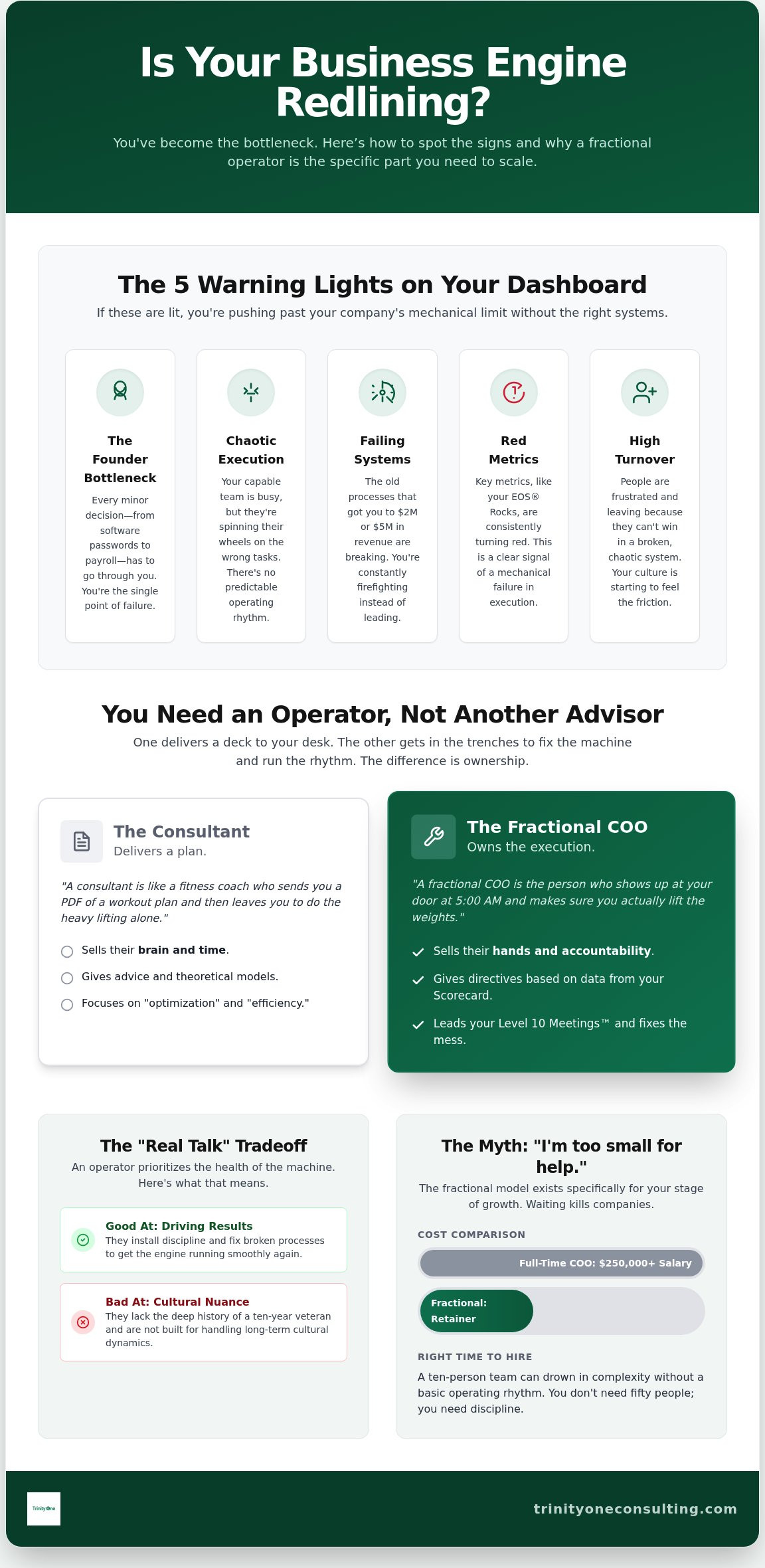
Knowing when to hire a fractional COO happens the moment your growth stalls because you've become the single point of failure for every decision. If your team is busy but the wrong tasks are getting done, you need an operator to install a predictable rhythm. This lets you stop managing chaos and focus on strategy again. You're the bottleneck.
You've likely spent years grinding to get the revenue to $2 million or $5 million. The old systems are breaking. It's frustrating to watch a capable team spin their wheels while you spend ten hours a day answering Slack messages about basic operations. I've seen this redline state in dozens of companies where the founder's vision is trapped by the friction of daily execution.
I'll show you exactly how to spot the mechanical failures in your business engine before they cause a total burnout. You'll learn why a fractional operator is the specific part you need to scale without adding more noise to your life. We're going to fix the operating rhythm so you can get back to growing the company.
Key Takeaways
- Recognize the signs of a redlining engine where the founder has become the bottleneck for every minor operational decision.
- Hire an integrator who fixes the machine instead of a consultant who just gives advice.
- Identify the friction points that signal when to hire a fractional COO so you can stop the daily firefighting.
- Stop babysitting your leadership team. Start leading them by installing a predictable operating rhythm.
- Understand why software doesn't fix culture and how the Dream Manager methodology (Matthew Kelly) aligns personal growth with company results.
Why most founders wait until they are burning out to hire an operator
You started this company because you had a vision for something better. Now you spend your Monday mornings resetting software passwords and your Tuesday afternoons chasing down payroll errors. This isn't leadership. It's a slow death by a thousand paper cuts. You've become the ceiling for your own business.
Waiting until you are physically and mentally spent is the most common mistake I see in my 30 years of operations. Most founders only start asking when to hire a fractional COO once they've hit a wall. By that point, your team is likely frustrated and your growth has already flatlined. You are the bottleneck.
Scaling requires a fundamental shift in your identity as a leader. You have to stop being the engine that drives every single piston and start being the pilot who determines the destination. If the plane won't fly unless you are personally holding the wings together, you don't have a business. You have a very expensive, very stressful job.
The myth of being too small for help
I talk to founders with eight or ten employees who believe they are too small for an operator. They think they need fifty people and a massive HR department before they can justify the expense. That is a lie that kills companies. I have seen ten-person teams drown in complexity because they lacked a basic operating rhythm. They had the talent but no machine to run it.
The fractional executive model exists specifically for this stage of your growth. It allows you to buy the leadership you need without the $250,000 salary of a full-time executive. You get the discipline of a seasoned veteran for a manageable monthly retainer. It's a tactical move to protect your time and your sanity.
When your business engine starts redlining
Your business has a mechanical limit. When you push past that limit without the right systems, the engine starts to smoke. You'll see it in your weekly meetings first. If you are using EOS, look at your Rocks (an EOS term). Are they consistently turning red? That is a sign of a mechanical failure in your execution.
Friction also shows up in your culture. If you have high staff turnover or keep hearing that "things are too chaotic," your engine is redlining. People want to win, but they can't win in a broken system. We step in as a fractional COO to install the rhythm that stops the friction. It's about turning that chaos into a predictable machine.
Is a fractional COO just a consultant with a fancy title?
A consultant is like a fitness coach who sends you a PDF of a workout plan and then leaves you to do the heavy lifting alone. A fractional COO is the person who shows up at your door at 5:00 AM and makes sure you actually lift the weights. The difference is ownership. One delivers a deck on your desk. The other stays to fix the machine and run the rhythm.
I call this "real talk" operations. It focuses on the work that actually gets done rather than the theoretical models we wish we were following. If you hire a consultant, you are paying for their brain and their time. When you decide when to hire a fractional COO, you are paying for their hands and their accountability. They own the execution of your strategy so you don't have to babysit the process.
This ownership comes with a price. A fractional leader won't have the same deep history with your company as a ten-year veteran. They are bad at handling long-term cultural nuances that require years of presence. They are good at one thing: results. They prioritize the health of the machine over the feelings of the people who might be slowing it down.
Defining the Integrator role
In the EOS world, we call this person an Integrator. Their job is to harmonise the functions of the business like an orchestra conductor. They manage the pulse of the company so the Visionary can focus on the future. This is about creating a unified operating cadence for the entire organisation. Without an Integrator, the Visionary founder often ends up stuck in the weeds of payroll disputes or software logins.
Execution versus advice
Consultants love to talk about things like "optimization" or "improving efficiency." Operators don't use those words. We just clean up the mess. Your fractional COO should be the one leading your Level 10 meetings (an EOS term). They should be staring at your Scorecard (an EOS term) every single week to identify exactly where the engine is failing. They don't give suggestions. They give directives based on data.
Research on Part-Time Senior Leaders shows that high-level expertise in a limited capacity can provide the same stability as a full-time hire. It is a tactical move for companies that need executive-level discipline but aren't ready for a $200,000 salary plus benefits. If you want to see how this rhythm fits your specific business model, let's discuss your current operating cadence and see where the friction is hiding.
How do you know when your business engine is redlining?
Redlining isn't about being busy. It's about being busy with the wrong things. If you feel like you are babysitting your leadership team instead of leading them, you've hit the mechanical limit of your current structure. You shouldn't be the person reminding a director to update their Scorecard (an EOS term). That's a sign the machine is broken and you're the one holding the parts together with duct tape.
Look at your meeting notes from three months ago. If the same three problems keep appearing in your weekly huddles month after month, your execution has stalled. You might have a vision for AI implementation to save time, but no one has the capacity to build the actual workflows. The engine is spinning at 8,000 RPMs but the wheels aren't turning. You're burning fuel and getting nowhere.
Your best people will leave if they don't see a clear path forward. In the Dream Manager methodology by Matthew Kelly, we know people only give their best when they are becoming better versions of themselves. If your business is too chaotic to support their personal growth, they'll find a competitor with a better rhythm. High staff turnover is a loud warning light that your operational engine is about to blow.
The five signs of operational failure
Decision fatigue is the first sign that you are the bottleneck. If every $500 expense or minor schedule change requires your personal approval, you've stopped being a CEO and started being a clerk. You'll also see missed financial targets even when your team is working 50 hours a week. This is a lack of alignment, not a lack of effort.
Processes that worked when you were at $2 million will snap once you hit $10 million. You can't manage ten people the same way you managed three. When systems fail, the culture becomes reactive. Everyone is firefighting. No one is looking at the horizon. This state of constant crisis is a clear indicator of when to hire a fractional COO to install a repeatable operating cadence.
Measuring the cost of doing nothing
Do the math on your hourly rate. If you are a founder capable of bringing in $1,000 an hour in new business but you spend five hours a week on payroll and software logins, you're losing $5,000 every week. That is $20,000 a month in "founder tax." Every month you delay is a month of lost growth and increased risk. You can see the breakdown of a fractional COO vs full time COO cost to see how the math actually works for your headcount.
What should you look for in a fractional integrator?
Industry experience is the shiny object that distracts most founders. I've spent 30 years in the trenches and I've seen leaders with decades of software experience fail because they lacked the grit to run a Tuesday morning meeting. Operational discipline is what actually moves the needle. You need a battle-tested practitioner who values execution over theory. They should care more about your Scorecard than your industry jargon.
Understanding when to hire a fractional COO is only the first step. Finding the right fit is where the real work begins. This person must act as a translator. They need to speak "operator" to your team to ensure tasks get finished. They also need to speak "visionary" to you so your big ideas don't get lost in the noise. It's a rare skill set that requires high emotional intelligence and clinical precision.
You should check my list of questions to ask a potential fractional COO before you sign a retainer. This vetting process will save you months of wasted time and thousands of dollars in bad hires. Don't rush the selection because you're tired of answering emails. A bad integrator is worse than no integrator at all.
The Visionary and Integrator dynamic
The Visionary (an EOS term) has ten ideas a minute. The Integrator (an EOS term) picks the one that won't break the company. This relationship is built on total trust and a complete lack of ego. If your operator is just a "yes person" who agrees with everything you say, they aren't an Integrator. They're just an expensive assistant. You need someone who is willing to tell you "no" when your latest idea threatens the current operating rhythm.
Vetting for operational grit
Ask a candidate exactly how they handle a director who misses their Rocks (an EOS term) two quarters in a row. You don't want a theoretical answer about "coaching." You want to hear about the specific accountability conversation they had. Look for someone who has managed a team through a genuine crisis or a high-stakes launch sprint. They should arrive with a clear methodology for running your operating cadence from day one.
Why your operating system needs both AI and a human pulse
Software alone won't fix a broken culture. I've seen founders spend $50,000 on custom dashboards only to find their team still misses every deadline. If your people aren't aligned, the best tech in the world just helps you fail faster. You need a system that balances machine precision with human motivation.
This balance is the core of our fractional COO services. We don't just give you a person to run meetings. We install a dual-engine system that combines AI execution with the Dream Manager methodology. This is the difference between a business that survives and one that scales without the founder burning out.
Knowing when to hire a fractional COO involves looking at both your tech stack and your turnover rate. If your data is a mess and your best people are leaving, you have a systemic failure. You need an operator who understands how to integrate AI into your daily rhythm while keeping the human element alive. My conviction is that your company only becomes the best version of itself to the extent your people are becoming better versions of themselves.
Machine operations with Trinity Cadence
We use Trinity Cadence to integrate your machine operations so you can see execution as it happens. This AI-native operating system removes the need for manual reporting and those painful Friday afternoon status updates. You get real-time visibility into every project and every goal without asking for it. Manual reporting is a profit killer. I've seen directors spend four hours a week just cleaning up spreadsheets for a Level 10 meeting (an EOS term). That's $400 in wasted salary every week for a single manager.
The system doesn't just watch. It coaches. AI coaching helps your team stay on track between your weekly huddles by identifying friction before it becomes a fire. This keeps the operating rhythm precise and predictable. It's about using technology to do the heavy lifting of data management so your people can focus on high-value work. We use these tools to ensure nothing falls through the cracks while you focus on the vision.
The human pulse with Dream Management
A company is a collection of people with their own hopes and fears. We use the Dream Manager programme (attributed to Matthew Kelly) to drive retention and engagement. This isn't soft talk. It's a calculated strategy to align personal ambition with company results. When your people see that their work fuels their personal dreams, their performance changes. They stop working for a paycheck and start working for their future.
We use DreamCompass to help your people track their personal goals across the twelve dream categories defined by Matthew Kelly. These categories cover everything from physical health to financial stability. We don't just talk about work. We talk about life. This human pulse is what keeps the machine running when things get difficult. If you want to scale without losing your soul, you need this alignment.
If you are ready to stop the redline and start scaling, let's talk about your specific operational needs. Book a discovery call today to see how a fractional operator can fix your rhythm.
Get your time back and scale the machine
You can't lead a $10 million company with a $2 million mindset. Deciding when to hire a fractional COO is the moment you choose growth over burnout. I've spent 30 years helping founders install the operating rhythm they need to step back from the daily fires. It's about moving from being the engine to being the pilot who determines the destination.
We combine the clinical precision of our AI-native Trinity Cadence system with the human depth of the Dream Manager methodology. This ensures your systems are as strong as your culture. As a Certified Dream Manager, I know that your people only give their best when the company supports their personal growth. We take the weight of execution off your shoulders so you can focus on the vision again.
Your vision deserves a business that can actually support it. It's time to stop holding the wings together and start flying the plane. I'm ready to help you fix the rhythm.
Common questions about fractional operations
How much does a fractional COO cost in 2026?
Industry data for 2026 shows that monthly retainers for experienced fractional COOs typically range between $8,000 and $18,000. Small businesses often find rates between $4,000 and $10,000 for roughly 10 to 15 hours of work per week. You are paying for the removal of friction and the recovery of your own time, not just a block of hours.
Hourly rates for high level operators currently sit between $150 and $350. Project based fees for a specific operational overhaul can range from $20,000 to $60,000 depending on the headcount and complexity. It is an investment in the machine that generates your profit.
What is the difference between an integrator and a COO?
An Integrator is a specific role defined by EOS that focuses on harmonizing the major functions of a business and managing the daily pulse. COO is a broader corporate title used across many different industries. In my practice, I use the term Integrator because it describes the actual work of holding a leadership team accountable to their Rocks (an EOS term).
How many hours a week will a fractional COO spend on my business?
Most engagements require between 5 and 15 hours per week to be effective. This time is spent leading your Level 10 meetings (an EOS term) and reviewing your Scorecard (an EOS term) to spot redline issues. If an operator needs 40 hours to run a small company, they aren't fixing the system. They are just becoming another part of the chaos.
Can a fractional COO help with AI implementation and workflows?
A modern operator must understand how to install AI workflows that eliminate manual reporting. We use Trinity Cadence to provide real time visibility into your machine operations without the need for status meetings. This technology allows your team to stay focused on execution while the software handles the data tracking.
What is the difference between a fractional COO and an operations consultant?
A consultant gives you a report and a bill while a fractional COO gives you a functional team and finished projects. The difference is ownership of the results. Knowing when to hire a fractional COO means you are ready for someone to run the business rhythm instead of just giving you a list of suggestions.
Is my business too small to hire a fractional integrator?
You aren't too small if you've become the bottleneck for every minor decision in the company. I've seen teams of eight people fail because the founder was stuck resetting passwords and answering basic payroll questions. If your revenue is over $1 million and you can't focus on strategy, you are big enough for help.
How long does a typical fractional COO engagement last?
Most engagements last between six and eighteen months. The goal is to install a predictable operating rhythm so the founder can lead effectively or the company can eventually hire a full time executive. It is a tactical bridge designed to get you through a specific stage of growth without burning out.
How do I measure the ROI of hiring a fractional operator?
Measure ROI by the number of high value hours you regain and the reduction in your staff turnover rate. If you save 15 hours a week at a founder rate of $500 per hour, the role pays for itself through your increased capacity. You also gain the financial upside of hitting your quarterly goals because someone is actually watching the machine.